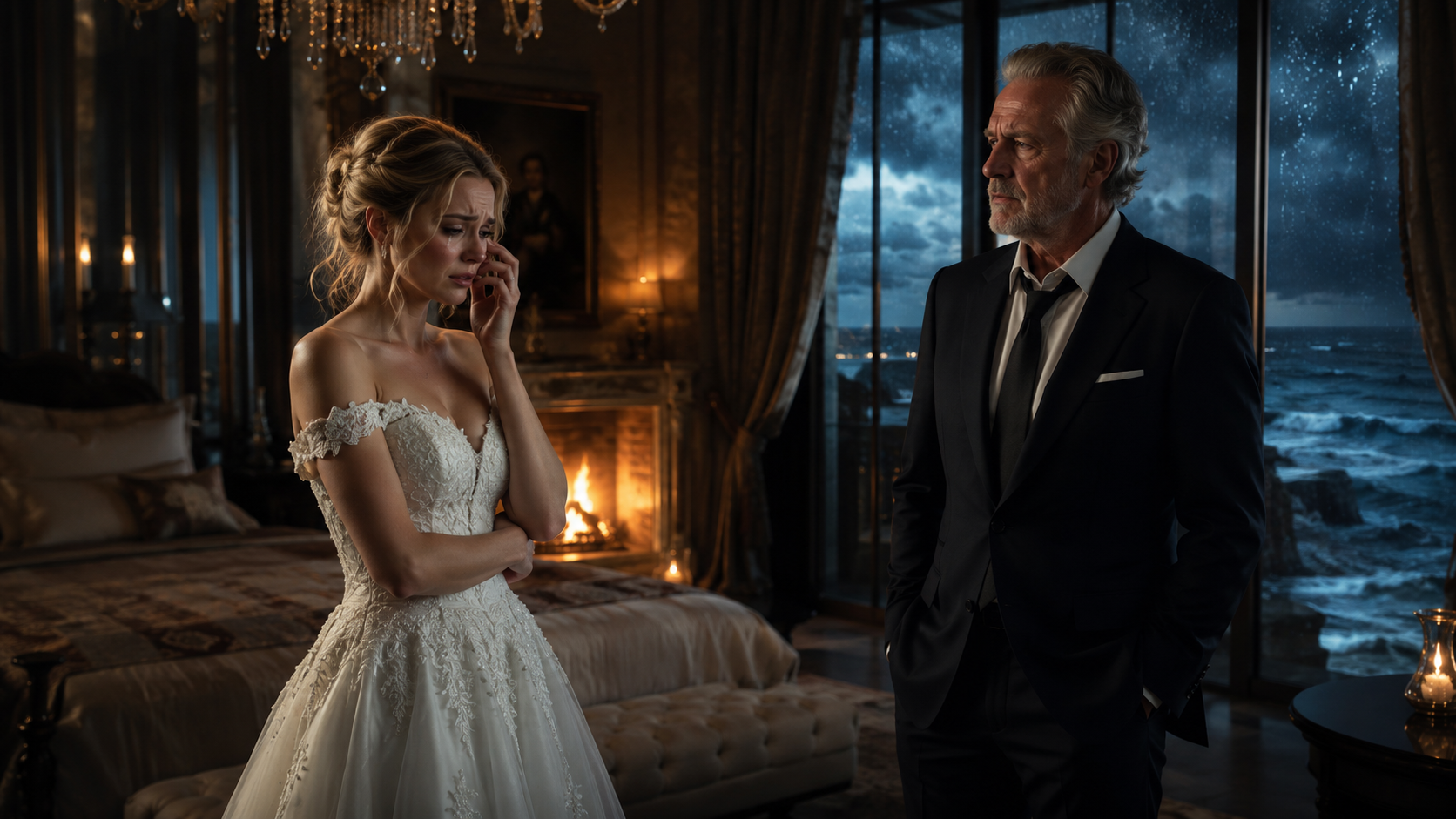
The wedding, she discovered, had not been Dorian’s first plan.
It had been hers.
Or rather, it had been the plan she agreed to when panic left no room for imagination.
Dorian had offered alternatives through lawyers: protection, relocation, financial assistance structured as a loan she could repay over time. But Victor had escalated. He threatened Eli. He threatened to leak false documents. He threatened Mara’s mother while she was still recovering.
And Mara, exhausted and terrified, had asked Dorian one question:
“If I marry you, can he still touch my family?”
Dorian had answered, “No.”
So she had said yes.
Now, in the quiet after the ceremony, Mara began to understand that the marriage was not the cage. The cage had existed before Dorian. He had only placed his name across the lock and dared the wolves to bite through it.
That did not make the situation simple.
Kindness did not erase the age between them. Protection did not become love overnight. Gratitude could still be dangerous if she mistook it for choice.
Dorian seemed to know this.
He never asked her to play hostess. Never asked her to smile for photographers. Never entered a room without knocking. When they dined together, he sat across from her, never beside her, as if distance were a language he had learned for her sake.
On the fifth night, Mara found him in the library.
It was the warmest room in the house, lined with books and bronze lamps. A chessboard sat near the fire. Rain threatened again beyond the windows.
Dorian looked up from a stack of papers.
“I can leave,” Mara said.
“This is your house too, for as long as you want it to be.”
She stepped inside.
“That sounds like something a lawyer told you to say.”
“No,” he said. “A lawyer would have used more expensive words.”
She laughed before she meant to.
Dorian looked surprised by the sound.
Mara noticed, and the surprise made her brave.
“Tell me about your sister.”
The room became very still.
For a moment she thought she had asked too much.
Then Dorian removed his glasses and set them carefully on the desk.
“Her name was Lenora.”
Mara sat in the chair near the fireplace.
Dorian did not look at her while he spoke.
Lenora Vale had been nineteen when she fell in love with a man who mistook devotion for ownership. Their father had dismissed it as youthful drama. Their mother had valued appearances more than danger. Dorian, only twenty-seven then and building his first company, had believed there would be time to intervene properly.
There had not been.
Lenora disappeared for three days.
When she returned, something bright in her had gone quiet forever.
“She lived,” Dorian said, voice controlled. “But not as she had been. And I learned too late that money is useless when it arrives after courage was needed.”
Mara’s chest ached.
“Where is she now?”
“In a small village in Switzerland. She paints. She refuses to speak to most people. She sends me one postcard every Christmas with no message, only her name.”
“Does she hate you?”
“Yes,” Dorian said. “I believe she does.”
Mara did not offer false comfort.
Perhaps that was why he continued.
“When Victor spoke about you, I heard the same language. Ownership disguised as rescue. Threats disguised as opportunity. I thought of Lenora. I thought, not twice.”
Mara looked at the fire.
“You should have told me.”
“Yes.”
“Before the wedding.”
“Yes.”
“Why didn’t you?”
Dorian’s mouth tightened. “Because I was afraid you would think I was using my grief to persuade you.”
“Were you?”
“No.”
She believed him.
That frightened her more than doubt had.
The scandal broke two weeks later.
Not the scandal society expected.
Victor Harrow was arrested on a Tuesday morning outside a private club, surrounded by cameras he had once used to shame other people. Documents surfaced. Recordings surfaced. Witnesses came forward after Dorian’s legal team created a protected channel for them. Women. Families. Small business owners. Immigrants. Students. People who had been told they were alone.
Mara watched the news from the kitchen, barefoot, holding a mug of tea gone cold.
Dorian entered quietly.
“You do not have to watch.”
“Yes,” she said. “I do.”
Victor’s face appeared on screen, pale with fury as reporters shouted questions.
Mara expected satisfaction.
Instead she felt something heavier, like a chain falling from her shoulders only after she had grown used to carrying it.
Dorian stood beside the doorway.
“He will have excellent lawyers,” he said. “But so will everyone he hurt.”
Mara turned to him.
“You did that?”
“We did that.”
“I didn’t do anything.”
“You survived him,” Dorian said. “That is not nothing.”
She looked away because tears came too easily around him now, and she disliked how he never seemed embarrassed by them.
The world changed its story quickly.