She Married an Aging Billionaire—But the Words He Whispered on Their Wedding Night Destroyed Every Lie She Believed

The rain began just after midnight, tapping softly against the tall windows of the old coastal mansion as if the sky itself were trying not to disturb the bride.

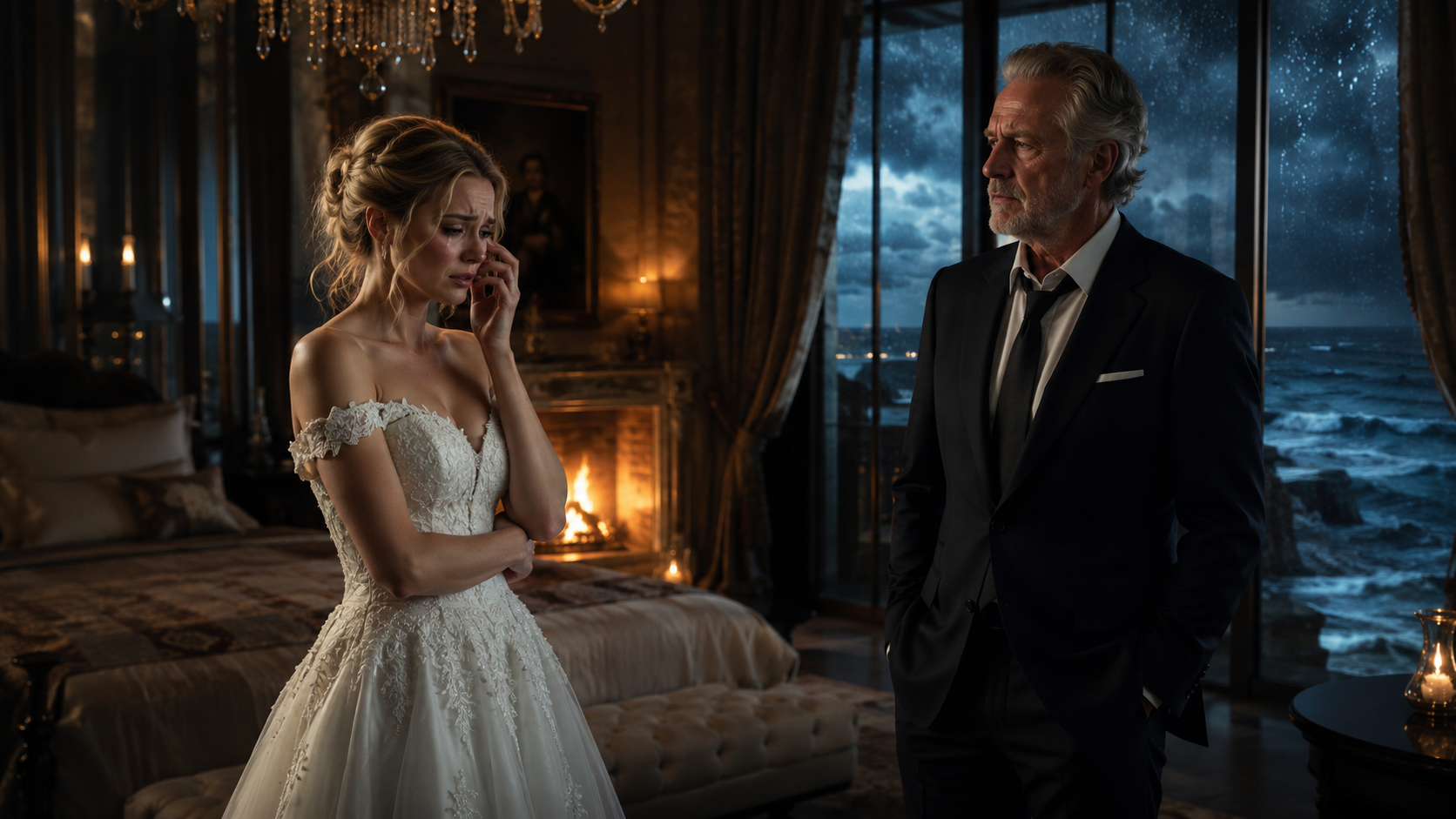
Mara Whitestone sat alone on the edge of a bed too large for one person and too beautiful for comfort. The white silk of her wedding gown pooled around her like spilled moonlight. Her hands were folded tightly in her lap, though she could not stop them from trembling.

Everything in the room looked like it belonged to someone else.

The carved ivory wardrobe.
The velvet chairs.
The marble fireplace.
The crystal lamps glowing with a golden softness.
The heavy curtains framing a view of black ocean waves breaking against the private shore below.

Even the silence felt expensive.

Mara had grown up in a two-bedroom apartment over a laundromat, where the pipes rattled in winter and the neighbors argued through paper-thin walls. She knew the smell of boiled potatoes, unpaid bills, secondhand coats, and fear hidden behind a mother’s smile. She knew how to stretch one meal into two, how to mend a torn sleeve so nobody noticed, how to lower her eyes when rich people spoke as though kindness was a favor they could revoke.

But she did not know how to sit in a billionaire’s bedroom on her wedding night.

She did not know how to be the wife of Dorian Vale.

The name alone could change the temperature of a room. Dorian Vale, founder of Vale Meridian Holdings. Hotel towers, shipping lines, private islands, charity hospitals, art museums, political friends, silent enemies. Sixty-one years old. A widower to the public, a mystery to the press, and a man so wealthy that newspapers described his money as if it were weather.

Mara was twenty-three.

By morning, the world would call her greedy.

By evening, strangers would zoom in on wedding photos and decide what kind of woman she was. They would say she sold herself. They would say he bought beauty before age could make him lonely. They would say no young woman married a man nearly four decades older unless she wanted a crown made of gold.

The worst part was that Mara had heard those words before anyone printed them.

Her aunt had said them.
Her neighbors had whispered them.
Even her younger brother, who loved her more than anyone, had looked at her with wounded confusion and asked, “Mara, do you even know him?”

She had not known how to answer.

Because yes, she knew Dorian Vale.

And no, she did not.

She knew that he had paid for her mother’s surgery without announcing it. She knew he had never raised his voice in her presence. She knew he listened as though words mattered. She knew he remembered small things: that she hated lilies, that she took tea without sugar, that she could not sleep when doors were left open.

But she also knew men could perform gentleness beautifully when they wanted something.

The bedroom door opened.

Mara stiffened.

Dorian entered quietly, removing his cufflinks as he crossed the room. He had changed out of his black wedding jacket but still wore the white shirt from the ceremony, the collar unfastened, silver hair combed back with a few loose strands falling near his temple. He looked tired, not from age but from carrying too many rooms, too many decisions, too many people waiting for him to become either cruel or generous.

He stopped when he saw her face.

“Mara,” he said softly.

She tried to smile. It failed.

His eyes moved to her hands. To the way her fingers twisted together. To the slight shake in her shoulders.

He did not come closer.

“Are you frightened of me?” he asked.

The honesty of the question cut through her like cold air.

Mara looked down. “I don’t know.”

Most men would have been offended.

Dorian only nodded once, as though she had given him an answer he respected.

“That is fair.”

Fair.

The word undid something inside her. She had expected persuasion, wounded pride, a reminder that she had agreed to the marriage. She had expected him to tell her she was safe because he said so, because he had money, because he had given her family protection from ruin.

Instead, he accepted her fear as if it had a right to exist.

He walked to the far side of the room and poured water into two glasses from a silver tray. He drank from one first, then set the other on the table nearest her.

“You do not have to take it,” he said.

Her throat tightened.

He noticed everything.

That made him either dangerous or kind. Mara still could not decide which.

The wedding had been beautiful in the way storms were beautiful from behind glass. White roses, candlelit tables, violin music, a chapel on the cliff above the sea. The guests had been polished and silent, smiling with their mouths but not their eyes. Mara had felt like a painting hung in the wrong house.

Dorian’s relatives had watched her as though she were evidence of a crime.

His niece, Celeste, had kissed both of Mara’s cheeks and whispered, “You must be very brave.”

But her tone had said, You must be very clever.

Mara had wanted to run then. She had wanted to tear the veil from her hair and return to the cramped apartment where at least the walls knew her name. But then she had looked at her mother sitting in the front row, alive because Dorian’s doctors had acted when no public hospital would, and she had stayed.

Gratitude was not love.

Debt was not devotion.

But sometimes life tied them together until a woman could not tell where one ended and the other began.

Dorian turned toward the fireplace. “I owe you an explanation.”

Mara laughed once, a small broken sound. “Now?”

“Yes,” he said. “Especially now.”

He reached into the drawer of the writing desk and removed a sealed envelope. He did not hand it to her. He placed it on the foot of the bed, far enough away that she would have to choose to take it.

“That contains a legal document. It was signed before the ceremony. You have your own attorney, not mine. She will visit tomorrow morning and explain every line. If you wish to leave this marriage, you may. Tonight, next week, next year. You will leave with your name, your freedom, your mother’s medical care secured, and enough money to live without depending on me.”

Mara stared at him.

The rain grew louder.

“What?”

His expression did not change. “You heard me.”

Her heart began to pound so hard that the room seemed to tilt.

“That wasn’t our agreement.”

“No,” Dorian said. “It was mine.”

She rose too quickly, the skirt of her gown catching beneath her shoes. “Then why marry me? Why stand in front of all those people? Why let everyone think—”

“Because there are men who cannot be stopped by pity,” he said. “But they can be stopped by power.”

The words fell heavily between them.

Mara went still.

She had not spoken of Victor Harrow in months. She had tried not to think his name. Victor, the creditor who had bought her father’s old debts after his death. Victor, who smiled with small teeth and expensive shoes. Victor, who told Mara that poor families did not get miracles, they got arrangements. Victor, who had hinted that her brother’s scholarship could vanish, that her mother’s surgery could be delayed, that one signature could save everyone she loved.

Dorian saw the recognition in her eyes.

His voice lowered.

“I know who cornered you. I know what he offered. I know what he threatened.”

Mara could barely breathe. “How?”

“Because he came to me first.”

Her stomach turned.

Dorian’s jaw tightened, the first sign of anger she had seen from him all day.

“Victor Harrow tried to sell me your desperation. He assumed I was like him. He said a beautiful young woman with debts would be grateful for a wealthy husband, and that if I wanted loyalty, fear was cheaper than affection.”

Mara covered her mouth.

The room blurred.

Dorian took one step closer, then stopped himself.

“I did not marry you to own you,” he said. “I married you so no one else could claim they had a right to.”

She shook her head, but not because she disbelieved him. Because believing him was too painful. It meant the terror she had carried for months had been visible. It meant someone had seen the trap closing around her and had not blamed her for being caught inside it.

Dorian’s voice became almost a whisper.

“Mara, listen to me carefully. You do not belong to me. You are not payment. You are not a bargain. Tonight, you do not have to be my wife. You only have to be free.”

The sob came from somewhere deeper than thought.

It tore out of her before she could stop it.

Mara pressed both hands against her chest as if she could hold herself together, but she was breaking in a way that felt almost like breathing. Tears spilled down her face, hot and humiliating and unstoppable. She turned away because she hated crying in front of anyone, especially him, especially now.

Dorian did not rush to comfort her. He did not touch her without permission. He simply stood there, steady as a lighthouse, while the storm moved through her.

“I thought…” Her voice cracked. “I thought I had chosen a kinder prison.”

Dorian closed his eyes for a moment.

When he opened them, they looked older.

“No,” he said. “You chose a door. Whether you walk through it is yours to decide.”

Mara sank back onto the bed.

The envelope remained untouched beside her.

For a long time, the only sounds were rain, fire, and breath.

Then Dorian walked to the wardrobe and removed a folded blanket and a pillow. He placed them over one arm.

“I will sleep in the library,” he said. “This room is yours. Lock the door if that helps. Tomorrow, after your attorney explains the papers, you may decide what you want to do next.”

Mara looked up at him through tears.

“What if I leave?”

“Then I will arrange a car.”

“What if people laugh at you?”

Something like a smile touched his mouth, but it was sad. “People have been laughing, fearing, flattering, and lying to me for thirty years. I have survived worse than embarrassment.”

“What if they say I used you?”

“Then they will be wrong.”

“What if they say you bought me?”

Dorian’s face hardened.

“Then I will make sure they hear the truth.”

Mara wiped her cheeks with shaking fingers. “Why would you do this for me?”

He was quiet so long that she thought he might not answer.

Then he said, “Because many years ago, someone should have done it for my sister.”

The sentence changed the air.

Mara did not ask. Not then.

Dorian moved toward the door. Before leaving, he paused.

“There is one more thing,” he said.

Mara waited.

“No servants will enter unless you call. Breakfast will be placed outside at eight. Your phone is on the table. The number for your attorney is already saved. So is your brother’s.”

She looked at the small black phone near the lamp.

“You saved Eli’s number?”

“I thought you might need to hear a voice that belonged to your real life.”

That nearly broke her again.

Dorian opened the door.

“Good night, Mara.”

She whispered, “Good night.”

The door closed.

For several minutes, she could not move.

Then, slowly, she reached for the envelope.

Inside were documents she did not fully understand, but she understood enough. Separate accounts. Medical care guaranteed regardless of marital status. A trust for her mother. Tuition protection for her brother. A private apartment in her name. A confidentiality clause that protected her, not him. No requirement to live with him. No requirement to remain married. No penalty for leaving.

At the bottom of the final page was a handwritten note.

Mara,
No one should have to trade fear for survival.
D.V.

She read it three times.

Then she cried again, but differently.

Not because she was trapped.

Because she might not be.

At dawn, the storm passed, leaving the sky pale and washed clean.

Mara had not slept. She had changed out of the wedding gown and into a soft robe she found folded in the dressing room. The mansion felt different in morning light, less like a palace and more like a place built by lonely people pretending stone could protect them.

At eight, breakfast appeared outside the door exactly as promised. No one knocked. No one entered.

At nine, her attorney arrived.

Her name was Priya Senn, and she was not impressed by Dorian Vale.

Mara liked her immediately.

Priya had sharp eyes, short black hair, and a leather folder full of notes. She sat across from Mara in the sunlit morning room and explained every document with brutal clarity.

“He gave you unusually strong protections,” Priya said. “Frankly, stronger than I expected.”

“Is there a catch?”

“I looked for one all night.”

“And?”

“There isn’t one that I can find.”

Mara stared down at the papers.

Priya leaned back. “But protection is not the same as trust. You do not owe him affection because he behaved decently. Decency is the floor, not the ceiling.”

Mara almost smiled. “You really are my attorney.”

“Yes,” Priya said. “And because I am your attorney, I will tell you this plainly. You can annul this marriage. You can stay temporarily while we investigate Victor Harrow. You can negotiate new terms. You can disappear into a quiet apartment and never see Dorian Vale again except through lawyers.”

Mara looked toward the window. The ocean glittered under a thin strip of sunlight.

“What would you do?”

Priya’s expression softened slightly. “I would stop asking what I owed everyone else long enough to hear what I wanted.”

No one had ever said that to Mara before.

Wanting had always seemed like a luxury for people who did not count grocery money.

That afternoon, she called Eli.

Her brother answered on the first ring.

“Mara? Are you okay?”

The fear in his voice nearly crushed her.

“I’m okay,” she said.

“Tell me the truth.”

She looked across the garden, where Dorian stood near the cliffs speaking with a security officer. He was not looking at her. He had not tried to approach her all morning.

“I think,” she said slowly, “I might be safer than I thought.”

Eli was silent for a moment.

“Do you love him?”

Mara closed her eyes.

“I don’t know him well enough to love him.”

“Then why do you sound like you’re about to defend him?”

She opened her eyes again.

Because he defended me first, she thought.

But aloud she said, “Because maybe not every strange thing is a terrible thing.”

The first week of their marriage did not look like a marriage.

Mara moved into the east wing of the mansion, not Dorian’s bedroom. She met with Priya twice. She spoke with investigators. She learned that Victor Harrow had built a business out of purchasing desperate debts and turning them into private leverage. Dorian had been tracking him for six months, long before Mara knew she was part of the game.

The wedding, she discovered, had not been Dorian’s first plan.

It had been hers.

Or rather, it had been the plan she agreed to when panic left no room for imagination.

Dorian had offered alternatives through lawyers: protection, relocation, financial assistance structured as a loan she could repay over time. But Victor had escalated. He threatened Eli. He threatened to leak false documents. He threatened Mara’s mother while she was still recovering.

And Mara, exhausted and terrified, had asked Dorian one question:

“If I marry you, can he still touch my family?”

Dorian had answered, “No.”

So she had said yes.

Now, in the quiet after the ceremony, Mara began to understand that the marriage was not the cage. The cage had existed before Dorian. He had only placed his name across the lock and dared the wolves to bite through it.

That did not make the situation simple.

Kindness did not erase the age between them. Protection did not become love overnight. Gratitude could still be dangerous if she mistook it for choice.

Dorian seemed to know this.

He never asked her to play hostess. Never asked her to smile for photographers. Never entered a room without knocking. When they dined together, he sat across from her, never beside her, as if distance were a language he had learned for her sake.

On the fifth night, Mara found him in the library.

It was the warmest room in the house, lined with books and bronze lamps. A chessboard sat near the fire. Rain threatened again beyond the windows.

Dorian looked up from a stack of papers.

“I can leave,” Mara said.

“This is your house too, for as long as you want it to be.”

She stepped inside.

“That sounds like something a lawyer told you to say.”

“No,” he said. “A lawyer would have used more expensive words.”

She laughed before she meant to.

Dorian looked surprised by the sound.

Mara noticed, and the surprise made her brave.

“Tell me about your sister.”

The room became very still.

For a moment she thought she had asked too much.

Then Dorian removed his glasses and set them carefully on the desk.

“Her name was Lenora.”

Mara sat in the chair near the fireplace.

Dorian did not look at her while he spoke.

Lenora Vale had been nineteen when she fell in love with a man who mistook devotion for ownership. Their father had dismissed it as youthful drama. Their mother had valued appearances more than danger. Dorian, only twenty-seven then and building his first company, had believed there would be time to intervene properly.

There had not been.

Lenora disappeared for three days.

When she returned, something bright in her had gone quiet forever.

“She lived,” Dorian said, voice controlled. “But not as she had been. And I learned too late that money is useless when it arrives after courage was needed.”

Mara’s chest ached.

“Where is she now?”

“In a small village in Switzerland. She paints. She refuses to speak to most people. She sends me one postcard every Christmas with no message, only her name.”

“Does she hate you?”

“Yes,” Dorian said. “I believe she does.”

Mara did not offer false comfort.

Perhaps that was why he continued.

“When Victor spoke about you, I heard the same language. Ownership disguised as rescue. Threats disguised as opportunity. I thought of Lenora. I thought, not twice.”

Mara looked at the fire.

“You should have told me.”

“Yes.”

“Before the wedding.”

“Yes.”

“Why didn’t you?”

Dorian’s mouth tightened. “Because I was afraid you would think I was using my grief to persuade you.”

“Were you?”

“No.”

She believed him.

That frightened her more than doubt had.

The scandal broke two weeks later.

Not the scandal society expected.

Victor Harrow was arrested on a Tuesday morning outside a private club, surrounded by cameras he had once used to shame other people. Documents surfaced. Recordings surfaced. Witnesses came forward after Dorian’s legal team created a protected channel for them. Women. Families. Small business owners. Immigrants. Students. People who had been told they were alone.

Mara watched the news from the kitchen, barefoot, holding a mug of tea gone cold.

Dorian entered quietly.

“You do not have to watch.”

“Yes,” she said. “I do.”

Victor’s face appeared on screen, pale with fury as reporters shouted questions.

Mara expected satisfaction.

Instead she felt something heavier, like a chain falling from her shoulders only after she had grown used to carrying it.

Dorian stood beside the doorway.

“He will have excellent lawyers,” he said. “But so will everyone he hurt.”

Mara turned to him.

“You did that?”

“We did that.”

“I didn’t do anything.”

“You survived him,” Dorian said. “That is not nothing.”

She looked away because tears came too easily around him now, and she disliked how he never seemed embarrassed by them.

The world changed its story quickly.

First Mara had been the greedy bride.

Then she became the rescued girl.

She hated both versions.

Reporters waited outside the gates. Former classmates sent messages full of sudden concern. Her aunt, who had warned her not to shame the family, now told everyone she had always known Mara was special.

Dorian offered to release a statement.

Mara said no.

Then, after three days of watching strangers narrate her life, she changed her mind.

But she wrote it herself.

It was only four sentences.

I did not marry for money.
I did not marry for romance.
I married because I was afraid, and I stayed because I was given a choice.
Now I am choosing privacy, work, and the right to define my own life.

Dorian read it once.

Then he said, “Perfect.”

“Too blunt?”

“Perfect,” he repeated.

She posted it without a photograph.

By morning, the world had moved on to another woman, another rumor, another feast.

Mara began working again, not because she needed money immediately, but because she needed hours that belonged to her. She had once coordinated events in hotel ballrooms, arranging flowers for people who forgot her name. Now she enrolled in business courses and began designing small, private ceremonies for families who could not afford luxury but deserved beauty anyway.

Dorian never offered to buy the company for her.

He asked questions. Hard ones.

“What is your margin?”
“How many clients can you serve without losing quality?”
“Who owns the photographs after the event?”
“What happens if you become ill?”

At first, she found it irritating.

Then she realized he was not treating her dream like a hobby.

He was treating it like a business.

One evening, after she snapped at him for asking whether she had registered the company properly, he simply handed her a folder.

“What is this?” she asked.

“A list of three accountants. Interview them. Choose the one who annoys you least.”

“I didn’t ask for help.”

“No,” he said. “You rejected interference. Help is different. You may refuse both.”

She stared at him, then took the folder.

“You are very frustrating.”

“So I have been told by more experienced people than you.”

She tried not to smile and failed.

Their marriage grew strangely, unevenly, like a vine finding light through stone.

They did not fall in love in one cinematic moment.

They built trust in fragments.

A cup of coffee left outside her office door during exam week.
A note from Mara reminding him to eat before a board meeting.
A shared laugh over burnt toast.
A silent walk along the cliffs after nightmares.
His hand offered, not taken.
Her hand choosing, one winter morning, to reach back.

The first time she kissed him, it was not dramatic.

They were in the kitchen at midnight, arguing about whether soup counted as dinner. Dorian insisted it did. Mara said billionaires could not be trusted on matters of soup because they had people to rescue them from bad meals.

He laughed.

Not politely. Not briefly. Fully.

The sound changed his face.

Mara stepped closer before fear could ask permission. She touched his cheek. He went completely still.

“Mara,” he whispered, almost warning himself.

“I know,” she said.

“You owe me nothing.”

“I know.”

“This must be yours.”

“It is.”

Then she kissed him.

Softly.

Dorian did not move at first. Then his hand rose, stopped in the air, and waited.

Mara took it and placed it at her waist.

Only then did he pull her closer.

Months later, when people asked why she stayed, Mara never gave them the answer they wanted. She did not say money. She did not say rescue. She did not say romance, though romance eventually came, quiet and deep and nothing like the songs promised.

She said, “Because he gave me room to become someone who could leave.”

Most people did not understand.

That was fine.

The ones who needed to understand did.

On their first anniversary, Dorian took Mara back to the room where she had cried on their wedding night. The mansion had changed since then. Or perhaps she had. The room no longer looked like a cage made of velvet. It was only a room: windows, fire, ocean, rain.

On the bed lay a new envelope.

Mara arched a brow. “More legal documents?”

“Yes.”

She sighed. “Very romantic.”

“I thought so.”

She opened it.

Inside was a deed.

Not to the mansion. Not to a penthouse. Not to some glittering monument to his wealth.

It was the deed to the old laundromat building where she had grown up. The apartments above it. The cracked brick walls. The place where her mother had worked double shifts and Mara had learned to fold sheets before she could spell her own name.

Mara stared at the paper, unable to speak.

“I bought it from the landlord,” Dorian said. “Your mother mentioned he planned to sell it to developers. It is yours now. Not ours. Yours. Keep it, restore it, sell it, burn it down in your imagination. I only ask that you let a structural engineer look at it before any dramatic decisions.”

A laugh broke through her tears.

“You bought me a laundromat?”

“I bought you a beginning.”

She pressed the papers to her chest.

For a long moment, she was twenty-three again, frightened in a wedding dress, listening to a man tell her she was not property. Then she was twenty-four, standing in the same room, no longer wondering whether freedom was real.

Dorian touched nothing, claimed nothing. He simply waited.

Mara walked to him.

“You know what you whispered to me that night?” she asked.

His eyes softened. “Yes.”

“You said I only had to be free.”

“I did.”

She looked at the rain sliding down the glass, at the ocean beyond, at the man who had never asked her to confuse protection with possession.

Then she smiled through tears.

“I think I am,” she said.

Dorian’s voice was rough when he answered.

“Good.”

And this time, when Mara cried, it was not because she was afraid.

It was because somewhere between a locked door, a signed paper, a ruined enemy, a shared kitchen, and a love that never demanded surrender, she had finally become the woman everyone else had tried to name for her.

Not a poor girl bought by a billionaire.

Not a rescued bride.

Not a rumor in silk.

Mara Vale Whitestone was a woman who had walked into a marriage expecting a prison and found, against every warning, a key.

But the miracle was not that Dorian had given it to her.

The miracle was that he had placed it in her hand and stepped back.

So she could decide whether to open the door herself.

She Married an Aging Billionaire—But the Words He Whispered on Their Wedding Night Destroyed Every Lie She Believed
How the girl who was called ugly became the sexiest woman alive