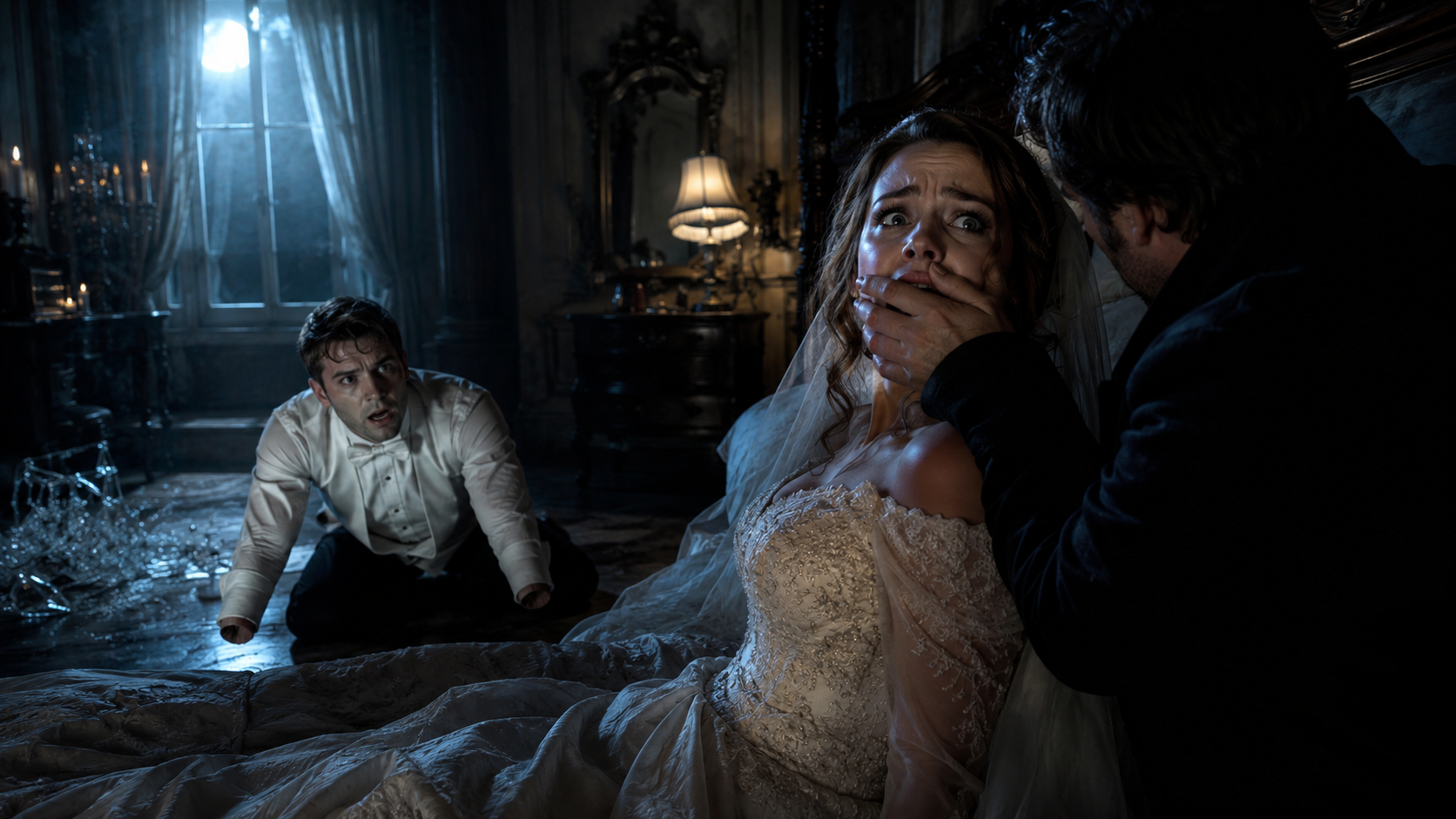
She Married a Man Without Hands to Save Her Mother — But on Their Wedding Night, She Felt Fingers in the Dark

When the fingers closed over Nora Vance’s mouth in the dark, her first thought was impossible.

Her husband had no hands.

That fact had been whispered about in the church, pitied over at the wedding breakfast, and used like a weapon by every guest who looked at Silas Blackthorne with soft eyes and sharp tongues. Four years earlier, Silas had lost both hands in an accident at his family’s glassworks. His sleeves had hung neatly pinned at the wrists during the ceremony. He had signed the marriage register with a mechanical stamp guided by his forearm. He had eaten nothing at the wedding feast because his mother said he was too tired.

So when Nora woke in the bridal bedroom with a warm palm pressed hard against her lips, her mind split in two.

One part screamed.

The other part said, This is not Silas.

Moonlight spilled through the curtains in thin silver strips. Across the floor, beside the overturned chair, Silas lay on his side. A cloth was tied between his teeth. His empty sleeves were twisted beneath him. His eyes were wide, frantic, pleading.

He was trying to warn her.

The man above Nora leaned close enough for her to smell brandy on his breath.

“Quiet, little bride,” Rowan Blackthorne whispered. “You don’t want to wake the house on your first night.”

Nora’s blood turned cold.

Rowan.

Silas’s older brother. The charming one. The one who had toasted her at dinner with a smile too bright and eyes too still. The one who had said, “Welcome to the family,” as if family were a room with no windows.

Nora tried to twist away, but her body moved slowly, as if she were underwater. Her arms felt heavy. Her tongue was thick. The sweet almond milk Lady Evangeline had insisted she drink before bed burned in her stomach like a secret.

Silas slammed his shoulder against the floor.

Once.

Twice.

The dull sound barely reached the door.

Rowan glanced back at him and laughed softly. “Still trying to be a hero? That’s touching.”

Nora stopped struggling for one second.

Only one.

Then she bit Rowan’s hand with every ounce of strength she had left.

He cursed and jerked backward. Nora rolled off the bed, hit the floor hard, and dragged herself toward Silas. Her knees shook. Her head spun. She could taste blood, his or hers, she did not know.

Rowan caught her ankle.

“No,” Nora rasped.

Silas kicked the fallen chair with such force that it skidded across the floor and crashed into a small table. A lamp toppled. Glass shattered.

The house woke.

Footsteps thundered in the corridor. Nora looked toward the door with desperate hope.

It opened.

Lady Evangeline Blackthorne stood there in a dark silk robe, her white hair pinned perfectly, a gold cross shining at her throat. Behind her hovered two maids and the housekeeper, Mrs. Mabel Rowe, pale as candle wax.

For one blessed second, Nora believed help had arrived.

Then she saw Evangeline’s face.

Not horror.

Not shock.

Irritation.

Rowan released Nora’s ankle and stepped away, breathing hard. Blood dripped from the bite in his palm. Silas writhed on the floor, trying to spit out the gag.

Evangeline looked around the room as though someone had spilled wine on her carpet.

“Well,” she said coldly. “That did not take long.”

Nora stared at her. “He attacked me.”

Evangeline’s eyes moved to Rowan’s bleeding hand, then back to Nora.

“You have been in this house less than twelve hours,” she said, “and already you are making accusations.”

Silas made a muffled sound from the floor.

Mrs. Rowe stepped forward. “My lady, perhaps we should—”

“Leave,” Evangeline snapped.

The maids lowered their eyes and disappeared at once. Mrs. Rowe hesitated. She looked at Silas. Then at Nora. Something terrible passed across her face.

Fear.

Not confusion.

Fear.

“Leave,” Evangeline repeated.

Mrs. Rowe obeyed, but slowly, like a woman walking away from a fire she had helped start.

Evangeline crossed the room and bent beside Silas. With sharp fingers, she untied the cloth from his mouth.

Silas gasped for air. “Mother, let her go.”

Evangeline struck him across the face.

The sound was small, almost polite.

Nora flinched.

Silas did not.

That frightened her more than the slap. A man who did not flinch had been hit before.

“You ungrateful son,” Evangeline hissed. “After everything I arranged for you.”

Silas lifted his head, eyes burning. “You arranged her for Rowan.”

Nora felt the room tilt.

Rowan laughed under his breath.

Nora pulled her torn sleeve across her chest and pushed herself against the wall. “What is this?”

Evangeline stood slowly. The gracious widow from the church was gone. In her place stood a woman carved from old money and colder pride.

“This,” she said, “is the truth behind the vows.”

“I married Silas.”

“Legally, yes.”

Rowan wiped his bleeding hand on a white handkerchief. “But poor Silas cannot exactly be a husband, can he?”

Silas’s face twisted. “Shut your mouth.”

Rowan smiled. “Or what?”

Nora felt something break through the drugged fog. Not courage. Not yet.

Rage.

Evangeline turned to her. “Listen carefully, Miss Vance. I paid your mother’s hospital debt. I paid for the specialist. I paid for the medicine that keeps her alive. You signed the marriage papers because I made survival possible. That means you will behave like a grateful woman.”

“My mother is not your chain.”

“She is whatever I decide she is.”

The room went silent.

Nora’s heart pounded once, hard.

Evangeline stepped closer. “Your mother’s treatment is scheduled every week. One word from me, one delay in payment, one lost document, and the hospital will discover that charity has limits. Do you understand?”

Silas struggled to sit up. “Mother, don’t do this.”

Evangeline ignored him.

“Rowan has appetites,” she continued. “Silas has a name. I have a family reputation to preserve. You were poor, desperate, and convenient. Do not confuse convenience with importance.”

Nora looked at Silas.

His eyes were wet with shame.

Not guilt.

Shame.

And in that moment she understood the first true thing about her marriage.

She had not married a monster.

She had married another prisoner.

“You drugged me,” Nora said.

Evangeline’s mouth tightened. “You were nervous. I gave you something to calm you.”

Rowan smirked. “Clearly not enough.”

Nora lunged for a shard of broken lamp glass on the carpet. Rowan moved toward her, but Silas threw his body sideways and struck Rowan’s knees with his shoulder. Rowan stumbled. Nora grabbed the glass and held it out with both trembling hands.

“Touch me again,” she whispered, “and this house will hear you scream.”

For the first time that night, Rowan stopped smiling.

Evangeline’s eyes narrowed. “You filthy little seamstress.”

Nora’s fingers tightened around the glass. “Then you should have checked the seams before you bought the dress.”

Something changed in Silas’s face.

A spark.

Tiny.

Terrified.

Alive.

Evangeline lifted her chin. “You will regret speaking to me like that.”

Nora looked at Rowan. Then at Evangeline. Then at Silas, bruised and gag-marked on the floor.

“I already regret entering this house,” she said. “Do not make the mistake of thinking regret is the same as surrender.”

That night, Nora was locked in a small guest room at the back of the second floor.

Not the bridal room.

Not even a room with a proper latch on the inside.

The door locked from the hallway. The window was narrow and painted shut. A faded portrait of some dead Blackthorne ancestor stared down at her from the wall as though judging her for breathing.

Nora stayed awake until sunrise.

She thought of the hospital ward where her mother, Lucia, slept beneath thin blankets and humming machines. She thought of the bills folded in her purse like death sentences. She thought of Lady Evangeline arriving at the charity office in black gloves, saying, “There are honorable arrangements between families, Miss Vance.”

At the time, Nora had believed she was sacrificing herself to a lonely disabled man.

A marriage in name.

A strange bargain.

A life she could survive if it meant her mother could live.

Now she understood.

The Blackthornes had not needed a wife for Silas.

They had needed a curtain.

By morning, Nora had stopped shaking.

At eight, Mrs. Rowe unlocked the door and came in carrying tea, toast, and a small dish of jam. Her hands trembled so badly the spoon rattled against the tray.

“You should eat,” the housekeeper whispered.

Nora looked at the tea.

“No.”

“It is only tea.”

“Then drink it.”

Mrs. Rowe went still.

That was answer enough.

Nora pushed the tray away. “Where is Silas?”

“In his room.”

“Locked in?”

Mrs. Rowe lowered her eyes.

Nora stood. “Help me.”

“I can’t.”

“Yes, you can.”

“You don’t know what they are capable of.”

Nora laughed once, without humor. “I learned quickly.”

Mrs. Rowe looked toward the hallway, then closed the door behind her. When she spoke again, her voice was barely more than breath.

“Rowan has always been cruel. Since he was a boy. Lady Evangeline covered everything. Broken windows. Broken animals. Broken servants. Girls came to work here and left before the month was out. Some were paid. Some were threatened. Some had nowhere else to go.”

Nora’s stomach turned.

“And Silas?”

Mrs. Rowe’s face crumpled.

“Silas tried to stop him.”

Nora stepped closer. “Stop him from what?”

“Everything.”

Mrs. Rowe’s eyes filled. “Before the accident, Silas was the only decent Blackthorne left. He wanted the glassworks inspected. He wanted workers paid properly. He found records proving Rowan had stolen wages, bribed safety officers, and hidden injuries from the authorities. Silas was going to report it.”

“And then he lost his hands.”

Mrs. Rowe nodded slowly.

“It was no accident.”

The words seemed to drain the air from the room.

“Rowan caused it?” Nora whispered.

“There was a fight near the furnace line. A worker saw Rowan shove him. Silas fell against the cutting press. The machine did the rest.” Mrs. Rowe wiped her cheeks with the heel of her hand. “Lady Evangeline called it a tragic malfunction. She paid the witness to leave town. She had the reports rewritten. Silas tried to speak, but after the surgeries he was weak, medicated, dependent. She told everyone grief had damaged his mind.”

Nora remembered Silas at the altar. Pale. Silent. Watching her with eyes that seemed to apologize before she knew why.

“He tried to warn me,” she said.

“Yes.”

“Why didn’t he stop the wedding?”

“Because Lady Evangeline told him if he refused, your mother’s care would be withdrawn before morning.”

Nora closed her eyes.

The cage was larger than she had thought.

Mrs. Rowe whispered, “I stayed because someone had to watch him. But watching is not the same as helping.”

“No,” Nora said. “But telling me is a start.”

The housekeeper looked at her with desperate hope and shame tangled together. “What can you do? They own the police. They own the factory. They own half the town.”

Nora looked at the tray. Then at the locked door. Then at the hem of her dress, where she had sewn a hidden pocket years ago out of habit.

“I am a seamstress,” she said.

Mrs. Rowe blinked. “What?”

“I mend things people think are ruined. I open machines people say are jammed forever. I find the thread that holds the knot.” Nora lifted her chin. “If their power is stitched together, it can be unstitched.”

By noon, Nora was brought downstairs.

Evangeline sat at the breakfast table with a Bible open beside her plate. Rowan leaned near the fireplace, one hand bandaged, a lazy smile on his mouth.

Silas sat by the window in a wheelchair. His sleeves were pinned neatly. A bruise darkened one side of his face.

Nora walked straight to him.

Evangeline’s voice cracked across the room. “Sit.”

Nora ignored her and knelt beside Silas.

“Are you hurt?” she asked.

Silas looked at her with misery. “I should be asking you.”

“You tried to warn me.”

“Too late.”

“No,” Nora said. “Not too late.”

Rowan clicked his tongue. “Sweet. Tragic. Boring.”

Evangeline closed the Bible.

“Last night,” she said, “never happened.”

Nora turned.

“You were overwhelmed,” Evangeline continued. “You became hysterical. Silas had one of his spells. Rowan intervened to help. That is the story.”

Silas’s voice shook with fury. “You will not make her say that.”

Evangeline smiled. “And who will contradict me? You?”

The cruelty landed exactly where she meant it to.

Silas lowered his head.

Nora stood.

“I understand,” she said quietly.

Silas looked at her sharply.

Rowan’s smile widened. “There. She learns.”

Evangeline studied Nora for a long moment. “Good. A clever poor girl is still poor. Remember that.”

Nora lowered her eyes.

Not in surrender.

In concealment.

For the next four days, Nora became exactly what the Blackthornes expected.

Silent.

Careful.

Useful.

She cooked when told. She helped Silas drink water. She cleaned the sitting room. She smiled when Evangeline watched. She never accepted a cup she had not poured herself. She slept with a chair wedged under the doorknob and the shard of lamp glass wrapped in cloth beneath her pillow.

And she watched.

She learned Evangeline wore the house keys on a chain beneath her skirts. She learned Rowan drank heavily after midnight and always went to the basement office before bed. She learned the hallway cameras pointed toward doors, not windows. She learned Mrs. Rowe left the pantry window unlatched whenever she wanted Nora to know she was not alone.

Most importantly, she learned Silas had not given up.

His body had been damaged.

His will had been starved.

But some part of him still stood upright inside.

On the fourth afternoon, while Evangeline attended a charity luncheon and Rowan was at the glassworks, Nora pushed Silas’s wheelchair into the winter garden under the excuse of fresh air.

The sky was pale. Frost clung to the dead roses.

Silas looked toward the back gate. “You should run.”

“And leave my mother?”

“I will find a way to help her.”

“With what?”

She regretted it the instant she said it.

Silas looked away.

“I’m sorry,” Nora whispered.

“No,” he said. “You’re not wrong.”

She knelt in front of him. “Silas, I need the truth. All of it. About Rowan. About the accident. About your mother.”

He closed his eyes.

For a moment, she thought he would refuse.

Then he began.

Before the accident, Silas had been the Blackthorne heir in everything but temperament. He had studied accounts, factory management, and law. He wanted safer furnaces, fair wages, and medical funds for injured workers. Rowan wanted profit without questions. Evangeline wanted the family name untouched by scandal.

Silas discovered forged safety certificates, hidden injury reports, bribes to local officials, and a private ledger showing money stolen from worker pensions. He copied everything onto a small storage drive and hid it before confronting Rowan.

“The day before the accident,” Silas said, “Rowan told me if I exposed him, he would make sure I never signed another report.”

Nora’s skin prickled.

“Where is the evidence now?”

Silas gave a bitter laugh. “Most of it vanished.”

“Most?”

He looked at her.

For the first time, something like hope crossed his face.

“My father built a hidden safe in my mother’s old sewing room. Evangeline locked it after my mother died. I hid the drive there before I went to the factory that day.”

Nora almost smiled.

“A sewing room?”

“Yes.”

“Your mother bought a seamstress and locked the truth inside a sewing room.”

Silas’s mouth twitched. “It appears so.”

“Where?”

“Third floor. East wing. Behind a warped blue door.”

“Combination?”

“I never knew. My father changed it after my mother died.”

Nora looked toward the house.

Every prison had a weak seam.

That night, she made her first move.

She waited until Evangeline retired and Rowan’s drunken footsteps faded toward the back hall. Then Nora slipped from her room with a hairpin, a butter knife, a spool of thread, and the calm terror of a woman who had already survived the worst night of her life.

The third floor smelled of dust and old cedar.

The blue door was locked.

Old locks were not so different from old sewing machines. They jammed, resisted, complained, and then surrendered if a person listened carefully enough.

It took nine minutes.

The lock clicked.

Nora entered the sewing room.

Moonlight revealed covered furniture, folded fabric, a cracked dress form, and an old black sewing machine with gold lettering dulled by dust. For one strange second, the room felt less haunted than the rest of the house.

Perhaps because someone had once made things there instead of destroying them.

Nora found the safe behind a loose panel beneath the cutting table.

The combination nearly defeated her.

She tried birthdays Mrs. Rowe had mentioned. Nothing.

She tried the year Silas’s father died. Nothing.

Then she saw initials scratched into the underside of the table.

A.B. + C.B.

Arthur Blackthorne and Celia Blackthorne.

Silas’s parents.

Beside the initials was a tiny carved rose.

Nora remembered Mrs. Rowe saying Celia Blackthorne had died in June, when the roses were blooming.

She tried 0612.

The safe clicked open.

Inside were jewelry boxes, old letters, a folded lace veil, and a small black drive wrapped in handkerchief linen.

Nora took it.

A floorboard creaked behind her.

She turned.

Rowan stood in the doorway.

For one heartbeat, neither moved.

Then he smiled.

“There you are,” he said softly. “I wondered how long it would take the little mouse to find a hole.”

Nora backed away, hiding the drive in her fist.

Rowan stepped into the room and closed the door behind him.

“My mother thinks fear lasts forever,” he said. “I told her fear wears thin if you rub it hard enough.”

“You should leave,” Nora said.

“This is my house.”

“No,” she said. “It is your mother’s house. You only haunt it.”

His smile vanished.

“Give me what you found.”

“I found dust.”

He lunged.

Nora threw a folded bolt of fabric into his face and ran for the door. Rowan grabbed her sleeve. The cloth tore. She drove her elbow into his ribs and stumbled into the hall.

“Nora!” Silas shouted from below.

She looked over the banister.

He was at the second-floor landing, wheelchair angled dangerously near the stairs.

“Catch!” she cried.

She threw the drive.

It spun through the air.

Silas leaned hard to one side and trapped it between his forearm and his body as it landed in his lap.

Rowan seized Nora from behind.

Before he could drag her back, Mrs. Rowe stepped out of the shadows with a cast-iron pan in both hands.

She swung.

The pan struck Rowan’s shoulder with a heavy crack.

He screamed and collapsed against the wall.

Mrs. Rowe stood there shaking, but she did not drop the pan.

“I am done being afraid of spoiled boys,” she said.

A door opened below.

Evangeline appeared on the staircase in a silk robe, her face white with fury.

“What is happening?”

Silas looked up at his mother.

For the first time since Nora had met him, he smiled.

“The house is opening,” he said.

Everything after that happened quickly.

Rowan tried to reach Silas. Mrs. Rowe screamed loud enough to wake the staff. Two stablemen appeared at the foot of the stairs. Evangeline lunged for the drive, but Nora grabbed a vase and hurled it at the wall. Porcelain exploded. Everyone froze.

“Touch him,” Nora said, “and the next one is aimed.”

Mrs. Rowe ran to the kitchen and called the police from the landline.

“My name is Mabel Rowe,” she said, voice trembling but clear. “Send officers to Blackthorne House. A woman has been drugged. A disabled man has been restrained and abused. There is evidence connected to the old glassworks accident.”

Evangeline tore the phone from the wall.

But the call had gone through.

Within minutes, sirens cut through the night.

Before the officers arrived, Evangeline transformed.

Her hair was smoothed. Her robe was replaced with a black dress. Her cross hung at her throat. Her voice became soft, wounded, maternal.

“Officers,” she said at the door, “my new daughter-in-law is unstable. The marriage has overwhelmed her. My son Silas is fragile, and my elder son was trying to calm everyone.”

Nora stood beside Silas, torn sleeve visible, bruises already rising on her wrist.

Mrs. Rowe stood behind them holding the drive.

Rowan shouted that Nora was a thief.

Silas spoke before anyone else could.

“My mother and brother are lying,” he said. “My wife is in danger. So am I.”

Evangeline sighed sadly. “You see? He has been like this since the accident.”

Silas looked straight at the officers.

“Ask her why she refused me adaptive therapy for four years. Ask her why my medical funds disappeared. Ask why the worker who saw my accident left town the next morning. Ask why my wife was given sedatives on her wedding night.”

One officer’s expression changed.

Nora added, “The cup is still in the bridal room. Test it.”

Evangeline’s face went still.

That was the first crack in the saintly mask.

The police separated everyone.

Nora and Silas were taken to the hospital. Rowan was detained after officers documented Nora’s bruises, his injured hand, the damaged room, and signs that Silas had been restrained. Evangeline was not arrested that night, but her world had begun to split open.

At the hospital, Nora sat under a blanket with her knees drawn up, staring at nothing.

Silas waited beside her in his wheelchair.

For a long time, neither spoke.

Then he said, “I am sorry.”

Nora closed her eyes. “Don’t.”

“I should have stopped the wedding.”

“You tried.”

“Not enough.”

“You were tied to the floor with no hands and still tried to save me.” She turned to him. “Do not insult that by calling it nothing.”

Silas’s eyes filled.

Nora reached toward his sleeve, then paused. “May I?”

He nodded.

She touched the cloth gently where his hand should have been.

“I don’t know what this marriage is,” she said. “But I know what it is not.”

Silas looked at her.

“It is not theirs anymore.”

The drive changed everything.

It contained copies of safety reports, payroll records, letters between Evangeline and local officials, photographs from the glassworks, and a recorded argument between Rowan and Silas from the day before the accident.

Rowan’s voice was clear.

“If you expose me, little brother, you will never sign another report again.”

Two days later, investigators searched Blackthorne Glass.

They found forged inspections, hidden worker injuries, unpaid settlements, missing pension money, and chemical waste dumped near the river. Former employees began speaking. A safety inspector resigned. A judge ordered Silas removed from Evangeline’s control. Nora’s marriage contract was challenged as coercive.

The Blackthorne name, once polished like silver, began to blacken in public.

Evangeline appeared outside church in mourning black, telling reporters, “A greedy young woman married my disabled son for money and is now trying to destroy our family.”

Nora watched the clip from her mother’s hospital room.

Lucia Vance lay weak but awake, her hand resting over Nora’s.

“Did you suffer because of me?” Lucia whispered.

Nora bent her head. “No, Mama.”

“Do not lie to a woman who raised you.”

Nora broke then.

She cried the way she had not cried in the locked room, not in the police car, not under the hospital lights.

Lucia touched her cheek.

“I cleaned houses until my hands cracked so you would never have to sell your life for mine.”

“I thought you would die.”

“I know.” Lucia’s eyes shone. “But a mother does not want her child breathing in a cage.”

Nora lowered her head onto the bed and wept.

For the first time, she allowed herself to understand the trap fully.

Poverty had pushed her toward that house.

But poverty had not drugged her.

Poverty had not tied Silas to the floor.

Poverty had not covered crimes with prayers and polished silver.

People had done that.

Powerful people.

People who knew desperation could be used like a leash.

The trial took nearly a year.

During that time, Nora moved into a small apartment near the hospital. Silas moved into a rehabilitation center where, for the first time since the accident, he received proper therapy, adaptive equipment, trauma counseling, and legal protection from his mother.

He learned to use voice-controlled software.

He learned to guide a motorized chair with shoulder movements.

He learned to eat with adaptive tools.

He learned to sign documents electronically without anyone touching the pen for him.

The first time he sent Nora a message he had typed entirely by himself, it said:

I chose these words without help.

Nora cried for twenty minutes.

Their marriage remained legal while the courts untangled Evangeline’s contracts, payments, and threats. Nora visited Silas twice a week. Sometimes they spoke about the case. Sometimes about Lucia. Sometimes about nothing at all.

One rainy afternoon, Silas watched Nora repair a torn coat sleeve in the rehabilitation center’s common room.

“You can divorce me,” he said.

Nora did not look up. “I know.”

“I will not contest anything.”

“I know.”

“You do not owe me companionship because my mother purchased it.”

Nora set down the coat.

“No,” she said. “I don’t.”

He nodded, trying to hide the hurt.

“But I also do not owe fear a quick decision,” she continued. “For the first time in months, no one is forcing me to choose. I would like to know what I want before I sign anything.”

Silas looked at her.

Nora picked up the needle again. “Besides, someone has to beat you at chess.”

He laughed.

It startled them both.

It was the first sound Nora had heard from him that did not carry shame inside it.

In court, Evangeline’s defense was reputation.

Her lawyers spoke of charity luncheons, church donations, widowed dignity, and a mother’s devotion to an injured son. They described Nora as a desperate opportunist. They described Silas as emotionally damaged. They described Rowan as a troubled but loving brother.

Then Mrs. Rowe testified.

She walked to the stand in a plain gray dress, hands folded tightly in her lap.

She admitted she had stayed silent for years.

She admitted she had watched young women leave Blackthorne House in tears.

She admitted Evangeline had ordered sedatives placed in Nora’s wedding-night drink.

She admitted Silas had been controlled, neglected, and humiliated inside his own home.

Evangeline stared at her as if hatred alone could kill.

Mrs. Rowe looked back and said, “I was afraid of you for fifteen years. I am still afraid. But I am more ashamed than afraid now.”

That sentence changed the room.

The former glassworks employee who had witnessed Silas’s accident was found in another state. He testified that Rowan shoved Silas during their fight and that Evangeline paid him to disappear.

Doctors testified that Nora had sedatives in her blood.

Therapists testified that Silas had been deliberately denied independence.

Accountants testified that Blackthorne money had been used to silence workers, bribe inspectors, and control legal claims.

Rowan’s attorney tried to suggest Nora had exaggerated everything because she regretted marrying a disabled man.

The prosecutor stood and answered with one sentence.

“A woman who is drugged, locked inside a house, threatened through her mother’s medical care, and cornered by the family that bought her has not consented to anything.”

The jury understood.

Rowan was convicted of assault, unlawful restraint, conspiracy, fraud, and crimes connected to Silas’s injury and the factory cover-up.

Evangeline was convicted of conspiracy, witness intimidation, financial crimes, abuse of a vulnerable adult, and coercion related to Nora and Lucia’s medical care.

At sentencing, Evangeline wore black and held her gold cross.

The judge looked at her for a long time.

“Lady Blackthorne,” he said, “public virtue does not erase private cruelty. You used motherhood as a weapon, wealth as a chain, disability as a prison, and charity as camouflage. This court sees no holiness in that.”

Evangeline’s face tightened.

She received a long sentence.

Rowan received longer.

Blackthorne Glass was placed under outside control. Money was set aside for injured workers, unpaid families, environmental cleanup, and Silas’s care. Nora’s contract was declared void because it had been signed under coercion.

For the first time since she had stepped into Blackthorne House, Nora owed them nothing.

Six months later, Lucia’s health stabilized. She was not cured, but she was alive, receiving treatment through public assistance and a nonprofit medical program that Evangeline could not touch.

Nora rented a narrow storefront between a laundromat and a bakery.

She named it The Second Seam.

At first, people came for hems, buttons, wedding alterations, and winter coats.

Then Silas began helping her design clothing for people whose bodies the world forgot: shirts with magnetic closures, jackets that could be put on without hands, dresses that opened discreetly for medical ports, trousers shaped for wheelchair comfort, coats that did not bunch under seated backs.

Silas became her first consultant.

Then her business partner.

Their marriage changed slowly.

Not like a fairy tale.

More like cloth being repaired after a tear: patient, careful, reinforced where the strain had been worst.

Nora learned Silas hated pity but appreciated being asked. Silas learned Nora went quiet when afraid and sharp when cornered. They argued sometimes. They apologized better. They went to therapy separately and together. They built habits no one had forced on them.

One evening, a year after the wedding night that had almost destroyed them, Silas came into the shop wearing a charcoal jacket Nora had made for him. It fastened with hidden magnets and fit his shoulders perfectly.

He looked nervous.

Nora narrowed her eyes. “What did you do?”

“Nothing illegal.”

“That is a low standard, but continue.”

Using the speaker attached to his chair, Silas played a message he had prepared in his own voice.

“Nora, our first wedding was a contract signed under fear. Neither of us chose it freely. So I am asking now, with no money between us, no threat over your mother, no locked door, and no Blackthorne watching from the hallway…”

His eyes shone.

“Would you go on a real first date with me?”

Nora covered her mouth.

Silas looked terrified. “You can say no.”

“I know.”

“And?”

She stepped closer.

“Yes.”

Their first real date was at a diner with bad coffee and excellent pie. Silas knocked over a water glass with his elbow. Nora burned her tongue on soup. They both laughed so hard the waitress smiled from across the room.

Love did not arrive overnight.

Trust did not bloom because a judge had signed papers.

But it grew.

Stitch by stitch.

Two years after the trial, Nora and Silas stood outside the old Blackthorne House.

The mansion had been sold to pay restitution, then purchased by a nonprofit that planned to turn it into a rehabilitation center for survivors of abuse and workplace injury. The bridal bedroom had been stripped. The locks had been changed. The sewing room was preserved as a workshop.

Mrs. Rowe attended the opening ceremony.

She cried when Nora hugged her.

“I should have helped sooner,” she said.

Nora held her tightly. “You helped when you could finally breathe.”

Silas looked up at the front entrance, where workers were building a wide ramp.

“For years,” he said, “I thought this house was where my life ended.”

Nora stood beside him. “Maybe now it becomes where someone else begins again.”

He glanced at her. “That sounds like something embroidered on a pillow.”

“I am a seamstress,” she said. “I am allowed.”

He laughed.

At the ceremony, Nora gave a short speech.

She did not tell every detail. Some wounds did not belong to the public. But she told enough.

“I once believed desperation had forced me to sell my life,” she said. “But desperation did not create the evil in that house. People did. People who knew that medical bills, poverty, disability, and silence can be twisted into chains.”

The crowd listened.

“I learned that a person can be trapped in a mansion more completely than in a cell. I learned that a man without hands can still reach for courage. I learned that a frightened housekeeper can become a witness. I learned that a sick mother can still teach her daughter what freedom costs.”

Silas lowered his head.

Nora continued.

“If someone controls your medicine, your money, your family, your mobility, your reputation, or your fear, and calls it love, hear me clearly: you are not property. A contract signed in terror is not devotion. A locked room is not a home.”

Applause rose slowly.

Then strongly.

Lucia sat in the front row with a blanket over her knees, crying openly.

That evening, Nora and Silas returned to The Second Seam. Rain tapped against the window. They ate noodles from paper cartons on the cutting table between sketches, fabric rolls, and half-finished orders.

Silas looked around the shop.

“Do you ever regret marrying me?”

Nora set down her fork.

She thought about the hospital bill. The wedding dress. The almond milk. The dark room. The hand over her mouth. Silas on the floor. The trial. The slow work afterward.

Then she looked at him.

“I regret why I married you,” she said. “I do not regret knowing you.”

Silas’s eyes softened.

“That may be the kindest honest thing anyone has ever said to me.”

“I specialize in repairs.”

“Is that what we are?” he asked.

Nora smiled.

“No. We are not something repaired.”

She reached across the table and touched his sleeve.

“We are something remade.”

Years later, when people told the story, they always began with the shocking part.

The poor seamstress.

The husband without hands.

The wedding night terror.

The cruel brother.

The saintly mother who was never a saint.

But Nora always corrected them.

“The story is not about the hands that hurt me,” she would say. “It is about the people who helped me reach the door.”

And when people asked whether Silas was her husband because of pity, gratitude, or obligation, Nora would smile.

“No,” she would say. “The first marriage was bought. The second one was chosen.”

Because three years after that terrible wedding night, Nora married Silas again.

Not in a cathedral filled with Blackthorne guests.

Not under Evangeline’s cold eyes.

Not beside a contract waiting to be signed.

They married in a small garden behind The Second Seam, beneath white roses and strings of warm lights.

Lucia sat in the front row.

Mrs. Rowe held a handkerchief to her eyes.

The officiant asked if they had written vows.

Silas activated the speaker he controlled himself.

“Nora,” his voice said, steady and clear, “I cannot hold your hand the way another man might. But I promise never to cage you, never to buy your silence, never to mistake kindness for debt, and never to let any door in our life lock from the outside.”

Nora cried before he finished.

Then she spoke.

“Silas, I entered your family’s house because I was terrified of losing my mother. I found cruelty there. I found fear. But I also found you. Not a savior. Not a burden. A witness. A survivor. A man who taught me that love is not measured by what the body has lost, but by what the heart refuses to become.”

When the officiant pronounced them married, Silas leaned forward.

Nora kissed him first.

The garden erupted in applause.

There were no chains that day.

No locked doors.

No drugged sweetness in a cup.

No bargain hidden beneath white flowers.

Only sunlight, choice, and two people who had walked through horror without allowing horror to write the ending.

And beyond the town, the old Blackthorne House stood with its windows open, filled now with voices that were no longer afraid to speak.

That was the real revenge.

Not violence.

Not ruin.

Freedom.

She Married a Man Without Hands to Save Her Mother — But on Their Wedding Night, She Felt Fingers in the Dark
My Critically Ill Daughter’s $140,000 Hospital Bill Was Anonymously Paid – Four Years Later, a Stranger Approached Me and Said, ‘I Owed You This’