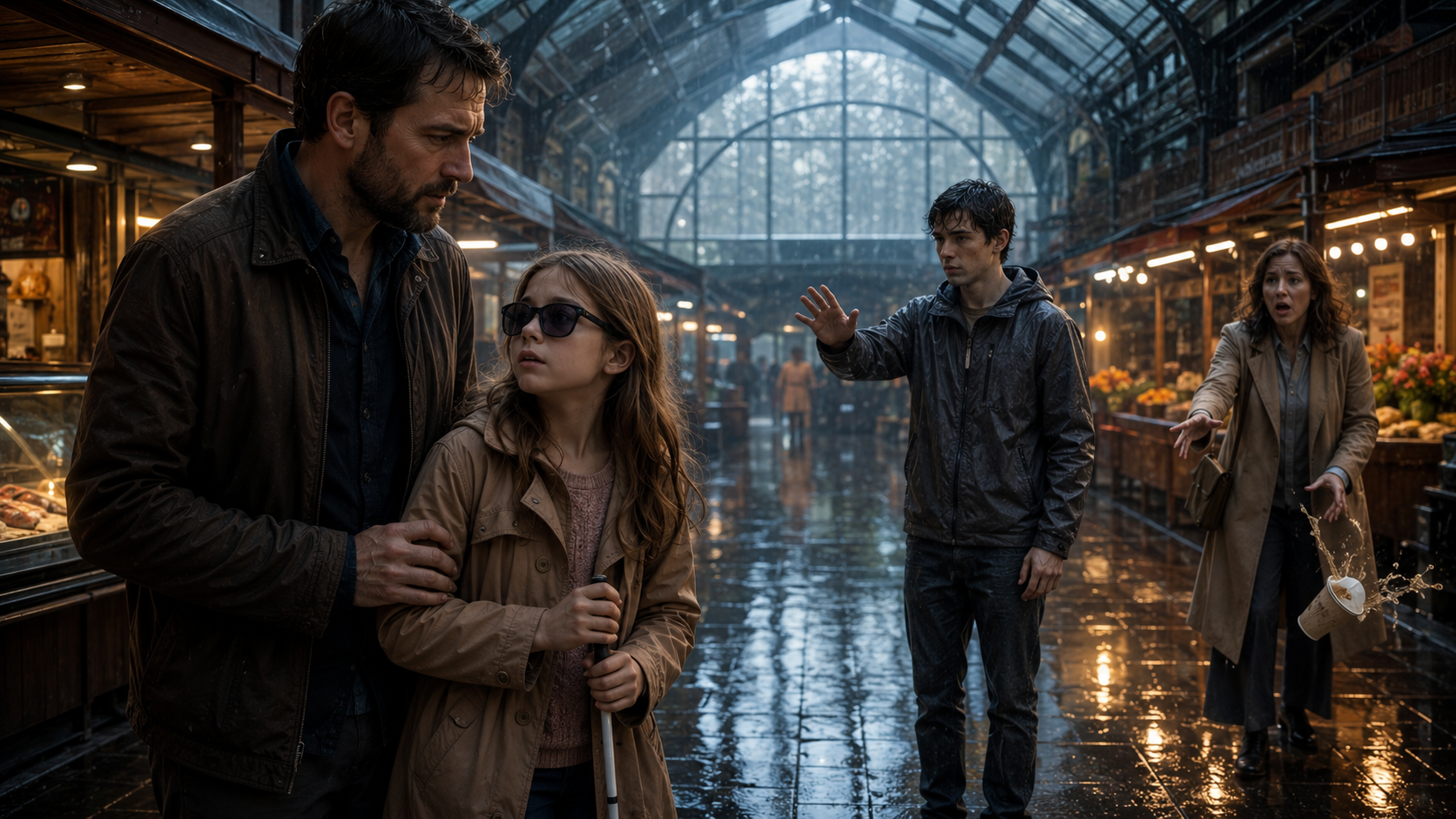
SHE HAD NEVER BEEN BLIND — BUT HER FATHER LEARNED THE TRUTH YEARS TOO LATE

For nine years, Ethan Walker had described the world to his daughter.

He described sunsets she could not see.

He described Christmas lights glowing against fresh snow.

He described the silver surface of the river in winter and the deep green leaves that returned every spring.

Whenever ten-year-old Sophie asked him what a color looked like, Ethan searched for a feeling instead of an explanation.

“Red is warm,” he once told her. “Like standing close to a fireplace.”

“What about green?”

“Green feels like grass under your bare feet.”

“And blue?”

Ethan had hesitated.

“Blue feels like having nowhere you need to be.”

Sophie had smiled.

“I think blue might be my favorite.”

Then she reached for his hand because she needed him to guide her across the room.

Moments like that broke him.

Sophie had been barely two when doctors first became concerned about her eyesight.

She had suffered a severe infection accompanied by weeks of fever. Afterward, according to Ethan’s wife, Vanessa, their little girl stopped reacting normally to light.

Doctors were consulted.

Tests were performed.

Medications appeared on the bathroom shelf.

Then came specialists.

New clinics.

New diagnoses.

New disappointments.

Ethan remembered sitting in waiting rooms while Vanessa handled the conversations with physicians.

She had always been better with medical language.

Better with paperwork.

Better at remembering complicated instructions.

When Sophie became frightened, Vanessa knew exactly how to calm her.

So Ethan trusted her.

Completely.

Eventually, the family stopped hoping for a miracle.

Sophie learned to use a cane.

She learned the number of steps from her bedroom to the staircase.

She learned to recognize people from their footsteps.

She learned that her father always smelled faintly of coffee and cedarwood.

She learned that her mother wore a small silver bracelet that made a soft metallic sound whenever she moved.

Ethan learned something too.

He learned how quickly a parent can rearrange an entire life around a child.

He changed jobs so he could work closer to home.

He stopped traveling.

He rejected promotions.

He installed textured markers on appliances and railings along the walls.

Their home became a carefully controlled universe built around Sophie’s darkness.

Vanessa managed nearly everything related to her condition.

Ethan never questioned it.

Why would he?

She was Sophie’s mother.

And she seemed willing to sacrifice anything for their daughter.

That was what Ethan believed until a rainy Saturday in October.

The three of them had gone to Hawthorne Market, an old indoor market near the train station.

Sophie loved the place.

She could not see the rows of fruit, flowers and handmade crafts, but she loved the sounds.

Vendors calling to customers.

Coins dropping into metal cash boxes.

People laughing.

Coffee machines hissing.

A violinist often played near the eastern entrance, and Sophie could recognize him before they even reached the building.

That afternoon, Vanessa left to buy tea while Ethan and Sophie waited beneath the covered entrance.

Rain struck the glass roof above them.

Sophie stood beside him wearing dark glasses, one hand wrapped around the grip of her white cane.

A group of teenagers rushed past.

One of them collided with Ethan’s shoulder.

“Sorry, sir.”

“No problem.”

The teenager continued walking.

Then stopped.

He looked back.

He was perhaps sixteen.

Thin.

Wet hair hanging across his forehead.

An oversized gray jacket covered most of his body.

He stared at Sophie.

Ethan immediately became uncomfortable.

“What?”

The boy said nothing.

Sophie tilted her head.

“Dad?”

“It’s okay.”

The teenager slowly raised one hand.

He moved it from left to right.

Sophie’s face followed the motion.

Barely.

So slightly that Ethan almost missed it.

The teenager repeated the movement.

Again, Sophie’s head shifted.

Ethan frowned.

“What are you doing?”

The boy looked at him.

“Testing something.”

“Don’t.”

“Your daughter followed my hand.”

Ethan’s expression hardened.

“She heard your jacket moving.”

The boy removed his jacket.

Underneath he wore a black sweatshirt.

Then, without making a sound, he lifted his hand again.

Left.

Right.

Sophie’s face moved with it.

Ethan stopped breathing.

The boy whispered:

“She can see me.”

“That’s enough.”

“She can.”

Ethan stepped between them.

“My daughter is blind.”

“No,” the boy answered quietly.

“She believes she is.”

The sentence struck harder than an insult.

Ethan grabbed the teenager by the arm.

“Who are you?”

The boy pulled free.

“Someone who pays attention.”

Then Sophie spoke.

“Dad?”

Her voice sounded different.

Uncertain.

“What is it, sweetheart?”

“There’s something bright behind him.”

Ethan stared at her.

“What?”

“The boy.”

The teenager froze.

Sophie pointed almost directly toward him.

“There’s light around his head.”

Ethan’s knees nearly gave way.

At that exact moment, Vanessa returned carrying two paper cups.

She saw the teenager.

Then she saw Ethan’s face.

One cup slipped from her hand.

It struck the floor and burst open.

Hot tea spread across the concrete.

“Ethan.”

He turned.

Something was wrong.

Vanessa wasn’t confused.

She wasn’t surprised.

She was afraid.

Deeply afraid.

The teenager noticed it too.

He looked from Vanessa to Sophie.

Then back to Ethan.

“Ask her,” he said.

Vanessa stepped forward.

“Get away from my daughter.”

“I didn’t touch her.”

“Leave!”

Several shoppers turned toward them.

Ethan stared at his wife.

“Vanessa.”

“Don’t listen to some random kid.”

“How did Sophie know where he was standing?”

“She heard him.”

“He wasn’t moving.”

“She can sense people. She’s always been good at that.”

The teenager shook his head.

Vanessa snapped toward him.

“Go!”

He backed away.

But before disappearing into the crowd, he said something Ethan would remember for the rest of his life.

“Blind people don’t track shadows.”

Then he vanished between two market stalls.

For the rest of the afternoon, Ethan barely spoke.

Vanessa talked constantly.

She explained.

Defended.

Rationalized.

Sophie had probably heard the boy breathing.

Maybe she had sensed air movement.

Maybe the market lighting triggered some residual perception.

Doctors had always said she might retain minimal light sensitivity.

Every explanation sounded reasonable.

That was the problem.

Vanessa was extremely good at sounding reasonable.

That night, after Sophie fell asleep, Ethan entered their bedroom.

Vanessa was sitting on the edge of the bed.

“Who was that boy?” she asked.

“I don’t know.”

“Did he follow us?”

“No.”

“Then forget about him.”

Ethan remained standing.

“When was Sophie’s last full examination?”

Vanessa looked up.

“What?”

“Her eyes. When were they physically examined?”

“Four months ago.”

“By Doctor Pierce?”

“Yes.”

“I want another opinion.”

Vanessa stood immediately.

“We’ve had dozens of opinions.”

“I want another.”

“Why?”

“Because my daughter pointed at someone today.”

“She pointed toward a voice.”

“He wasn’t speaking.”

Vanessa’s jaw tightened.

“You’re letting a stranger manipulate you.”

Ethan studied her.

For nine years he had known every version of his wife’s face.

Happy.

Angry.

Exhausted.

Tender.

Terrified.

But the expression he saw now was different.

It looked like calculation.

“Give me Sophie’s medical records.”

Vanessa laughed nervously.

“It’s almost midnight.”

“Tomorrow morning.”

“They’re stored in different places.”

“You said you kept copies.”

“I do.”

“Then I want them.”

Silence filled the bedroom.

Finally Vanessa nodded.

“Fine.”

But Ethan did not sleep.

At three seventeen in the morning, he walked downstairs.

He opened the kitchen cabinet where Vanessa kept Sophie’s medication.

Most bottles looked familiar.

One didn’t.

Small.

Brown glass.

No pharmacy label.

Only a handwritten date.

Ethan picked it up.

His hands began shaking.

The following morning, he photographed every bottle before Vanessa woke.

Then he called an ophthalmology clinic in another city.

He did not tell his wife.

Three days later, Ethan told Vanessa he was taking Sophie to visit his brother.

Instead, he drove two hours to a private medical center.

Sophie sat quietly in the passenger seat.

“Dad?”

“Yes?”

“Are we really seeing Uncle Michael?”

Ethan gripped the steering wheel.

“No.”

“Where are we going?”

“To see a doctor.”

Sophie became tense.

“Mom said doctors can’t fix my eyes.”

“I know.”

“Then why?”

Ethan swallowed.

“Because sometimes adults can be wrong.”

The examination lasted nearly four hours.

Ethan waited outside during several tests.

Every minute felt longer than the last.

Finally, Dr. Hannah Reed entered the consultation room.

She closed the door.

Then she sat across from Ethan.

“Mr. Walker, I need to ask you a difficult question.”

His stomach tightened.

“Go ahead.”

“Who told you your daughter was completely blind?”

“My wife. Doctors. Everyone.”

Dr. Reed looked at the file.

“I’ve examined Sophie personally. She has severe visual impairment, but I’m seeing responses that don’t match the history you’ve described.”

Ethan’s mouth went dry.

“What does that mean?”

“It means I need more tests before I can make any definitive statement.”

“Can she see?”

The doctor paused.

“She can detect light.”

Ethan stared at her.

“She can distinguish motion.”

His eyes filled with tears.

“And based on today’s results, I believe she may be able to distinguish large shapes.”

Ethan stood so quickly that his chair scraped across the floor.

“No.”

Dr. Reed remained calm.

“I know this is overwhelming.”

“You don’t understand. She has been blind for almost her entire life.”

“Mr. Walker, I’m not saying her vision is normal.”

“Then what are you saying?”

“I am saying her eyes are functioning better than you were led to believe.”

Ethan covered his face.

For years he had described sunsets to his daughter.

Flowers.

Birthdays.

Snow.

His own face.

And perhaps, somewhere inside that darkness, she had been seeing fragments all along.

The doctor continued.

“There is something else.”

She placed several photographs on the desk.

“These are retinal and optic nerve images.”

Ethan understood none of them.

“Your daughter does not show the structural damage I would expect in a child who has experienced complete irreversible blindness for eight or nine years.”

Ethan slowly lowered his hands.

“Then why can’t she see properly?”

“That is the question we need to answer.”

He remembered the brown bottle.

Ethan took out his phone.

“I photographed her medications.”

Dr. Reed reviewed the images.

One picture made her stop.

She enlarged it.

“Where did this come from?”

“I don’t know.”

“Does Sophie still receive this?”

“I think so.”

“How often?”

“My wife handles the medication.”

The doctor looked up.

Her expression changed.

“Do not give Sophie anything from that bottle until we identify exactly what it contains.”

Ethan felt cold.

“What are you saying?”

“I’m saying we don’t know what it is.”

He returned home after sunset.

Vanessa was waiting in the living room.

She had called him seventeen times.

“Where were you?”

Ethan closed the door.

“Sophie is upstairs?”

Vanessa folded her arms.

“She went to her room because she thought you were angry.”

“Good.”

“Good?”

“I don’t want her hearing this.”

Vanessa’s face lost color.

Ethan placed the brown bottle on the table.

The room became completely silent.

“What is that?” he asked.

Vanessa looked at it.

Then at him.

“You know what it is.”

“No. I don’t.”

“It’s part of her treatment.”

“There is no label.”

“It came from a specialist.”

“Which specialist?”

Vanessa did not answer.

Ethan stepped closer.

“Which specialist?”

“I don’t remember.”

“You remember every appointment Sophie has had since she was two.”

“Don’t interrogate me.”

“A doctor examined her today.”

Vanessa stopped moving.

Ethan watched the truth reach her face before he even finished speaking.

“She can see light.”

Vanessa whispered his name.

“She can see movement.”

“Ethan…”

“She can see shapes.”

“Please.”

The word changed everything.

Not you’re wrong.

Not the doctor is mistaken.

Please.

Ethan felt something inside him collapse.

“What did you do?”

Vanessa began crying.

“I was trying to protect her.”

“From what?”

“She was sick.”

“Nine years ago.”

“You don’t remember how bad it was.”

“I remember everything.”

“No, you don’t!” Vanessa shouted. “You were working fourteen hours a day. I was the one holding her while she screamed. I was the one sitting beside her hospital bed.”

Ethan stared.

“What did you do?”

Vanessa sank onto the sofa.

At first, she refused to answer.

Then the story emerged in broken pieces.

After Sophie’s illness, her vision genuinely had been affected.

Doctors believed much of it could improve.

Vanessa became obsessed with every symptom.

Every headache became a crisis.

Every complaint became evidence that Sophie was still dangerously ill.

When one physician suggested reducing certain treatments, Vanessa found another doctor.

When that doctor disagreed with her, she found another.

She searched online.

Ordered unregulated products.

Combined treatments that were never meant to be combined.

Some temporarily increased Sophie’s sensitivity to light.

Others blurred her vision.

The little girl began keeping her eyes closed because opening them hurt.

Vanessa gave her dark glasses.

Then a cane.

She told Sophie she was blind.

Again.

And again.

And again.

Until the child stopped trying to see.

“What about the bottle?” Ethan asked.

Vanessa covered her face.

“It helped with the light sensitivity.”

“What’s inside it?”

“I don’t know exactly anymore.”

“You gave our daughter something and you don’t know what it is?”

“I thought I knew!”

“For nine years?”

“I couldn’t stop!”

Ethan stepped backward.

That answer frightened him more than anything else.

Vanessa continued through tears.

“The longer it went on, the harder it became to admit I had made a mistake. Everyone thought I was the mother who never gave up. The doctors praised me for managing everything. You trusted me.”

“So you kept going.”

“I was scared.”

“Of what?”

Vanessa looked toward the staircase.

“Of losing her.”

“You had her.”

“No,” Vanessa whispered. “She was growing up. She needed me less every year.”

Ethan stared at her.

“And when she was sick?”

“She needed me for everything.”

The room felt suddenly too small.

Ethan understood.

Vanessa had built her entire identity around being indispensable.

Sophie’s helplessness had become the foundation beneath her life.

And somewhere along the way, protecting her daughter had transformed into preserving that helplessness.

Ethan’s voice dropped.

“You didn’t protect her.”

Vanessa cried harder.

“You made her afraid of her own eyes.”

The next morning, Ethan took Sophie away.

The months that followed were brutal.

There were hospitals.

Investigations.

Psychological evaluations.

Medical reviews.

Lawyers.

Questions Ethan could barely answer.

But there was also progress.

Dr. Reed developed a treatment and rehabilitation plan.

Sophie began without her dark glasses for several minutes each day.

At first, light caused panic.

She had spent almost her entire conscious life being taught that looking was impossible.

Her brain had learned to trust sound and touch instead.

Recovering vision would not be like switching on a lamp.

It would be learning an unfamiliar language.

One afternoon, Ethan sat across from her in a quiet rehabilitation room.

A therapist placed three large colored cards on a table.

Red.

Yellow.

Blue.

Sophie stared toward them.

Her eyes moved uncertainly.

“Don’t guess,” Ethan said.

“I don’t know.”

“That’s okay.”

She pointed toward the yellow card.

“That one feels brighter.”

The therapist smiled.

“It is.”

Sophie laughed.

A small, shocked laugh.

Ethan looked away because he did not want her to hear him crying.

Weeks later, she recognized the outline of a tree.

Then a doorway.

Then a car.

Three months after the market encounter, Sophie stood in front of Ethan and touched his face.

She had done it thousands of times before.

But this time, her eyes were open.

She stared at him for almost a minute.

Ethan couldn’t move.

Finally she smiled.

“Your beard looks messier than it feels.”

Ethan burst out laughing.

Then Sophie laughed too.

He pulled her into his arms.

Later that evening, she asked him a question.

“Dad?”

“Yeah?”

“Was Mom trying to hurt me?”

Ethan had rehearsed possible answers.

None of them felt right.

“I think your mother became afraid and started making terrible choices.”

“Does she love me?”

“Yes.”

Sophie thought about that.

“Can someone love you and still hurt you?”

Ethan looked out the window.

Night was falling.

“Yes,” he said quietly. “Sometimes that’s the hardest kind of hurt to understand.”

Almost a year passed.

Sophie never gained perfect vision.

Doctors warned that some limitations might remain for life.

But she could see.

She could recognize faces.

She could read very large letters.

She could walk through familiar places without her cane.

Most importantly, she no longer lived inside the darkness she had been taught to expect.

On the first Saturday of the following October, Ethan took her back to Hawthorne Market.

She insisted.

The same violinist played near the entrance.

The coffee machine hissed.

Vendors shouted prices.

Rain tapped gently against the glass roof.

Sophie looked around slowly.

“So this is what it looks like.”

Ethan smiled.

“Disappointed?”

“No.”

They walked toward the spot where the strange teenager had stopped them.

Sophie scanned the crowd.

“Do you think he’s here?”

“I’ve looked for him.”

“Did you find him?”

Ethan shook his head.

Security had reviewed footage from that day.

They found Ethan.

Sophie.

Vanessa.

Hundreds of customers.

They found the teenager too—but only briefly.

One camera showed him entering the market.

Another showed him walking toward Ethan.

After that, nothing.

There was no clear image of him leaving.

Police never identified him.

Nobody working at the market recognized him.

Ethan eventually stopped searching.

Sophie hadn’t.

Suddenly she grabbed his arm.

“Dad.”

“What?”

She pointed across the hall.

A teenage boy in a gray jacket stood near the eastern exit.

Ethan’s heart stopped.

The boy looked older.

Or perhaps Ethan only imagined that he did.

People moved between them.

For one second, Ethan saw his face clearly.

Calm eyes.

Wet hair.

A faint smile.

“That’s him,” Sophie whispered.

Ethan began moving.

“Wait here.”

He pushed through the crowd.

“Hey!”

The boy turned.

“Wait!”

A family stepped between them.

Ethan moved around them.

The doorway was empty.

He ran outside.

Rain covered the street.

Cars passed.

Pedestrians hurried beneath umbrellas.

The boy was gone.

“Dad!”

Sophie had followed him.

Ethan turned.

She was standing beneath the market awning, staring upward.

Rainwater reflected the evening lights.

For years, Ethan had described colors to her.

Now Sophie was seeing hundreds of them at once.

Gold from the streetlights.

Red from car taillights.

Green from the market sign behind the glass.

And above the buildings, just beyond the storm clouds, a narrow strip of evening sky remained visible.

Sophie stared at it.

“Dad?”

“Yes?”

“You told me blue felt like having nowhere you need to be.”

Ethan smiled.

“I remember.”

She kept looking upward.

“You were wrong.”

“Oh?”

Sophie reached for his hand.

“Blue feels like getting somewhere you thought you’d never reach.”

Ethan looked at his daughter.

Then toward the place where the stranger had disappeared.

For nine years, he had believed Sophie’s story had already been written.

A childhood without sight.

A future constructed around limitations.

A world she would only know through somebody else’s descriptions.

One stranger had changed everything with a gesture so small most people would have ignored it.

He had raised his hand.

A little girl had followed the shadow.

And a father had finally looked at what had been in front of him all along.

Sophie squeezed his hand.

“Come on.”

“Where?”

“I want to see the flowers.”

They returned to the market.

This time Sophie walked ahead of him.

And Ethan followed.