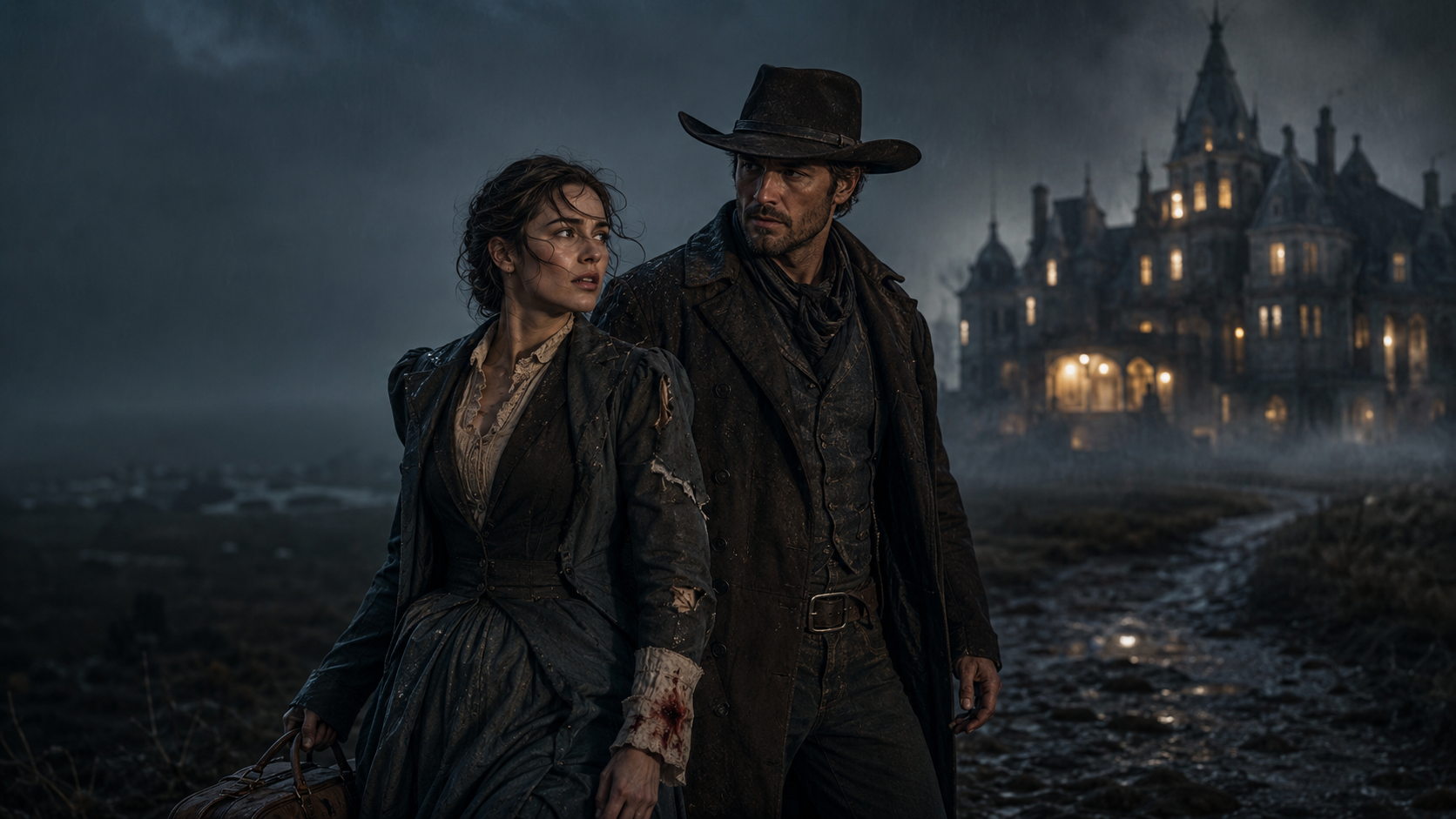
“I know Ashcroft & Vale.”
“My guardian’s firm.”
“They purchased paper on ranches west of Laramie last winter. Quietly. Too quietly. My neighbor lost his place after they called the note early.”
The blood drained from Eleanor’s face. “He knew where I went.”
“Maybe not at first.”
“But now?”
Callum’s jaw tightened.
“Now I expect he does.”
Two days later, a polished carriage rolled through the dust and stopped at the gate of Iron Hollow Ranch.
A man in a gray city suit stepped down, holding a leather portfolio. He introduced himself as Mr. Dorian Pike, legal representative of Victor Ashcroft.
Eleanor’s hands went cold.
Callum stepped between them without touching her.
“My wife doesn’t receive uninvited men.”
Pike smiled. “Your wife is precisely the misunderstanding I have come to correct.”
He produced papers.
So many papers.
A physician’s statement declaring Eleanor mentally unsound. A petition claiming guardianship. An affidavit accusing Callum Rook of coercion, fraud, and exploitation. A notice demanding Eleanor’s return to Blackthorn Hall for her own welfare.
The words blurred.
Pike’s voice became Victor’s voice: smooth, sorrowful, reasonable, deadly.
“Mrs. Rook,” he said, “Mr. Ashcroft is prepared to forgive this regrettable episode if you return without public embarrassment.”
“My name is not Mrs. Rook in your papers,” she said.
Pike paused.
Callum glanced at her.
Eleanor drew a breath.
“And Eleanor Whitcombe is not my name.”
The confession came like stepping off a cliff.
“My name is Lydia Fairborne.”
Pike’s smile sharpened. “A confused woman often clings to invented identities.”
Lydia lifted her chin. “Victor locked me in my room.”
“Mr. Ashcroft protected you from hysteria.”
“He beat me.”
Pike looked at Callum with pity polished like silver. “You see the difficulty.”
Callum moved so fast Pike took a step back.
“Call my wife a liar again,” Callum said quietly, “and you’ll need a softer diet.”
Before Pike could answer, another rider appeared on the ridge.
It was Amos Bell, Callum’s neighbor, a former army scout with patient eyes and a rifle across his saddle. Beside him rode Deputy Marshal Grant Sutter, who had followed after Amos saw the carriage pass.
The deputy read the papers, spat into the dirt, and looked at Pike.
“Massachusetts ink doesn’t give you a rope in Wyoming Territory.”
“She is unstable,” Pike insisted.
“She looks scared,” Sutter said. “Those aren’t the same.”
Pike left with threats.
Threats were something Lydia understood.
They lived longer than men.
That night, Lydia told Callum everything.
She told him about Blackthorn Hall, with its marble stairs and locked nursery wing. She told him how Victor had dismissed her father’s servants after the funeral and replaced them with people who would not meet her eyes. How he had read her letters before she did, then stopped letting letters come at all. How he had made every room smaller without moving a single wall.
She told him about the night she ran.
Victor had announced she would be declared unfit and placed permanently under his care. He had smiled while saying it. He had spoken gently while taking the key from the door. After midnight, Lydia broke the window latch with a fireplace poker, cut her wrist on the glass, climbed down the ivy, and ran with blood soaking her cuff.
Callum listened without interrupting.
When she finished, the fire had burned low.
“There’s something else,” she said.
Callum waited.
“My father spoke once of Western land. I was young, and he thought I wasn’t listening. He said water was worth more than gold if men were foolish enough to look only for gold.”
Callum’s brows drew together.
“What land?”
“I don’t know. Victor said all my father’s investments failed.”
“Men like Ashcroft don’t chase failures across a continent.”
A week later, the bank summoned Callum to Laramie.
Lydia went with him.
The manager would not look at either of them when he explained that Callum’s mortgage had been purchased by an Eastern firm. The full balance was due in thirty days.
“Who bought it?” Callum asked.
The manager swallowed.
Lydia already knew.
“Victor Ashcroft.”
The manager’s silence answered for him.
Outside, wagons rattled along the street. Callum stood motionless, his hat in one hand.
“I’m sorry,” Lydia whispered.
He turned. “For what?”
“He found you because of me.”
“He found me because men like him collect knives and call them opportunities.”
“If I had never answered your advertisement—”
“I would still be in debt. I would still be one bad season from losing Iron Hollow. You didn’t create the weakness. He found it.”
“But I gave him a reason.”
“No,” Callum said. “You gave him a fear.”
They hired a lawyer named Miriam Creed, a widow with sharp eyes and a reputation for making judges uncomfortable. She listened to Lydia’s story, examined the bank notice, and asked one question.