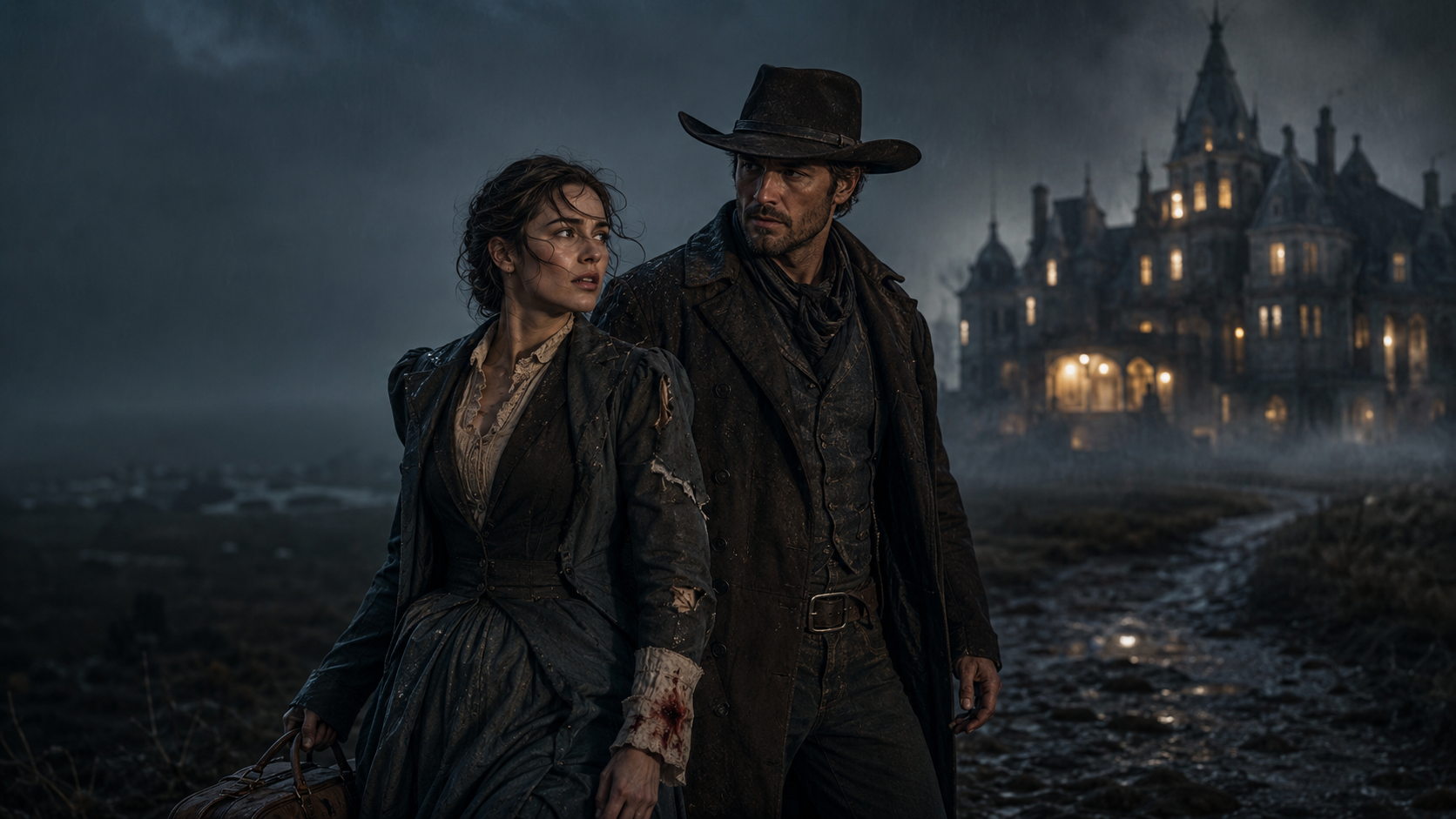
“My parents died when I was nineteen,” she said. “My guardian managed everything after that.”
Callum waited.
“He managed the house. The servants. The accounts. My letters. My visits. My clothes. My sleep.”
Her hand drifted again toward the bloody cuff.
Callum’s voice lowered. “Did he do that?”
She did not ask what he meant.
“Yes.”
The single word sat between them, small and terrible.
“Is he your husband?”
“No.”
“Are you promised to any man?”
“No.”
“Are you accused of a crime?”
She looked startled. “No.”
“Then if you still want to marry me tomorrow, I’ll marry you. If you don’t, I’ll put you on a train to wherever you think is safest and see that you have enough money to get there.”
Suspicion returned quickly. “Why would you do that?”
“Because you’re afraid.”
Her eyes filled before she could turn away.
Not mad. Not difficult. Not wicked. Not ungrateful.
Afraid.
It was the first honest name anyone had given her suffering in years.
“I don’t know how to be a wife,” she whispered.
Callum’s mouth softened. “I don’t know how to be a husband. We may have to learn without pretending.”
They were married the next morning in a small chapel that smelled of damp wood, candle smoke, and old hymnals. Eleanor gave the preacher the false name she had given Callum. Callum heard the hesitation again, but said nothing. He slid a plain ring onto her finger with careful hands.
When the preacher said he might kiss the bride, Eleanor went still as glass.
Callum stepped back.
“Not today,” he said.
The preacher looked confused.
Callum did not explain.
That evening, alone behind the locked door of her room, Eleanor sat on the bed and stared at the ring. It should have felt like another chain. It did not. That frightened her almost more than if it had.
The next morning, Callum bought her boots, wool stockings, gloves, a heavy coat, and a riding skirt. She tried to protest the cost.
“You can’t cross Wyoming in Boston slippers,” he said.
“I am not from Boston,” she said too quickly.
Callum looked at her.
She looked back.
He only nodded. “Then wherever the slippers came from, they won’t last.”
They rode west beneath a sky so wide it made Eleanor dizzy. She had never been taught to ride, so Callum set her behind him and told her where to place her hands, when the horse would move, and how to lean when the trail dipped. He warned her before every shift. He never laughed when she tightened her grip.
By sunset, they reached Iron Hollow Ranch.
It was smaller than she expected.
A cabin stood at the edge of a creek valley, its chimney crooked, its porch uneven, its roof patched in three shades of tin. Behind it rose a barn that looked as if it had survived storms out of spite. Farther off, cottonwoods traced the creek, and beyond them the hills lifted blue and solemn beneath the evening light.
“It’s not much,” Callum said.
Eleanor stepped inside.
The cabin smelled of cedar, smoke, coffee, leather, and sun-warmed wool. There was a table scarred by use, two chairs, shelves of tools, a stove, a narrow bedchamber with a door, and a cot folded near the hearth.
She noticed the door first.
It had a latch on the inside.
Only on the inside.
Her throat tightened.
“It’s beautiful,” she said.
Callum looked at her as though he did not know whether to believe her.
She meant it.
The first month nearly broke her in ordinary ways.
At Blackthorn Hall, she had been taught piano, French, embroidery, and silence. She had not been taught how to milk a cow, bake bread, carry water, mend a harness, chop onions without crying, or walk through mud without losing a boot.
The ranch did not care that she had once eaten from porcelain plates. The stove smoked. The hens escaped. The bread burned black on the bottom and stayed raw in the middle. A brindled cow named Duchess kicked over a bucket and stared at Eleanor with the moral certainty of a bishop.
Callum never laughed unless she laughed first.
When she produced biscuits so hard they made a wooden sound when dropped on the table, he picked one up, examined it, and said, “This one could fix the loose shutter.”
She stared at him in horror.
Then he smiled faintly.
She laughed.
The sound startled them both.
After that, the cabin seemed less afraid of her.
Callum taught her without crowding her. He showed her how to read clouds over the ridge, how to gather eggs without angering the hens, how to hold a knife safely, how to drive nails, how to oil leather, how to saddle a horse, and how to fire a rifle.
She hated the rifle most.
The crack of it tore open memories.
Callum stood several feet away, hands visible, voice calm.
“You decide where the shot goes,” he said. “Not the fear. Not the gun. You.”
On the seventh try, she hit a tin plate nailed to a fence post.
Callum’s smile came slow and quiet. “There you are.”
The praise warmed her.