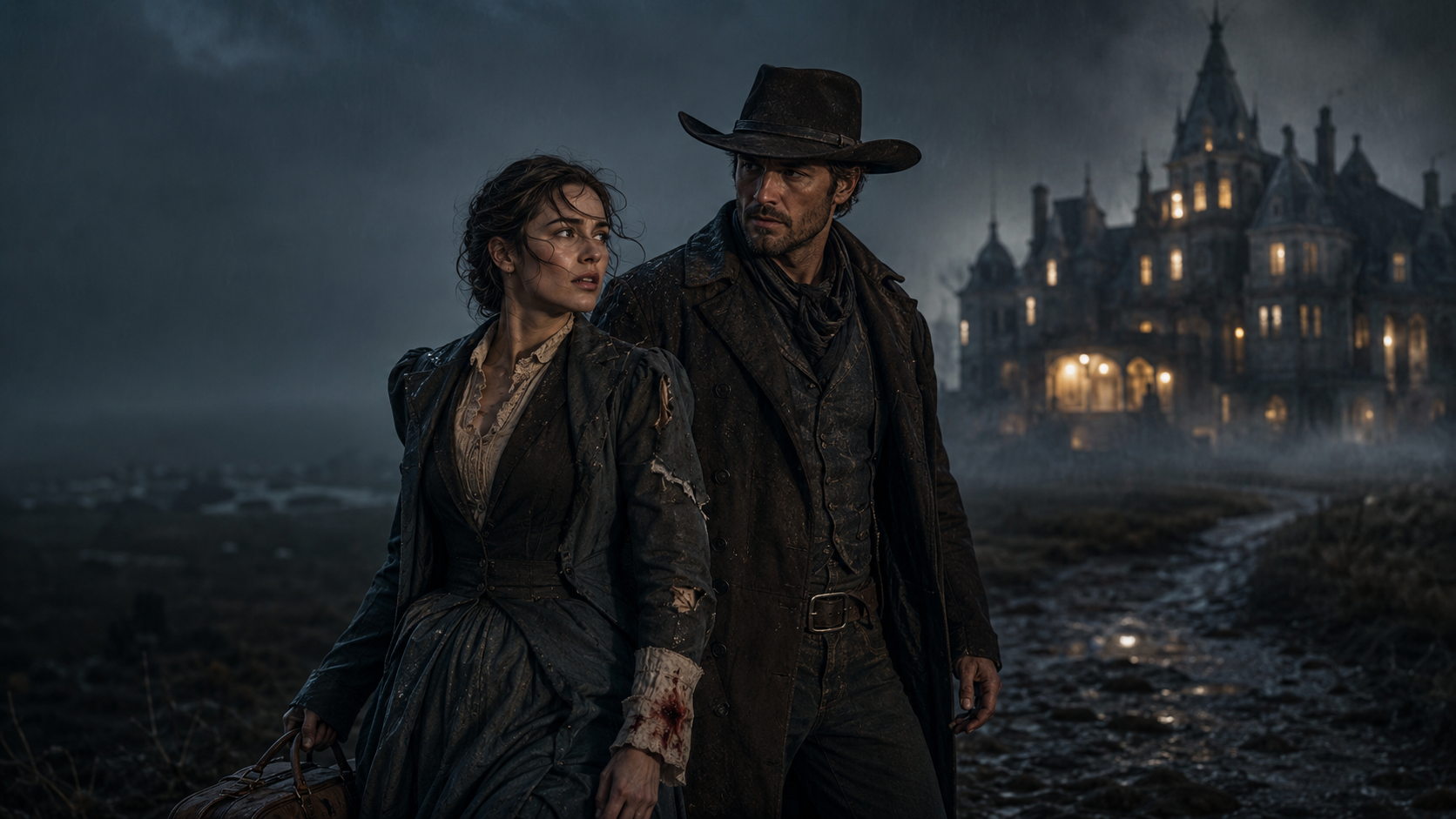
She Escaped Blackthorn Hall With Blood on Her Sleeve—And the Silent Cowboy Knew Why Her Guardian Wanted Her Back

The first thing Callum Rook noticed was not the blood.

It should have been. The stain was dark and dry against the lace cuff of the young woman’s glove, a brown-red smear half-hidden beneath the sleeve of a travel coat that had once been expensive and was now torn at the hem. But Callum had seen blood before. He had seen men bleed in cattle pens, soldiers bleed under winter tents, horses bleed from bad wire and worse hands.

Blood told him something had happened.

Her eyes told him it was not over.

She stood at the far end of the Cheyenne depot with a carpetbag clutched in both hands, her back straight in the way frightened people sometimes stood when they believed dignity was the last thing they owned. Her bonnet was crooked. Rain had loosened brown curls against her temples. Her mouth was pale, but her chin lifted as if she had spent a lifetime being ordered to lower it and had finally run out of obedience.

Callum held the folded newspaper advertisement in one hand.

Wife wanted. Respectable woman of sound character. Must be willing to live on a ranch, work honestly, and begin again. No dowry required. No questions asked unless freely answered.

He had written the last sentence after three attempts and one long night beside a cold stove. It had felt foolish at the time. Now, looking at the woman across the platform, he was glad of it.

She saw him watching her and stepped forward.

“Mr. Rook?”

Her voice was steady only because she was forcing it to be.

“Yes, ma’am.”

“I’m Eleanor Whitcombe.”

That was a lie.

Callum heard it at once. Not because she spoke badly. She spoke too well, with the careful polish of parlors and piano lessons, but the name arrived half a breath late, like a dress borrowed from someone else’s wardrobe.

He did not challenge it.

“Did you come from Boston?”

“I came from a place I do not intend to return to.”

Callum nodded as if that were answer enough.

A porter pushed past with a trunk. Somewhere behind them, a man laughed too loudly. Eleanor flinched before she could stop herself, and Callum saw her fingers tighten around the handle of the carpetbag until her knuckles whitened.

He glanced toward the street.

“There’s a hotel with a dining room two blocks over,” he said. “You look like you could use supper before any big decisions.”

Her eyes sharpened. “I answered your advertisement to marry, not to dine.”

“That doesn’t mean you have to be hungry while doing it.”

She stared at him as though kindness were a trap whose mechanism she had not yet located.

“I have very little money.”

“I didn’t ask you to buy the meal.”

Her mouth trembled once, quickly. “And what do you ask for in return?”

Callum was quiet for a moment.

“Nothing tonight,” he said. “Nothing you don’t offer. Nothing you don’t understand.”

The words seemed to strike her harder than a demand would have. She looked down at her cuff then turned it inward, hiding the stain.

Too late.

Callum had already seen it.

He took a step back and lifted his hand toward her bag, but stopped before touching it. “May I carry that?”

She blinked.

No one, he guessed, had asked her permission about small things in a long while.

After a pause, she handed it over.

At the hotel, the clerk looked from Eleanor’s torn sleeve to Callum’s dust-colored coat and made the mistake of smirking.

“One room?”

“Two,” Callum said.

The clerk’s eyebrows lifted. “For a man and his intended wife?”

“For two people.”

The smile slipped. “That’ll cost more.”

Callum placed coins on the counter. “Then count slowly, so you get it right.”

Eleanor stood beside him, silent. She did not look grateful. Gratitude would have been too simple. She looked stunned, and then suspicious of being stunned.

In the dining room, she managed three spoonfuls of stew and half a slice of bread before setting down her spoon.

Callum did not urge her to eat. He took his own meal slowly, letting the clink of dishes and low voices fill the space between them.

At last, she said, “Why did you put an advertisement in an Eastern paper?”

“Because I own three hundred cattle, two bad-tempered mules, one roof that leaks over the bed, and a ranch that listens better than it answers.”

Despite herself, she looked at him.

“That is your reason?”

“It’s the honest one.”

“I thought Western men wanted wives for cooking, washing, and sons.”

“Some do.”

“And you?”

Callum turned his coffee cup with one finger. “I wanted someone who wanted a place badly enough to help make it one. I wanted a partner. Maybe that sounds grander than I deserve, but there it is.”

She studied him for a long time.

“You are either a good man,” she said softly, “or a very practiced liar.”

“Both are possible, I suppose.”

That almost made her smile.

Almost.

Then she looked toward the window, where rain slid down the glass like black thread.

“My parents died when I was nineteen,” she said. “My guardian managed everything after that.”

Callum waited.

“He managed the house. The servants. The accounts. My letters. My visits. My clothes. My sleep.”

Her hand drifted again toward the bloody cuff.

Callum’s voice lowered. “Did he do that?”

She did not ask what he meant.

“Yes.”

The single word sat between them, small and terrible.

“Is he your husband?”

“No.”

“Are you promised to any man?”

“No.”

“Are you accused of a crime?”

She looked startled. “No.”

“Then if you still want to marry me tomorrow, I’ll marry you. If you don’t, I’ll put you on a train to wherever you think is safest and see that you have enough money to get there.”

Suspicion returned quickly. “Why would you do that?”

“Because you’re afraid.”

Her eyes filled before she could turn away.

Not mad. Not difficult. Not wicked. Not ungrateful.

Afraid.

It was the first honest name anyone had given her suffering in years.

“I don’t know how to be a wife,” she whispered.

Callum’s mouth softened. “I don’t know how to be a husband. We may have to learn without pretending.”

They were married the next morning in a small chapel that smelled of damp wood, candle smoke, and old hymnals. Eleanor gave the preacher the false name she had given Callum. Callum heard the hesitation again, but said nothing. He slid a plain ring onto her finger with careful hands.

When the preacher said he might kiss the bride, Eleanor went still as glass.

Callum stepped back.

“Not today,” he said.

The preacher looked confused.

Callum did not explain.

That evening, alone behind the locked door of her room, Eleanor sat on the bed and stared at the ring. It should have felt like another chain. It did not. That frightened her almost more than if it had.

The next morning, Callum bought her boots, wool stockings, gloves, a heavy coat, and a riding skirt. She tried to protest the cost.

“You can’t cross Wyoming in Boston slippers,” he said.

“I am not from Boston,” she said too quickly.

Callum looked at her.

She looked back.

He only nodded. “Then wherever the slippers came from, they won’t last.”

They rode west beneath a sky so wide it made Eleanor dizzy. She had never been taught to ride, so Callum set her behind him and told her where to place her hands, when the horse would move, and how to lean when the trail dipped. He warned her before every shift. He never laughed when she tightened her grip.

By sunset, they reached Iron Hollow Ranch.

It was smaller than she expected.

A cabin stood at the edge of a creek valley, its chimney crooked, its porch uneven, its roof patched in three shades of tin. Behind it rose a barn that looked as if it had survived storms out of spite. Farther off, cottonwoods traced the creek, and beyond them the hills lifted blue and solemn beneath the evening light.

“It’s not much,” Callum said.

Eleanor stepped inside.

The cabin smelled of cedar, smoke, coffee, leather, and sun-warmed wool. There was a table scarred by use, two chairs, shelves of tools, a stove, a narrow bedchamber with a door, and a cot folded near the hearth.

She noticed the door first.

It had a latch on the inside.

Only on the inside.

Her throat tightened.

“It’s beautiful,” she said.

Callum looked at her as though he did not know whether to believe her.

She meant it.

The first month nearly broke her in ordinary ways.

At Blackthorn Hall, she had been taught piano, French, embroidery, and silence. She had not been taught how to milk a cow, bake bread, carry water, mend a harness, chop onions without crying, or walk through mud without losing a boot.

The ranch did not care that she had once eaten from porcelain plates. The stove smoked. The hens escaped. The bread burned black on the bottom and stayed raw in the middle. A brindled cow named Duchess kicked over a bucket and stared at Eleanor with the moral certainty of a bishop.

Callum never laughed unless she laughed first.

When she produced biscuits so hard they made a wooden sound when dropped on the table, he picked one up, examined it, and said, “This one could fix the loose shutter.”

She stared at him in horror.

Then he smiled faintly.

She laughed.

The sound startled them both.

After that, the cabin seemed less afraid of her.

Callum taught her without crowding her. He showed her how to read clouds over the ridge, how to gather eggs without angering the hens, how to hold a knife safely, how to drive nails, how to oil leather, how to saddle a horse, and how to fire a rifle.

She hated the rifle most.

The crack of it tore open memories.

Callum stood several feet away, hands visible, voice calm.

“You decide where the shot goes,” he said. “Not the fear. Not the gun. You.”

On the seventh try, she hit a tin plate nailed to a fence post.

Callum’s smile came slow and quiet. “There you are.”

The praise warmed her.

Then frightened her.

Kindness had always been a beginning before. Men in fine houses had kind voices when servants were listening. Her guardian had called his cruelties concern. He had sent flowers after bruises, books after locked doors, apologies wrapped around threats. Eleanor had learned that gentleness could be bait.

So she waited for Callum to become someone else.

He did not.

He slept on the cot. He knocked before entering the bedchamber. He did not touch her waist when passing behind her. He did not ask why she woke shaking. He never demanded the true name she kept folded behind her teeth.

One night in late spring, a storm rolled over Iron Hollow like a black wagon.

Callum rode out before dusk to bring in two calves from the lower pasture. By dark, he had not returned.

Eleanor stood on the porch with rain blowing sideways into her face. She told herself he knew the land. She told herself to stay inside. She told herself she was no use in a storm.

Then she heard a calf crying near the creek.

She took the rifle.

The ground sucked at her boots. Lightning opened the hills in white flashes. She found Callum half in the water, one arm locked around a calf tangled in broken wire. Blood ran from a cut near his hairline.

“Go back!” he shouted.

“No.”

His head turned sharply.

The old Eleanor would have obeyed. The old Eleanor would have apologized for disobeying before she had even chosen.

This woman slid down the bank, dropped to her knees in the mud, and grabbed the calf’s head before it thrashed into Callum’s injured shoulder.

“Tell me what to do.”

For half a second, he stared at her.

Then he handed her his knife.

“Cut there. Away from the leg. Slow.”

Her hands shook, but she cut. Rain blinded her. The calf kicked, pain shot up her wrist, and Callum swore under his breath. She kept cutting until the wire snapped free.

When the calf stumbled away, Callum tried to rise and nearly fell.

Eleanor caught him.

He was heavier than she expected, but she held.

Back at the cabin, she cleaned the cut at his temple with boiled water and cloth. Her hands moved with practiced skill before she realized he was watching.

“You’ve done that before,” he said.

She looked at the reddened cloth.

“Yes.”

He waited.

“My guardian did not allow doctors to see what he called discipline.”

Callum closed his eyes.

For one wild moment, she thought he might strike the table, curse, demand names and details. Men always wanted their anger to be the loudest thing in the room.

Callum only said, “I’m sorry.”

The simplicity of it undid her.

She did not sob. She did not collapse. Tears only slipped down her face silently while the storm hammered the roof.

Callum reached toward her, then stopped.

“May I?”

She knew what he was asking.

After a long moment, she nodded.

He took her hand between both of his and held it as if it were something breakable and worth keeping.

Nothing more.

By midsummer, Eleanor could drive the wagon to the far pasture. She could bake bread that rose, more often than not. She knew which horse would nip, which hinge screamed in dry weather, and which floorboard near the stove complained under weight. She knew Callum hummed when mending tack and went quiet when worried.

She also knew he was in debt.

She discovered it when a letter came from the bank in Laramie. Callum read it once, folded it, and slipped it into his pocket.

His face changed.

Not much.

Enough.

“How bad?” she asked.

He looked up.

For a moment, she saw him consider lying kindly.

Then he sighed.

“Bad.”

“Tell me.”

“The ranch is mortgaged. Winter was hard. Cattle prices are worse. I thought I had until October.”

“And now?”

“Now the bank has remembered I exist.”

“How much?”

He gave the number.

To Eleanor, raised among fortunes and locked cabinets, it was not impossible money. To Callum, it might as well have been a mountain.

“Why didn’t you tell me before we married?” she asked.

Shame crossed his face. “Because I didn’t want you thinking I put that advertisement in the paper looking for a purse.”

“Did you?”

His answer was immediate. “No.”

Then, softer, “No, Eleanor. I wanted a partner. I wanted another voice at the table. I wanted to stop coming home to a house that sounded like it was waiting for me to die. I should have told you about the debt. But I did not marry you for money.”

She believed him.

That was its own terror.

Because once you believed someone, they had the power to become another disappointment.

“My father left money,” she said slowly. “Property, perhaps. I was never allowed to see the accounts.”

“Your guardian kept them?”

“Yes.”

“What is his name?”

Her breath caught.

Callum saw it.

“You don’t have to answer now.”

She looked at the fire.

“Victor Ashcroft.”

The name changed the room.

Callum went still.

Eleanor turned toward him. “You know it.”

“I know Ashcroft & Vale.”

“My guardian’s firm.”

“They purchased paper on ranches west of Laramie last winter. Quietly. Too quietly. My neighbor lost his place after they called the note early.”

The blood drained from Eleanor’s face. “He knew where I went.”

“Maybe not at first.”

“But now?”

Callum’s jaw tightened.

“Now I expect he does.”

Two days later, a polished carriage rolled through the dust and stopped at the gate of Iron Hollow Ranch.

A man in a gray city suit stepped down, holding a leather portfolio. He introduced himself as Mr. Dorian Pike, legal representative of Victor Ashcroft.

Eleanor’s hands went cold.

Callum stepped between them without touching her.

“My wife doesn’t receive uninvited men.”

Pike smiled. “Your wife is precisely the misunderstanding I have come to correct.”

He produced papers.

So many papers.

A physician’s statement declaring Eleanor mentally unsound. A petition claiming guardianship. An affidavit accusing Callum Rook of coercion, fraud, and exploitation. A notice demanding Eleanor’s return to Blackthorn Hall for her own welfare.

The words blurred.

Pike’s voice became Victor’s voice: smooth, sorrowful, reasonable, deadly.

“Mrs. Rook,” he said, “Mr. Ashcroft is prepared to forgive this regrettable episode if you return without public embarrassment.”

“My name is not Mrs. Rook in your papers,” she said.

Pike paused.

Callum glanced at her.

Eleanor drew a breath.

“And Eleanor Whitcombe is not my name.”

The confession came like stepping off a cliff.

“My name is Lydia Fairborne.”

Pike’s smile sharpened. “A confused woman often clings to invented identities.”

Lydia lifted her chin. “Victor locked me in my room.”

“Mr. Ashcroft protected you from hysteria.”

“He beat me.”

Pike looked at Callum with pity polished like silver. “You see the difficulty.”

Callum moved so fast Pike took a step back.

“Call my wife a liar again,” Callum said quietly, “and you’ll need a softer diet.”

Before Pike could answer, another rider appeared on the ridge.

It was Amos Bell, Callum’s neighbor, a former army scout with patient eyes and a rifle across his saddle. Beside him rode Deputy Marshal Grant Sutter, who had followed after Amos saw the carriage pass.

The deputy read the papers, spat into the dirt, and looked at Pike.

“Massachusetts ink doesn’t give you a rope in Wyoming Territory.”

“She is unstable,” Pike insisted.

“She looks scared,” Sutter said. “Those aren’t the same.”

Pike left with threats.

Threats were something Lydia understood.

They lived longer than men.

That night, Lydia told Callum everything.

She told him about Blackthorn Hall, with its marble stairs and locked nursery wing. She told him how Victor had dismissed her father’s servants after the funeral and replaced them with people who would not meet her eyes. How he had read her letters before she did, then stopped letting letters come at all. How he had made every room smaller without moving a single wall.

She told him about the night she ran.

Victor had announced she would be declared unfit and placed permanently under his care. He had smiled while saying it. He had spoken gently while taking the key from the door. After midnight, Lydia broke the window latch with a fireplace poker, cut her wrist on the glass, climbed down the ivy, and ran with blood soaking her cuff.

Callum listened without interrupting.

When she finished, the fire had burned low.

“There’s something else,” she said.

Callum waited.

“My father spoke once of Western land. I was young, and he thought I wasn’t listening. He said water was worth more than gold if men were foolish enough to look only for gold.”

Callum’s brows drew together.

“What land?”

“I don’t know. Victor said all my father’s investments failed.”

“Men like Ashcroft don’t chase failures across a continent.”

A week later, the bank summoned Callum to Laramie.

Lydia went with him.

The manager would not look at either of them when he explained that Callum’s mortgage had been purchased by an Eastern firm. The full balance was due in thirty days.

“Who bought it?” Callum asked.

The manager swallowed.

Lydia already knew.

“Victor Ashcroft.”

The manager’s silence answered for him.

Outside, wagons rattled along the street. Callum stood motionless, his hat in one hand.

“I’m sorry,” Lydia whispered.

He turned. “For what?”

“He found you because of me.”

“He found me because men like him collect knives and call them opportunities.”

“If I had never answered your advertisement—”

“I would still be in debt. I would still be one bad season from losing Iron Hollow. You didn’t create the weakness. He found it.”

“But I gave him a reason.”

“No,” Callum said. “You gave him a fear.”

They hired a lawyer named Miriam Creed, a widow with sharp eyes and a reputation for making judges uncomfortable. She listened to Lydia’s story, examined the bank notice, and asked one question.

“Do you have any document from your father? A will, a Bible, a deed, letters, a family box?”

Lydia thought of Blackthorn Hall.

“My mother kept a rosewood case in the library cabinet. Victor kept it locked after she died. He said it contained sentimental things.”

Miriam’s mouth thinned. “Men who steal often keep proof near them. They like to look at what they think no one else can touch.”

Callum said, “No.”

Lydia looked at him. “I haven’t said anything yet.”

“You’re thinking of going back.”

“If the proof is there—”

“No.”

The word struck old bruises.

Lydia rose from her chair. “Do not tell me no as if I belong to you.”

Regret crossed his face at once.

“You’re right,” he said. “I’m sorry.”

She stood very still.

“I meant I’m afraid,” he continued. “I can face a man at my gate. I can ride into weather. I can take a beating if I have to. But I don’t know how to protect you from a house that already knows where every lock belongs.”

Her anger softened, but did not vanish.

“Maybe this time,” she said, “I am not asking you to protect me. Maybe I am asking you to stand where I can see you while I protect myself.”

Three days later, they boarded an eastbound train.

Miriam went with them. Amos Bell came too, claiming he had always wanted to see Boston and had never yet regretted carrying a rifle near rich men.

The journey east felt different from Lydia’s flight west. Fear still traveled with her, but it no longer held the ticket. Callum sat across from her, quiet and present, making no promises he could not keep.

Blackthorn Hall looked smaller than it had in her nightmares.

That nearly broke her.

She had imagined it rising monstrous against the sky. Instead, it was only stone, iron, glass, and money. A house. A thing built by men. A thing that could be entered. A thing that could be left.

Miriam had chosen their arrival carefully.

Victor Ashcroft was hosting a charity dinner for the Ladies’ Reform Committee, which meant the hall was full of witnesses polished in jewels and hypocrisy. Lydia entered through the front door on Callum’s arm, Miriam behind her with a leather case, Amos behind them with a stare that made footmen reconsider their loyalties.

Conversation died in pieces.

Victor stood near the grand staircase with a glass of wine in his hand.

For the first time in Lydia’s life, she saw him surprised.

Then the mask returned.

“My dear girl,” he said. “Had you written, I would have prepared your room.”

“No more locked rooms,” Lydia said.

A woman gasped.

Victor’s smile thinned. “You hear her. Still dramatic. Still unwell.”

Miriam stepped forward. “Mrs. Rook is well enough to file claims of unlawful confinement, theft of inheritance, medical fraud, and attempted abduction across territorial lines.”

Victor looked at Miriam as if a chair had begun speaking.

“And you are?”

“The woman who brought paper sharper than your teeth.”

Callum almost smiled.

Lydia did not wait for permission.

She crossed the hall toward the library. Every step dragged memory behind it. Here, Victor had gripped her arm hard enough to bruise. There, he had told guests she was resting while she was locked upstairs without supper. At that desk, he had made her sign letters he never sent.

Her hand shook when she opened the cabinet.

The rosewood case was there.

Victor moved.

Callum moved faster, placing himself in the doorway.

“This is my house,” Victor said.

“And that was her mother’s,” Callum answered.

Lydia took the case.

The key was gone, but Amos handed her a small iron tool. One twist broke the lock.

Inside lay pearls, a miniature portrait, a bundle of letters, and a prayer book bound in blue leather. Beneath the lining, Lydia felt a ridge.

Miriam took a knife and slit the velvet seam.

A packet of papers slid free.

The room seemed to stop breathing.

Miriam unfolded the first document.

Her eyes sharpened.

“Well,” she said softly. “There you are.”

“What is it?” Lydia asked.

Miriam looked at Victor.

“A deed. A codicil. And an accounting ledger your guardian should have burned if he were half as clever as he thinks.”

Victor’s face went white.

Miriam’s voice carried now, clear enough for every guest to hear.

“Your father did not lose his Western investments. He placed them in trust. Upon your marriage or your twenty-fifth birthday, control passed to you directly. Not to Mr. Ashcroft. The property includes the valley surrounding Iron Hollow Ranch, the water rights to its creek, and a surveyed rail passage.”

Lydia stared at the papers.

Callum stared at Lydia.

Victor stared at the ruined lock.

Miriam continued. “Mr. Ashcroft has been collecting income on land he did not own, suppressing title documents, and attempting to acquire debt attached to improvements built on Mrs. Rook’s property.”

“Lies,” Victor said.

But the word came too fast.

Too frightened.

Lydia understood then.

Victor had not chased her only because she had escaped him. He had chased her because marriage had made her dangerous. Her signature could open ledgers. Her name could expose him. Her freedom could ruin him.

Iron Hollow was not only Callum’s home.

It was her inheritance.

Victor lunged for the papers.

Lydia stepped back, but he caught her wrist.

For one terrible second, she was nineteen again, trapped between a desk and a locked door while Victor explained that pain was instruction.

Then Callum’s hand closed around Victor’s arm.

“Let go of my wife.”

Victor’s civilized face cracked.

“She is mine.”

Silence fell so hard it seemed to break the chandelier light.

Lydia pulled her wrist free.

“No,” she said.

One word.

Clear.

Steady.

Final.

“I was never yours. Not as a child. Not as a ward. Not as a woman. Not as a line in your ledger. You stole from me because you believed fear would make me small enough to keep.”

Her voice trembled, but did not fail.

“You were wrong.”

Miriam had arranged the final blow before entering the house. A federal marshal waited in the hall. The papers went into his hands. Victor tried outrage first, then dignity, then denial. None survived contact with ink, witnesses, and numbers.

The physician who had signed Lydia’s false diagnosis turned gray and asked for counsel.

The bank letters tied Victor to the attempt to seize Iron Hollow.

The hidden ledger showed years of theft.

As the marshal took him away, Victor looked back at Lydia.

“You think that cowboy loves you?” he spat. “He’ll love the land more.”

Lydia looked at Callum.

His eyes were not on the deed. They were on the red mark Victor’s fingers had left around her wrist.

“No,” she said quietly. “He taught me the difference.”

They stayed in Boston long enough to bury the legal ghosts.

Miriam filed petitions until clerks groaned at the sight of her. The trust passed to Lydia. The mortgage demand vanished. Blackthorn Hall was sold, not because Lydia needed money, but because she refused to let it stand as a monument to fear.

Before leaving, she stood alone in her old bedroom.

The broken window latch had been replaced. The curtains were clean. The wallpaper was the same pale green. The bed was made. The room looked harmless.

That was the cruelest part.

Bad places did not always look bad.

Sometimes they had polished floors, silver tea sets, and neighbors who praised the man holding the key.

Callum appeared at the threshold but did not enter.

“You all right?”

Lydia looked at the window.

“I used to think escape meant never being afraid again.”

“And now?”

“Now I think it means being afraid and opening the door anyway.”

Callum nodded.

She crossed the room and took his hand.

“Take me home.”

They returned to Wyoming when the cottonwoods had turned gold along the creek. Iron Hollow looked the same and not the same. The barn still leaned. The porch still complained. Duchess the cow still treated Lydia’s absence as a personal insult.

Legally, the land was hers.

In practice, they made it theirs.

Lydia paid the debts. Callum insisted on a written partnership agreement, drafted by Miriam before they left Boston. His cattle remained his. Her land remained hers. Decisions required both names.

“Very romantic,” Lydia said when he laid the agreement on the kitchen table.

“Very necessary,” Callum replied.

She read every line.

Then she signed.

Winter came early. By then, Lydia could saddle her own horse, split kindling, bake bread worth eating, read accounts without flinching, and shoot a bottle from a fence post when Amos’s nephews needed humbling.

She still woke from nightmares.

On those mornings, Callum never told her to forget. He lit the stove, made coffee, and sat nearby until the room remembered it was safe.

In spring, they took in the first woman.

She arrived from a mining camp with a split lip and two children asleep in a wagon. Lydia gave her soup, a bed, and work if she wanted it. Then came a widow whose brother wanted her land. Then a schoolteacher ruined by gossip after refusing a banker’s son. Then a girl who had stolen her own wages back from an employer who called theft justice.

Iron Hollow became known for good horses, strong coffee, and doors that locked only from the inside.

One evening, a year after Lydia had arrived with blood on her cuff, she stood on the porch watching Callum mend a bridle in the low gold light.

He looked up.

“What?”

“I’m trying to understand you.”

“Any progress?”

“Some.”

“And?”

“You are stubborn. Too quiet when you’re hurt. Bad at admitting fear. Certain that coffee should taste like burned rope. You pretend not to be tender because tenderness embarrasses you.”

“That all?”

“No.”

She stepped down from the porch and crossed to him.

“You are also the first man who made staying feel like a choice.”

The humor left his face.

“Lydia.”

She took his hand.

For a long time, Callum had waited for her to decide what closeness meant. He had never made patience sound noble. He had never treated restraint as a debt she owed him. In that quiet space, love had grown without being forced to bloom before it had roots.

Now she gave it a name.

“I love you,” she said. “Not because you saved me. Because you stood beside me until I remembered I could save myself.”

Callum’s eyes shone in the fading light.

“I love you,” he said. “Not because of the land. Not because of what you brought here. Because the first day you saw this half-broken place, you called it beautiful.”

“It was more than half broken.”

“It had character.”

“It had mice.”

“Respectable mice.”

She laughed, and he pulled her close only after she leaned toward him first.

The kiss was gentle. Unhurried. Nothing like a claim.

Behind them, lamplight glowed in the cabin window. In the lower pasture, cattle moved like shadows through the grass. The world remained dangerous, unfair, and full of men who called control protection and law whatever served them.

But Lydia no longer measured freedom by distance from Blackthorn Hall.

Freedom was the porch beneath her boots. The ring on her finger that had become a promise instead of a shackle. The ledgers she read for herself. The rifle she knew how to use and hoped not to. The women sleeping safely under her roof. The man beside her, holding her as if love meant shelter, never ownership.

Once, she had escaped through a broken window with blood on her sleeve and terror in her throat.

Now she opened her own front door whenever she pleased.

And every time she did, the wide Wyoming sky was waiting.

She Escaped Blackthorn Hall With Blood on Her Sleeve—And the Silent Cowboy Knew Why Her Guardian Wanted Her Back
A mother and her nine-month-old daughter were tragically killed in an accident, after which the grandmother noticed something that gave her goosebumps