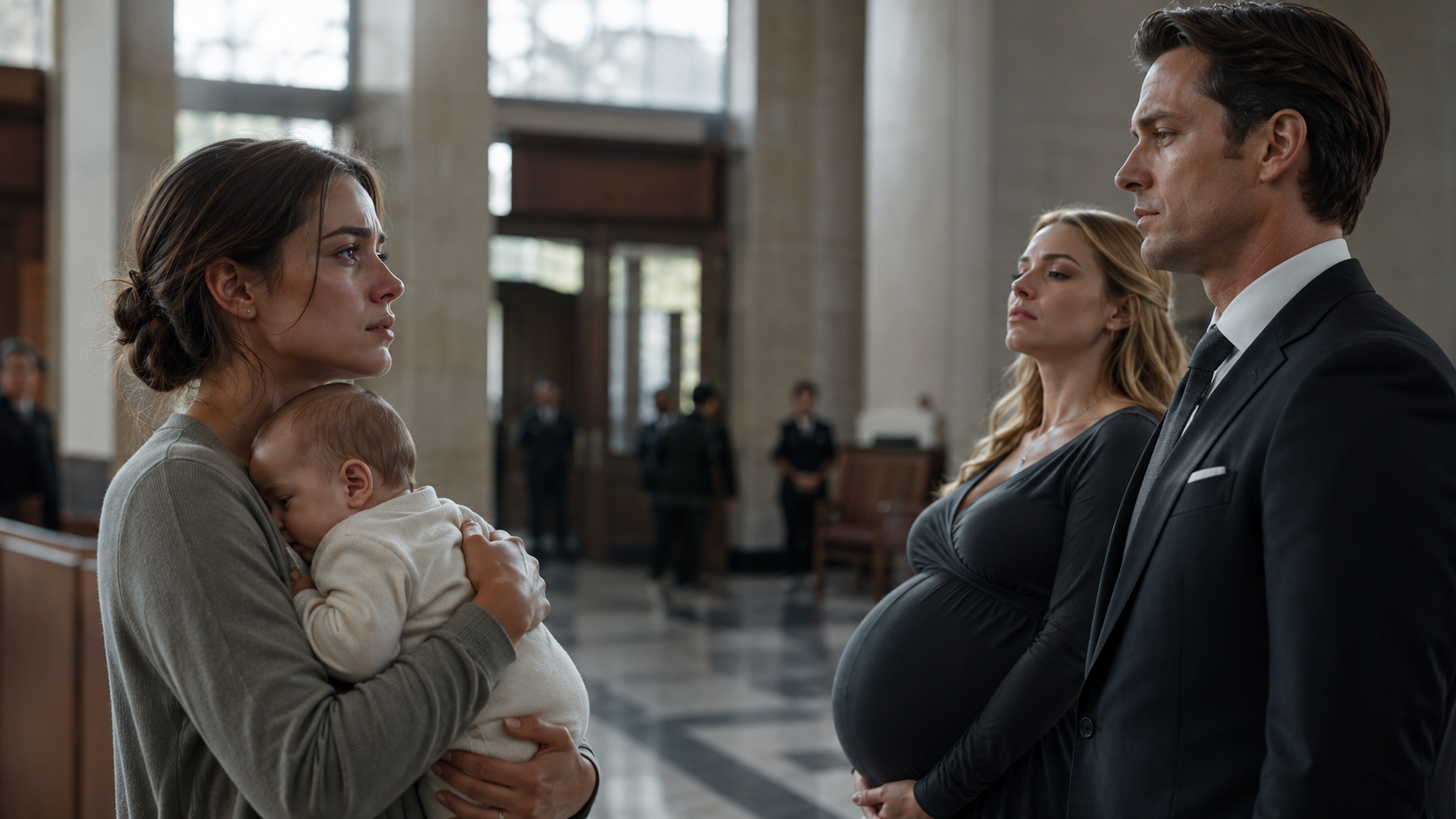
Judge Morris’s voice was low.
“Temporary sole custody remains with Mrs. Voss. Mr. Voss’s visitation will continue under supervision. The court will appoint a guardian ad litem. Mr. Voss is ordered to submit complete financial disclosures within seven days. Any further attempt to influence witnesses or fabricate evidence will be referred for appropriate sanctions.”
Callum stared at Ava as if she had done this to him.
For years, she might have accepted that look as truth.
Now she understood it as habit.
After the hearing, Margaret waited near the elevators.
She was not crying this time.
“You have destroyed my son,” she said.
Ava shifted Theo higher against her shoulder.
“No,” Ava said. “I stopped letting him use me as a place to hide.”
Margaret’s face twisted.
“You think any man will want you now? A divorced mother with a baby?”
Ava smiled then.
It surprised both of them.
“I’m not here to be wanted,” she said. “I’m here to be free.”
The elevator doors opened.
Ava stepped inside.
For the first time since Theo’s birth, she did not feel like she was escaping.
She felt like she was leaving.
The divorce took ten months.
Callum fought every inch until fighting became too expensive. His company collapsed under audits and lawsuits. His investors discovered the missing money before Ava ever had to say a word publicly. The image he had protected so fiercely shattered without her help.
Elise gave birth to a daughter in late autumn.
Ava heard through Meredith that Elise had filed her own support action and refused to let Callum use the baby as leverage. Ava did not celebrate. Pain was not a competition, and freedom did not require another woman’s suffering.
But she did save one final message Elise sent through her attorney.
You were right. He uses children like doors he thinks he can unlock.
Ava did not reply.
Some truths did not need conversation.
By spring, Ava moved into a smaller house with yellow kitchen walls, a fenced backyard, and morning light that poured across the nursery floor. It was not grand. It did not impress anyone. It had secondhand furniture, mismatched mugs, and a front door only she had keys to.
Theo learned to roll over on a quilt Ava’s grandmother had sewn.
He laughed for the first time at the sound of rain tapping the window.
He grew two tiny teeth.
Callum saw him twice a week under supervision and complained through lawyers that the arrangement was humiliating.
Ava did not care.
Humiliation was being abandoned in labor and told to be grateful for flowers.
Humiliation was listening to strangers debate whether your tears made you dangerous.
Humiliation was being treated like a temporary obstacle between a man and money.
This was not humiliation.
This was consequence.
On Theo’s first birthday, Ava invited only people who had loved them without conditions.
Meredith came and brought a wooden train.
Nurse Priya came with a knitted blue hat.
Ava’s mother sat near the window, stronger now, holding Theo while he smashed cake into his own hair.
There were no grand speeches.
No dramatic announcements.
No expensive decorations meant for photographs.
Just a child laughing in a sunlit kitchen while the women who had helped protect him drank coffee and told stories.
Later that evening, after everyone left, Ava carried Theo to the porch.
The sky was turning pink over the rooftops.
Theo rested his sticky cheek against her shoulder.
Ava thought of the courthouse: the cold floors, the sharp voices, the paper sliding toward her like a sentence.
Sign it.
Stop being difficult.
You are not thinking clearly.
She had been thinking clearly.
Clearer than she ever had.
Because the day Callum tried to take her son was the day Ava finally understood that peace was not the absence of conflict.
Peace was a locked door.
A safe crib.
A bank account no one could drain.
A child who would grow up never watching his mother apologize for surviving.
Ava kissed Theo’s hair.
Behind her, the little yellow house glowed with warm light.
In her arms, her son slept without fear.
And for the first time in a long time, so did she.