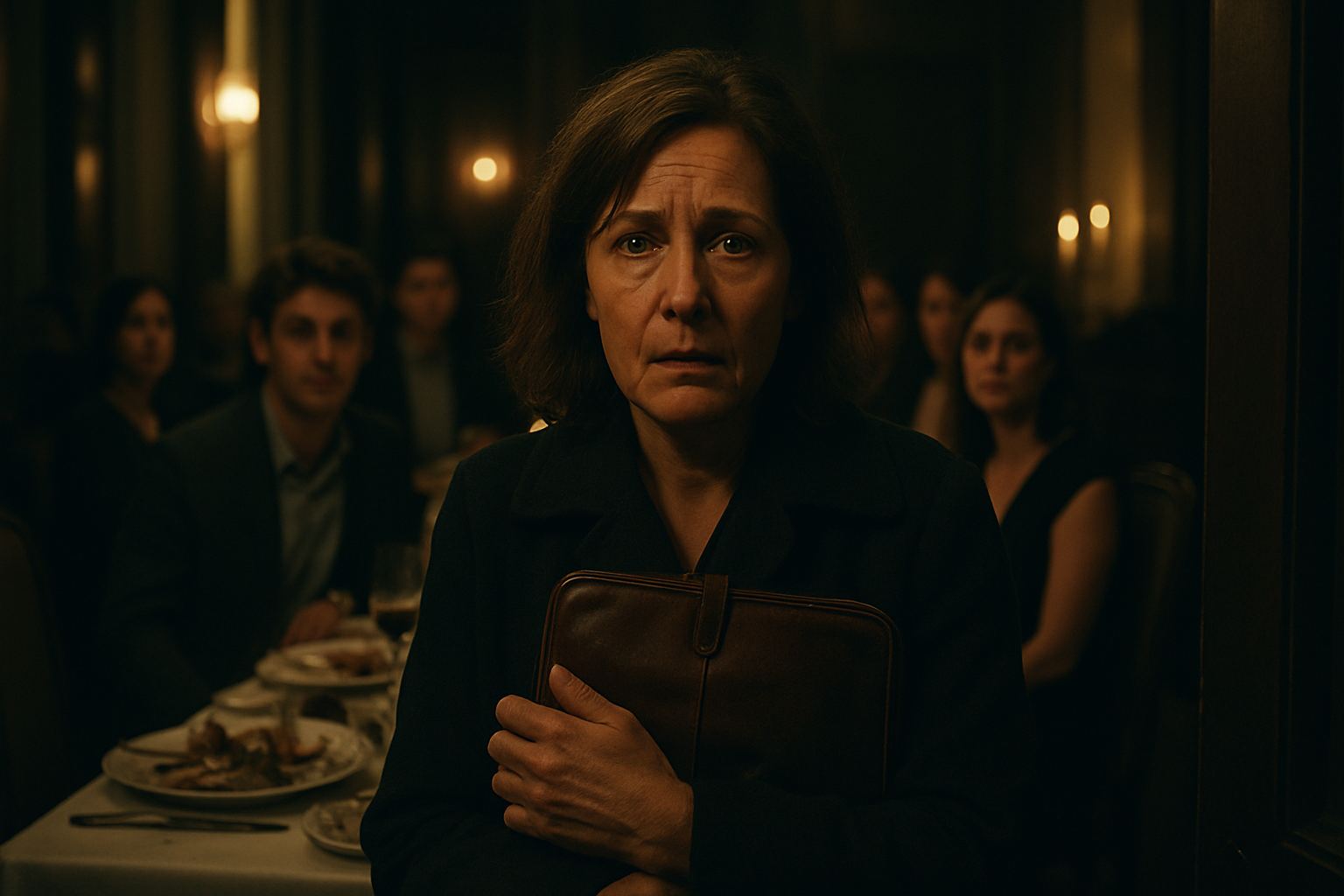
It declined.
Celeste whispered, “Daniel.”
He did not look at her.
Julian spoke gently. “Would anyone else at the table like to provide payment?”
For the first time all night, the people who had laughed at Evelyn found their laps very interesting.
At last, Gloria paid half. Celeste’s aunt covered another part. The cousins scraped together the rest.
Daniel stood there, humiliated, while the people he had tried to impress paid for the meal he had used to shame his mother.
Evelyn did not enjoy it.
That surprised her.
She had thought revenge would taste sweet.
Instead, it tasted like grief with sharper edges.
When the bill was finally settled, Celeste leaned close and whispered, “You just lost your son.”
Evelyn looked at Daniel.
Pale. Silent. Motionless.
Then she looked back at Celeste.
“No,” she said quietly. “I lost him years ago. Tonight, I stopped paying for the funeral.”
Celeste recoiled as if slapped.
Evelyn stood and picked up her notebook.
Julian walked her to the entrance.
At the door, he said, “Would you like someone to walk you to your car?”
Evelyn glanced back.
Celeste was arguing with her mother. Daniel stood frozen. The others were hurrying out, desperate to escape the humiliation they had enjoyed until it turned on them.
“No,” Evelyn said. “I’m not afraid of them anymore.”
Outside, the Charleston night was warm and damp. Streetlights glowed on the restaurant windows.
Evelyn sat in her car and finally let her hands tremble.
Her phone buzzed before she started the engine.
Daniel.
She let it ring.
Then the texts came.
Mom, we need to talk.
You humiliated me.
Celeste is crying.
That was not the way to handle it.
Evelyn stared at the screen.
For almost forty years, every crisis in Daniel’s life had become hers. Bad grades. Lost jobs. Failed investments. Marital fights. Credit card debt. Forgotten birthdays.
Even his cruelty arrived at her door expecting dinner and forgiveness.
This time, she typed one sentence.
Call me when you are ready to tell the truth.
Then she turned off the phone.
The next morning, Evelyn went to the bank.
Not the branch Daniel knew. Not the one near his house.
She went downtown, where her longtime financial adviser, Maribel Sloan, met her in a private office with black coffee and a folder waiting.
“I reviewed the documents you sent,” Maribel said. “Evelyn, this is serious.”
“I know.”
“Your signature was forged on at least two applications. Possibly three. Someone tried to use your assets as implied collateral.”
“My daughter-in-law?”
“Her company submitted the paperwork. But Daniel’s email appears in the chain.”
Evelyn closed her eyes.
There are betrayals a woman expects from strangers. There are betrayals she fears from lovers.
But when betrayal comes in the voice of your child, something ancient inside you refuses to believe it.
“You need an attorney,” Maribel said.
“I have one.”
Evelyn had called him before the dinner.
Whitaker Bell was a quiet elder-law and financial fraud attorney with silver hair, a bow tie, and the patience of a surgeon. He had handled one of Evelyn’s old audit cases years before.
He reviewed the documents, the notebook, the messages, and the loan applications.
Then he removed his glasses.
“Evelyn,” he said, “you have been financially exploited.”
She almost laughed.
Such a neat phrase.
Financially exploited.
As if it belonged in a report. Not at a family table. Not beside photographs of grandchildren on a refrigerator.
“What happens now?” she asked.
Her handbag sat on the chair beside her. In the side pocket was a drawing from Lily, her eight-year-old granddaughter.
A crooked house. A yellow sun. Three stick figures labeled Nana, Me, and Caleb.
No Daniel.
No Celeste.
Just the children and her.
“If I report him,” Evelyn said, “Celeste will keep the children away.”
Whitaker’s face softened. “She may try.”
“She already has.”
That was the oldest wound.
For years, Celeste had controlled access to the grandchildren like a faucet. If Evelyn paid for summer camp, she could have a weekend. If she refused money, plans changed. If she asked questions, the children were suddenly “busy.”
Daniel never stopped it.
Sometimes he sounded ashamed.
Never enough to act.
Whitaker leaned forward. “Do you believe the children are safe?”
Evelyn took too long to answer.
That told them both everything.
Three days later, Evelyn received a call from Caleb, her eleven-year-old grandson. He was using the old tablet she had given him two Christmases before.
“Nana?” he whispered.
Evelyn gripped the kitchen counter. “Caleb? Sweetheart, are you okay?”
“Mom and Dad are fighting.”
Her heart dropped. “Where are you?”
“In my room. Lily’s with me.”
“What happened?”
“Mom said you ruined everything. Dad said he didn’t know she used your name. Mom threw a glass. Dad left. Then Mom told Lily if we ever asked to see you again, she’d send us away to boarding school.”
Evelyn closed her eyes.
Not from weakness.
From focus.
“Listen to me. Are you hurt?”
“No.”
“Is Lily hurt?”
“No. She’s scared.”