Because Isaac Reed opened a blacksmith shed beside the ferry road and refused to shoe horses for men who called him by false names.
Because Lottie taught children to read bills of sale backward, forward, upside down, and in candlelight.
Because the springhouse stone still held the memory of a deed hidden by frightened hands and recovered by braver ones.
One evening, months after the courthouse, Seraphine found Jonah repairing the barn door.
“You still fix things crooked,” she said.
Jonah looked at the hinge. “The hinge was crooked when I found it.”
“That is what guilty men say about history.”
He almost smiled.
Then did not.
She stood beside him in the orange light.
For a long while neither spoke.
Finally she said, “You should have told me my mother’s name before you asked anything of me.”
“Yes.”
“That choice was mine.”
“Yes.”
“You stole it.”
Jonah closed his eyes.
“Yes.”
She waited.
He opened them.
“I thought if you knew how badly I failed her, you would leave before I could help your brother.”
“That does not make it better.”
“No.”
“It makes it understandable.”
He looked at her.
She kept her gaze on the fields. “Do not mistake that for pardon.”
“I won’t.”
A bell hung from the barn beam now. Not the old plantation bell that called people to forced labor, but a cracked iron dinner bell Abram had found and Caleb had polished badly.
Every evening, Seraphine used it in lessons.
Not obedience lessons.
Control.
A girl who had stabbed a man with a fork learned how to hold a needle steady.
A boy who screamed at closed doors learned how to breathe before opening one.
Tobias learned numbers and discovered a talent for accounts so sharp that Lottie said God had made a joke out of thieves by turning a stolen boy into a terror of dishonest ledgers.
That evening, Seraphine reached up and took the bell rope.
Jonah watched.
“You taught me one useful thing,” she said.
“Only one?”
“Do not get greedy.”
He nodded.
She pulled.
The bell rang once.
Clean.
Clear.
Strong enough to cross the yard.
Gentle enough not to frighten the horses.
Jonah listened until the sound faded.
Seraphine said, “Men like Havelock were never afraid of my strength.”
Jonah looked at her.
“No?”
“No. Strength can be chained, bought, worked, mocked, and killed. What frightened them was not that I could lift an iron trunk.”
“What frightened them?”
She looked toward the house, where Tobias sat at the table writing his own name again and again, making each letter darker than the last.
“What frightened them,” Seraphine said, “was that I remembered who I was.”
Years later, people told the story badly, as people often do.
They said a poor farmer bought a giant woman for seven cents and turned her into a weapon.
That was not the truth.
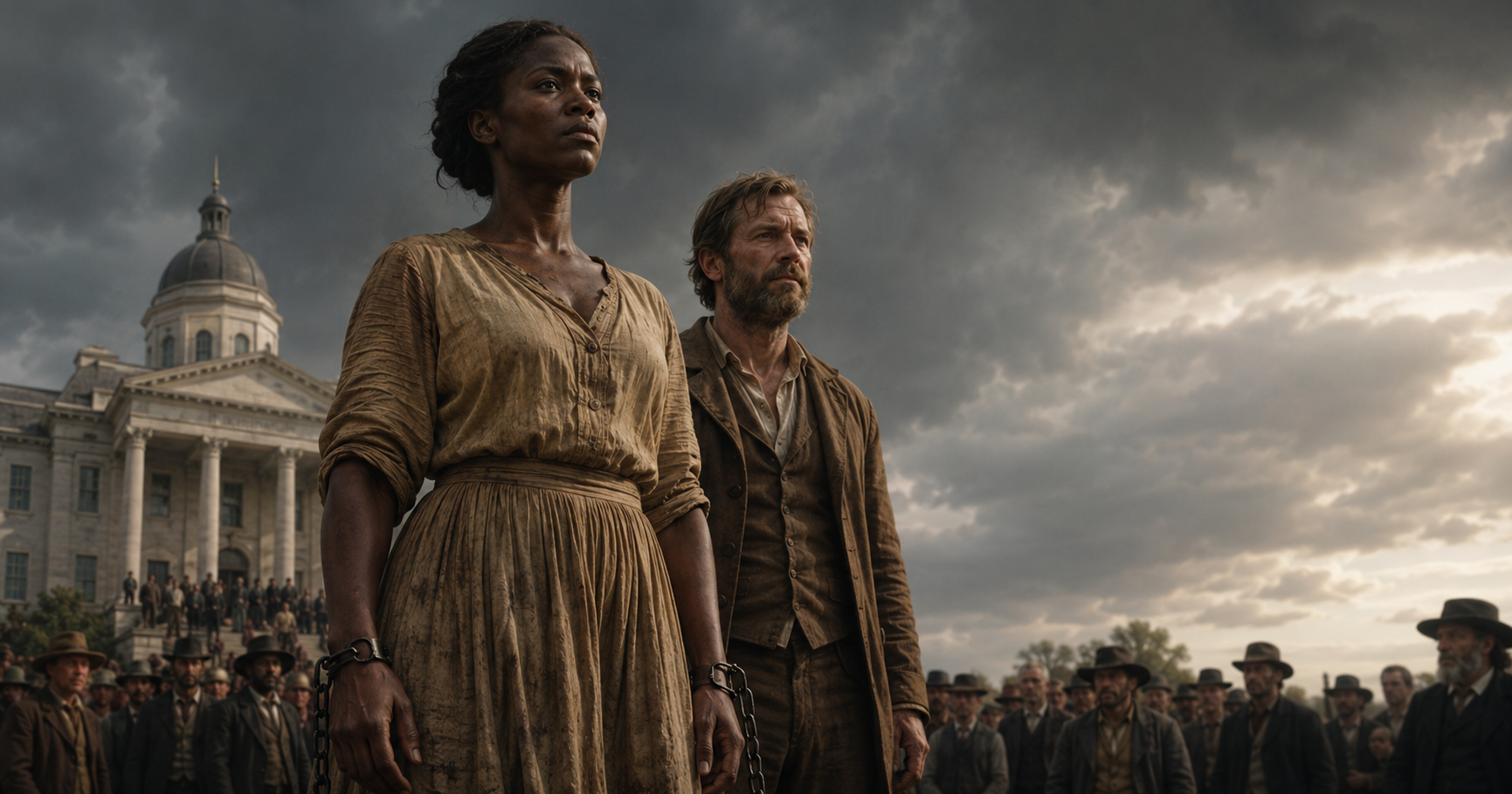
The truth was that Seraphine Rowe had been stolen, renamed, priced, beaten, and nearly erased. A guilty farmer bought a false paper because the world around him respected paper more than people. Then Seraphine carried that paper, her mother’s deed, her brother’s hand, and an iron trunk full of buried crimes into a courthouse that had never wanted to hear her name.
The farmer did not give her power.
She had power before he was brave enough to witness it.
He only lived long enough to see the day she stopped using that power merely to survive and began using it to build a place where others could enter under their true names.
At Rowe Crossing, no child was asked first who owned them.
No woman was asked what price had been paid.
No man was asked what lie had been written above his life.
Seraphine asked one question first.
Always.
She would kneel, no matter how tall she was, so the frightened child could look straight into her face.
Then she would ask gently, “What is your real name?”
Because that was where freedom began.