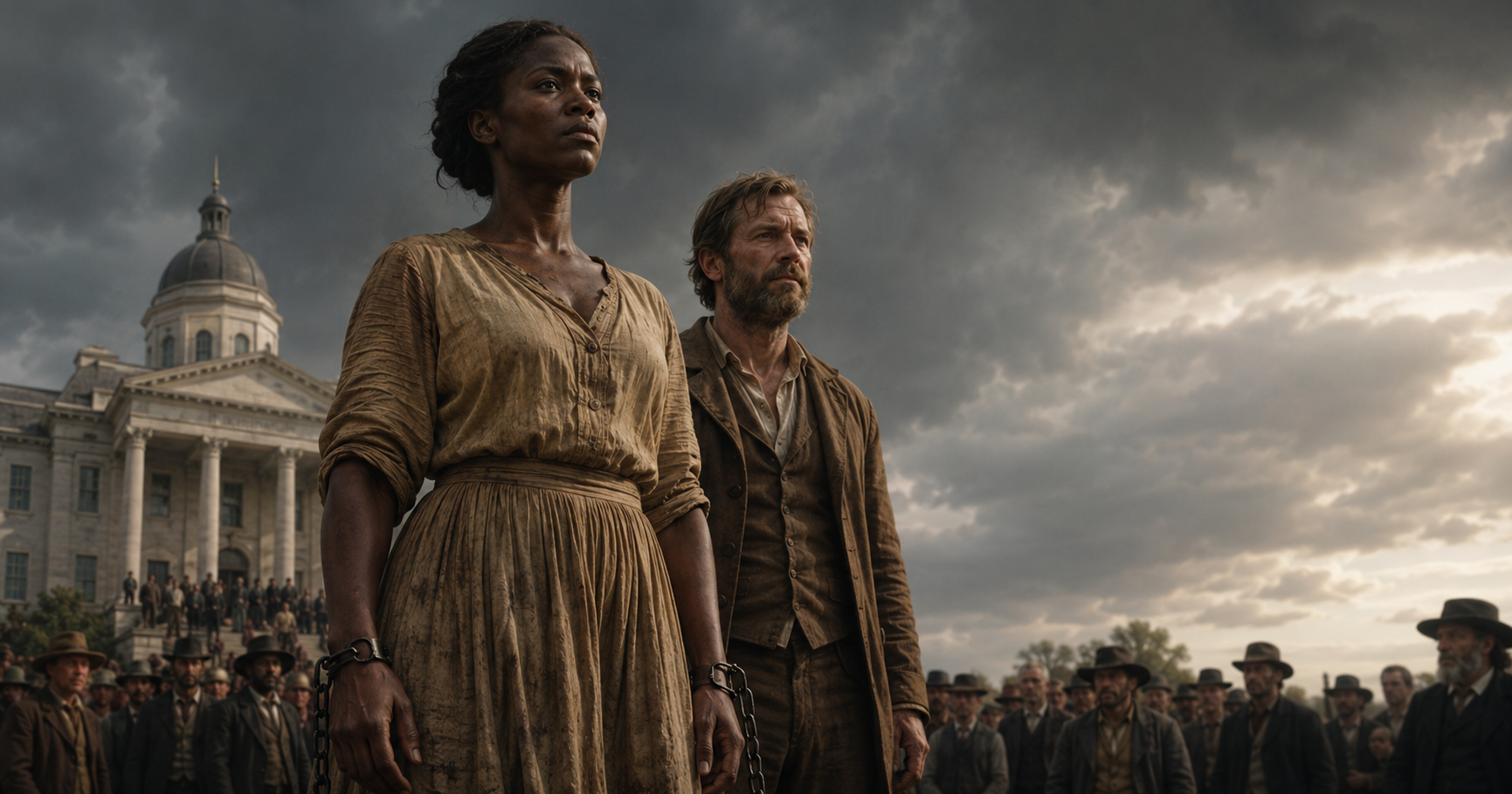
Seven Cents for the Woman They Tried to Erase

By the time the rain began, the auction yard already smelled of mud, horse sweat, wet tobacco, and shame.

No one in Carter’s Landing had meant to stay so late. Men had come for mules, wagons, plows, sacks of seed, and the sort of human misery they pretended was business because business sounded cleaner than sin. The sky had been low all morning, the river thick and brown beyond the warehouses, and the auctioneer’s voice had grown hoarse from selling the living and the broken with the same careless rhythm.

“Next lot!”

The crowd shifted.

A woman was brought onto the platform.

For a moment even the rain seemed to pause.

She was tall. Not merely tall in the way a man might say at supper, “That woman has height on her.” She stood above most of the men in the yard by half a head, broad-shouldered, long-armed, with wrists thick enough to make the iron cuffs look foolish. Her dress had been patched so many times that no original cloth remained. Her hair was wrapped in a torn gray rag. One cheek was swollen. Her mouth was cut.

But it was her stillness that unsettled them most.

She did not tremble.

She did not plead.

She did not look at the buyers as if they held her fate.

She looked beyond them, toward the courthouse clock, as if measuring how long a lie could stand before it cracked.

The auctioneer cleared his throat.

“This one is called Bina,” he said. “Strong as an ox, though twice as troublesome. Sold cheap because she is difficult. Good for hauling, timber work, stone clearing, mill labor, field labor if watched close. No domestic use. No guarantee of obedience.”

A laugh moved through the crowd.

Someone near the front spat and said, “No guarantee she won’t tear the roof off your barn, either.”

Another man said, “Or your head off your shoulders.”

The woman’s eyes moved, slow as a gate swinging open.

The man who had spoken found sudden interest in his boots.

The auctioneer lifted the paper in his hand. “Starting bid. One dollar.”

No one answered.

The rain started again, harder now, ticking against hats and shoulders.

“Seventy-five cents.”

Silence.

“Fifty.”

A butcher laughed. “Pay me fifty and I’ll take her off your platform.”

More laughter.

The auctioneer’s smile tightened. He did not like losing a sale, even an ugly one.

“Twenty-five cents.”

A farmer in a patched brown coat stood near the back of the crowd with his hat low and his hands in his pockets. His name was Jonah Vale, though most men in Carter’s Landing called him either poor Jonah, stubborn Jonah, or that fool from Briar Creek. He owned forty-two acres of hard land, one tired horse, a barn that leaned south in high wind, and debts enough to make a banker smile in church.

He had not come to buy anyone.

At least, that was what he had told himself when he crossed the river at dawn.

But in his coat pocket lay seven cents.

And in the lining beneath his left sleeve lay something far more dangerous than money: a folded deed, sewn flat against the cloth, its edges worn thin from years of being hidden.

The auctioneer dropped his voice. “Ten cents.”

No one moved.

The woman on the platform looked down at the boards beneath her feet.

“Seven cents,” Jonah said.

At first the auctioneer did not hear him.

Then every face turned.

Jonah lifted his chin. “Seven cents.”

A roar of laughter broke over the yard.

“Seven cents?” shouted the butcher. “Jonah Vale finally found a wife he can afford!”

Another man called, “Careful, Jonah. She’ll eat your little farm by winter.”

The auctioneer’s face colored. “This is not a market for jokes.”

“I offered money,” Jonah said.

“Seven cents is not money.”

“It is if you are poor enough.”

More laughter.

The woman looked at him then.

Jonah had expected anger. He had expected contempt, suspicion, hatred. He deserved all three.

But what he saw in her eyes was recognition without knowing. As if she had been waiting for something terrible to happen and understood, before anyone else did, that he was part of it.

The auctioneer glanced at the man who had brought her in, a narrow fellow named Abel Crane, trader, thief, liar, and friend to men who wore better coats while doing worse things.

Crane leaned in and muttered, “Take it. She is costing me feed.”

The auctioneer struck the block with his hammer.

“Sold. Seven cents.”

The laughter changed shape.

Some men laughed harder.

Some stopped laughing altogether.

Jonah walked forward. He counted the coins into the auctioneer’s palm. One by one. Five pennies. Two copper cents gone green at the edges.

The receipt was written with mock ceremony.

Lot name: Bina.

Price: seven cents.

Buyer: Jonah Vale.

Condition: unsound temper.

When the paper was handed to him, Jonah did not look at the woman. He looked at the name.

Bina.

A name placed over another name like dirt thrown over a grave.

“Unlock her cuffs,” he said.

Crane snorted. “You unlock them when you get her home.”

“I paid.”

“You paid seven cents.”

“And you took it.”

The crowd murmured.

Crane stepped close. “You are not leaving this yard with her hands free.”

Jonah looked past him toward the courthouse. Two deputies stood beneath the awning, watching for entertainment, not justice.

“I bought what your paper claimed you had the right to sell,” Jonah said quietly. “If you refuse delivery, we can ask the clerk whether the sale was lawful.”

Crane’s eyes narrowed.

The auctioneer cursed under his breath. He wanted the day finished.

“Unlock her,” he snapped.

The cuffs came off.

Red grooves circled her wrists.

The woman did not rub them. She simply flexed her fingers once.

The sound of knuckles cracking made three men step back.

Jonah turned away first.

“My wagon is behind the cooper’s shed,” he said. “You may ride in it or walk beside it. There is bread under the seat. I won’t touch you.”

She did not move.

Then she said, “Why?”

Her voice was low, rough, and controlled so tightly that rage could be heard beneath every word.

Jonah should have answered with the whole truth.

He should have said: Because I knew your mother.

He should have said: Because the men who sold you stole more than your body.

He should have said: Because I was a coward when courage was required, and I have been paying interest on that cowardice ever since.

Instead he said, “Because seven cents was all I had.”

Her stare did not change.

“That is not an answer,” she said.

“No,” Jonah admitted. “It is only the first one.”

She stepped down from the platform.

The boards groaned beneath her.

No one laughed then.

The wagon ride out of Carter’s Landing passed beneath a sky the color of old pewter. Jonah drove. The woman sat behind him on the wagon bed, not on the bench, with her back against a barrel and her eyes on the road they had left.

The bread remained untouched.

So did the canteen.

When the town was a mile behind them, Jonah stopped beside an abandoned smokehouse at the edge of a flooded field. He climbed down, took a knife from his boot, and cut the rope that had been tied around the woman’s ankles for transport.

She watched his hands.

“You expect gratitude?” she asked.

“No.”

“Fear?”

“No.”

“Then what do you expect?”

Jonah folded the rope and dropped it in the mud. “Nothing tonight.”

Her eyes narrowed. “Men who buy people always expect something.”

“Yes,” he said. “They do.”

“You saying you are different?”

“No.”

That answer finally disturbed her.

Jonah took the receipt from his coat and held it out.

She did not take it.

“That paper says I own you,” he said. “It lies. But lies written on paper have power in this country. I bought the lie because leaving it in Crane’s hand would have killed you.”

“Many things have tried.”

“I know.”

“You know nothing about me.”

“I know the name on that paper is false.”

The air changed.

The woman’s face did not move, but every part of her became more alert.

Jonah lowered his voice. “I know you had a brother once. A younger one.”

Her hand closed around the edge of the wagon plank. The wood cracked.

Jonah did not step back.

“What did you say?” she asked.

“I said you had a younger brother.”

“Had?”

“I don’t know if he is alive.”

The plank split under her grip.

Jonah kept his hands visible. “But I know where he was taken.”

She rose.

She did not rush him. That might have been less frightening. She simply stood, unfolding to her full height, the gray rain behind her, her shadow falling over him like a storm cloud.

“Say his name,” she said.

“I don’t know his true name.”

“Then you know nothing.”

“I know the men who took him called him Little Ben.”

Her breath left her once.

Not a sob.

Not a gasp.

A wound opening.

Jonah saw it and hated himself for using it.

She looked away toward the field, where crows walked through the mud like black-coated judges.

“My brother’s name is not Ben,” she said.

“I believe you.”

“And mine is not Bina.”

“I believe that, too.”

“Then why did you buy me under that name?”

“Because dead lies are easier to carry than living people.”

She turned back slowly.

“What do you want from me, farmer?”

Jonah took off his hat. Rain silvered his hair. He was not old, not exactly, but grief had done work on him that age had not yet had time to finish.

“There is a plantation south of here called Redfern Hall,” he said. “The man who owns it, Colonel Darius Havelock, has been stealing free people and selling them under false names for years. Children, widows, river workers, laundresses, men with trade papers, women with family deeds. He changes names, burns certificates, bribes clerks, and sells the stolen twice over.”

The woman said nothing.

Jonah continued, “I have pieces of proof. Not enough. A torn ledger page. Two statements. A map. And one deed hidden where no one has found it.”

“Why tell me?”

“Because your name is tied to that deed.”

Her eyes sharpened.

“My name?”

“Your real one.”

She crossed the distance between them so quickly that Jonah had no time to move.

Her hand closed around his coatfront and lifted him until his boots barely touched mud.

“Do you know it?” she whispered.

Jonah’s throat worked against the pressure of his collar.

“Yes.”

“Say it.”

He did not.

Her hand tightened. “Say it.”

“If I say it here, before you know why I know it, you may run straight back toward the man who holds your brother. And if you run now, with no plan, you die before sunset.”

“I have died before.”

“No,” Jonah said, voice rough. “You have survived men who wanted you to. That is not the same.”

For a moment he thought she would throw him through the smokehouse wall.

Instead she lowered him.

He stumbled, caught himself, and did not touch his bruised throat.

She turned away. “You talk like a preacher.”

“I am not a preacher.”

“Good. I have no use for men who sell heaven while standing in hell.”

“Nor do I.”

The rain softened.

The woman looked toward the road. “Where is your farm?”

“Briar Creek. North of the river bend.”

“Is it a trap?”

“Yes.”

She looked at him sharply.

Jonah met her gaze. “Everything in this country is a trap for someone like you. My farm is simply one where you will see the doors.”

That answer did not satisfy her.

But it made her climb back into the wagon.

Briar Creek was not much to look at.

There was no white-columned house, no avenue of oaks, no iron gate. Jonah Vale’s farm crouched between river cane and poor soil, a low farmhouse with a crooked chimney, a barn too large for the acreage, and a springhouse built of limestone blocks. The fences were mended with whatever wood had not been needed for heat. The yard held chickens, a black mule, three children chasing a hoop, and a woman with a rifle across her arms.

The woman was small, dark-skinned, gray at the temples, and unimpressed by everything in the world.

She stood on the porch as Jonah drove up.

“You bought her,” she said.

Jonah climbed down. “I bought the paper.”

“That is not what I asked.”

“I know.”

The woman on the wagon studied the porch woman.

The porch woman studied her back.

Finally the porch woman said, “I am Aunt Lottie to people I like and Mrs. Lottie Green to people who test me.”

The tall woman did not answer.

Lottie looked at Jonah. “Did you tell her?”

“Some.”

“Meaning no.”

“Meaning enough for tonight.”

Lottie shook her head. “White men can make a meal out of half a crumb and call it supper.”

A boy of about fourteen appeared behind her, carrying kindling. He stared at the tall woman with open astonishment until Lottie snapped, “Caleb, if your eyes fall out, do not ask me to put them back.”

The boy dropped his gaze.

Jonah said, “This is not a slave farm.”

The tall woman’s face hardened. “Every man says what makes him look clean.”

Lottie nodded. “True.”

Jonah looked at Lottie. “You could help me.”

“I am helping you. I did not shoot you from the porch.”

The tall woman almost smiled.

Almost.

Inside the farmhouse, the table was already set. Cornbread. Beans. Onion broth. Apples dried on a string above the stove. Five people sat or stood in the room: Lottie; her husband Abram, broad and quiet; Caleb; a young woman named Pearl with a baby sleeping against her shoulder; and an old man called Mr. Finch, who watched the windows as if the trees might inform on them.

No one asked the tall woman to sit.

No one ordered her to stand.

That confused her more than either would have.

Jonah placed the auction receipt on the table.

“Seven cents,” Lottie read.

Abram took the paper and made a sound of disgust. “They put a price lower than a bent nail.”

“Because they wanted her gone,” Jonah said.

The tall woman spoke from the doorway. “Because they were afraid I would remember.”

The room quieted.

Lottie looked at her. “Do you?”

The woman’s jaw tightened.

“Pieces.”

“What pieces?”

“A river at night. My mother’s yellow shawl. My brother crying because he lost one shoe. A man with a scar across his lip. Fire. A cellar door. Someone singing through wood.”

Jonah closed his eyes briefly.

Lottie saw it.

The tall woman saw Lottie see it.

“What?” she demanded.

Lottie did not soften her voice. “You will get the truth in this house. But truth is heavy. You want all of it dropped on your head tonight?”

“I have carried heavier.”

“Maybe. But heavy things still break bones.”

The woman’s gaze moved around the room. “Are you free?”

Abram answered first. “By paper.”

Pearl said, “By running.”

Lottie said, “By refusing to answer when liars call.”

The old man Finch lifted his hand. “By being too old to interest wicked men and too stubborn to die for polite ones.”

The tall woman looked at Jonah. “And you?”

Jonah’s mouth twisted. “By law.”

“Law does not mean clean.”

“No.”

Lottie pointed to the stable loft through the back window. “You can sleep there. No lock. No chain. Pitchfork on the wall if you want one. If you leave before dawn, Abram will show you the north road. If you stay, Jonah will owe you answers.”

“I owe them now,” Jonah said.

Lottie did not look at him. “Then start paying.”

The tall woman remained in the doorway.

“My name,” she said, “is not Bina.”

No one spoke.

“My mother called me Seraphine.”

Jonah’s hand tightened around the back of a chair.

The tall woman saw it.

“You knew,” she said.

“Yes.”

Lottie closed her eyes.

Abram muttered, “Lord help us.”

Seraphine stepped fully into the kitchen. The floorboards creaked beneath her weight.

“How?”

Jonah looked at the receipt on the table. “Because I knew your mother’s name, too.”

Seraphine crossed the room in two strides. Everyone tensed, but no one moved to stop her.

“My mother is dead,” she said.

“Yes.”

“Who killed her?”

Jonah’s voice dropped. “Darius Havelock’s men.”

“And you know this how?”

“Because they came through my barn the night before it happened.”

The room held still.

Even the baby on Pearl’s shoulder seemed to stop breathing.

Seraphine’s face went empty in a way that was worse than anger.

“Tell it,” she said.

Jonah looked at Lottie.

Lottie’s voice was cold. “Do not look at me for rescue.”

So Jonah told it.

Not all of it. Not yet. But more than he had ever said aloud in one sitting.

Sixteen years earlier, a free woman named Eliza Rowe had traveled north with two children and a packet of papers hidden in the hem of her skirt. She had been born free, educated secretly by a minister’s widow, and married to a river pilot named Thomas Rowe, who had purchased land near Briar Creek through trusted names because Black ownership invited theft wearing legal gloves.

Eliza had carried the deed.

She had carried certificates.

She had carried names.

She had also carried a stubborn belief that paper could protect her children if enough decent people chose to honor it.

“She reached my barn after midnight,” Jonah said. “My wife, Miriam, brought her in. Your brother was sick. You were little, maybe seven or eight, but already tall for your age. You had a cut on your hand. You would not let Miriam wash it until your mother nodded.”

Seraphine’s eyes flickered.

Memory moved behind them.

“Miriam wanted to leave at once,” Jonah continued. “Lottie said the same. Abram said the road would flood by dawn and we had to move before then.”

“And you?” Seraphine asked.

Jonah swallowed. “I said we should wait.”

“Why?”

“Because men had come earlier with warrants. False ones, but stamped. I thought if they returned, I could talk them off the land.”

Lottie gave a bitter laugh. “Talk.”

Jonah accepted it. “Yes. Talk.”

Seraphine stared at him. “You thought words would stop guns.”

“I thought being reasonable made me righteous.”

“And did it?”

“No.”

The stove popped.

Jonah looked at the table, not at her.

“They came before daylight. Havelock’s riders. A trader with them. Abel Crane. The man who sold you today.”

Seraphine’s hands slowly closed.

“Miriam hid the deed beneath a loose stone in the springhouse. Lottie took your brother into the cellar. Your mother held the door while Abram tried to get the horses ready. I stood in the yard arguing law. I told them they had no right.”

His mouth tightened.

“They laughed.”

No one interrupted him.

“They dragged your mother from the door. She fought. God help me, she fought like ten people. You ran at one of them with a split rail. He struck you with his pistol. Miriam came out with a shotgun. Someone fired. I do not know who fired first.”

Seraphine’s voice became very soft. “My mother?”

“Shot near the well.”

The room blurred around her.

She did not fall.

Women like Seraphine learned young that grief was dangerous when done in public.

“And my brother?” she asked.

“Lottie got him as far as the creek. One of Havelock’s men caught her from behind. Miriam shot him. Abram took the boy. They almost reached the cane break.”

“Almost.”

Jonah closed his eyes.

“Crane had dogs.”

Seraphine turned away.

For a moment she was again a child hearing barking in the dark, feeling mud under bare feet, tasting blood in her mouth, trying to scream through a throat that had forgotten how.

Then she came back into the room.

“And you lived,” she said.

It was not an accusation.

It was worse.

It was fact.

“Yes,” Jonah said.

“Miriam?”

Jonah’s face changed.

Lottie answered for him. “Miriam died three nights later from a bullet they did not dig out in time.”

Seraphine looked at Jonah.

He did not ask pity.

That was wise.

“Why did you not come for us?” she asked.

“I tried.”

“Not hard enough.”

“No,” Jonah said. “Not hard enough.”

The honesty struck the room like a slap.

Seraphine did not know what to do with a guilty man who did not defend himself.

Jonah reached into his coat and pulled the folded deed from the torn lining.

The paper was wrapped in oilcloth.

He placed it on the table.

“This belongs to your family,” he said. “Briar Creek’s river landing. The springhouse. Twelve acres of low field. The old ferry road. It was never mine.”

Seraphine did not touch it.

“If it is mine,” she said, “why did you keep it?”

“Because Havelock wanted it. Because without it, he could not easily claim the crossing. Because if I recorded it without you, he would have had it buried. Because I was afraid. Because I told myself hiding it was protection when part of it was cowardice.”

“That is many becauses.”

“Yes.”

“None are good enough.”

“No.”

Lottie watched Seraphine carefully.

The tall woman’s face was stone, but her breathing was wrong.

At last Seraphine asked, “My brother. Is he alive?”

Jonah looked at Abram.

Abram nodded once.

Jonah said, “Three weeks ago, a boy matching him was seen at Redfern Hall. He was called Toby by one man and Little Ben by another. He had a scar near his left ear.”

Seraphine sat down so suddenly the chair nearly broke.

Her little brother had once had a round face, a laugh that came out in hiccups, and a habit of hiding stolen biscuits inside his shirt. He had been afraid of frogs and thunder, but he would put himself between Seraphine and punishment whenever he could, though he was half her size.

He had a scar near his left ear because she had dropped a clay jar when they were children and a shard had cut him.

Alive.

The word hurt more than dead.

Dead ended a road.

Alive demanded walking.

“What do you want?” Seraphine asked.

Jonah touched the auction receipt. “This paper says I can move you without Crane claiming theft. The deed says Havelock stole land. The old statements say he stole people. But courts like men like Havelock. They will call me mad, debtor, liar, abolitionist, thief. They will say I forged the deed. They will say you are dangerous. They will say your brother is property. They will say the names they invented are more lawful than the names your mother gave you.”

Seraphine stared at him. “And?”

“And Havelock keeps a black ledger in his counting room. Names before and after. Where people came from. What papers were burned. Who paid. Who signed. If that ledger reaches a courthouse with witnesses standing beside it, even men who love lies may find the truth safer.”

Lottie said, “Or they may hang us all.”

“Yes,” Jonah said.

Seraphine looked at the deed.

Then the receipt.

Then Jonah.

“You want me to go back.”

“No.”

“Do not dress the knife in flowers.”

Jonah’s face tightened. “I want your brother out. I want the others out. I want the ledger. But I will not send you back to Redfern Hall. If you choose to go, the choice is yours. If you refuse, we find another way.”

“There may not be another way.”

“I know.”

Seraphine stood.

The chair legs scraped loudly.

“Where do I sleep?”

Lottie pointed again. “Stable loft.”

“Is the pitchfork sharp?”

“Sharp enough.”

Seraphine nodded once and left the kitchen.

In the stable loft, she did not sleep.

She sat with the pitchfork across her lap and listened to the farm breathe.

Horses shifting.

Rain tapping the roof.

A baby crying once in the house, then quieting.

Abram coughing.

Lottie humming low in the kitchen.

Jonah walking out to the springhouse, then returning.

Near dawn, Seraphine took the auction receipt from where Jonah had left it on the stair.

She held it to the lantern.

Bina.

Seven cents.

Unsound temper.

She nearly tore it in half.

Then she folded it carefully and placed it inside her dress.

A lie could become a weapon if carried correctly.

Training began after breakfast.

Not because Jonah ordered it.

Because Seraphine said, “If I go back, I will not go back as the woman they remember.”

Jonah led her to the barn, where Abram had hung a row of objects from beams: a tin cup, a sack of corn, a rope loop, an iron hook, a cracked wagon wheel, and an egg inside a wooden spoon.

Seraphine stared at the egg.

“Is this a joke?”

“No,” Jonah said.

“I have lifted millstones.”

“I know.”

“I have broken chains.”

“I believe you.”

“And you bring me an egg.”

“Yes.”

She looked at Lottie, who had come to watch from the doorway.

Lottie said, “Do not look at me. I told him the egg was foolish.”

Jonah picked up the spoon and placed it in Seraphine’s hand.

“Carry it from this post to that barrel without cracking it.”

Seraphine’s mouth tightened. “I am not a child.”

“No. Children learn faster. They do not yet hate the lesson.”

She nearly threw the spoon at him.

Instead she walked.

The egg rolled, struck the edge of the spoon, dropped, and broke on the dirt.

Seraphine stared at the yellow mess.

Caleb laughed from the doorway, then stopped when Lottie looked at him.

Jonah handed Seraphine another egg.

She took it.

This one broke before she reached the second post.

The third broke because she gripped the spoon too tightly.

The fourth because anger shook her wrist.

The fifth because Jonah said, “Again,” too calmly.

On the sixth try, Seraphine turned on him.

“What does this teach me? That I can be made small enough to carry breakfast?”

Jonah’s answer was quiet. “It teaches your hand that strength is not only how much you can destroy.”

Seraphine stepped close enough that he had to look up.

“I know how to be gentle.”

“I did not say you didn’t.”

“You think rage made me this way?”

“No. Men did.”

The answer stopped her.

Jonah continued, “Rage kept you alive. I will not insult it. But Redfern Hall is full of men waiting for your rage to make their story true. If you break the wrong thing at the wrong moment, they win before the ledger is opened.”

Seraphine looked down at the broken egg.

Then she took the seventh.

By sunset, she carried it from post to barrel without cracking the shell.

By the third day, she could lift the wagon wheel onto its peg without scraping the wall.

By the fifth, she could untie knots with hands that had once torn rope apart.

By the sixth, Abram taught her how to break a chain quietly with leverage instead of fury.

By the seventh, Lottie put a newspaper upside down in front of her and said, “Read it.”

Seraphine froze.

Lottie smiled with no kindness in it. “Do not insult me. I have watched you looking at words all week.”

“I cannot read,” Seraphine said.

“Lying is work. Save it for people who deserve the labor.”

Seraphine looked at Jonah.

He said nothing.

That was the first correct thing he had done all morning.

Lottie tapped the paper. “Read.”

Seraphine read.

Slowly at first.

Then faster.

The kitchen listened.

When she finished, Caleb whispered, “She reads better than Mr. Finch.”

Mr. Finch sniffed. “I have cataracts and moral burdens.”

Lottie placed bills of sale before Seraphine next.

Then false travel passes.

Then marriage certificates.

Then missing notices clipped from newspapers.

“These,” Lottie said, “are the teeth of the trap. Learn their shape.”

So Seraphine learned how theft put on ink.

She learned how ages were changed.

How mothers became “unknown.”

How freeborn became “likely runaway.”

How children were separated because a family remembered what papers tried to erase.

At night, Jonah opened the old bundle of evidence.

A torn page from Havelock’s ledger.

Three names visible.

Margaret Hale, renamed Molly.

Isaac Reed, renamed Sam.

Eliza Rowe’s daughter, renamed Bina.

Seraphine touched that last line.

Not with her fingertips.

With one knuckle, as if touching a bruise.

“I was eight,” she said.

No one answered.

“They sold me first in Louisiana. Then to a sugar place. Then to a brick yard. Then to a widow who wanted me for hauling wood and hated that I grew taller than her sons. Then Crane. Every time, a new name.”

Lottie’s voice softened despite herself. “Did you keep yours?”

Seraphine looked at the lamp.

“At first. Then only inside. Then only when I dreamed. Then not even there.”

Jonah’s face bent under the words.

Seraphine saw it and hated him a little for being human.

It was easier when guilty men were monsters.

The plan formed slowly.

Havelock believed Jonah desperate.

That part was true.

The bank held Jonah’s notes. The banker, Mr. Silas Vane, was Havelock’s dinner companion and owed him favors. Jonah’s land, including the hidden Rowe deed, stood near the old ferry road. Havelock wanted that road because wagons could cross there unseen when the main landing flooded.

So Jonah wrote a contract.

Temporary labor hire.

One month.

The woman called Bina, purchased at Carter’s Landing, would be hired to Redfern Hall for heavy work, with payment credited against Jonah Vale’s debt.

Seraphine read the contract at the kitchen table.

“You wrote me as property.”

“I wrote the lie Havelock expects.”

She looked up.

“Read it again,” he said.

She did.

At the bottom, beneath the formal words, in a space where no one would notice unless taught to look, Jonah had written a second line in pale ink made from lemon and ash.

The bearer of this contract acts under her own will and is not chattel of Jonah Vale.

Seraphine stared at it.

“It will not protect me,” she said.

“No.”

“Then why write it?”

“Because even useless truth deserves a place to stand.”

She folded the contract.

“You have too much faith in paper.”

“I have little faith in men. Paper sometimes embarrasses them into pretending decency.”

Lottie snorted. “Put that on his grave.”

When Jonah rode to Redfern Hall two days later, Seraphine watched from the barn.

He returned near dusk with mud on his boots and murder behind his eyes.

“He is there,” Jonah said.

Seraphine knew who he meant.

Her hands went cold.

“My brother.”

“Yes.”

“Did you speak to him?”

“No.”

“Did he see you?”

“For a moment.”

“And?”

“He is thin. There is a scar near his left ear. He limps.”

Seraphine closed her eyes.

Jonah said, “Havelock agreed. We leave Friday.”

Her eyes opened.

“We?”

“I will drive you there.”

“No.”

Jonah blinked.

“You will not drive me like a delivery,” she said. “Abram will. You will come later, when they need a man with papers to underestimate.”

Lottie smiled from the doorway. “She learns.”

Friday came hot, bright, and full of insects.

Seraphine wore the same patched dress from the auction yard. Lottie had cleaned it but not mended every tear. “Let them see what they think they know,” she had said.

Before dawn, Seraphine stood beside the springhouse.

Jonah approached with a small cloth bundle.

Inside was the deed.

“No,” she said. “Keep it hidden.”

“It belongs to you.”

“It belongs in court. If I carry it into Redfern and they find it, everything ends.”

Jonah nodded.

Then he held out something else.

A yellow scrap of cloth.

Seraphine did not take it.

“My mother’s?”

“Miriam tore it from Eliza’s shawl when she tried to stop the bleeding. She kept it. After Miriam died, I kept it.”

Seraphine’s face went blank.

“Do not give me relics,” she said.

Jonah lowered his hand.

“I am not trying to buy forgiveness.”

“Good. You cannot afford it.”

He nodded.

She turned away.

Then stopped.

Without looking at him, she said, “Keep it until I ask.”

Jonah closed his fingers around the cloth.

Abram drove her to Redfern Hall.

The plantation rose from the heat like a white lie.

Tall columns.

Wide porch.

Clean windows.

Fields stretching behind it in green rows that smelled of sweat and fear.

Darius Havelock stood on the steps, silver-haired, handsome in the way knives are handsome when polished. Beside him stood his overseer, Lem Cade, a thick-necked man with one bad knee and eyes like dirty water.

“Well,” Havelock said, smiling. “Jonah Vale’s giant.”

Seraphine lowered her gaze.

“Name?” Cade snapped.

She let a pause stretch just long enough to annoy him.

“Bina, sir.”

Havelock’s smile deepened. “Perhaps Jonah has improved her manners.”

Abram’s hands tightened on the reins.

Seraphine did not look at him.

Cade took her first to the mill shed, where a cracked beam had trapped part of the press. Four men had tried and failed to raise it.

“Lift,” Cade ordered.

Seraphine looked at the beam.

There had been a time she would have seized it in anger and torn half the shed apart.

Instead she placed her feet.

Breathed.

Found the balance.

Lifted.

The beam rose.

The men scrambled to brace it.

No one laughed.

Cade’s eyes changed.

Not admiration.

Use.

By evening, every person at Redfern Hall knew the giant woman could raise what men could not.

Havelock ordered her kept near the counting house instead of the quarters.

“Too much talk among field hands breeds sickness,” he said.

Seraphine lowered her head.

“Yes, sir.”

The room where she slept had sacks of seed, broken harness, and a wall shared with the old laundry.

At midnight, three soft taps came through the plank.

Seraphine sat up.

Her heart struck once so hard it hurt.

Two taps answered from her hand before she thought.

Silence.

Then a whisper.

“Sera?”

The name opened the world.

She pressed both hands over her mouth.

Through a gap near the floor, she saw one eye.

Brown.

Wet.

Alive.

“Tobias,” she whispered.

A shaky laugh came through the wall. “Nobody calls me that.”

“I do.”

“You got tall.”

“You got stupid. Letting them keep you here.”

“I did not apply for the position.”

She choked on a laugh that almost became a sob.

“How bad?” she whispered.

“Not dead.”

“That is not an answer.”

“It is the one I have.”

She closed her eyes.

There were a thousand things to say and no time to say them.

“Listen. There may be a wagon near the west ditch tomorrow or the next night. If I come, you move. No questions.”

“What about the others?”

Seraphine rested her forehead against the plank.

Of course he would ask.

He had once hidden half a biscuit for a girl he did not know because she cried from hunger.

“How many?”

“Four children in the root cellar. Two men chained near the smokehouse. A woman named Margaret in the laundry. She says she was born free in Kentucky. There are papers somewhere. Havelock burns most, but not all.”

“The ledger?”

“Counting room. Iron trunk. Cade has one key. Havelock has another.”

“Can you get near Cade?”

“No.”

“I can.”

“Sera,” Tobias whispered, fear rising, “do not do what you used to do.”

She knew what he meant.

Do not turn pain into a hammer and call every skull a nail.

“I won’t,” she said.

“Promise.”

She breathed in.

The egg in the spoon.

The wagon wheel.

The knots.

The newspaper.

Her mother’s unseen voice.

“I promise.”

The next day, she watched Cade.

He touched the key ring at his belt whenever he lied.

He drank after supper.

He favored his left side.

He trusted women with laundry because contempt had made him stupid.

At dusk, Seraphine spilled a basket of wet sheets near the pump.

Cade stormed toward her.

“You useless ox!”

She bent her head. “Sorry, sir.”

“Pick them up.”

She knelt.

He stepped close enough to kick one sheet aside.

Her left hand gathered cloth.

Her right hand moved once.

Not fast.

Not violent.

Exact.

The key ring slid from his belt into the wet sheet.

Cade did not notice until he reached the counting house.

By then, the key had passed from Seraphine’s hand to Margaret’s laundry basket, from Margaret’s basket through a cracked board, and from Tobias’s hand into the root cellar where four children stared at it like it was a miracle.

But keys were not freedom.

Keys were only questions asked of locks.

That night, Havelock held supper for Mr. Silas Vane, the banker, and two county men. Through the dining room windows, Seraphine saw white cloth, silver forks, wine glasses, and faces bright with comfort purchased by other people’s pain.

She carried wood past the porch.

Havelock’s voice floated through the screen.

“Vale is finished. Once the note comes due, Briar Creek is mine. The crossing, the spring, the ferry road. He can keep his conscience in a ditch.”

Vane laughed. “And the woman?”

“After the month? I may buy her properly. Not for seven cents, though. Jonah has accidentally found value.”

Seraphine kept walking.

Behind the smokehouse, Abram waited in the shadows with a peddler’s wagon. Lottie sat beside him dressed as an old herb seller, face hidden beneath a bonnet. Caleb lay under sacks in the wagon bed, shaking with excitement and terror.

“Tonight?” Abram whispered.

“Tonight.”

“Jonah?”

“Coming with the sheriff’s clerk at dawn if we fail. With the judge by noon if we live.”

Lottie leaned down. “You have the key?”

Seraphine opened her palm.

Lottie’s eyes flashed. “Then move like truth with its shoes off.”

The counting room smelled of ink, tobacco, and locked sins.

Seraphine waited until Cade began shouting near the stable, searching for the key he believed he had dropped. Havelock went to see what the noise was. The house servants moved like shadows. No one watched the giant woman with the seed sacks because everyone believed strength made a person simple.

She entered the counting room.

The iron trunk sat beneath the desk.

It was heavier than she expected.

Not too heavy.

Only insulting.

The key turned.

Inside were ledgers wrapped in blue cloth.

Letters.

Bills of sale.

A packet of certificates tied with black string.

And, tucked beneath the top ledger, a small child’s shoe.

Seraphine stared.

One shoe.

Cracked brown leather.

A memory struck her with such force that she nearly dropped the lamp.

Tobias crying in the mud because he had lost his shoe.

Her mother saying, Leave it, baby, run.

Havelock had kept it.

Not as evidence.

As a trophy.

The room tilted.

Her hand closed around the trunk handle.

For one burning second, she wanted to wait for Havelock, lift the iron trunk, and bring it down until his face became nothing history could remember.

Then Tobias’s whisper returned.

Promise.

Seraphine took the ledgers, the letters, the certificates, and the shoe.

She placed them back in the trunk.

She lifted the trunk against her chest.

It bit into her ribs.

Outside, someone shouted, “Fire!”

Not a real fire.

Abram’s distraction: damp hay smoking near the old shed.

Men ran.

Dogs barked.

Cade limped across the yard, cursing about thieves, keys, and women too dumb to breathe.

Seraphine moved through the rear door with the trunk in her arms.

Tobias waited near the root cellar with the children. Margaret had the two chained men beside the washhouse. One chain still held.

Seraphine set the trunk down, took the wagon jack Abram had hidden under the steps, and placed it between the links.

“Hold still,” she told the man.

“I am trying.”

“Try better.”

She pressed.

The link bent.

Not from rage.

From angle.

Pressure.

Breath.

The chain snapped.

They ran toward the ditch.

Then Cade appeared.

For one second, the whole night held its breath.

Cade saw the children.

The trunk.

Seraphine.

His hand went to his pistol.

Seraphine threw the wagon jack.

Not at his head.

At his bad knee.

It struck with a crack.

Cade screamed and dropped.

Tobias looked at her.

“You promised.”

“I kept it.”

They ran.

Havelock came from the yard carrying a pistol.

“Bina!” he shouted.

The false name cracked across the night.

Seraphine stopped.

Tobias grabbed her arm. “No.”

She turned.

Havelock stood in the glow of the smoking hay, silver hair loose, pistol raised.

“You think Jonah Vale can save you?” he called. “You think papers can make you real? I knew your mother’s name, girl. I signed the order that buried it.”

Seraphine lifted the iron trunk.

Havelock fired.

The bullet struck the trunk with a sound like a church bell hit by lightning.

The force drove Seraphine back one step.

Only one.

She kept moving.

Havelock fired again.

Missed.

Abram’s wagon burst from the cane.

Lottie pulled Tobias and the children inside.

Margaret climbed after them.

Seraphine shoved the trunk into Abram’s hands, then climbed behind it.

As the wagon lurched forward, she looked back once.

Havelock stood in the smoke, no longer smiling.

That was the first payment.

The courthouse in Briar County had never seen so many frightened powerful men before breakfast.

By nine o’clock, the benches were full.

By ten, people stood in the aisles.

By eleven, Colonel Darius Havelock arrived with two lawyers, Mr. Silas Vane the banker, and a fury polished to look like dignity.

Jonah Vale stood at the front with his hat in his hands.

Beside him stood Seraphine.

Behind her stood Tobias, Margaret, two freed men, four children, Lottie, Abram, Caleb, and Mr. Finch, who had brought a cane he did not need but enjoyed pointing at people he disliked.

Judge Alton Greer entered looking irritated before he looked alarmed.

“What is this?” he demanded.

Havelock stepped forward first. “Theft, kidnapping, armed conspiracy, and the unlawful removal of my property.”

Seraphine felt Tobias tremble beside her.

She placed one hand on his shoulder.

Not to quiet him.

To remind him he was not alone.

Jonah said, “Your Honor, we have documents.”

Havelock laughed. “Stolen documents.”

Lottie said, “Recovered sins.”

A deputy barked, “Quiet.”

Lottie looked at him. “I have been quiet for forty years. You will survive my voice.”

The deputy reddened but said nothing.

Judge Greer rubbed his temple. “Mr. Vale, you are a debtor farmer with a reputation for unlawful sympathies. Choose your next words carefully.”

Jonah placed the iron trunk on the clerk’s table.

“Read them,” he said.

Havelock’s face changed.

Seraphine saw it.

Fear does not always look like trembling. Sometimes it looks like a man suddenly remembering every door in a room.

“Read what?” Judge Greer asked.

“The ledger,” Jonah said. “The certificates. The letters. And the deed hidden from this court for sixteen years.”

Havelock snapped, “No.”

One word.

Too quick.

Too loud.

Too revealing.

The courtroom shifted.

Judge Greer looked at him. “Colonel?”

Havelock recovered. “Private records have no place in an accusation made by thieves.”

Jonah’s voice hardened. “If the records prove your ownership, you lose nothing by having them read.”

Silence followed.

It was not agreement.

It was curiosity turning into danger.

Vane stepped forward. “Your Honor, Mr. Vale’s farm is under lien. He has every motive to fabricate claims against Colonel Havelock, who is a respected landholder and—”

“Respected by whom?” Mr. Finch asked. “His tailor?”

Lottie smiled.

The judge struck the gavel. “Enough.”

Seraphine stepped forward.

The floorboards complained beneath her.

Havelock looked up at her.

For years men had looked at her body before her face. They saw height, muscle, labor, threat. They rarely saw memory.

That was their mistake.

“You said my mother’s name last night,” she said.

The courtroom stilled.

Havelock’s jaw tightened.

“Say it here,” Seraphine said.

He smiled thinly. “I do not know what this creature means.”

“Say it.”

Judge Greer leaned forward. “Mr. Vale?”

Jonah reached into his coat and removed the oilcloth packet.

His hands shook.

Not from fear.

From the weight of waiting too long.

“I knew her mother,” he said.

Seraphine turned her head.

Even though she had known part of the story, hearing it in that room, before those men, made the air change around her.

Jonah unfolded the deed.

“Eliza Rowe was born free in Ohio. She married Thomas Rowe, a licensed river pilot. Through trustees, they purchased land at Briar Creek: the ferry road, the springhouse, and twelve acres beside the bend. My wife and I were among those trustees. This deed was never mine. It belongs to the Rowe heirs.”

Tobias whispered, “Mama owned land?”

Seraphine could not answer.

Jonah placed the deed before the judge.

“Havelock’s men attacked my farm sixteen years ago to seize Eliza Rowe, her children, and the papers proving her status. Thomas Rowe was killed before he could reach the county line. Eliza was shot in my yard. Her children were taken and renamed.”

Havelock laughed once. “A touching ghost story.”

Jonah looked at him. “Ghosts are what guilty men call witnesses they failed to bury.”

The room stirred.

Judge Greer opened the deed.

His expression tightened as he read.

Havelock saw danger and reached for contempt. “Even if some dead woman once owned a patch of mud, these two were sold lawfully afterward. Records exist.”

Lottie pointed at the trunk. “Then let us see how lawful.”

The judge ordered the trunk opened.

The clerk fumbled with the latch.

His hands shook as he lifted the first ledger.

Names filled the page.

Columns.

Old names.

False names.

Ages.

Locations.

Buyers.

Payments.

Notes in Havelock’s own hand.

The first entry read aloud was Margaret Hale, born free in Kentucky, seized near Cairo, renamed Molly, sold as kitchen labor.

Margaret began to weep without making a sound.

The second named Isaac Reed, a blacksmith with papers from Indiana, renamed Saul, sold twice.

Isaac stood so straight he seemed carved from grief.

Then came the entry for the Rowe children.

The clerk swallowed.

Seraphine said, “Read it.”

The clerk looked at the judge.

Judge Greer nodded.

The clerk read.

Female child, unusually tall, memorable, resistant. Original name Seraphine Rowe. Rename immediately at each transfer. Separate from male child Tobias Rowe when possible. Kinship increases defiance.

Tobias gripped Seraphine’s hand.

The courtroom had gone so quiet that the scratch of the clerk’s sleeve against the paper sounded loud.

The clerk continued.

Mother’s certificates destroyed. Deed believed hidden by J. Vale. If deed appears, discredit Vale as debtor, radical, thief, or forger.

The judge’s face drained of color.

Seraphine lifted her chin.

“They laughed out loud when he bought me,” she said. “Read out loud what they sold.”

The clerk read the letters.

One by one.

A county man named as witness to false transfers.

A doctor paid to change ages.

A sheriff’s deputy who returned children for reward.

A banker who held notes over Jonah’s farm while helping Havelock reach the crossing.

Silas Vane stepped back.

Too late.

Havelock’s dignity fell from him piece by piece until only anger remained.

“You think ink beats power?” he said.

Seraphine moved toward him.

No one stopped her.

She stood close enough that he had to look up.

Once, she had imagined this moment with blood in it.

Her hands around his throat.

His fear beneath her thumbs.

His name ending under hers.

But standing there, with Tobias breathing behind her and her mother’s name alive in the room, revenge seemed suddenly too small.

“No,” she said. “Ink does not beat power.”

Havelock’s mouth twitched.

“Memory does. Paper only shows cowards where the truth was buried.”

Judge Greer stood.

The decision he gave was not brave enough to be called justice, but it was frightened enough to become useful.

The Rowe deed would be entered into county record.

Seraphine Rowe and Tobias Rowe were not to be returned to anyone.

Margaret Hale, Isaac Reed, and the others named in the ledger would remain under court protection pending verification.

Colonel Darius Havelock, Abel Crane, Lem Cade, and all named accomplices would answer charges of kidnapping, fraud, unlawful sale, and destruction of free papers.

Havelock did not accept ruin quietly.

As deputies moved toward him, he drew a small pistol from beneath his coat.

He aimed at Jonah.

Seraphine moved first.

She did not strike Havelock.

She seized the clerk’s heavy table and drove it sideways.

The pistol fired into the ceiling.

Plaster rained down.

The table pinned Havelock’s arm against the wall hard enough to make him scream.

For a heartbeat, Seraphine stood over him.

He looked smaller there.

Not because she had grown.

Because the lie had.

Jonah was alive.

She looked at him and hated that it mattered.

Not because he deserved forgiveness.

Because living men could still work.

Spring came late that year.

Briar Creek changed its name quietly at first. Names spoken too loudly had a way of drawing riders.

But after the deed was recorded, after the ledger copies traveled north, after Havelock’s friends began denying they had ever dined at his table, people started calling the place Rowe Crossing.

Not Jonah Vale’s farm.

Not Havelock’s desired road.

Rowe Crossing.

Seraphine did not leave.

Not because anyone asked her to stay.

Not because Jonah owned a breath of her.

Never again.

She stayed because Tobias slept in the loft without chains.

Because Margaret Hale found work there and wrote letters searching for her sister.

Because Isaac Reed opened a blacksmith shed beside the ferry road and refused to shoe horses for men who called him by false names.

Because Lottie taught children to read bills of sale backward, forward, upside down, and in candlelight.

Because the springhouse stone still held the memory of a deed hidden by frightened hands and recovered by braver ones.

One evening, months after the courthouse, Seraphine found Jonah repairing the barn door.

“You still fix things crooked,” she said.

Jonah looked at the hinge. “The hinge was crooked when I found it.”

“That is what guilty men say about history.”

He almost smiled.

Then did not.

She stood beside him in the orange light.

For a long while neither spoke.

Finally she said, “You should have told me my mother’s name before you asked anything of me.”

“Yes.”

“That choice was mine.”

“Yes.”

“You stole it.”

Jonah closed his eyes.

“Yes.”

She waited.

He opened them.

“I thought if you knew how badly I failed her, you would leave before I could help your brother.”

“That does not make it better.”

“No.”

“It makes it understandable.”

He looked at her.

She kept her gaze on the fields. “Do not mistake that for pardon.”

“I won’t.”

A bell hung from the barn beam now. Not the old plantation bell that called people to forced labor, but a cracked iron dinner bell Abram had found and Caleb had polished badly.

Every evening, Seraphine used it in lessons.

Not obedience lessons.

Control.

A girl who had stabbed a man with a fork learned how to hold a needle steady.

A boy who screamed at closed doors learned how to breathe before opening one.

Tobias learned numbers and discovered a talent for accounts so sharp that Lottie said God had made a joke out of thieves by turning a stolen boy into a terror of dishonest ledgers.

That evening, Seraphine reached up and took the bell rope.

Jonah watched.

“You taught me one useful thing,” she said.

“Only one?”

“Do not get greedy.”

He nodded.

She pulled.

The bell rang once.

Clean.

Clear.

Strong enough to cross the yard.

Gentle enough not to frighten the horses.

Jonah listened until the sound faded.

Seraphine said, “Men like Havelock were never afraid of my strength.”

Jonah looked at her.

“No?”

“No. Strength can be chained, bought, worked, mocked, and killed. What frightened them was not that I could lift an iron trunk.”

“What frightened them?”

She looked toward the house, where Tobias sat at the table writing his own name again and again, making each letter darker than the last.

“What frightened them,” Seraphine said, “was that I remembered who I was.”

Years later, people told the story badly, as people often do.

They said a poor farmer bought a giant woman for seven cents and turned her into a weapon.

That was not the truth.

The truth was that Seraphine Rowe had been stolen, renamed, priced, beaten, and nearly erased. A guilty farmer bought a false paper because the world around him respected paper more than people. Then Seraphine carried that paper, her mother’s deed, her brother’s hand, and an iron trunk full of buried crimes into a courthouse that had never wanted to hear her name.

The farmer did not give her power.

She had power before he was brave enough to witness it.

He only lived long enough to see the day she stopped using that power merely to survive and began using it to build a place where others could enter under their true names.

At Rowe Crossing, no child was asked first who owned them.

No woman was asked what price had been paid.

No man was asked what lie had been written above his life.

Seraphine asked one question first.

Always.

She would kneel, no matter how tall she was, so the frightened child could look straight into her face.

Then she would ask gently, “What is your real name?”

Because that was where freedom began.

Seven Cents for the Woman They Tried to Erase
A waitress served a homeless man, not knowing she was in for a surprise