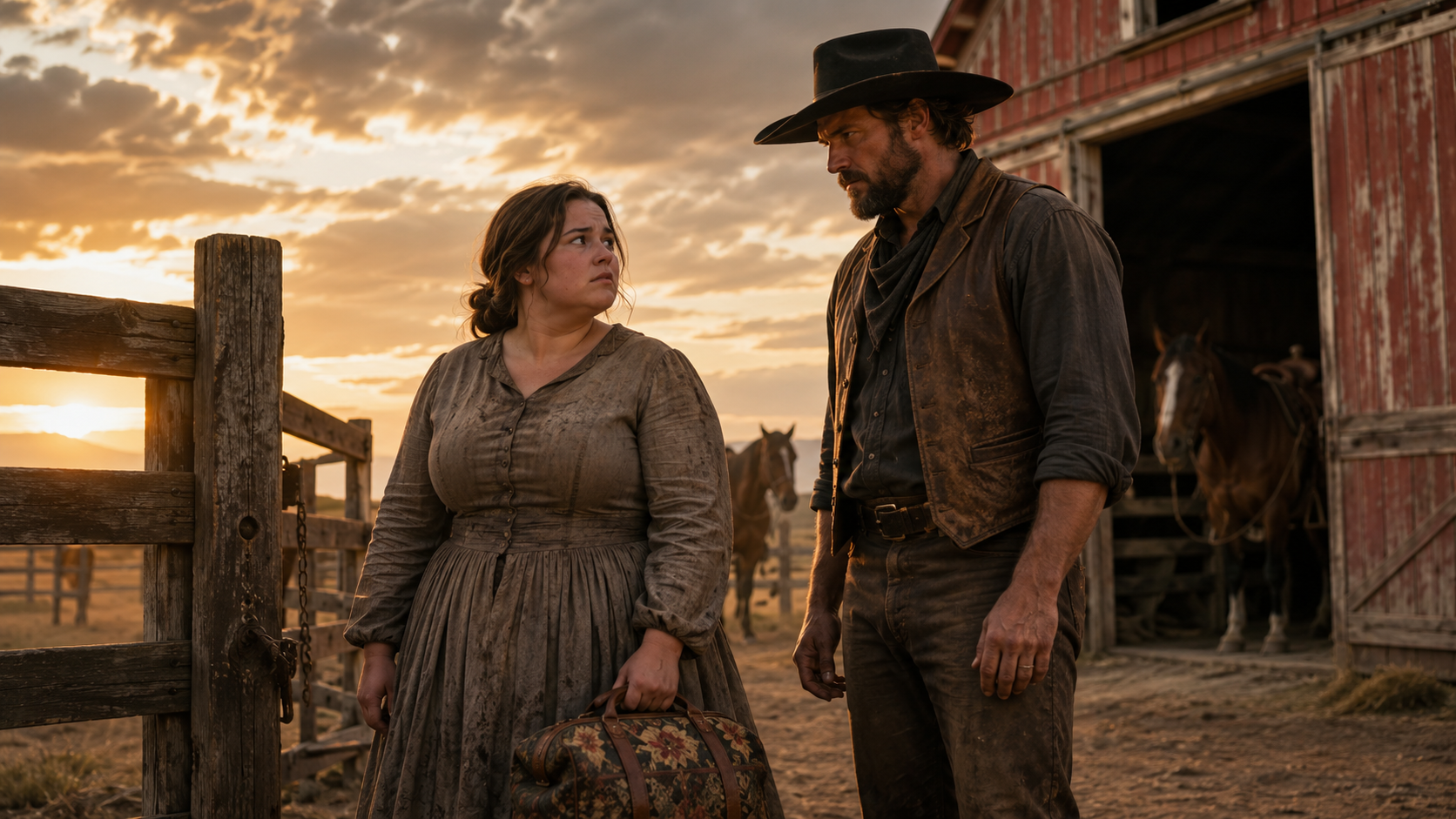
Mara wiped her cheek with her sleeve. “Doesn’t it?”
“No.” He glanced at her. “Sometimes it only makes him empty.”
“What makes a person strong, then?”
He thought about it.
“Staying kind without handing cruel people the knife.”
That evening, when Mara returned to Pruitt House, her attic bed had been stripped bare.
Her blanket lay folded in the hall. Her carpetbag sat beside it. The little tin box that held her mother’s thimble was balanced on top like an insult.
Mrs. Pruitt waited beneath the lamp.
“You are no longer welcome here.”
Mara’s mouth went dry. “Because I work for him?”
“Because you have become a source of talk.”
“The talk came from your girls.”
“My girls know how to behave.”
Mara looked past her.
Lottie stood in the parlor doorway with Mara’s blue hair ribbon looped around one finger.
Mara’s chest tightened. “Give that back.”
Lottie glanced down. “This?”
“It was my mother’s.”
“Then your mother had plain taste.”
Something inside Mara changed.
Not loudly.
Not like a door bursting open.
More like a rope, pulled thread by thread for years, finally snapping.
She walked forward.
Lottie’s smile vanished as Mara took the ribbon from her hand.
No grabbing. No shouting.
Just taking back what was hers.
Mara turned to Mrs. Pruitt. “I will pay what I owe when Mr. Ash pays me. Not a penny more. Not a prayer less.”
Mrs. Pruitt’s mouth opened.
Mara picked up her carpetbag.
For once, she left before anyone dismissed her.
The road to Broken Spur was darker than she expected. The moon hid behind clouds. Coyotes called beyond the creek bed. Every shrub looked like something crouched. Her feet blistered. Her stomach was empty. Twice she stopped and nearly turned back, not because she wanted Pruitt House, but because misery was familiar and freedom had no lamp.
Then she saw one.
A lantern burned at the Broken Spur gate.
Gideon stood beside it with a rifle in one hand.
He lowered the gun when he saw her.
“Mara?”
She tried to answer but could not.
His eyes moved to the carpetbag.
Understanding entered his face.
“She threw you out.”
Mara nodded.
For one terrible moment, she waited for him to sigh, to tell her that was not his concern, to say he had only hired her for stable work and could not invite scandal under his roof.
Instead, Gideon opened the gate.
“There’s a room off the kitchen,” he said. “Used to be my mother’s sewing room. Bed is small. Roof is honest.”
Mara stared. “I cannot stay in your house. People will talk.”
“People already talk.”
“I don’t want to damage your name.”
A humorless smile touched his mouth. “Mara, my name was dragged through mud before you set foot on this road.”
“That doesn’t make it right.”
“No,” he said. “It doesn’t.”
The simplicity of that answer nearly undid her.
He carried her carpetbag inside.
The room off the kitchen smelled faintly of cedar and lavender. A narrow bed stood beneath a small window. A washstand held a cracked pitcher. On the wall hung a framed piece of embroidery: Mercy is not weakness.
Mara touched the stitches.
“My mother made that,” Gideon said from the doorway.
“She believed it?”
“She tried to.”
Mara looked at him.
He nodded toward the door. “There’s a bolt inside.”
“I trust you.”
The words surprised them both.
Gideon’s throat moved. “You shouldn’t trust easy.”
“I don’t,” Mara said. “That is why it matters.”
He looked away first.
“Good night, Mara.”
“Good night, Gideon.”
It was the first time she had used his name without fear.
He paused as if the sound had touched a bruise.
Then he left.
Mara slept better than she had in years.
Not because the bed was soft.
It wasn’t.
Because no one laughed beneath her floor.
The next weeks made a life out of routine.
Mara rose early, tied her hair back with her mother’s blue ribbon, and worked until the sun turned the hills white. She cleaned stalls, mended blankets, washed tack, learned which horse liked apples and which one pretended to bite for sport. Gideon taught her how to judge hay, how to read a hoof crack, how to stand near a nervous animal without crowding it.
At night, they sat at opposite ends of the kitchen table.
At first, Gideon cleaned tack or repaired harness while Mara darned her stockings. Then one evening she noticed his account ledger lying open and frowned.
“These numbers don’t match,” she said.
Gideon looked up. “They do.”
“They don’t.”
“My books are fine.”
“Your handwriting looks like a spider drowned in ink, but that is not the issue.”
His mouth twitched.
Mara turned the ledger toward him. “You sold thirty head to Silas Creed in April.”
“I did.”
“The payment here is for twenty-four.”
“Creed said six came in light.”
“Were they light?”
“No.”
“Then he cheated you.”
Gideon leaned over the page. His shoulder came close enough that Mara smelled soap, leather, and smoke.