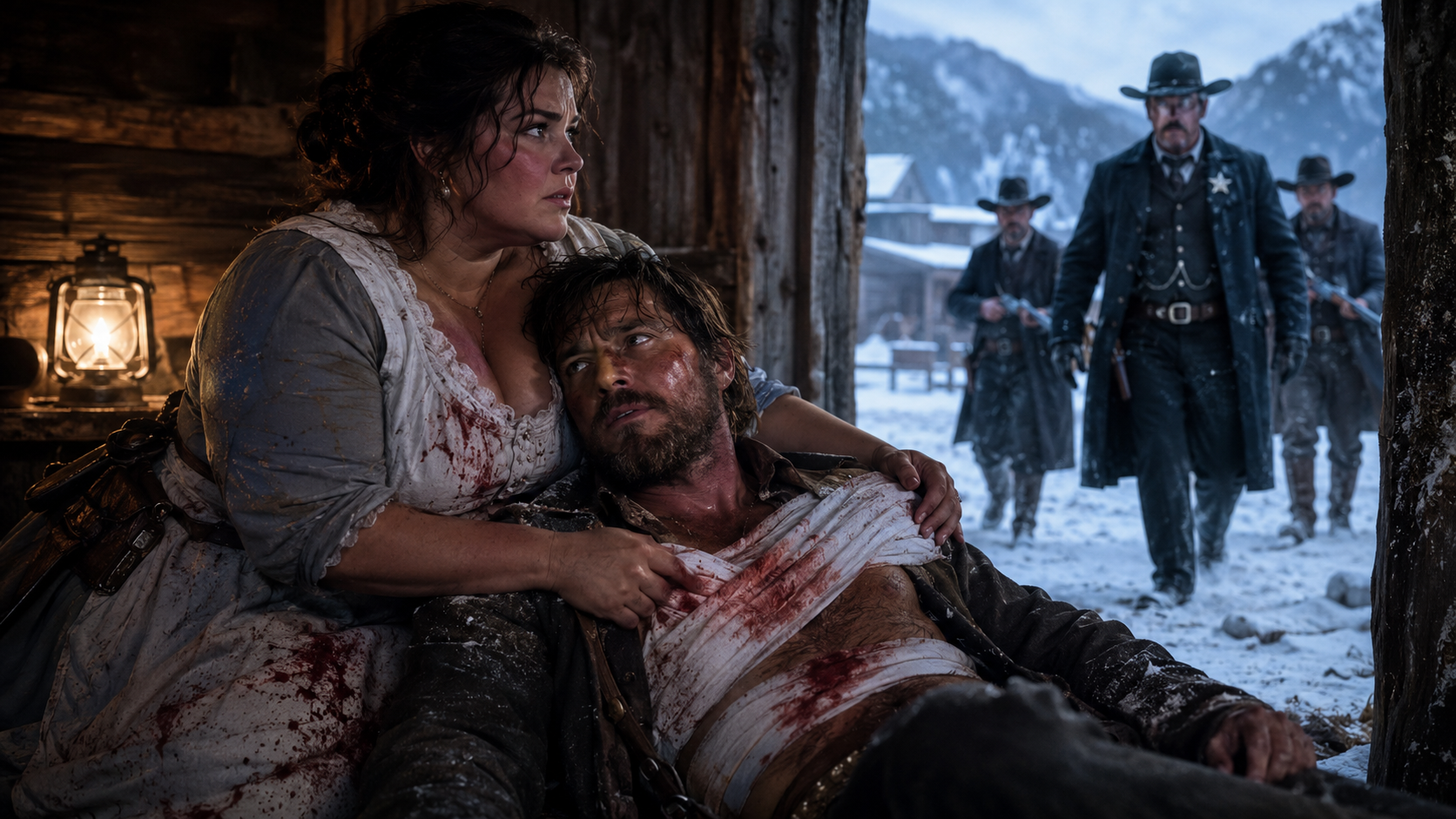
The first thing Martha Crane noticed was the blood on the man’s sleeve.
Not his face. Not the frost in his beard. Not the way he burst through the clinic door so hard the brass bell above it nearly tore loose.
The blood.
It had frozen dark against the wool, stiff as old paint.
Martha stood from the little desk where she had been sorting bandages by lamplight. Outside, the town of Mercy Ridge had already folded itself into winter silence. Snow pressed against the windows. The wind dragged its nails along the roof. No decent person came knocking after midnight unless death had already put one boot through the door.
The man in front of her was not death.
But he had ridden close to it.
“Miss Crane,” he gasped. “You’ve got to come.”
Martha took one look at him and reached for her medical bag.
“Who is it?”
The rider swallowed. His eyes moved away from hers.
That hesitation told her more than the answer.
“Miles Rourke,” he said.
Her hand froze above the leather strap.
In Mercy Ridge, that name could empty a room.
Some said Miles Rourke was a rustler. Some said he had killed a man near the northern crossing. Some said he robbed widows’ winter stores and sold the goods to miners beyond the county line. And some said worse things, because small towns were good at making monsters from men they had already decided not to understand.
Martha had never met him.
She had only seen him twice from a distance: once at the edge of the blacksmith’s yard, paying for a broken stirrup without speaking to anyone, and once in the rain, standing outside the church fence like a man listening to a hymn he did not believe he was allowed to enter.
“Where?” she asked.
The rider blinked, surprised that she had not refused.
“North gulch. Old sawmill cabin.”
“What happened?”
“Catamount,” he said. “Maybe two. He was checking fence near Raven Draw. His horse came back without him. We found him after dark.”
“We?”
“Me and Caleb Voss.”
At the name Voss, Martha looked up fully.
Sheriff Abel Voss owned half the law in Mercy Ridge and the other half behaved as if it belonged to him too. Caleb was his nephew, nervous, young, and still soft enough around the eyes to be troubled by what older men called necessary.
“Why didn’t you bring Miles here?”
The rider’s mouth tightened.
“Sheriff said he shouldn’t be moved through town.”
“Because of his wounds?”
“Because of who might see.”
There it was.
Martha buckled the bag shut.
“What is your name?”
“Levi Pike.”
“Well, Mr. Pike, you can either stand there freezing and explaining politics to me, or you can get me a horse that won’t throw me into a ravine.”
His face shifted, almost into relief.
“I brought one.”
“Good. Then stop bleeding on my floor and show me the way.”
He glanced down, as if only then remembering his sleeve. “It isn’t mine.”
That made her move faster.
Mercy Ridge had always known what to do with a woman like Martha Crane. It knew how to place her at the edge of every room. It knew how to call her capable when it needed her hands and plain when it judged her face. It knew how to praise her courage in the same breath it mocked the width of her hips, the roundness of her cheeks, the way her body refused to become small no matter how tightly she laced her corset.
Patients trusted her.
Their wives whispered about her.
Men looked past her until fever, childbirth, or bullet wounds made them look directly.
Martha had learned not to waste anger on every fool who deserved it. Anger was useful, but only when saved sharp.
Tonight, she saved it.
The ride into the mountains was a punishment.
Snow swept sideways across the trail, white and silver in the lantern glow. Levi rode ahead, hunched low, one hand clamped to his hat. Martha followed on a bay mare named Juniper, whose common sense was the only reason either of them stayed alive.
Twice the trail vanished beneath drifts. Once the mare slid so close to the edge that Martha saw nothing below but blackness and heard stones falling a long time before they struck anything.
Levi turned once and shouted, “We can turn back!”
Martha shouted back, “You first!”
He did not suggest it again.
By the time they reached the sawmill cabin, the eastern sky had begun to lose its deepest black. A thread of smoke rose from the chimney, thin and uncertain. The door hung crooked. One window had been boarded from the inside. The whole place looked less like shelter than a secret someone had nailed together in a hurry.
Caleb Voss met them outside with a rifle in his hands and fear on his face.
“He’s worse,” Caleb said.
Martha pushed past him.
Inside, heat hit her hard. Then the smell.
Blood. Sweat. Damp wool. Fever.
Miles Rourke lay on a narrow cot beside the stove. He was broader than she expected, built not like the elegant cowboys in penny papers but like a man shaped by weather, rope, and labor. His dark hair stuck to his forehead. His shirt had been cut away, revealing long, brutal claw marks running from his right shoulder across his chest and down toward his ribs.
Someone had packed the wounds with cloth.
Someone had also done it badly.
Martha set down her bag.
“Boil more water.”
Caleb moved too slowly.
She turned on him. “Now.”
He jolted into action.
Levi hovered near the door.
“Get every clean cloth you can find. Tear sheets if you must. If anyone complains, tell them I said the dead have no use for bedding.”
Miles did not wake when she touched his wrist.
His pulse stumbled beneath her fingers.
Too fast.
Too weak.
Not gone.
Not yet.
She cleaned her hands with carbolic, rolled up her sleeves, and bent over him.
The first pour of antiseptic into the wound brought him back like a man dragged through fire.
He surged upward with a broken sound and caught her wrist.
His grip was strong, even half-dead.
His eyes opened.
They were green, fever-bright, and full of terror he would never have shown if he’d had the strength to hide it.
“Please,” he rasped.
Martha leaned close. “Lie still.”
His fingers tightened.
“Please don’t leave me.”
The cabin seemed to fall silent around those words.
Caleb stopped moving near the stove. Levi lowered the cloth in his hands. Even the wind outside seemed to pause against the walls.
Miles was not looking at Martha as a stranger.
He was looking through her, into some older darkness.
Martha’s voice softened, but only by a fraction.
“I’m not leaving. But you are going to let me save your life, and that will hurt.”
His eyes focused slowly.
Shame came into them, then confusion.
“Who are you?”
“Martha Crane. Nurse.”
He blinked. “A nurse came up here?”
“Yes.”
“Why?”
“Because you were inconsiderate enough to start dying where I had to ride uphill.”
For half a second, something almost like amusement touched his mouth.
Then pain swallowed it.
“Sheriff send you?”
“No.”
His eyes sharpened.
“Good.”
Martha did not ask why.
Not yet.
She had work.
For the next three hours, the world narrowed to the body in front of her. She cut away filthy packing. She washed blood from torn flesh. She pulled splinters of bark and cloth from the wounds. She stitched what could be stitched, packed what could not, and kept talking in a low, firm voice whenever Miles began to drift.
“Stay with me.”
“I am.”
“Then prove it. Tell me your horse’s name.”
“Bishop.”
“Ugly name.”
“Good horse.”
“Wrong. Good horses deserve better names.”
He breathed something that might have been a laugh, then nearly fainted.
At dawn, the fever had not broken, but the bleeding had slowed. Martha tied the last bandage with fingers stiff from cold and exhaustion.
Levi slept sitting against the wall.
Caleb stood near the window, watching the trail below.
Miles opened his eyes again.
Clearer now.
Not safe.
But clearer.
“You should go,” he said.
Martha sat down hard in the chair beside him. “I am beginning to dislike that sentence.”
“You don’t understand.”
“That is possible. Men with fevers are famous for making sense.”
His gaze moved toward the window.
“Voss will come.”
“Sheriff Voss?”
Miles swallowed. “He won’t let me live long enough to talk.”
Caleb turned from the window, pale.
“Miles—”
“Don’t,” Miles said. “You know it.”
The young deputy’s face crumpled around the truth he had been trying not to hold.
Martha looked between them.
“All right,” she said quietly. “Somebody start explaining.”
No one answered at first.
Then hoofbeats came from outside.
Not one horse.
Several.
Caleb whispered, “Too late.”
The door opened without a knock.
Sheriff Abel Voss stepped into the cabin as if the boards had been waiting for his boots.
He was not a large man, but he had the kind of presence that made people move aside before he needed to ask. His coat was clean despite the storm. His silver badge caught the lamplight. Behind him came two men with rifles and faces made careful by obedience.
Voss looked at Miles.
Then at Martha.
Then at her open medical bag, the bloody water, the bandages, the chair pulled close to the cot.
His smile was slow.
“Well. Mercy Ridge is full of surprises.”
Martha stood.
“He can’t be moved.”
“I did not ask for your opinion.”
“No,” she said. “You walked in hoping no one would have one.”
The deputies shifted.
Voss’s eyes narrowed slightly.
“Miss Crane, you have done your duty. Admirable, considering the weather. Now step aside.”
“Why?”
“Because Miles Rourke is under arrest for theft, assault, and murder.”
Miles gave a dry laugh that turned into a cough.
“Murder now?”
Voss looked at him. “You should have stayed in the hills.”
Martha moved between the sheriff and the cot.
It was not a dramatic motion. She did not pick up a gun. She did not shout. She simply placed herself where he would have to go through her.
“He will die if you drag him down that trail.”
“Then he should have chosen a better life.”
“Did you come here to arrest him or to make sure he stops breathing before court?”
The cabin went very still.
Voss’s smile disappeared.
“Careful.”
“I usually am.”
“You are a nurse, Miss Crane. Not a judge.”
“True. But I know the difference between a prisoner and a corpse.”
Voss stepped closer.
“People in town already talk about you enough. Do not make them talk worse.”
There it was again.
The old weapon.
Not a pistol. Not a warrant.
Reputation.
Martha felt it strike and found, to her surprise, that it did not pierce as deeply as it once had.
Behind her, Miles spoke, low and rough.
“Don’t let him use that on you.”
Voss looked past her. “Quiet.”
Miles pushed himself higher on one elbow, face gray with pain.
“You’re scared.”
The sheriff’s jaw moved.
Miles smiled without warmth. “That is new.”
Voss stared at him for a long moment. Then he adjusted his gloves.
“Twenty-four hours,” he said to Martha. “That is what I’ll give you. Tomorrow morning I come back. If he is breathing, he rides. If you interfere then, you will be charged with aiding a fugitive.”
“And if he isn’t breathing?”
Voss’s eyes were flat.
“Then Mercy Ridge will be safer.”
He turned and left.
The deputies followed.
Only Caleb remained for three seconds longer, shame burning red across his neck.
Then he went too.
When the horses faded down the trail, Martha sat again.
For the first time since Levi entered her clinic, her hands trembled.
Miles saw it.
“You should have let him take me.”
“No.”
“You don’t owe me anything.”
“I don’t owe him obedience either.”
His eyes searched her face as though he had not expected to find anyone standing there.
“Martha Crane,” he said softly.
“What?”
“You are either the bravest woman in Colorado or the worst judge of danger.”
“Both can be true.”
This time, his laugh was real.
It cost him.
She gave him water and made him drink slowly. Then she pulled the chair closer.
“Talk.”
His humor vanished.
“You won’t like the story.”
“I rarely do.”
For a long while, he stared at the ceiling.
Then he began.
Three years earlier, his younger brother Samuel had owned a narrow piece of land east of Mercy Ridge, where the river bent around red rock and widened into a natural crossing. It was poor ranch land, mostly scrub and stone, but it had one thing everyone wanted: water that did not freeze solid in winter.
When the Copper Star Mining Company came looking for a wagon route, that crossing became valuable overnight.
Samuel refused to sell.
A month later, cattle went missing from Voss’s cousin’s ranch. Tracks were found near Samuel’s boundary. Then storehouses were robbed. Then a miner was shot outside a card room, and someone swore they saw Miles riding away.
“Did you?” Martha asked.
“No.”
“But the town believed it?”
“They wanted to. It was easier.”
“What happened to your brother?”
Miles closed his eyes.
“His barn burned.”
Martha went still.
“He was inside?”
“Samuel. His wife. Their little girl.”
The stove popped in the silence.
Miles swallowed.
“I got there after. Voss told everyone I started it to collect insurance money and lost my nerve when the family came home early. There was no proof. There didn’t need to be. A dead family, a bad reputation, and a sheriff willing to point his finger—that was enough.”
“Why didn’t you fight it?”
“With what?” His voice sharpened, then broke under pain. “Half the town owed Voss money. The other half feared him. Witnesses forgot what they saw. Records vanished. And I…” He looked away. “I had been drinking that night. I could not even remember the hours cleanly enough to defend myself.”
“So you ran.”
“I survived.”
“No,” Martha said. “You ran.”
He looked at her.
She held his gaze.
After a moment, he gave the smallest nod.
“Yes.”
That honesty mattered.
Not enough to heal anything.
But enough to begin.
Martha stood and crossed to the window.
Below, the trail wound down toward Mercy Ridge like a pale scar through the trees.
“Why does Voss want you dead now?”
Miles hesitated.
“Because Samuel kept papers.”
“What papers?”
“I don’t know exactly. He came to me the week before the fire. Said he found something strange in the county office. Land filings. A mining survey. Payments made under false names.” Miles clenched his jaw. “He hid a packet somewhere. I never found it.”
“And Voss thinks you did.”
“He thinks I know where Samuel put it.”
“Do you?”
Miles’s eyes shifted.
Martha folded her arms.
“Miles.”
He sighed. “Maybe.”
Outside, wind struck the cabin wall.
Martha stared at him.
“You were going to die up here with that information?”
“I was going to die up here keeping it away from him.”
“That is not noble. That is wasteful.”
He looked almost offended. “You lecture dying men often?”
“Only stubborn ones.”
Levi woke with a snort from the corner.
“I know where Samuel used to hide things,” he said.
Both Martha and Miles turned.
Levi rubbed his face, suddenly aware he had spoken.
“He fixed my mother’s roof once. Wouldn’t take money. She baked him bread for a month. He told me he liked hiding cash in boring places because thieves always look for clever ones.”
Miles frowned. “Where?”
Levi stood.
“Church hymnals.”
Martha blinked.
Miles stared at him.
Levi shrugged. “I said it was boring.”
By noon, Martha had made her decision.
Miles could not ride. That was clear.
But somebody had to go to town.
Not for Voss.
Around him.
She wrote three notes. One to Doctor Elias Finch, the old physician who had trained her and trusted her hands more than most men trusted women with opinions. One to Mrs. Clara Bell, who cleaned the church and knew every loose board, hidden drawer, and badly behaving husband within ten miles. One to the newspaper printer, Arthur Lyle, who had once told Martha that truth was safest when copied quickly.
Caleb Voss returned near sunset, alone.
He stopped at the edge of the clearing like a man approaching a confession.
Martha walked out to meet him.
“You came without your uncle.”
He looked down.
“Yes.”
“Why?”
His mouth worked before sound came.
“Because I saw him burn a paper last night.”
Martha’s breath slowed.
“What paper?”
“I don’t know. But it had Samuel Rourke’s name on it.”
She studied him.
Caleb was young, but not innocent. No man wearing a badge under Abel Voss remained innocent for long. Still, fear and guilt had made a battlefield of his face.
Martha held out the notes.
“I need these delivered.”
“If he finds out—”
“He will threaten you.”
“He’ll do more than that.”
“Yes.”
Caleb stared at the folded papers.
Martha stepped closer.
“You have been waiting for courage to feel good. It won’t. It feels like nausea. Take the letters anyway.”
For a moment, she thought he would refuse.
Then he took them.
By nightfall, Miles’s fever rose.
It came with violent shivers, sweat, muttering, and memories that did not know they were old.
He gripped the blanket and whispered names.
Samuel.
Rose.
Little Ellie.
Once, he tried to climb from the cot, eyes blind with terror.
“The barn,” he gasped. “The door is barred.”
Martha held him down with all her strength.
“Miles. Listen to me. You are in the cabin.”
“The door—”
“You are in the cabin.”
“They can’t get out.”
His voice broke on the last word.
Something inside Martha cracked with it.
She had seen pain before. She had seen men shot open, women hemorrhage after birth, children go blue with fever. But there was a special cruelty in watching a strong man trapped in the one night he could not change.
When the fever finally loosened near morning, he lay exhausted, eyes wet and furious.
“You heard.”
“Yes.”
“Forget it.”
“No.”
He turned his face away.
She touched his wrist.
Not tenderly at first.
Just enough to anchor him.
“You loved them.”
His throat moved.
“I failed them.”
“Those are not the same thing.”
His eyes closed.
For a long time, he said nothing.
Then he whispered, “I don’t know how to live if that is true.”
Martha looked at the bandages across his chest.
“Then start by not dying tonight.”
At dawn, hoofbeats came again.
This time it was not Voss.
Doctor Finch arrived in a sleigh with a shotgun across his knees and Mrs. Bell beside him, bundled in black wool and looking deeply offended by the weather.
Arthur Lyle rode behind them with a satchel full of paper and ink-stained fingers.
Caleb came last.
His face was pale.
But he was still there.
Mrs. Bell marched into the cabin, pulled a packet from under her coat, and placed it on the table.
“I found it inside the church organ bench,” she announced. “Not the hymnals. Men always underestimate church ladies and overestimate their own memories.”
Miles struggled to sit.
Martha pushed him back down.
“I swear,” he muttered, “every person in this room enjoys ordering me.”
“You inspire it,” she said.
Arthur opened the packet.
Inside were copies of mining surveys, tax transfers, signed receipts, and a letter from Samuel Rourke to the territorial marshal.
Arthur read silently at first.
Then his face changed.
Doctor Finch leaned over his shoulder.
Mrs. Bell crossed herself.
Caleb whispered, “God forgive us.”
Martha felt cold spread through her.
The papers showed that Abel Voss had been buying land through relatives and false companies for months before the Copper Star route became public. Samuel’s property had been the key crossing. When Samuel refused to sell, a false lien was filed. When that failed, Voss arranged pressure, thefts, and rumors to isolate the family.
Then came the final page.
A statement from a dying stable hand who claimed he had seen two men carry kerosene toward Samuel’s barn the night of the fire.
One of the men was Sheriff Voss.
The other was Caleb’s older brother, Daniel.
Caleb made a small sound and sat down hard.
Miles went utterly still.
Martha looked at him, afraid of what grief might do to wounds already barely held together.
He did not rage.
That was worse.
He simply stared at the paper as if his soul had stepped out of his body to look at the shape of its own ruin.
“All this time,” he said. “He made me carry his crime.”
Martha stood beside him.
“You are not carrying it alone anymore.”
Arthur was already pulling blank sheets from his satchel.
“I can print this by noon.”
“No,” Martha said.
Everyone looked at her.
She picked up the packet.
“We don’t wait until noon. Voss comes here this morning. He expects Miles wounded, hidden, and alone.”
Miles looked at her.
“You have a plan.”
“Yes.”
“I already dislike it.”
“You will hate it.”
Doctor Finch frowned. “He cannot travel.”
“He doesn’t need to travel far,” Martha said. “Voss does.”
Three hours later, Mercy Ridge gathered in front of the church because Mrs. Bell rang the bell like the building was on fire.
People came running from stores, stables, kitchens, and workshops. Men with suspenders half fastened. Women with shawls over their hair. Children clutching biscuits. Miners smelling of smoke. Ranch hands still wearing spurs.
Sheriff Voss arrived last.
He rode in slowly, already angry.
“What is the meaning of this?”
Mrs. Bell stood on the church steps, arms folded.
“I found something that belongs to the dead.”
A murmur passed through the crowd.
Voss’s eyes moved from her to Doctor Finch, then to Arthur Lyle, then to Caleb, who stood near the church door with a face like ash.
“You,” Voss said to his nephew. “Come here.”
Caleb did not move.
Voss’s expression hardened.
“Caleb.”
The church door opened.
Martha stepped out first.
The murmurs sharpened.
Then Levi and Doctor Finch helped Miles Rourke into view.
He was wrapped in a coat, face pale, one arm bound against his body. Every step cost him. Every breath showed. But he stood.
The crowd went quiet.
Voss’s hand moved toward his pistol.
Martha saw it.
So did half the town.
“Don’t,” she said.
The word rang clear across the snow.
Voss looked at her as if she were an insect that had learned to speak.
“You have made a serious mistake.”
“No,” Martha said. “I made copies.”
Arthur lifted a stack of papers.
The crowd stirred.
Martha raised her voice.
“Three years ago, Samuel Rourke tried to expose land fraud tied to the Copper Star route. His property controlled the best winter crossing east of Mercy Ridge. He refused to sell. Soon after, accusations began against his brother Miles. Then Samuel’s barn burned with his family inside.”
Voss laughed once.
It was a good laugh.
Smooth. Public. Practiced.
“This is madness. That woman has spent a night alone in the mountains with a wanted man and now brings fairy tales to church steps.”
Some people looked away.
Some looked at Martha.
There was the old weapon again.
Shame.
This time, she smiled.
Not warmly.
“Sheriff, if my reputation is your best defense against murder, you are in poorer condition than my patient.”
A ripple moved through the crowd.
Voss’s face darkened.
Arthur began reading.
He read the land transfers.
The false lien.
The mining survey.
The stable hand’s statement.
Then Caleb stepped forward.
His voice shook, but it carried.
“My uncle burned one of Samuel Rourke’s papers last night. I saw him. And I know Daniel rode out the night of the fire. He came home with his coat smelling of kerosene.”
Voss turned on him.
“You lying coward.”
Caleb flinched.
But he did not step back.
“No,” he said. “Not anymore.”
Mrs. Bell lifted another paper.
“And I have here the church donation ledger. Sheriff Voss paid Daniel’s gambling debt the morning after the fire. He wrote it under ‘charity.’ I remember because I thought it was the first charitable thing he had ever done.”
A few people gasped.
Someone cursed.
Miles looked at Voss.
For three years he had been turned into a ghost story. A warning. A convenient villain. Now he stood in daylight and watched the story come apart.
“You killed them,” Miles said.
Voss’s eyes were no longer polished.
They were bare.
Dangerous.
“You think this town will choose you?” Voss asked. “You? A drunk? A fugitive? A man who hid in the hills while decent people kept order?”
Miles swayed.
Martha moved closer, but he lifted his good hand slightly.
“I was a drunk,” he said. “I was a coward sometimes. I ran because I let shame convince me it was the same thing as punishment.” His voice roughened. “But I did not burn my brother alive. I did not murder his wife. I did not trap a child behind a barred door.”
The silence after that was not empty.
It was full of people remembering.
A blacksmith stepped into the street first.
Then a baker.
Then two miners.
Then Mrs. Bell descended from the church steps and stood beside Martha.
Levi joined them.
Doctor Finch.
Arthur.
Caleb.
One by one, Mercy Ridge stopped being a crowd and became a witness.
Voss saw it happen.
For the first time in years, he counted the town and realized he did not own enough of it.
His hand flashed toward his gun.
Miles tried to move, but his body failed him.
Caleb drew first.
Not to shoot.
To aim.
“Don’t make me,” Caleb said, voice breaking.
Voss froze.
The pistol remained half-drawn.
Then Doctor Finch raised his shotgun.
The blacksmith lifted a hammer.
A miner cocked a rifle.
Martha stood at the center of it all, unarmed except for a packet of papers and the terrible certainty that truth, once spoken loudly enough, could become heavier than fear.
Voss slowly let go of the gun.
By sunset, the territorial marshal had been summoned. Voss sat locked in the same jail where he had meant to put Miles. Caleb removed his badge and placed it on Doctor Finch’s desk until the marshal could decide what sort of law Mercy Ridge deserved next.
Arthur printed the whole story that night.
By morning, copies were nailed to every post from the church to the feed store.
And Miles Rourke nearly died anyway.
Not from Voss.
From the ride down, the standing, the stubborn refusal to remain horizontal while his wounds reopened beneath the bandages.
Martha found him collapsing behind the clinic, one hand against the wall, blood darkening his shirt.
She caught him before he hit the snow.
“You impossible man.”
He tried to smile.
“I was useful for nearly an hour.”
“You were foolish for nearly an hour.”
“That too.”
She dragged him inside with help from Levi and Doctor Finch, furious enough to keep from crying. She cut away the bandages. Three stitches had torn. Infection still threatened. Fever hovered at the edge of him like a patient wolf.
For two days, Martha barely slept.
She cleaned wounds. Changed dressings. Counted pulse beats. Measured fever. Threatened him whenever he looked too peaceful.
On the third morning, Miles woke while she was sitting beside him with her head tipped back against the wall.
Sunlight had finally broken through the clinic window.
“Martha,” he whispered.
She opened her eyes at once.
“What hurts?”
“Everything.”
“Good. That means you are alive enough to complain.”
His mouth curved.
For a moment, he only looked at her.
Not like the town looked at her.
Not measuring size, usefulness, reputation, or convenience.
Just seeing.
“You stayed,” he said.
She looked down at her hands.
“I told you I would.”
“When I said that first night…” His voice grew quiet. “I wasn’t talking to you. Not really.”
“I know.”
“I think I was talking to everyone I lost.”
Martha nodded.
His fingers moved weakly against the blanket.
“But this time I am talking to you.”
She stilled.
“Please don’t leave me,” he said.
No fever carried the words now.
No delirium.
Only a man stripped down to honesty and afraid enough to ask without pride.
Martha could have given a soft answer.
A pretty answer.
But she was not built from soft things alone.
“I am not a woman a man asks to stay because he is lonely,” she said.
“I know.”
“I am not medicine for grief.”
“I know.”
“And if you ever speak to me as if I am something you found beside the road and decided to keep, I will break your other shoulder.”
His smile trembled.
“I know that too.”
She leaned closer.
“Then ask me properly when you can stand without bleeding on my floor.”
His eyes warmed.
“Yes, ma’am.”
The trial came in spring.
Abel Voss was convicted of murder, fraud, arson, and conspiracy. Daniel Voss confessed before sentencing and named every man who had helped carry lies through Mercy Ridge. Land was returned. Debts were exposed. The Copper Star route changed. The town did not become pure, because towns never do, but it became awake.
That was something.
Caleb left law work for a while and became a freight clerk. Later, when Mercy Ridge elected a new sheriff, he ran only after Mrs. Bell told him that guilt was useless unless it learned to serve.
Doctor Finch made Martha his full partner at the clinic before summer.
Some people objected.
Martha treated their fevers anyway.
Miles healed slowly.
At first, he came to town only for bandage changes. Then for supplies. Then for no convincing reason at all. He would sit on the clinic porch while Martha finished evening rounds, hat in his hands, saying little. She found she liked his silences. They did not demand performance. They simply made room.
By October, he could lift his right arm without wincing.
By November, he had rebuilt Samuel’s old crossing bridge with help from half the men who once refused to speak his name.
And on the first snow of December, he brought Martha up to a ridge above Mercy Ridge, where the pines stood black against a silver sky.
There was a foundation there.
Fresh timber stacked nearby.
A stone chimney half-started.
Martha looked at it, then at him.
“Miles Rourke.”
“Yes?”
“Is this a house?”
“It is trying to be.”
“For whom?”
He took off his hat.
The nervousness in his face did what danger had not.
It made him look young.
“For a man who is tired of hiding,” he said. “And for a woman who taught him the difference between being alive and merely not dead.”
Martha’s throat tightened.
He stepped closer, careful, always careful.
“I know you have work in town. I know you do not need rescuing. I know you are not here to make my life easy.” He breathed in. “But if you ever decide you want a place where your lamp can be seen from the road, where your horse has a stall, where nobody asks you to be smaller than you are, I would like to build it with you.”
Snow touched her hair.
Below, Mercy Ridge glowed with lanterns.
Above, the mountains held their peace.
Martha thought of the night ride, the blood, the whisper, the sheriff’s hatred, the town’s silence breaking open one voice at a time.
She thought of all the years she had been useful but not chosen.
Needed but not cherished.
Called strong by people who meant she should carry more.
Then she looked at Miles.
“And if I say yes?”
His voice softened.
“Then I spend the rest of my life making sure you never regret staying.”
Martha took his hand.
It was warm despite the cold.
“I will not promise to be easy,” she said.
His smile was slow and real.
“I would not trust easy.”
She looked at the unfinished foundation.
Then at the road below.
Then at the man who had once begged not to be left behind and had somehow learned to stand beside her instead.
“Yes,” Martha said. “Build it strong.”
Miles closed his fingers around hers.
And under the first clean snow of winter, in a town that had finally learned the cost of silence, a nurse who refused to shrink and a cowboy who refused to keep running began something neither of them had expected to survive long enough to want.
Something honest.
Something weathered.
Something that would stay.

