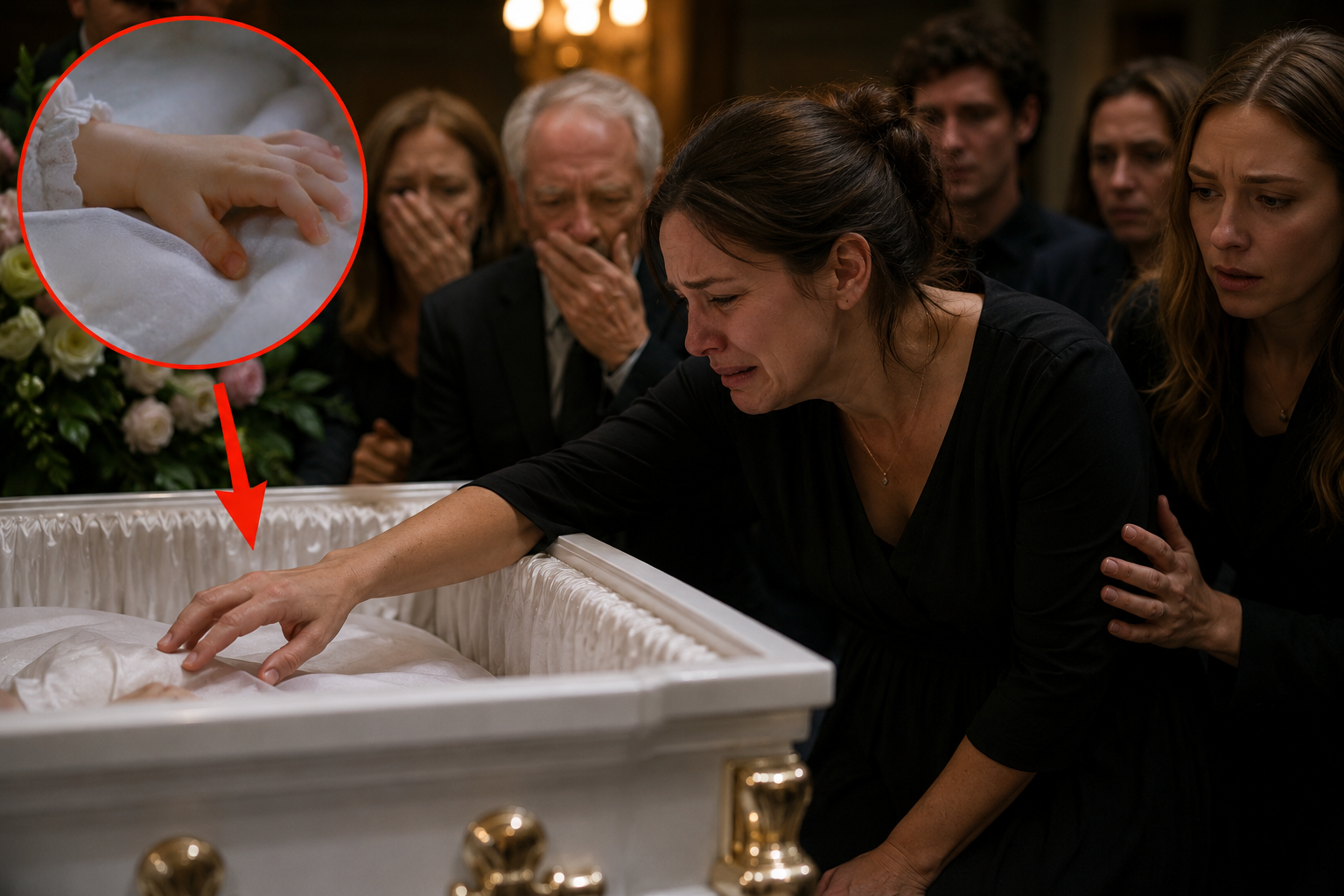
Someone already had a phone in hand. Another person ran toward the funeral home office. Within seconds, the quiet gathering turned into a scene of confusion, fear, and desperate urgency. People stepped aside. Others cried openly. A few kept repeating, “Please, God,” as if those two words were the only thing strong enough to hold the moment together.
Claire stood beside the coffin, one hand pressed against her chest.
“Lily,” she whispered, barely able to speak. “Baby, if you can hear me, hold on.”
No one knew whether Lily could hear anything.
No one knew whether anything they were seeing was real.
The minutes before help arrived felt endless.
Every sound became unbearable. The rain tapping against the windows. The low sobs near the doorway. The ringing phone in the office. The nervous breathing of dozens of people who did not know whether they were witnessing a miracle, a misunderstanding, or the beginning of an even deeper heartbreak.
Some people wanted to believe immediately. Others begged everyone not to raise false hopes. One woman said medical conditions existed that could make signs of life almost impossible to detect. Another insisted that only trained professionals could know for sure. A younger man, pale and shaken, kept repeating that he had seen her fingers move and would swear to it.
Claire heard none of it clearly.
She only heard her own heartbeat.
When the paramedics finally arrived, the room fell into a silence so complete it felt almost unnatural. Two medical professionals entered quickly but calmly, asking everyone to step back and give them space. Their voices were firm, careful, and controlled, but even they seemed to understand the weight of what they had walked into.
Claire backed away only because Hannah held her.
“Please,” Claire said to one of the paramedics. “Please check again. Please.”
The paramedic looked at her, not with false promises, but with a seriousness that made Claire’s knees weak.
“We’re going to evaluate her carefully,” he said. “Let us work.”
Everyone watched.
Nobody spoke.
The professionals checked for signs, used equipment, exchanged quiet words, and repeated the evaluation. Every movement felt painfully slow. Every glance between them made the family’s hope rise and fall. Claire searched their faces for answers, but they revealed almost nothing.
Then one of them looked up.
“We need to transport her immediately.”
The words hit the room like a wave.
It was not a clear answer. It was not a celebration. It was not confirmation that Lily was safe. But it was also not the final sentence the family had feared.
It was a possibility.
And after hours of believing there was nothing left, a possibility felt like a door opening in a wall.
Claire covered her mouth and broke down. Martin wrapped his arms around her, but he was crying too. Hannah kept asking the same question again and again, “Is she alive? Is she alive?” The paramedics did not give dramatic answers. They only moved with urgency, focus, and caution.
“She needs a hospital,” one of them said. “Now.”
As Lily was carefully taken from the funeral home and prepared for transport, people stepped aside in stunned silence. Some cried harder than before. Others stood with their hands clasped, unable to process what they had seen. Outside, the ambulance lights flashed against the wet pavement, turning the gray afternoon into red and white fragments.
Claire followed as close as she was allowed.
At the ambulance doors, she looked once more at the child she had thought she would never bring home.
“Mommy is here,” she whispered. “I’m right here.”
The doors closed.
The ambulance pulled away.
And the people left behind remained standing in the rain, staring after it as if the entire world had shifted beneath their feet.
Within hours, the story spread far beyond the neighborhood. Calls were made. Messages were shared. People repeated different versions of what had happened, each one more dramatic than the last. Some called it a miracle before any doctor had confirmed anything. Others urged caution, reminding everyone that the truth had to come from the medical team, not from fear, grief, or rumor.
At the hospital, Claire waited under bright lights that felt too harsh after the dim stillness of the funeral home. Doctors ran tests. Nurses moved in and out. Specialists were called. Nobody wanted to speak too soon. Nobody wanted to give the family hope without certainty.
But one thing was clear: the situation was serious enough that Lily had been brought in for urgent evaluation.
That alone changed everything.
A doctor later explained to the family that, in extremely rare circumstances, certain medical conditions can make vital signs very difficult to detect. It did not mean anyone should rush to conclusions. It did not mean every rumor was true. It meant the case had to be reviewed with care, patience, and responsibility.