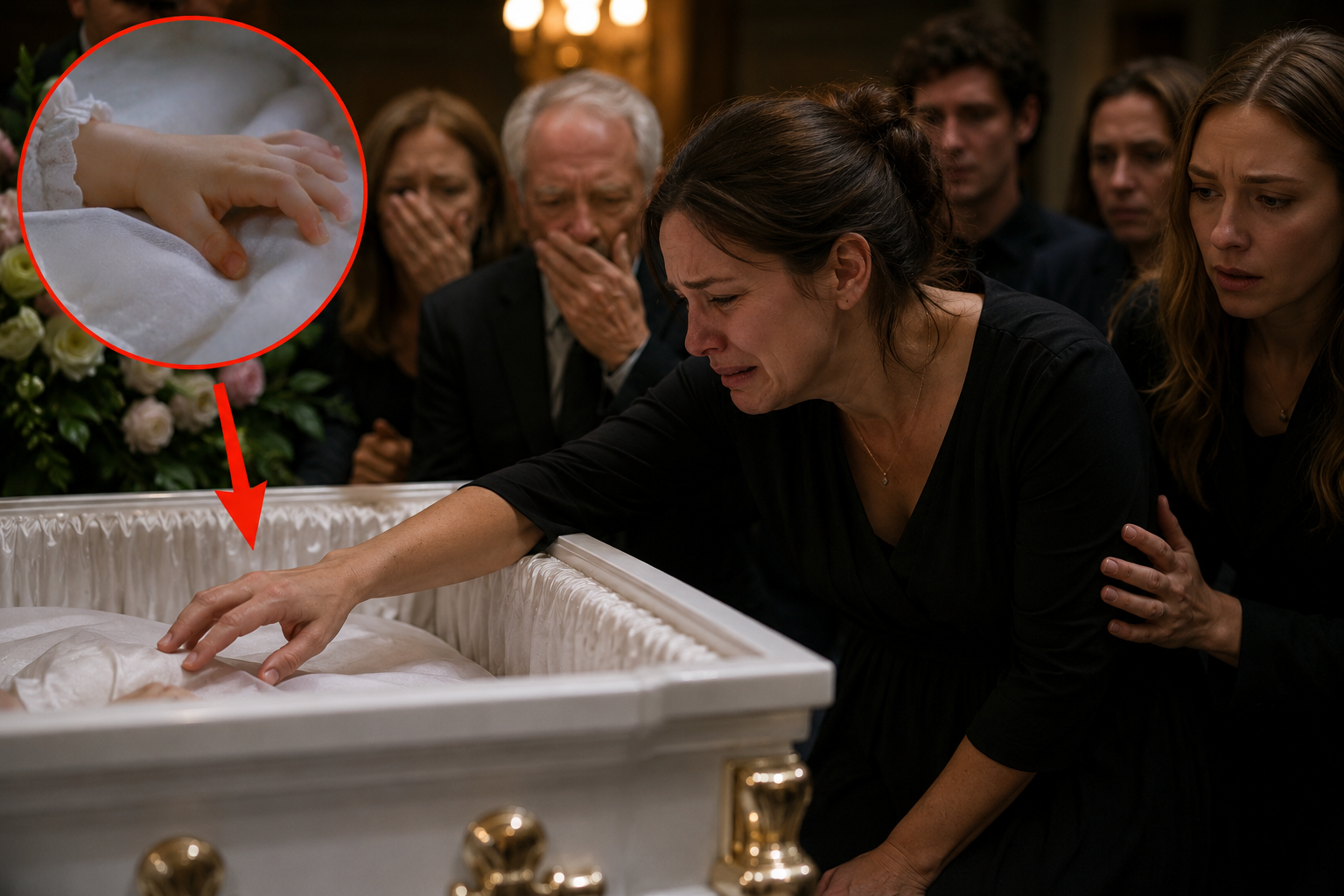
What happened next left every person inside the funeral home frozen in place.
For several long seconds, nobody moved. Nobody breathed loudly. Nobody even dared to blink. The room, which had been filled only moments earlier with whispered prayers and the heavy silence of farewell, suddenly changed into something no one there would ever forget. People who had arrived dressed in black, ready to say goodbye to a little girl they believed they had lost forever, now stood staring at the small white coffin with disbelief written across their faces.
At first, it was only a murmur.
Then came a gasp.
Then a woman near the front covered her mouth with both hands and whispered, “I saw it too.”
The mother, Claire Dawson, had been sitting closest to the coffin, her body bent forward as though grief itself had folded her in half. For hours, she had held herself together because relatives, neighbors, and friends kept approaching her with soft voices, wet eyes, and the same helpless words: I’m so sorry. She had nodded each time, even when she barely heard them. Her mind was somewhere else, trapped between the last time she had heard her daughter laugh and the impossible reality in front of her.
Her daughter, Lily, was supposed to be gone.
Everyone had been told that.
Everyone had accepted it because what else could they do?
The room smelled faintly of white flowers, candle wax, and rain-soaked coats. Outside, a storm had left the streets shining under gray light, and inside, the funeral home felt cold despite the many people gathered there. Relatives stood shoulder to shoulder along the walls. Neighbors who had watched Lily grow up wiped their eyes quietly. Even people who barely knew the family had come, moved by the tragedy of a child taken too soon.
It had begun like any other heartbreaking farewell.
There were framed photos near the entrance. There were flowers arranged around the room. There were trembling hands, quiet embraces, and people speaking in careful, gentle tones, as if any louder sound might break what little strength the family still had left.
But then, near the end of the viewing, something happened that no one knew how to explain.
Claire had been staring at Lily’s hand.
She did not know why. Maybe because she had held that same tiny hand through fevers, first school mornings, scraped knees, and sleepy walks from the car to the house. Maybe because a mother remembers the smallest details even when the world is collapsing. The curve of a finger. The shape of a wrist. The way a child’s hand used to tighten around yours when she was afraid.
Claire blinked through tears.
And for one terrifying, impossible second, she thought she saw a movement.
Not a large movement. Not something dramatic. Just the faintest shift, so small that another person might have dismissed it as a trick of grief.
Claire leaned forward.
Her sister, Hannah, noticed and touched her shoulder. “Claire?”
Claire did not answer.
Her eyes remained locked on the coffin.
Then it happened again.
A finger seemed to move.
Claire stood so suddenly that the chair behind her scraped against the floor. Every face turned toward her.
“Her hand,” Claire whispered.
The room went still.
Someone near the back murmured, “What did she say?”
Claire stepped closer, her voice shaking now. “Her hand moved.”
For a moment, nobody reacted. Grief can do cruel things to the mind, and everyone knew that. People see what they need to see. They hear voices in empty rooms. They feel a presence where there is none. Several relatives exchanged worried glances, afraid that Claire’s pain had finally become too heavy for her to carry.
But then Hannah saw it too.
She gasped, grabbed Claire’s arm, and whispered, “No… wait. I saw that.”
That was when the room began to change.
A few people moved forward cautiously. Others stepped back in fear. Someone began praying louder than before. An elderly neighbor crossed herself again and again. A man whispered that it was impossible. Another told everyone to stay calm, though his own voice trembled so badly that no one believed he was calm at all.
Claire’s father, Martin, pushed gently through the crowd until he reached his daughter.
“What’s happening?” he asked.
Claire could not take her eyes off Lily. “Dad, I think she moved.”
Martin looked toward the coffin, and all the color drained from his face.
Nobody wanted to say the words everyone was thinking.
What if there had been a mistake?
What if she was still alive?
The thought was too enormous, too frightening, too full of hope to hold all at once. Hope, in that room, was dangerous. It could save them. It could destroy them. It could lift them from the floor, or it could crush what remained of their hearts.
“Call emergency services,” Hannah said suddenly. “Now.”
Someone already had a phone in hand. Another person ran toward the funeral home office. Within seconds, the quiet gathering turned into a scene of confusion, fear, and desperate urgency. People stepped aside. Others cried openly. A few kept repeating, “Please, God,” as if those two words were the only thing strong enough to hold the moment together.
Claire stood beside the coffin, one hand pressed against her chest.
“Lily,” she whispered, barely able to speak. “Baby, if you can hear me, hold on.”
No one knew whether Lily could hear anything.
No one knew whether anything they were seeing was real.
The minutes before help arrived felt endless.
Every sound became unbearable. The rain tapping against the windows. The low sobs near the doorway. The ringing phone in the office. The nervous breathing of dozens of people who did not know whether they were witnessing a miracle, a misunderstanding, or the beginning of an even deeper heartbreak.
Some people wanted to believe immediately. Others begged everyone not to raise false hopes. One woman said medical conditions existed that could make signs of life almost impossible to detect. Another insisted that only trained professionals could know for sure. A younger man, pale and shaken, kept repeating that he had seen her fingers move and would swear to it.
Claire heard none of it clearly.
She only heard her own heartbeat.
When the paramedics finally arrived, the room fell into a silence so complete it felt almost unnatural. Two medical professionals entered quickly but calmly, asking everyone to step back and give them space. Their voices were firm, careful, and controlled, but even they seemed to understand the weight of what they had walked into.
Claire backed away only because Hannah held her.
“Please,” Claire said to one of the paramedics. “Please check again. Please.”
The paramedic looked at her, not with false promises, but with a seriousness that made Claire’s knees weak.
“We’re going to evaluate her carefully,” he said. “Let us work.”
Everyone watched.
Nobody spoke.
The professionals checked for signs, used equipment, exchanged quiet words, and repeated the evaluation. Every movement felt painfully slow. Every glance between them made the family’s hope rise and fall. Claire searched their faces for answers, but they revealed almost nothing.
Then one of them looked up.
“We need to transport her immediately.”
The words hit the room like a wave.
It was not a clear answer. It was not a celebration. It was not confirmation that Lily was safe. But it was also not the final sentence the family had feared.
It was a possibility.
And after hours of believing there was nothing left, a possibility felt like a door opening in a wall.
Claire covered her mouth and broke down. Martin wrapped his arms around her, but he was crying too. Hannah kept asking the same question again and again, “Is she alive? Is she alive?” The paramedics did not give dramatic answers. They only moved with urgency, focus, and caution.
“She needs a hospital,” one of them said. “Now.”
As Lily was carefully taken from the funeral home and prepared for transport, people stepped aside in stunned silence. Some cried harder than before. Others stood with their hands clasped, unable to process what they had seen. Outside, the ambulance lights flashed against the wet pavement, turning the gray afternoon into red and white fragments.
Claire followed as close as she was allowed.
At the ambulance doors, she looked once more at the child she had thought she would never bring home.
“Mommy is here,” she whispered. “I’m right here.”
The doors closed.
The ambulance pulled away.
And the people left behind remained standing in the rain, staring after it as if the entire world had shifted beneath their feet.
Within hours, the story spread far beyond the neighborhood. Calls were made. Messages were shared. People repeated different versions of what had happened, each one more dramatic than the last. Some called it a miracle before any doctor had confirmed anything. Others urged caution, reminding everyone that the truth had to come from the medical team, not from fear, grief, or rumor.
At the hospital, Claire waited under bright lights that felt too harsh after the dim stillness of the funeral home. Doctors ran tests. Nurses moved in and out. Specialists were called. Nobody wanted to speak too soon. Nobody wanted to give the family hope without certainty.
But one thing was clear: the situation was serious enough that Lily had been brought in for urgent evaluation.
That alone changed everything.
A doctor later explained to the family that, in extremely rare circumstances, certain medical conditions can make vital signs very difficult to detect. It did not mean anyone should rush to conclusions. It did not mean every rumor was true. It meant the case had to be reviewed with care, patience, and responsibility.
For Claire, medical explanations mattered, but they could not fully reach the place inside her where the shock lived.
That morning, she had walked into a funeral home to say goodbye.
That evening, she was sitting outside a hospital room, praying for the chance to say hello again.
The hours that followed were filled with uncertainty. Family members waited in the hallway, speaking in low voices. Friends brought coffee nobody drank. Neighbors sent messages. Strangers online wrote prayers, blessings, questions, doubts, and theories. The story touched people because it carried the one thing grief rarely allows: the possibility that the final moment might not be final after all.
But the family asked for patience.
They asked for privacy.
They asked people not to turn Lily’s condition into entertainment or rumor.
Because behind the shocking story was a mother whose heart had been broken twice in one day — first by loss, then by terrifying hope.
Late that night, Claire sat beside Lily’s hospital bed and held her hand again. Machines hummed softly. Nurses moved gently. The room smelled of antiseptic instead of flowers. For the first time all day, Claire allowed herself to breathe.
She leaned close to her daughter and whispered, “You don’t have to do anything big, sweetheart. Just keep fighting.”
For a long time, there was no answer.
Then, so faintly that Claire almost thought she imagined it, Lily’s fingers seemed to tighten around hers.
Claire froze.
Tears filled her eyes.
This time, she did not scream. She did not call the whole world to witness it. She simply bowed her head over her daughter’s hand and cried in silence, because whether it was a reflex, a sign, or something no one could yet explain, it gave her one more reason to believe that the story was not over.
No one knew what the final outcome would be.
No one could promise a miracle.
But everyone who had stood in that funeral home understood one thing: some moments divide life into before and after. And for Claire Dawson, the moment her daughter’s hand moved inside that impossible room would remain the moment despair turned, trembling and uncertain, into hope.

