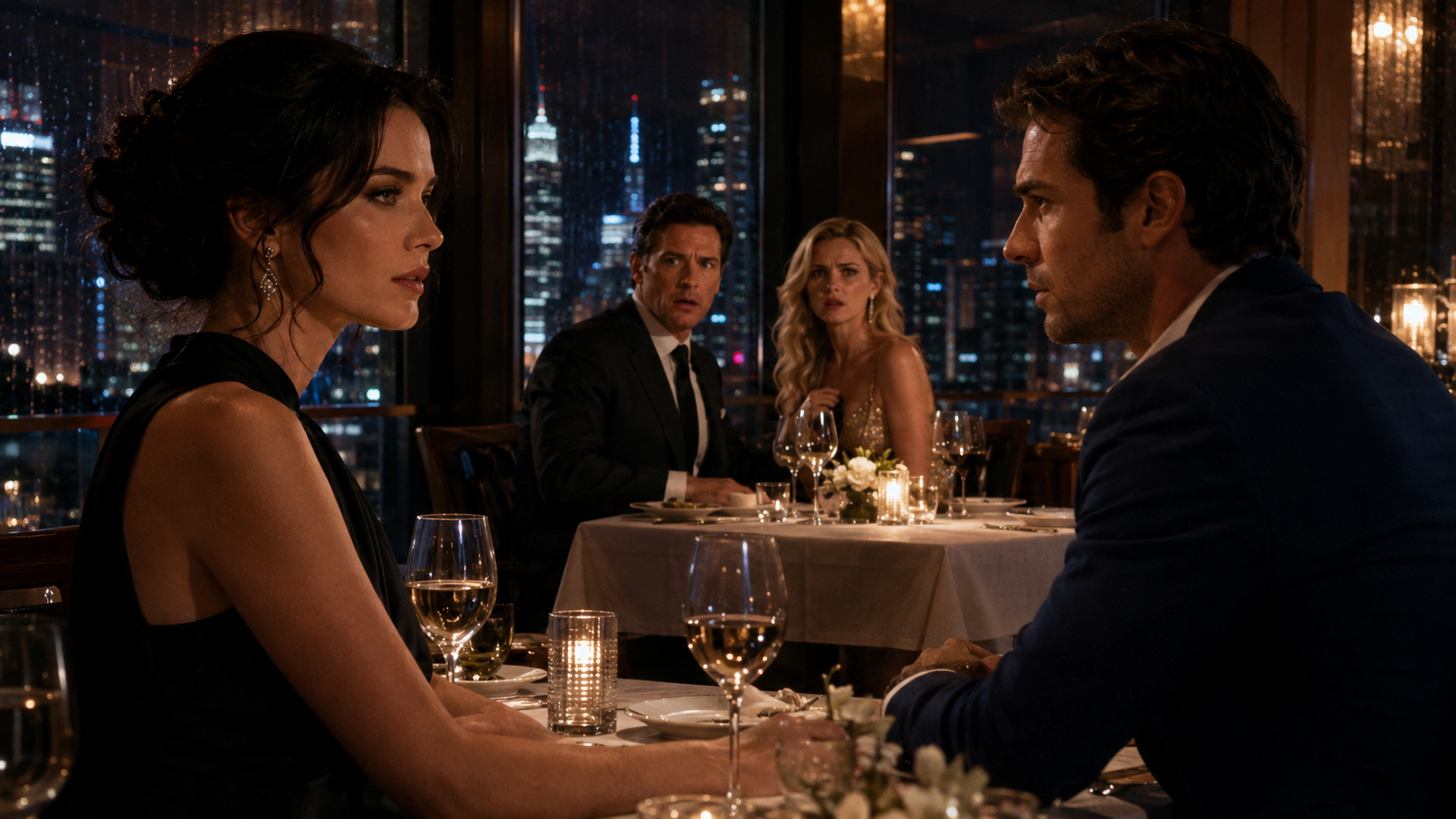
“Order the Most Expensive Thing. My Wife’s Account Can Survive It.”

The message was short enough to look harmless.

Can you meet me today? I think your wife and my husband have been lying to both of us.

Evelyn Marlowe stared at the words for almost a full minute before pressing send.

Then she set the phone face down on the stainless-steel counter and listened to the kitchen breathe around her.

The morning crew at Lark & Vine was already moving through its familiar music: knives tapping against cutting boards, the dishwasher groaning awake, the first onions hitting hot butter with a soft hiss, someone laughing near the back door because the fish delivery driver had once again tried to flirt with Beatrice, who could frighten grown men with one eyebrow.

Evelyn had built her adult life inside that sound.

Her father used to say a good restaurant had a heartbeat. Not a theme. Not a brand. A heartbeat. Lark & Vine had one. It was in the oak bar he had polished with his own hands, in the cracked green tile behind the espresso machine, in the photograph of her mother hanging near the wine shelves, smiling as if she had known every secret the room would ever hold.

Evelyn had thought her marriage had a heartbeat too.

For years, she had mistaken noise for life.

Adrian Marlowe’s world was always loud, even when he whispered. Hotels opening in Dubai. Resorts negotiated in Monaco. Private dinners with senators, board members, venture partners, architects who spoke as if glass towers were a moral achievement. Adrian never entered a room; he arrived inside a weather system. People adjusted around him. They lowered voices, straightened jackets, laughed earlier than the joke required.

Evelyn had once been proud to stand beside him.

Then she had become skilled at disappearing there.

Her phone buzzed.

She turned it over.

Who is this?

The reply came from Simon Ellery.

He had not saved her number, then. Of course he had not. They had met only twice, both times at charity events where Evelyn had stood beside Adrian while Simon stood beside his wife, Celeste. Simon had seemed quiet in a way that was not weak. He listened before speaking. He wore inexpensive glasses in expensive rooms and never seemed impressed by the right people.

Evelyn typed:

Evelyn Marlowe. I’m sorry to contact you this way. I have photographs. Receipts. Transfers. I don’t think this is only an affair.

Three dots appeared. Vanished. Appeared again.

Then:

Where?

Evelyn looked through the narrow window of the kitchen door toward the dining room. Sunlight spilled across table twelve, her favorite table, the one beneath the old brass lamp. It was too early for guests. The chairs were still upside down on some tables. The room looked peaceful in a way that made betrayal feel indecent.

She typed:

Café Ardent. Two o’clock. Please come alone.

Simon arrived at 1:52.

That mattered to Evelyn.

A man who arrived early to a message like that was either frightened, respectful, or both.

He came in wearing a dark wool coat and a charcoal scarf, his hair damp from the misting rain outside. He paused near the entrance and scanned the room without panic. When he saw Evelyn in the back corner, his expression did not change much, but she saw the tiny tightening around his mouth.

He knew.

Not everything, perhaps. But enough.

She stood. “Thank you for coming.”

Simon removed his coat slowly. “Your message sounded like the kind of message a person doesn’t send unless she has already lost sleep.”

“I haven’t slept properly in eleven days.”

He sat across from her. “Then show me.”

No performance. No accusation. No demand that she soften the blow so he could receive it more comfortably.

Evelyn appreciated that.

She opened the leather folder on the table and turned it toward him.

The first photograph showed Adrian leaving the Meridian Hotel with Celeste Ellery on his arm. The second showed Celeste laughing in the back of Adrian’s silver car, her hand on his knee. The third showed them at a private vineyard dinner in Napa, Adrian’s mouth close to her ear, Celeste wearing a sapphire bracelet Evelyn had never seen but recognized instantly from a charge buried in a corporate card statement.

Simon studied each picture with a stillness that made Evelyn’s own chest hurt.

He did not curse. He did not ask stupid questions. He did not defend the woman because he needed five more minutes of denial.

Finally, he closed the folder.

“How long?” he asked.

“At least seven months,” Evelyn said. “Possibly longer.”

Simon removed his glasses and rubbed one thumb along the bridge of his nose. “I knew there was someone.”

“I’m sorry.”

“I knew there was someone,” he repeated. “I did not imagine it would be Adrian Marlowe.”

The name landed on the table like a dropped knife.

Evelyn looked down at her coffee. It had gone cold. She had not taken a sip.

“There’s more,” she said.

Simon put his glasses back on.

Evelyn pulled out a thinner stack of papers. “These are payments made from one of my restaurant operating accounts. Small enough not to trigger the usual internal review. All marked as consulting, brand partnership, or event strategy.”

Simon’s expression sharpened immediately. Not like a jealous husband now. Like a man returning to his profession.

Before becoming a lecturer in financial ethics at Northridge University, Simon Ellery had spent eleven years as an investigator for the federal financial crimes unit. Evelyn had learned that the night they met, when Adrian had mocked him afterward in the car.

“Poor man,” Adrian had said. “Imagine spending your life reading other people’s lies for a government salary.”

At the time, Evelyn had thought it was only arrogance.

Now she understood it was fear disguised as contempt.

Simon took the papers.

“Who received these?” he asked.

“Luna Crest Advisory.”

His face changed.

Evelyn did not miss it.

“That’s Celeste’s company,” she said.

Simon looked up at her. “It was. On paper. She created it for consulting work years ago, but it never became much. Mostly nonprofit introductions, social events, donor dinners.”

“Adrian has paid it almost six hundred thousand dollars in eighteen months.”

Simon’s hands went very still.

Evelyn continued, “Some of that money came from Lark & Vine.”

“Your restaurant?”

“My family’s restaurant.”

His eyes lowered again to the papers.

Outside, rain slid down the café window in thin, silver lines.

Evelyn hated how calm everything looked. She had imagined betrayal would make the world theatrical. Thunder. Breaking glass. A woman screaming in a marble foyer.

Instead, it had arrived through bank statements.

Simon read the columns once, then again.

“These payment amounts are strange,” he said.

“I thought so too.”

“No round numbers. Nothing above ten thousand. Different invoice descriptions. Similar spacing between transfers.” His voice had gone flatter. Colder. “This is not romantic carelessness.”

“No,” Evelyn said. “I don’t think it is.”

He sat back and looked at her for a long moment.

“Why come to me?”

“Because Celeste is your wife.”

“That explains the photographs. Not the financial records.”

Evelyn folded her hands in her lap so he would not see them tremble.

“Because my attorney said the money trail could matter, but I don’t know what I’m looking at yet. Adrian knows I don’t. He counts on that. But when I saw your name, when I remembered what you used to do, I thought…” She stopped, then finished honestly. “I thought you might be the one person he would not want sitting across from me.”

Simon’s face did not soften, exactly, but something in his eyes shifted.

“You’re not asking me to save you.”

“No.”

“Good,” he said. “I would have refused.”

She almost smiled despite everything.

“I’m asking you to help me understand whether my husband used my family’s business to fund his affair, hide expenses, or move money.”

Simon looked at the papers again.

“Possibly all three.”

The words were quiet.

They still split Evelyn’s life in half.

She exhaled slowly. “They’re going to The Aurelia Room tonight.”

Simon looked up.

“Eight o’clock,” she said. “Adrian thinks I’m at a supplier dinner. Celeste thinks you’re at a faculty reception.”

A bitter smile touched Simon’s mouth and vanished.

“They’ve become very efficient with our lives.”

“I made a reservation,” Evelyn said. “Near theirs.”

He stared at her.

“You’re going there?”

“Yes.”

“To confront them?”

“To be seen,” Evelyn said. “There’s a difference.”

Simon leaned back. “That is an insane idea.”

“I know.”

“It will be humiliating.”

“It already is.”

He looked at her for several seconds. Then he gave a short, humorless laugh.

“You want me to sit beside you while my wife sits beside your husband.”

“Yes.”

“And eat dinner.”

“If you can.”

“That sounds less like dinner and more like surgery.”

Evelyn finally lifted her cold coffee and took one sip. It tasted terrible.

“My mother used to say some wounds have to be cleaned in bright light.”

Simon was silent.

Then he said, “What time should I meet you?”

At seven-thirty that evening, Evelyn stood in front of her closet and realized how little space she occupied in her own house.

Adrian’s suits filled the left wall. Adrian’s shoes lined the custom shelves. Adrian’s watches rested in velvet trays inside the drawer he had insisted was too small for both of them. Her dresses had been pushed to the far end, crowded behind garment bags from galas she had hated and fundraisers where she had smiled until her jaw hurt.

She moved hangers aside until she found the black dress.

Not funeral black.

Not obedient black.

It was the black of ink, of iron gates, of a night before a storm. She had bought it two years earlier in Florence when Adrian had canceled their anniversary dinner to take a “critical investor call” that lasted three hours and ended with lipstick on his shirt collar.

She had never worn the dress.

It still fit.

Evelyn looked at herself in the mirror.

For months, perhaps years, she had dressed like a woman trying not to embarrass a powerful man. Elegant but not distracting. Beautiful but not demanding. Expensive but not memorable enough to become a headline.

Tonight, she did not look like an accessory.

She looked like evidence.

Downstairs, Simon waited beside a black town car. He wore a navy suit, white shirt, and a tie so severe it almost made her laugh.

“You dressed for a sentencing,” she said.

“I dressed for documentation,” he replied.

“That’s worse.”

“It usually is.”

The ride to The Aurelia Room was quiet.

Manhattan moved around them in wet reflections, taxi lights stretching over the pavement, towers rising into low clouds. Evelyn watched the city pass and wondered how many windows contained people discovering quietly that their lives were not what they had been told.

Halfway there, Simon said, “You don’t have to prove pain in public.”

She turned from the window.

“I mean it,” he said. “Men like Adrian know how to use a woman’s anger. They provoke it, then call it instability. They injure you privately and judge your bleeding in public.”

Evelyn stared at him.

Simon gave a small shrug. “I investigated financial fraud for more than a decade. Half the job was watching powerful men rename consequences as attacks.”

“You sound like you’ve given that lecture before.”

“I have.”

“Was it popular?”

“With students, yes. With trustees, less so.”

For the first time all day, Evelyn laughed.

It did not last long.

But it was real.

The Aurelia Room sat on the top floor of a glass hotel Adrian had once tried to buy and failed, which Evelyn found almost poetic. The elevator opened directly into a dining room made of gold light, cream stone, tall windows, and the kind of quiet that only wealth could purchase.

Nobody stared openly.

Everyone noticed.

The hostess looked up. “Mrs. Marlowe?”

“Reservation for two.”

“Of course. This way.”

Evelyn had requested a table near the west windows, close enough to Adrian’s favorite corner to hear him if he became careless, far enough to pretend coincidence if needed.

She wanted to be seated first.

That mattered.

Simon pulled out her chair with simple courtesy, not performance. Evelyn sat, unfolded her napkin, and placed it in her lap.

For five minutes, they looked at menus.

The absurdity of it almost made her dizzy.

“What are you ordering?” Simon asked.

“The lamb.”

“Good choice.”

“And the most insulting bottle of Burgundy they have by the glass.”

His mouth twitched. “By the glass?”

“I’m angry, not irresponsible.”

“An important legal distinction.”

Then she heard Adrian’s voice behind her.

“Order whatever you want, darling. My wife’s account can survive it.”

Evelyn did not turn.

The words entered her body like ice water.

Simon went completely still.

Adrian laughed softly, pleased with himself. “She thinks I’m trapped at a private equity dinner. Poor Evelyn. She always did prefer menus to mathematics.”

A chair scraped.

Celeste’s perfume arrived before her voice: rose, amber, expensive guilt.

“You’re terrible,” Celeste whispered.

“No,” Adrian said. “I’m generous.”

Evelyn folded her hands on the table and looked at Simon.

His face had gone pale, but his eyes were clear.

“You okay?” he asked.

“No,” Evelyn said. “But I’m not leaving.”

“That may be enough for tonight.”

Adrian sat.

The moment took only three seconds.

He glanced toward the window, saw Evelyn, and froze.

His smile died so quickly it looked like a light being switched off.

Evelyn let him look.

Then she lifted her glass of water in a small, polite greeting.

“Adrian.”

Celeste turned.

Her face drained of color. “Simon?”

Simon looked at his wife, not with rage, but with such controlled grief that Evelyn almost looked away.

“Celeste.”

Adrian recovered first. Of course he did. Recovery had made him rich.

“Evelyn,” he said, smooth as polished stone. “What a surprise.”

“Isn’t it?” she replied. “New York is enormous until it becomes very small.”

Celeste’s lips parted, but no sound came.

Simon opened his menu. “Evelyn, you said the lamb?”

“Yes.”

“Then the lamb.”

Adrian stared at them as if they had violated a rule he had written without telling them.

The waiter arrived. Evelyn ordered the Burgundy. Simon ordered sparkling water. At the next table, Celeste whispered, “Adrian, what is happening?”

Adrian’s answer was too low to hear, but Evelyn knew the tone.

Manage. Control. Contain.

She ate one piece of bread.

It tasted like victory, which surprised her.

Fifteen minutes later, Adrian came to their table.

He did not storm. Men like Adrian did not storm in expensive restaurants. They bent slightly, placed one hand on the back of a chair, and made threats look like concern.

“Evelyn,” he said quietly. “May I speak with you outside?”

“No.”

The word was not loud.

It did not need to be.

His eyes flickered. “This is not the place.”

“It appears to be exactly the place.”

Simon set down his glass.

Adrian glanced at him. “I don’t know what she told you, Ellery, but this is a private matter.”

“My wife is sitting at your table,” Simon said. “That makes the privacy difficult.”

Adrian smiled thinly. “Celeste’s marriage is not your concern.”

Simon’s voice stayed calm. “That may be the most Adrian Marlowe sentence anyone has ever spoken.”

Evelyn almost smiled.

Adrian’s jaw tightened. “Careful.”

“No,” Evelyn said.

Both men looked at her.

She looked only at Adrian. “You don’t get to say that word to anyone tonight.”

A faint hush passed through the dining room. Not silence, exactly. Wealthy people were too disciplined for obvious silence. But forks slowed. Conversations lowered. The room leaned without admitting it.

Adrian bent closer. “You are embarrassing yourself.”

Evelyn felt the old reflex rise in her, quick and familiar. Smooth it over. Lower your voice. Protect the marriage. Protect the man. Protect the image. Smile so nobody has to ask what hurts.

Then the reflex died.

“No,” she said. “I embarrassed myself every time I pretended not to notice who you became.”

Celeste stood from the next table.

“Adrian,” she said. “Sit down.”

He turned. “Not now.”

Her hands trembled around her clutch. “Yes. Now.”

For one strange second, Evelyn thought Celeste might say something that would change everything.

Not apologize. Not explain the affair.

Confess.

There was fear in her face, not only shame. A deeper fear. A fear that belonged to money, documents, signatures.

Then Adrian touched her elbow.

The fear closed over her expression like a door.

“Sit down,” he said.

Celeste sat.

Evelyn saw it then.

Celeste was not innocent.

But she was not in control.

Dinner continued because life has a cruel talent for continuing.

The lamb was excellent. The wine was better than Adrian deserved. Simon asked Evelyn about the restaurant, and she told him how her mother had taught her to test soup with the back of a spoon, how her father could tell if the dining room was happy from the sound of the cutlery, how Lark & Vine had survived a recession, a flood, two bad reviews, and one chef who tried to put lavender in everything.

“My father said a kitchen tells the truth faster than a boardroom,” Evelyn said.

Simon looked toward Adrian’s table. “I suspect your father was right.”

At the next table, Adrian barely touched his food. Celeste drank half a glass of champagne, then stopped. Twice, Evelyn heard Celeste whisper Simon’s name. Twice, Adrian told her to keep her voice down.

At 9:06, Celeste stood abruptly.

“I can’t do this.”

Adrian grabbed her wrist.

The room noticed.

Celeste looked down at his hand. “Let go of me.”

He released her slowly.

Too slowly.

Simon stood, not like a man seeking violence, but like a man making himself visible in case violence tried to pretend it had not entered the room.

Celeste’s eyes filled with tears.

“Simon, I—”

“Not here,” he said quietly.

The kindness broke something in her face.

“I’m sorry,” she whispered.

Then she walked toward the elevator alone.

Adrian remained standing for a moment, humiliated and furious. Then he turned toward Evelyn.

“Are you proud of this performance?”

Evelyn dabbed her mouth with her napkin. “Not yet.”

His eyes narrowed.

She reached into her purse and removed a sealed envelope.

She placed it on the table between them.

Adrian looked at it. “What is that?”

“A beginning.”

Simon looked at her. She had not told him about the envelope.

Adrian opened it because arrogance cannot resist a locked door.

Inside were copies of twelve invoices, three bank statements, a preservation letter from Evelyn’s attorney, and a preliminary report prepared by a forensic accountant that morning.

Adrian read the first page.

His face changed.

Not enough for strangers to understand.

Enough for Evelyn.

He was not afraid of being caught with Celeste.

He was afraid of being followed by numbers.

“You have no idea what you’re looking at,” he said.

“You’re right,” Evelyn replied. “That’s why I hired people who do.”

Simon slowly took the top sheet when Evelyn nodded permission.

His eyes scanned the payment recipients.

“Luna Crest Advisory,” he said.

Celeste’s company.

Adrian folded the paper once, carefully. “This is a misunderstanding.”

“No,” Evelyn said. “A misunderstanding is when someone orders the wrong wine. This is eighteen months of money leaving my family’s restaurant through false consulting invoices.”

Adrian’s voice dropped. “Lower your voice.”

“No.”

The room heard that one.

Adrian leaned toward her. “If you take this where I think you’re taking it, you will ruin more than me.”

There it was.

Not guilt.

Leverage.

Simon heard it too. His expression hardened.

“What did you use her company for?” Simon asked.

Adrian looked at him with contempt. “You were always good at asking questions no one invited you to ask.”

Simon’s voice was flat. “That was literally my job.”

Evelyn looked at Adrian. “What did you do?”

He smiled then.

It was small, cold, and empty.

“You should have stayed in the kitchen, Evelyn.”

For years, that sentence might have wounded her.

Tonight, it sharpened her.

“I did,” she said. “That’s where we keep the records.”

Adrian placed the papers back into the envelope and set it down.

Then he left.

The next morning, Evelyn arrived at Lark & Vine before dawn.

The city was blue with early cold. Delivery trucks grumbled along the curb. The front windows were dark except for the glow from the small lamp her father had kept in the office because he believed overhead lights made invoices look more depressing.

Evelyn made coffee strong enough to raise the dead and opened six years of statements.

By eight o’clock, she had found twenty-two suspicious transfers.

By ten, forty-seven.

By noon, her attorney called.

Naomi Vale never wasted words. She was the sort of lawyer who made silence feel like a weapon with a license.

“How sentimental are you about peaceful afternoons?” Naomi asked.

Evelyn closed her eyes. “Tell me.”

“The accountant reviewed the first batch. These transfers appear structured. Not random. Not careless.”

“How much?”

“So far, a little over eight hundred thousand dollars.”

Evelyn gripped the desk.

Beyond the office, the restaurant moved as if the world had not cracked open: pans clattering, coffee grinding, Beatrice arguing with a mushroom supplier, someone calling for more towels.

Eight hundred thousand dollars.

From her parents’ work.

From the place her mother had run while pregnant because closing for three weeks would have meant losing the lease.

From the place her father had saved by sleeping in the office during the flood and lifting cases of wine onto the bar one by one while water rose around his boots.

“Where did it go?” Evelyn asked.

“Some to Luna Crest. Some from Luna Crest to a development consultancy tied to Adrian’s hotel group. Some to luxury travel, jewelry, private transportation, donor events, and a political action committee connected to zoning approvals.”

Evelyn stared at the old photograph on the wall.

Her mother, young and laughing, standing beside the hand-painted sign that read LARK & VINE OPEN TONIGHT.

Naomi continued, “This is no longer only divorce. If Adrian used your restaurant accounts to conceal personal or corporate expenditures, we may be looking at fraud, tax exposure, campaign finance problems, and possibly investor misrepresentation.”

Evelyn swallowed.

“What does that mean for me?”

“It means we preserve everything. Bank records. Invoices. Emails. Vendor files. Security footage if you have it. We notify the bank. We prepare for him to threaten settlement, reputation, and your sanity. We do not panic.”

“My mother used to say panic belongs in the walk-in freezer.”

Naomi paused. “Was she right?”

“Usually.”

“Then put it there. I need permission to proceed aggressively.”

Evelyn looked at her mother’s photograph.

For years, she had confused peace with silence.

“Proceed,” she said.

By evening, Adrian had called nineteen times.

Evelyn answered the twentieth because Naomi told her to let him talk.

“Evelyn.” His voice was sharp with anger dressed as concern. “You need to stop this immediately.”

“I’m reviewing financial records.”

“You don’t understand those records.”

“That’s why I hired professionals.”

Silence.

Then his voice softened.

That was always worse.

“Listen to me. Last night was painful. I understand that. You were hurt. You wanted to make a point.”

“You stole from my restaurant.”

“I moved funds temporarily.”

“You moved funds through your mistress’s company.”

“She is not—”

He stopped.

Evelyn let the unfinished lie rot between them.

Adrian tried again. “Celeste didn’t understand the full picture.”

That surprised her.

“Are you protecting her?”

“I’m protecting everyone,” he snapped. Then, after a breath, he lowered his tone. “Evelyn, this could destroy everything I built.”

“No,” she said. “It could reveal what you built it with.”

Another silence.

Then came the old sentence.

The one he had used for years in different clothes.

“Be careful,” Adrian said. “Everything you are exists because I put you beside me.”

Evelyn looked around the office.

The dented desk. The old lamp. The framed newspaper review from 1998. Her father’s handwriting on a faded inventory sheet. Her mother’s recipe notes in the drawer. The restaurant breathing beyond the door.

“No,” she said. “Everything I am survived being beside you.”

Then she hung up.

Three days later, the story broke.

BILLIONAIRE HOTEL DEVELOPER ADRIAN MARLOWE FACES FINANCIAL MISCONDUCT INVESTIGATION.

By noon, financial sites had discovered the invoices. By evening, news crews stood outside Lark & Vine, blocking the lunch delivery until Beatrice threatened to feed one of them to the stockpot. By the next morning, Adrian’s company released a statement containing words like cooperation, transparency, temporary leave, and confidence, which meant everyone in the building was looking for a clean exit.

Evelyn said nothing publicly.

Naomi handled reporters.

The staff guarded the restaurant like a family because, in the ways that mattered, they were one.

Her father came at noon.

He was eighty-one, slower than he used to be, but he still walked through the dining room like a man checking the pulse of a living thing. He touched the bar. The brick wall. The hostess stand. The worn edge of table twelve.

In the office, he found Evelyn staring at an article calling her “the shamed wife of disgraced billionaire Adrian Marlowe.”

Her father read the sentence over her shoulder and made a sound of disgust.

“You are not shamed,” he said.

Evelyn tried to smile. “No?”

“No. If a burglar is caught in your house, the shame belongs to the burglar, not the woman who turned on the lights.”

That was when Evelyn cried.

Not beautifully. Not dramatically. Just enough for her father to step forward and hold her like he had when she was nine and dropped a tray of glasses during dinner service.

“I should have seen it sooner,” she whispered.

Her father kissed her hair.

“You saw it when you could bear seeing it. That is soon enough.”

The legal months that followed did not move like a movie.

There was no single courtroom speech that repaired everything. There were depositions in cold conference rooms, emails written with surgical care, accountants who spoke in calm voices about ugly things, and attorneys who tried to make theft sound like complexity.

Evelyn did not let them.

She brought binders.

Dates. Receipts. Bank records. Vendor histories. Payroll schedules. Her father’s old ledgers. Her mother’s handwritten notes proving that Lark & Vine had never hired Luna Crest Advisory for anything, not even napkin folding.

At one deposition, Adrian’s attorney smiled at Evelyn and asked, “Mrs. Marlowe, would you consider yourself financially sophisticated?”

Evelyn smiled back.

“I know the price of rent, linen service, fish in winter, tomatoes in August, dish soap, insurance, gas repair, staff meals, broken glassware, overtime, and what happens when a man who has never survived a Saturday dinner rush thinks a restaurant account is invisible. So yes, Mr. Hayes. Sophisticated enough.”

Naomi coughed once into her hand.

The court reporter did not smile, but Evelyn saw her shoulders move.

Simon remained present without making himself the center.

He filed for divorce from Celeste after learning she had signed several Luna Crest documents without reading them carefully because Adrian told her they were harmless “pass-through arrangements.” That did not make her innocent. It made her vain, careless, and afraid to ask questions that might cost her the life she had chosen.

But as investigators dug deeper, it became clear Adrian had used her company like a velvet curtain hung over a locked door.

One rainy afternoon, Celeste came to Lark & Vine.

Evelyn almost refused to see her.

She was in the kitchen, sleeves rolled up, flour on one wrist, when Beatrice appeared at the pass.

“The blonde mistake is outside.”

Evelyn looked up. “She has a name.”

“I know. I am expressing support through disrespect.”

Despite herself, Evelyn smiled.

“Five minutes.”

Celeste stood near the front window in a beige coat, stripped of the glitter she wore in gala rooms. Without diamonds, perfect lighting, and Adrian’s hand at her back, she looked younger.

Not innocent.

Just young enough to make Evelyn tired.

“I’m not here to ask forgiveness,” Celeste said.

“Good.”

Celeste swallowed. “I’m cooperating with investigators.”

“I heard.”

“I didn’t know about the restaurant money at first.”

“At first?”

Her eyes filled. “Then I knew enough to be afraid. And I didn’t ask because I wanted the version of my life Adrian promised.”

Evelyn said nothing.

Celeste looked toward the kitchen doors. “Simon was a good husband.”

“Yes.”

“I treated goodness like something ordinary.”

Evelyn studied her.

There were answers meant to punish. There were answers meant to display moral superiority. Evelyn suddenly wanted neither.

“That will be yours to carry,” she said.

Celeste nodded, tears slipping down her face.

Then she reached into her purse and removed a velvet box.

“Adrian bought this for me after the first large transfer. I don’t know which money paid for it. I can’t keep it.”

Evelyn opened the box.

Inside lay the sapphire bracelet from the photograph.

Cold. Bright. Meaningless.

For one second, she imagined throwing it into the street.

Then she imagined her mother’s voice telling her never to waste something that could pay people properly.

“We’ll put it toward restitution,” Evelyn said.

Celeste nodded. “That’s more generous than I deserve.”

“Yes,” Evelyn said. “But it’s what the money deserves.”

Celeste looked at her for a long moment.

“Simon cares about you.”

“Simon is healing.”

“That wasn’t what I said.”

“No,” Evelyn replied. “It wasn’t.”

Celeste accepted the boundary. She turned to leave, then stopped.

“Adrian told me you would disappear without him.”

Evelyn’s face did not change.

Celeste gave a small, sad smile. “I think he said it because he knew he would disappear the moment you stopped looking at him.”

Then she left.

That sentence stayed with Evelyn longer than she expected.

Winter became spring.

Adrian’s empire did not collapse in one glorious cinematic explosion. Men like Adrian built exits into every tower. But he lost his chairmanship. Two partners sued. Prosecutors filed charges connected to wire fraud, misappropriation, and falsified vendor payments. His face, once printed beside words like visionary and titan, began appearing beside investigation and disgraced.

Evelyn’s divorce finalized in May.

She signed the papers in the office at Lark & Vine, with Naomi beside her and her father pretending not to wait outside the door.

The settlement returned every stolen dollar to the restaurant with penalties. Adrian fought over art, wine, and a ridiculous house in Aspen that Evelyn had visited twice and disliked both times. He did not fight for Lark & Vine because he could not.

It had never belonged to him.

When Evelyn signed the final page, she paused.

Evelyn Marlowe.

For the last time.

On the next document, she signed her birth name.

Evelyn Ward.

Her hand did not shake.

That evening, Simon came to dinner.

Not a date. Not officially.

Though everyone in the restaurant behaved as if it were a royal engagement. Beatrice sent out three extra dishes. Evelyn’s father wore a tie. The pastry chef made lemon tartlets and said loudly that he had “no opinion” while placing the prettiest one in front of Simon.

Simon and Evelyn had waited.

They had not rushed into each other’s arms after The Aurelia Room. It would have been easy to confuse shared humiliation with destiny, protection with love, adrenaline with truth.

Simon had named the danger first.

“I don’t want to become the man standing near the exit when your house was on fire,” he told her one late night over coffee at table twelve.

Evelyn looked at him for a long time.

“And I don’t want to become the woman you chose because your wife broke your heart.”

“Then we wait,” he said.

“For what?”

“For the truth to stay true after the smoke clears.”

The truth stayed.

It stayed through hearings, headlines, sleepless nights, bad dreams, difficult phone calls, awkward silences, and the strange grief of ending marriages that had died long before the paperwork admitted it.

It stayed in small things.

Simon sending her an article about restaurant labor law. Evelyn sending him a soup recipe with a note that read too much theory, not enough garlic. Quiet lunches. Honest disagreements. Walks in the rain. The patience of two people refusing to turn rescue into romance before it had earned the name.

By late spring, what grew between them did not feel like scandal.

It felt like something planted properly.

The night Adrian returned to Lark & Vine was the night Evelyn’s essay sold.

Not a blog post. Not a private family project. A real book deal with a respected publisher after an editor read her essay about food, inheritance, betrayal, and what kitchens know about survival.

The book would be called The Heat That Remains.

Her father cried when she told him.

He denied it so badly that Beatrice handed him a towel.

Simon arrived just after nine with flowers from the corner market, not extravagant roses, but bright yellow tulips wrapped in brown paper. He kissed Evelyn’s cheek near the office door, careful because her father was only ten feet away pretending to inspect a wine list upside down.

“I’m proud of you,” Simon said.

“You haven’t read the whole manuscript.”

“I’ve read enough to know it tells the truth.”

“Truth again?”

“Occupational hazard.”

She was still smiling when Beatrice’s expression changed.

Evelyn turned.

Adrian stood at the front door.

He looked thinner. Older. Not destroyed, perhaps, but reduced in the way men look when the world has stopped repeating their favorite story about them.

His coat was expensive but not new. His hair was neat. His eyes were not.

The dining room quieted.

Simon moved slightly, not stepping in front of Evelyn, but close enough for her to know he would if she asked.

She did not ask.

Evelyn walked to the door.

“Adrian.”

“Evelyn.”

“You have five minutes.”

He looked past her into the restaurant. At the full tables, the warm lamps, her father at the bar, the staff watching from the kitchen doors, Simon standing near the office.

Something like pain crossed his face.

Evelyn no longer felt responsible for translating it.

“I heard about the book,” he said.

“Then you read the news.”

“I also heard the restaurant is booked out for six weeks.”

“Seven.”

A faint, humorless smile touched his mouth. “Of course.”

Evelyn waited.

Adrian looked down at his hands.

“I came to say I’m sorry.”

The words landed between them like an object whose value had expired.

“For what?” Evelyn asked.

He looked up.

She held his gaze. “Be specific.”

That was the final thing he had not expected from her.

Not anger.

Not tears.

Specificity.

He swallowed. “For the affair.”

“That’s one.”

“For the money.”

“Say it properly.”

His jaw tightened, but the old anger had nowhere to stand.

“For stealing from Lark & Vine.”

“Two.”

“For making you feel small.”

The room behind her was silent.

Adrian’s voice dropped.

“For needing you to feel small so I could feel powerful.”

That was the closest he had ever come to telling the truth.

For a moment, Evelyn saw the man she had once married. Young, hungry, charming, standing outside Lark & Vine in the rain with flowers and promises large enough to mistake for love.

She had loved him once.

That mattered.

It did not change anything.

But it mattered because Evelyn refused to become the kind of person who pretended love had never existed simply because it had failed.

“Thank you for saying it,” she said.

Hope flickered in his face.

“Evelyn—”

“No.”

The hope died.

“I accept that apology as far as it can go,” she continued. “But it does not rebuild trust. It does not erase court records. It does not return the years I spent shrinking in rooms where you needed to be the largest person. And it does not give you a place in my life.”

Adrian’s eyes moved to Simon.

“Him?”

“Don’t do that.”

His gaze returned to her.

“Simon is not your punishment. He is not your replacement. He is not the man who won something you lost. I am not property changing hands.”

Adrian flinched.

“I belong to myself,” Evelyn said. “That was always true. I only forgot for a while.”

Behind her, her father made a small sound.

Adrian looked through the window at the full restaurant, at the food, the warmth, the life Evelyn had protected from him.

“You were never small,” he said.

“No.”

“I just needed you to be.”

“Yes.”

He breathed in. “Sentencing starts next month.”

“I know.”

“I’m scared.”

For once, he said it without trying to make it someone else’s responsibility.

Evelyn looked at him and felt no triumph.

Not pity either.

Only the recognition that a person can deserve consequences and still be human inside them.

“Then be scared honestly,” she said. “It may be the first useful thing fear has ever done for you.”

Adrian gave a broken little laugh. “That sounds like your father.”

“My father would have used fewer words.”

For the first time in a long time, his smile was real.

Brief.

But real.

Then he stepped back.

“Goodbye, Evelyn.”

“Goodbye, Adrian.”

He left.

No applause followed.

Real life rarely gives applause at the right moments.

The restaurant simply began breathing again. Forks moved. Voices returned. A glass clinked near the bar.

Simon approached slowly.

“Are you all right?”

Evelyn looked at the door Adrian had closed behind him.

Then she looked at the restaurant. Her restaurant. Her father. Her staff. The tulips on the office desk. The book contract waiting in her inbox. The man beside her who had never mistaken quiet for emptiness.

“Yes,” she said, surprised to find it true. “I think I am.”

One year later, The Heat That Remains was released on a rainy Thursday in October.

The launch party was held at Lark & Vine because Evelyn refused the publisher’s suggestion of a neutral venue. There was nothing neutral about the book. It belonged where the story began: under the brass lamps, beside the green tile, between the kitchen doors and table twelve.

The restaurant was closed to the public that night, but packed with family, staff, journalists, regulars, and people who had become relatives by showing up for birthdays, funerals, anniversaries, and Sunday dinners.

Her father wore his best suit and told anyone who would listen that Evelyn had been stubborn since childhood, “which is exhausting in a daughter but useful in a woman.”

Simon stood near the window, speaking with one of his former students. His own book had come out two months earlier, a quiet study of fraud, silence, and moral courage. Reviewers were calling it “unexpectedly moving.” Simon claimed not to care. Evelyn had caught him reading every review twice.

On the dedication page of The Heat That Remains, Evelyn had written:

For my parents, who taught me that food remembers.
For every kitchen that kept working while someone’s world was burning.
And for S., who asked me to tell the truth after the smoke cleared.

At ten, after speeches and wine and too many photographs, Evelyn slipped into the kitchen for one minute of quiet.

The counters were clean. The burners were off. The room smelled faintly of lemon, garlic, and rain from coats hanging near the back door.

Simon found her there.

“People are looking for you,” he said.

“Let them look.”

He leaned against the prep counter. “Big night.”

“Terrifying night.”

“You looked fearless.”

“I’m a restaurant owner. We plate panic beautifully.”

He laughed.

Evelyn picked up a spoon someone had left near the stove and ran her thumb along the handle.

“Do you ever think about The Aurelia Room?” she asked.

“Sometimes.”

“Me too.”

Simon nodded. “I used to think that was the night everything broke.”

“And now?”

“Now I think it was the night we stopped pretending broken things were whole.”

Rain tapped against the small kitchen window.

In the dining room, Beatrice loudly accused someone of stealing the last tartlet.

Simon stepped closer.

“Evelyn Ward.”

She smiled. “Simon Ellery.”

“I love you.”

The words were not theatrical.

No violins. No fireworks. No room full of witnesses.

They arrived in a kitchen after service, surrounded by clean counters, old recipes, and the ghosts of every meal cooked there.

That made them perfect.

Evelyn set down the spoon.

“I love you too,” she said.

Simon exhaled like a man who had been holding one sentence for a year.

Then he kissed her.

Not like rescue.

Not like revenge.

Not like two people trying to prove anything to anyone watching.

Like peace.

In the dining room, someone called Evelyn’s name. The party was still waiting. The book was still new. The future was still uncertain in the way all honest futures are uncertain.

Evelyn took Simon’s hand and walked back toward the noise, toward her father, toward her staff, toward the tables filled with people who had not come to witness a scandal, but to celebrate a woman who had survived one and made something nourishing from the ashes.

At the kitchen door, she paused and looked back once.

For years, she had believed endings were supposed to be clean and cinematic. A slammed door. A final word. A villain punished. A heroine transformed into someone untouchable.

But real healing was not like that.

Real healing was returning to the stove the next morning.

It was learning to sleep alone before choosing to wake beside someone.

It was signing your old name for the last time and not hating the woman who had carried it.

It was accepting an apology without reopening a door.

It was turning stolen money into wages, repairs, scholarships for young cooks, and a book full of recipes that told the truth.

It was understanding, finally, that betrayal had not made her powerful.

She had been powerful all along.

Betrayal had only forced her to stop hiding it.

Evelyn squeezed Simon’s hand.

Then she stepped into the warm noise of the restaurant, where her father was pretending not to cry again, Beatrice was guarding the dessert table like a soldier, and table twelve waited beneath the brass lamp.

Not as the place where she had been left.

As the place where she had come home.

“Order the Most Expensive Thing. My Wife’s Account Can Survive It.”
How can you be so beautiful at 56? She’s flawless!