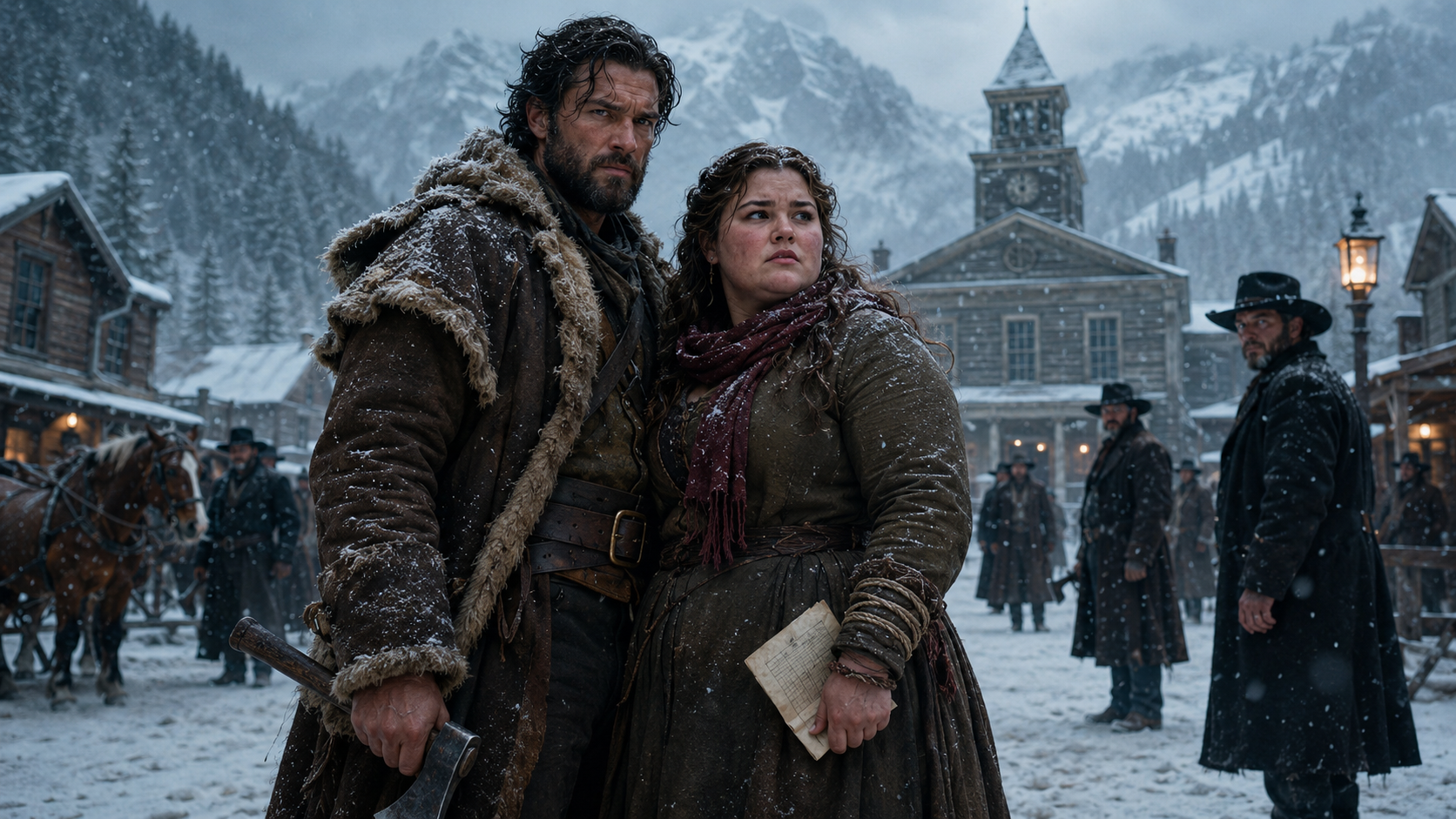
The county sheriff arrived two hours later, summoned by Deacon Harlan’s wife before dawn. By then, Trask’s cellar was open, the ledgers were spread across the mill hall tables, and half the town had found forged signatures written beside supplies they had never received.
Roland Pike was arrested after trying to flee.
Mabel Trask screamed until her voice gave out.
Mayor Crowe confessed quietly, not because he was noble, but because the evidence had finally grown heavier than his lies. He admitted Miriam had confronted him ten years earlier. He claimed her death had been an accident near the gorge, a struggle, a fall he never meant to cause.
Rowan listened without moving.
Clara stood beside him, close enough for her shoulder to touch his arm.
When Crowe finished, Rowan said only, “Show them where.”
The following spring, they found Miriam Vale beneath a cairn of stones near the river gorge.
Ash Hollow changed after that.
Not quickly.
Not cleanly.
Towns did not become honest overnight because guilty men were carried away. Shame had roots. Cowardice did too. But people began returning what they could. The church pantry reopened with three key holders instead of one. Relief ledgers were copied and read aloud at every meeting. Noah Finch became a deputy under the county sheriff. Mrs. Finch managed distribution and hired Clara to design the new inventory system.
Clara did not return to sleeping beside flour sacks in the mercantile.
She never again accepted wages promised “later.”
She lived on Blackbriar Pass.
At first, people whispered about that too.
Let them.
Clara had spent too much of her life being shaped by mouths that had never fed her.
She still had soft hips, a round face, and arms that filled her sleeves. She also had a steadier aim than half the men in town, a sharper head for numbers than any clerk Ash Hollow had ever hired, and a way of looking directly at liars that made them rethink their plans.
Rowan rebuilt the old smokehouse into a second cabin because, as he said, “People need doors of their own.”
Clara used it first for ledgers.
Then for storage.
Then for visitors who climbed the pass needing help Ash Hollow had once refused to give.
By autumn, Blackbriar became known less as the mountain where the killer lived and more as the place where no one asked what shape your shame had before offering coffee.
One evening, nearly a year after Clara had been tied to the courthouse rail, she and Rowan stood outside watching the first snow gather on the pines.
“Do you regret it?” he asked.
“Which part?”
“Staying.”
Clara looked down at the town lights flickering far below. Ash Hollow was still imperfect. So was she. So was Rowan. But imperfection no longer felt like a sentence.
She thought of the rope.
The crowd.
The ledger hidden against her heart.
She thought of Rowan walking into the square like a storm with a conscience.
She thought of herself raising a rifle and telling an entire town to look at her.
“No,” she said. “Not once.”
Rowan’s hand found hers, warm and scarred.
“Good,” he said. “Because I don’t either.”
The mountain wind moved around them, cold but no longer cruel. Below, Ash Hollow carried on, a little humbler, a little more careful with the truth. Above it, Clara Wynn stood without folding her shoulders inward, without apologizing for the space she filled, beside the man who had once demanded that a locked town open its door and let him see.
In the end, the lock that mattered had never been on a cellar.
It had been on fear.
And together, they had broken it.