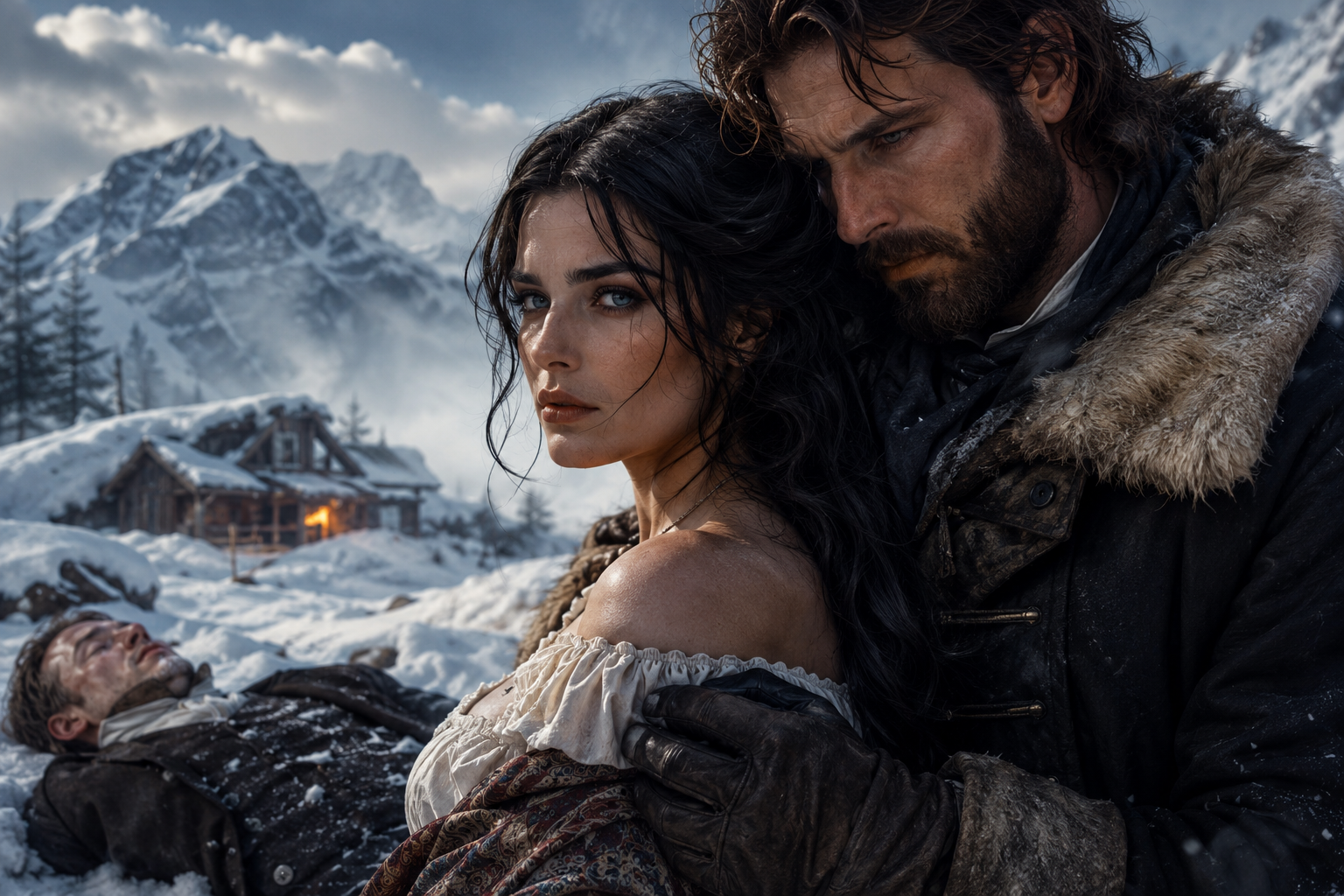
For one terrible second she wanted to. She wanted the mountain to swallow him, wanted every room he had controlled to hear the echo, wanted no other woman to learn the weight of his hand or the price of his smile.
Rowan stood beside her, one hand pressed to his bleeding side.
“Maribel,” he said softly.
Not command. Not plea. A reminder.
She breathed once. Twice.
Then she lowered the rifle.
Callum’s mouth curved.
That was his mistake.
Because Rowan stepped forward, took the knife, and threw it far into the creek ravine. Then he bound Callum’s hands with rawhide so tight the man gasped.
“What are you doing?” Callum demanded.
“Taking you down alive,” Rowan said.
Maribel looked at him. “Can we?”
“With difficulty.”
Callum laughed through bloodied teeth. “Alive, I talk.”
Maribel knelt in front of him. “Good. Talk loudly. Talk in court. Talk where miners’ widows can hear you. Talk where my mother’s map can answer.”
His eyes burned into hers. “You are nothing.”
She smiled then, small and cold and free.
“No,” she said. “I am the woman who said no.”
They left the watch station at sunset.
Callum walked between them, bound and stumbling, no longer elegant. Rowan’s wounds had been wrapped. Maribel’s feet ached with each step. The map lay safe inside her shirt, against her heart. The mountain trail down to Alder Creek was long, and night would come quickly, but the sky had cleared at last.
Stars appeared one by one.
Halfway down, Callum faltered near a drift and refused to move.
“You cannot drag me the whole way,” he spat.
Rowan looked at the darkening path, then at the man who had burned his cabin, hunted Maribel, and spoken of Rowan’s dead sister as though cruelty were wit.
“No,” Rowan said. “But I can make waiting memorable.”
He tied Callum to a pine with enough rope to stand, not enough to run. Then he built a small fire just beyond reach and placed a blanket over a branch where Callum could see it.
Maribel watched, uncertain. “We are leaving him?”
“For the sheriff and magistrate at first light. There is a patrol cabin two miles down. We reach it, send men back.”
Callum’s face changed. “You cannot leave me here.”
Rowan crouched before him. “You left miners under rotten beams. You left my sister behind a locked door. You left Maribel no choice but a blizzard. I am leaving you a fire you cannot touch and a night to consider distance.”
“It will freeze.”
“Not if you keep moving.”
Callum looked to Maribel. “You would allow this?”
She stepped close enough for him to see that she was not shaking anymore.
“All my life,” she said, “men told me mercy was obedience. Tonight I learned mercy can also be a rope, a witness, and a morning court.”
They walked away while he shouted after them.
His voice followed for a while, then faded into the trees.
By dawn, the sheriff’s men found Callum Voss alive, furious, frostbitten, and half buried by drifting snow. They dug him out cursing. They found the map in Maribel’s possession, the burned cabin above the ravine, the hired men hiding in a trapper’s shed, and enough fear among Callum’s former servants to turn silence into testimony.
News traveled faster than thaw.
By spring, the Voss Silver Works faced inquiry. By summer, widows received names for what had been called accidents. By autumn, Blackthorn Hall stood empty, its windows dark, its gates chained by creditors who discovered too late that power also leaves debts.
Maribel did not return to live there.
She sold what remained of the Ashford estate, paid what truly belonged to her father, and contested the rest. Aunt Eveline wrote once, asking forgiveness in language too careful to be honest and too sad to be cruel. Maribel answered with a single line:
I hope one day you try the door.
As for Rowan Hale, the valley expected him to return to the mountain and rebuild in solitude. He did rebuild, but not alone.
Maribel came first with nails, then with boards, then with a wagon full of supplies and a stubborn mule that refused every name except Duchess. She argued over the placement of windows. Rowan argued over the size of the woodpile. She wanted a blue door. He said blue invited weather. She painted it blue while he pretended not to watch.
One evening, months after the trial began and the snow had retreated to the highest peaks, they sat on the cabin steps while sunset turned the valley gold.
Rowan held out the silver hawk clasp, repaired and polished.
“Your mother was a clever woman,” he said.
“She was a frightened one too.”
“Clever and frightened often live in the same house.”
Maribel took the clasp. “Do you ever miss being alone?”
He looked across the ridge, then at her.
“Yes.”
She nodded, a little wounded despite herself.
“Sometimes,” he added, “I miss the quiet. Then you accuse my soup of lacking ambition, and I recover.”
She laughed.
He smiled, but his expression sobered. “Maribel.”
The way he said her name made her still.
“I love you,” he said. “That is not a claim. It is not a door closing. It is only a truth I did not want to hide in case hiding it made it heavier.”
Her throat tightened. The old fear rose by habit, looking for chains in every tender thing.
She found none.
“What do you want from me?” she asked.
“Nothing you do not place freely in my hands.”
The answer opened something wide and bright inside her.
She took his hand.
“Then hold this,” she said.
He looked down at their joined fingers. His thumb brushed once over her knuckles, careful as the first night, reverent as a vow.
Above them, the blue door stood open. Inside waited firelight, coffee, maps, two chairs, and a bed no one had turned into a deed.
Maribel leaned her shoulder against his.
“No man will ever own me,” she said.
Rowan kissed her hair, soft as falling snow.
“No,” he said. “But I would be honored to walk beside you.”
And this time, when the mountain wind rose, it did not sound like warning.
It sounded like freedom.