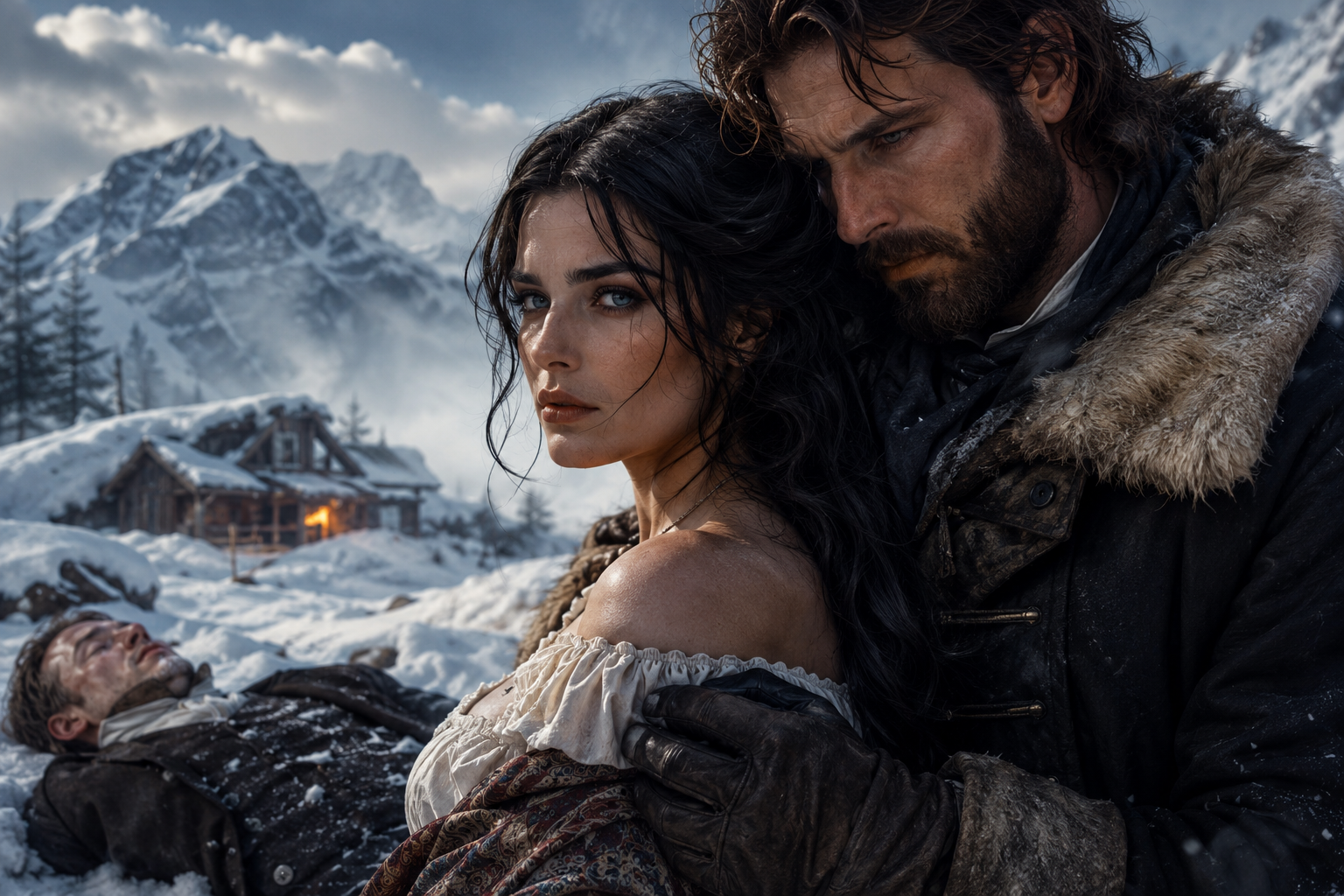
No Man Would Claim Her

The snow began before dusk, first as a whisper against the windowpanes, then as a white, furious curtain swallowing the valley road. By the time the last carriage wheels rolled away from Blackthorn Hall, the world beyond the iron gates had disappeared.

Maribel Ashford stood alone in the bridal chamber, still wearing the ivory gown chosen for her by people who had never asked what she wanted. Pearls circled her throat like a polite little noose. Satin gloves hid the half-moons her nails had cut into her palms during the ceremony rehearsal. Somewhere below, men laughed over brandy, servants carried silver trays through candlelit corridors, and her future husband spoke as though the matter were already settled.

Lord Callum Voss had not kissed her hand when her uncle announced the engagement. He had inspected it. He had turned her wrist in his fingers and said, “A wife with delicate bones learns obedience quickly.”

Everyone had laughed.

Maribel had smiled because she had been raised to smile at cruelty when it wore a gentleman’s coat.

Now she stood before the mirror and looked at the woman arranged inside it: pale face, pinned hair, lace sleeves, a bride who belonged to a house, to a contract, to a man waiting downstairs with a ring and a legal claim. The mirror showed beauty. Maribel saw a locked door.

A soft knock sounded.

She did not answer.

The door opened anyway, and Aunt Eveline entered with a cup of warm milk in her hand and a warning in her eyes.

“You must come down soon,” Eveline said. “Callum dislikes being kept waiting.”

“I am not going to marry him.”

The words came out quietly. Maribel expected them to tremble. They did not.

Her aunt stopped halfway across the room. “Do not begin this foolishness again.”

“It is not foolishness to refuse a cage.”

“It is foolishness to call comfort a cage.” Eveline set the cup on the dressing table hard enough to spill a white crescent over the saucer. “Your father left debts. Your mother left nothing but pride. Pride does not pay creditors, Maribel.”

“My father’s debts were not mine.”

“They became yours the moment men began discussing your future.”

Maribel turned from the mirror. “Men discuss many things they cannot own.”

Eveline’s face hardened. “A woman without protection is owned by hunger first, then by scandal. Callum offers you a name, a roof, position—”

“He offers a velvet collar.”

“He offers survival.”

“No,” Maribel said. “He offers himself.”

The wind screamed along the eaves. From below came the faint rise of voices, then a burst of laughter. Callum’s laugh was easy to recognize. It was always controlled, never joyful, the sound of a man practicing charm because command would not suit the parlor.

Eveline lowered her voice. “You are overwrought. The snow, the ceremony, the strain—”

“I am clear.”

“No, you are a child.”

“I am twenty-two.”

“You are unmarried. That is what matters.” Her aunt moved closer, speaking now with urgency instead of scorn. “Listen to me. Once the vows are spoken, much becomes easier. You will have security. You will have servants. You will have influence if you learn when to be silent.”

“And when he locks my door?”

Eveline flinched.

Maribel saw the answer in her face before her aunt could hide it.

“So you know,” Maribel whispered. “You know what kind of man he is.”

“I know what kind of world this is.”

The words settled between them colder than the storm.

Maribel reached behind her neck and unclasped the pearls. They fell into her palm, heavy and slick.

“Tell Lord Voss,” she said, “that no man will claim me while I still have breath enough to say no.”

Eveline stared. “And where will you go? Into the snow? Into the mountains? Wolves would show you more mercy than society.”

“Then I will take my chances with wolves.”

She threw the pearls onto the dressing table, gathered up her skirts, and crossed to the wardrobe. Beneath folded blankets lay the only thing she had hidden from the house: her mother’s old riding cloak, dark blue wool with a torn lining and a silver clasp shaped like a hawk. It smelled faintly of cedar, dust, and childhood. She pulled it over her wedding gown and tied it at her throat.

Eveline’s face drained of color. “Maribel.”

The use of her name without command nearly stopped her.

Nearly.

“I loved your mother,” Eveline said, and for the first time her voice broke. “She ran once too. She came back with frost in her hair and sorrow in her bones.”

“Did she regret running?”

Eveline did not answer.

That was enough.

Maribel went to the window, shoved the latch upward, and pushed against the frame. The storm fought her. For one breathless second she thought the house would keep her after all. Then the old wood groaned open, and winter burst into the room.

Behind her, Eveline whispered, “He will follow.”

Maribel climbed onto the sill.

“Then let him learn the road.”

She dropped into the snow.

The fall knocked the breath from her lungs. Cold surged under the cloak, through lace and silk, across skin never meant for mountain weather. She bit back a cry, rose shaking, and ran.

Behind her, Blackthorn Hall burned with light. Before her lay the orchard, the stable yard, the ridge path, and beyond that the high pass leading into a wilderness people spoke of only when firelight was strong and doors were locked. Maribel had ridden the lower trail in summer with grooms and picnic baskets. In winter, no sensible person climbed it after dark.

That was why she chose it.

The wind erased her tracks almost as quickly as she made them. Her slippers tore. Her gown caught on brambles. Twice she fell and came up with snow plastered to her sleeves. Somewhere behind, a bell began ringing.

They had discovered her absence.

She ran harder.

By the time she reached the pines, her lungs burned and the world had narrowed to white ground, black trunks, and the frantic drum of her heart. The ridge path rose sharply. The wedding gown became a weight dragging her backward. She tore at the skirt until lace ripped from hip to hem, freeing her knees. The sound might have made her laugh on any other night. Now she only climbed.

Hours blurred.

Snow filled her hair. Ice formed along her lashes. The storm stole direction, distance, sense. The ridge path vanished beneath drifts. Maribel kept moving because stopping felt too much like surrender. Once she heard hooves below and pressed herself behind a fallen pine, scarcely breathing as lantern light bobbed through the trees.

Callum’s voice carried upward.

“She cannot have gone far.”

Another man answered, “Not dressed like that, my lord.”

“Find her,” Callum said. “Alive if convenient.”

Maribel’s blood turned colder than the snow.

She waited until the lights moved away, then crawled from hiding and climbed toward the darker shoulder of the mountain. The wind had become a living thing, clawing at her cloak, shoving her sideways, hissing in her ears. Her feet had gone numb. Her hands no longer felt like hands.

When she saw the cabin light, she thought it was a star fallen among the trees.

It glowed small and amber beyond a stand of firs. Smoke bent low from a stone chimney. A mule stood under a lean-to, head down against the weather. Maribel stumbled toward it, no longer caring who waited inside. Wolf, thief, madman, saint—it did not matter. The cold had become a voice telling her to lie down.

She reached the door and lifted her fist.

The world tilted.

The last thing she heard before darkness took her was the door opening and a man saying, “Merciful heaven.”

Warmth returned as pain.

Maribel woke to firelight and the smell of pine smoke. She was lying beneath heavy blankets on a narrow bed. Her wedding gown hung in stiff, ruined folds over a chair. Her cloak had been spread near the hearth to dry. For one wild moment she thought she had been brought back to Blackthorn Hall.

Then she saw the room.

A single table. A rough shelf of tin cups. A rifle above the mantel. Snowshoes near the door. Bundles of herbs hanging from beams. No velvet. No portraits. No polished lies.

A man sat on the floor with his back against the wall, asleep but not peacefully. He was large in the way mountains were large, broad-shouldered, bearded, wrapped in a patched coat with one hand resting close to a knife. His dark hair fell across his forehead. Firelight carved deep lines beside his mouth and eyes, giving him the look of someone who had outlived more than one version of himself.

Maribel tried to sit up.

The man woke instantly.

“Easy,” he said, rising but not approaching. “You took half the storm into your bones.”

His voice was low, roughened by solitude. It did not soften for her like a gentleman’s performance. It simply existed, steady and unadorned.

“Where am I?” she asked.

“My cabin.”

“That tells me very little.”

“A fair answer for a woman who fell on my doorstep wearing a wedding dress in a blizzard.”

Maribel looked down. Someone had wrapped her in a clean wool shirt and loose trousers. Heat rushed to her face.

He noticed and turned toward the hearth at once, giving her his back. “Your clothes were frozen stiff. I cut away what I had to. I kept my eyes where a decent man keeps them. My name is Rowan Hale. Most folks in the valley call me North, on account of I live farther up than common sense.”

“Maribel Ashford.”

“I guessed the Ashford part.”

Her fingers tightened around the blanket. “How?”

“Only people from Blackthorn Hall wear silk in weather that can kill a horse.”

The name of the house struck like a hand around her throat. “Did anyone come?”

“Riders passed below an hour before dawn. Didn’t see the cabin.”

“Were they led by Lord Voss?”

Rowan looked over his shoulder, his expression unreadable. “A pale man on a black horse?”

“Yes.”

“He carries himself like weather should ask permission.”

“That is Callum.”

“Your husband?”

“No.”

“Your intended?”

“No.”

Rowan studied her for a moment, then nodded as though she had given him all the law he required. “Then he has no claim here.”

No claim.

The words were so simple that Maribel almost wept.

She looked toward the door, where snow pressed against the threshold in a silver ridge. “He will say otherwise.”

“Men say many things when they expect the world to kneel.”

“And do you?”

“Expect the world to kneel?” His mouth twitched. “No. I’ve had better luck asking coffee not to burn.”

The answer surprised a laugh from her. It hurt her cracked lips. The laugh became a shiver.

Rowan took one step closer, then stopped. “May I?”

She understood he meant the chair beside the bed.

The question undid something in her. Not the kindness itself, but the caution of it. Callum asked questions as traps. Rowan asked as though her answer mattered.

“Yes,” she said.

He sat, leaving distance between them. “You need broth. Then sleep. After that, we talk about the safest way down.”

“I cannot go down.”

“You cannot stay up here forever.”

“I can if forever is shorter than marriage to Callum Voss.”

Rowan’s eyes narrowed, not in judgment, but attention. “What did he do?”

Maribel looked at the fire. “He bought the debts attached to my father’s estate. He arranged the engagement with my uncle. He smiled while everyone told me I was fortunate. He told me after supper that a wife’s fear is only disobedience wearing perfume.”

The cabin went silent except for the storm.

Rowan’s hands rested on his knees. They were rough hands, scarred and square-knuckled. Hands that could break wood, carry weight, hold a weapon. Yet they did not move toward her.

“My mother used to say,” Maribel continued, “that some doors only look locked because we were taught never to try them. Tonight I tried.”

“And nearly died.”

“Yes.”

“Was it worth the risk?”

She turned to him. “I am here, am I not?”

“Barely.”

“But not his.”

For a long moment, Rowan said nothing. Then he rose, crossed to the hearth, and ladled broth from a blackened pot into a tin cup.

“My sister said something like that once,” he said.

Maribel accepted the cup with both hands. “Your sister?”

“Lydia.” He said the name as if it still had edges. “She married a man the town admired. He owned a mill, donated to the church, spoke politely to widows. Behind closed doors, he treated marriage like a deed to land.”

Maribel lowered the cup. “What happened to her?”

Rowan’s jaw tightened. “She wrote asking me to come. By the time I got there, I was too late.”

“I’m sorry.”

He nodded once. “I came up the mountain after that. Figured if I could not be useful to the living, I could at least stop disappointing them.”

The fire cracked.

“You saved me,” Maribel said.

“I opened a door.”

“Sometimes that is enough.”

His gaze met hers then, and something passed between them—not romance, not yet, not trust fully formed, but recognition. Two people carrying different wounds from the same kind of world.

Outside, the wind dropped.

Rowan turned his head.

Maribel heard it a heartbeat later: a distant horse, then another, muffled by snow.

He moved quickly, taking the rifle from above the mantel. “Get away from the window.”

Her cup clattered onto the floor. “They found me.”

“Not yet. They found smoke.”

A voice rose from the trees below, polished even through the storm.

“Mr. Hale. I know you are inside.”

Maribel stopped breathing.

Callum.

Rowan blew out the lantern. The cabin fell into firelit shadow.

Callum called again. “Send Miss Ashford out, and I will overlook your interference.”

Rowan stood beside the door, rifle angled downward. “Generous.”

“I am famous for generosity when men remember their station.”

Rowan slid the bolt back, chambering a round. “Your station is outside in the cold.”

Silence.

Then Callum laughed.

Maribel had heard that laugh in drawing rooms, over piano music, beside her uncle’s wine cabinet. Here in the dark, it sounded less refined. It sounded hungry.

“My dear Maribel,” Callum called. “You have made a dramatic point. I will forgive it. Come out now.”

She moved toward the wall, pressing a hand over her mouth.

Rowan glanced at her. “You owe him no answer.”

“I want to give one.”

“That may draw fire.”

“It may draw truth.”

Before he could stop her, Maribel stepped near the shutter but kept herself low. “I will not come with you.”

“My dear, you are cold, frightened, and confused.”

“No. I was confused when I thought fear was duty.”

“Do not embarrass yourself further.”

“I was embarrassed when I stood in a wedding gown chosen by my jailer.”

A sharp intake of breath came from outside. Not Callum’s. One of his men, perhaps.

Callum’s voice dropped. “Enough.”

“Yes,” Maribel said. “It is.”

The first shot shattered the window.

Rowan seized her around the waist and pulled her down as glass and splinters burst across the room. A second shot struck the mantel, showering stone dust into the fire. The mule screamed outside. Rowan rolled away, brought the rifle to his shoulder, and fired through the broken shutter.

A man cried out in the trees.

Maribel lay flat, heart hammering, cheek pressed to the floorboards. Fear tried to take her back to the bridal chamber, to the pearls, to Aunt Eveline’s voice saying survival meant silence.

She crawled toward the fallen tin cup, grabbed it, and threw it aside.

“What do I do?” she asked.

Rowan looked at her, then toward a smaller rifle leaning beside a crate.

“Ever fired one?”

“No.”

“Then tonight has been full of firsts.”

He shoved the rifle and a handful of cartridges toward her. “Load one at a time. Keep it pointed where you want thunder to go. Do not touch the trigger unless you mean it.”

Her hands shook. The cartridge slipped twice. On the third try it slid into place. Outside, Callum’s men spread through the trees. Rowan fired again. A muzzle flash answered. A bullet punched through the roof beam.

Smoke drifted in.

“They are at the lean-to,” Rowan said. “Trying to burn us out.”

Maribel smelled kerosene.

The fire outside caught with a hungry orange bloom. Heat licked through cracks in the wall. The mule broke its tether and bolted into the storm.

“Can we run?” she asked.

“Not through the door.”

“Then where?”

Rowan threw back the bearskin rug near the hearth and hooked two fingers through an iron ring hidden in the floor. A trapdoor lifted, revealing black earth and darkness.

Maribel stared. “You built a tunnel?”

“I distrust visitors.”

“Wise man.”

“First time anyone called it that.”

He dropped a satchel into the hole, then turned to her. “Go.”

“What about you?”

“I follow.”

The cabin shook as flames climbed the lean-to. Maribel lowered herself into the tunnel. Cold dirt scraped her palms. The space was narrow enough to turn each breath into a decision. She crawled forward with the rifle dragging beneath her, listening to Rowan pull the trapdoor shut behind them.

Above, boots crashed into the cabin.

A man shouted, “They’re gone!”

Another shot rang out, useless and furious.

The tunnel sloped downward through frozen earth, then opened behind a screen of brush in a ravine. Dawn had begun to stain the storm clouds gray. The cabin above burned like a warning to the sky.

Rowan emerged behind her, coughing. Blood darkened his sleeve.

“You’re hurt,” Maribel said.

“Splinter.”

“That is blood.”

“A bloody splinter.”

She caught his arm before he could move away. “Do not treat me like a fool.”

He looked down at her hand on his sleeve. She let go at once, but he did not rebuke her. Instead he leaned against the ravine wall and exhaled.

“A bullet grazed me.”

The wound ran along his upper arm, deep enough to soak his shirt. Maribel tore a strip from the hem of the ruined wedding gown still beneath her borrowed coat. The gown had been made for a ceremony. It would serve better as a bandage.

“This will hurt,” she said.

“Likely.”

She tied the cloth tight. Rowan’s face went pale, but he made no sound.

“You have done this before?” he asked.

“No.”

“You lie with confidence.”

“I learn quickly under pressure.”

“That I believe.”

They climbed as the sky brightened. Snow continued falling, softer now, smoothing the ravine behind them. Rowan knew paths invisible to her—deer trails, frozen creek beds, cuts between boulders. Still, blood loss slowed him. Twice he stumbled. Twice Maribel pretended not to notice his pride collapsing.

At the top of a ridge, they found a narrow shelf beneath an overhang. Rowan pulled her into its shadow moments before riders appeared below.

Callum rode at the front on his black horse, elegant as a funeral. Three men followed with rifles. A fourth led another horse, side-saddle already strapped, as though Maribel’s return were an errand delayed by weather.

Callum dismounted and looked up toward the ridge.

“Maribel,” he called. “This has become tiresome.”

Rowan’s hand tightened on his rifle.

Maribel whispered, “Can we outrun them?”

“No.”

“Can you shoot them?”

“Not all before they shoot back.”

“Then we speak.”

Rowan gave her a look. “That usually ranks low among survival plans.”

“It is the only weapon he believes I do not have.”

Before Rowan could answer, Maribel stepped from the overhang.

Callum saw her and smiled.

Not with relief. With possession restored in imagination.

“There you are.”

“Here I am.”

“You look dreadful.”

“I feel clear.”

His smile thinned. “Come down.”

“No.”

A flicker of impatience crossed his face. “This rebellion has cost one man his cabin, another his blood, and you any mercy society might have extended. You have made your point.”

“I have not begun.”

Callum removed his gloves slowly. “You think refusal makes you strong. It does not. Refusal merely delays the inevitable until hunger, law, or force corrects you.”

“Law?” she said. “You speak of law after buying debts, bribing my uncle, and arranging a marriage without my consent?”

“Consent is a decorative word. Families arrange futures. Women accept them.”

“Not this woman.”

His gaze hardened.

Rowan stepped beside her, rifle lowered but ready. “You heard her.”

Callum looked at him with sudden recognition. “Rowan Hale.”

Rowan went still.

Callum’s smile returned. “No. Not Hale. Rowan Vale, wasn’t it? Lydia’s brother.”

Maribel felt Rowan change beside her, as if every old wound had opened beneath his skin.

Callum continued softly, “Your sister was difficult too. Less theatrical, perhaps, but difficult. My cousin never did have patience for difficult women.”

Rowan raised the rifle.

Maribel caught the barrel before it lifted fully. “No.”

“He knows what happened to her,” Rowan said.

“Yes. And he wants your grief to aim for you.”

Callum clapped slowly, the sound crisp in the snow. “How touching. The runaway bride has learned strategy.”

Maribel’s eyes never left his. “Why do you want me so badly?”

“My dear, you flatter yourself.”

“No. You could have chosen ten other desperate women with better manners and fewer objections. You chose me. You pushed the engagement quickly. You searched for me in a blizzard. Why?”

For the first time, Callum looked annoyed rather than amused.

Maribel remembered her mother’s cloak, the torn lining, the silver hawk clasp. She remembered Aunt Eveline’s face when she took it from the wardrobe. She remembered her mother whispering once, long ago, that hawks hide what doves cannot carry.

Her hand rose to the clasp.

Callum’s eyes followed.

There.

A truth, small as a spark.

Maribel unclasped the hawk and turned it over. The back plate, worn by years, had a hairline seam. Her numb fingers struggled until the plate opened. Folded inside, wrapped in oilskin, lay a tiny square of paper.

Rowan looked at it. “What is that?”

Callum’s voice cut across the snow. “Give it to me.”

Maribel unfolded the paper.

Not a letter. A map.

Lines crossed the page: ridges, a creek, three marked shafts, and a name written in her mother’s hand.

Voss Silver Works.

Rowan’s face sharpened. “Those are mine tunnels.”

“My father invested in them,” Maribel said, memories surfacing. “My mother accused Lord Voss’s family of stealing claims after a collapse. Everyone said grief made her foolish.”

Callum’s jaw tightened. “Your mother meddled in business she did not understand.”

“She hid proof.”

“She hid confusion.”

“She hid something you are willing to kill for.”

The men behind Callum shifted.

Maribel lifted the map high. “If I go back with you, I vanish into your house. If I die here, the map still exists. If you shoot Rowan, I scream until every man in the valley asks why Lord Voss chased a bride into a storm for a scrap of paper.”

Callum’s expression became very calm.

That frightened her more than anger.

“You overestimate the valley’s appetite for truth.”

“And you underestimate mine.”

For a moment, the mountain held its breath.

Then Callum drew his pistol.

Rowan fired first.

The shot struck Callum’s hand, spinning the pistol into the snow. Callum screamed. His men raised their rifles. Maribel lifted hers and fired without thinking. The bullet struck a branch above them, dumping snow onto the nearest horse. The animal reared, crashing into another. Chaos broke the neat line of weapons.

Rowan grabbed Maribel’s wrist. “Run.”

They ran along the ridge as shots cracked behind them. Snow burst from rocks. Bark shattered. Rowan pulled her through a gap between boulders and down a slope so steep they half slid, half fell into a lower basin. At the bottom stood a frozen creek, its surface milky under fresh snow.

“Across,” Rowan said.

“Will it hold?”

“No.”

He stepped onto the ice anyway.

It groaned.

Maribel followed, every nerve screaming. Behind them, Callum’s men reached the slope. One fired. The bullet struck the ice near Maribel’s foot. A black crack opened.

“Faster,” Rowan said.

They were three steps from the far bank when the ice broke.

Maribel plunged to her thigh. Cold seized her with such violence she could not even scream. Rowan turned back, caught her under the arms, and hauled her free. Together they collapsed onto the bank as the creek split wider behind them.

One of Callum’s men tried to cross and stopped at the sight of the black water.

Callum stood on the opposite bank, cradling his bleeding hand, his face twisted by rage.

“You cannot run forever,” he shouted.

Maribel rose, shaking, soaked, alive.

“No,” she called back. “But I can run farther than your permission.”

Rowan pulled her into the trees.

By noon they reached an old watch station used by trappers in summer and forgotten in winter. It leaned against the mountain, half buried, but the roof held. Inside were dry kindling, a rusted stove, and a crate of supplies Rowan had hidden years before.

“You prepare for everything,” Maribel said through chattering teeth.

“Not everything.”

He looked at her when he said it.

This time, warmth that had nothing to do with the stove moved through the room, fragile and dangerous. Maribel looked away first.

Rowan built a fire. She changed behind a hanging blanket into wool clothes too large for her, then sat near the stove while he checked the map. His wounded arm had stiffened. His face was gray with exhaustion.

“You need a doctor,” she said.

“And you need dry boots, legal help, witnesses, and a town not owned by Voss.”

“One impossible thing at a time.”

He smiled faintly. “There is a magistrate in Alder Creek who hated Callum’s father. If we reach him with that map, it may matter.”

“May?”

“Truth matters more when someone powerful can profit by hearing it.”

Maribel sat beside him. “You do not trust much.”

“No.”

“Do you trust me?”

He looked at her then, and the silence that followed was not empty.

“I trust that you choose,” he said. “That is more than I trust most.”

Her throat tightened.

Outside, the storm thinned. Sunlight pressed weakly through cloud, turning the snowfields silver. For an hour they rested. Maribel expected sleep to swallow her, but her mind would not stop circling Callum’s face, her aunt’s warning, her father’s debts, her mother’s hidden map.

Then a sound broke the quiet.

A horse.

Rowan was on his feet at once, rifle ready.

Maribel took the smaller gun and moved to the side window. Through a crack in the boards, she saw Callum riding alone into the clearing. His hand was bandaged red. His face was pale. No men followed him.

“That is wrong,” Rowan muttered.

Callum stopped ten yards from the door.

“Maribel,” he called. His voice was ragged now, charm worn thin by pain. “Come out. Just you. Let us end this without further stupidity.”

Rowan shook his head.

Maribel answered from inside. “Say what you came to say.”

“I came to offer mercy.”

“You came alone because your men abandoned you.”

A pause.

Then Callum laughed once, bitterly. “Men hired by coin leave when coin begins to look cursed.”

“Wise men.”

“You think you have won because you found a trinket in a cloak. You have not. The courts will bury you. Your uncle will deny you. Your aunt will weep on command. The magistrate will hesitate. Papers vanish. Witnesses reconsider. I know the world, Maribel.”

She opened the door.

Rowan hissed her name.

She stepped onto the threshold but did not move farther. “You know your world.”

Callum’s gaze moved over her: the borrowed coat, the rifle, the tangled hair, the absence of pearls. Disgust and fascination warred in his eyes.

“You look like a beggar.”

“I look like myself.”

“You look ruined.”

“Only to men who price women like furniture.”

His mouth tightened. “Come with me now, and I will still marry you.”

The absurdity of it struck her so hard she almost smiled. “Still?”

“You need my name.”

“I have one.”

“You need my house.”

“I slept better in the snow.”

“You need protection.”

“I needed protection from you.”

Something in him snapped.

He dismounted, drawing a knife with his left hand.

Rowan stepped out behind her, rifle raised. “Stop.”

Callum did not. His eyes were fixed on Maribel, and in them she saw the truth stripped clean: not love, not desire, not even ambition alone. He hated that she had refused him and continued existing afterward.

“You will not make me small,” Callum said.

Maribel lifted the rifle.

“I never made you anything.”

He lunged.

Rowan fired, but Callum’s horse jerked sideways at the blast, and the shot went wide. Callum crashed into Maribel, driving her back into the snow. The rifle flew from her hands. His knife flashed downward. She caught his wrist with both hands, the blade trembling inches from her throat.

“You should have smiled,” he snarled.

She drove her knee upward. He grunted. Rowan reached them, but Callum twisted, slashing wildly. The knife cut Rowan across the side. Rowan staggered. Callum grabbed the fallen rifle and swung it toward him.

Maribel seized the silver hawk clasp from her cloak and drove its sharp pin into Callum’s wounded hand.

He screamed.

Rowan struck him hard across the jaw. Callum fell backward into the snow, stunned but not unconscious. The rifle lay between them. Maribel snatched it first and aimed at his chest.

Callum froze.

His breath came fast, fogging the air. Blood spotted the snow around him like scattered rubies.

“You will not shoot me,” he said, but doubt had entered his voice.

Maribel’s finger rested near the trigger.

For one terrible second she wanted to. She wanted the mountain to swallow him, wanted every room he had controlled to hear the echo, wanted no other woman to learn the weight of his hand or the price of his smile.

Rowan stood beside her, one hand pressed to his bleeding side.

“Maribel,” he said softly.

Not command. Not plea. A reminder.

She breathed once. Twice.

Then she lowered the rifle.

Callum’s mouth curved.

That was his mistake.

Because Rowan stepped forward, took the knife, and threw it far into the creek ravine. Then he bound Callum’s hands with rawhide so tight the man gasped.

“What are you doing?” Callum demanded.

“Taking you down alive,” Rowan said.

Maribel looked at him. “Can we?”

“With difficulty.”

Callum laughed through bloodied teeth. “Alive, I talk.”

Maribel knelt in front of him. “Good. Talk loudly. Talk in court. Talk where miners’ widows can hear you. Talk where my mother’s map can answer.”

His eyes burned into hers. “You are nothing.”

She smiled then, small and cold and free.

“No,” she said. “I am the woman who said no.”

They left the watch station at sunset.

Callum walked between them, bound and stumbling, no longer elegant. Rowan’s wounds had been wrapped. Maribel’s feet ached with each step. The map lay safe inside her shirt, against her heart. The mountain trail down to Alder Creek was long, and night would come quickly, but the sky had cleared at last.

Stars appeared one by one.

Halfway down, Callum faltered near a drift and refused to move.

“You cannot drag me the whole way,” he spat.

Rowan looked at the darkening path, then at the man who had burned his cabin, hunted Maribel, and spoken of Rowan’s dead sister as though cruelty were wit.

“No,” Rowan said. “But I can make waiting memorable.”

He tied Callum to a pine with enough rope to stand, not enough to run. Then he built a small fire just beyond reach and placed a blanket over a branch where Callum could see it.

Maribel watched, uncertain. “We are leaving him?”

“For the sheriff and magistrate at first light. There is a patrol cabin two miles down. We reach it, send men back.”

Callum’s face changed. “You cannot leave me here.”

Rowan crouched before him. “You left miners under rotten beams. You left my sister behind a locked door. You left Maribel no choice but a blizzard. I am leaving you a fire you cannot touch and a night to consider distance.”

“It will freeze.”

“Not if you keep moving.”

Callum looked to Maribel. “You would allow this?”

She stepped close enough for him to see that she was not shaking anymore.

“All my life,” she said, “men told me mercy was obedience. Tonight I learned mercy can also be a rope, a witness, and a morning court.”

They walked away while he shouted after them.

His voice followed for a while, then faded into the trees.

By dawn, the sheriff’s men found Callum Voss alive, furious, frostbitten, and half buried by drifting snow. They dug him out cursing. They found the map in Maribel’s possession, the burned cabin above the ravine, the hired men hiding in a trapper’s shed, and enough fear among Callum’s former servants to turn silence into testimony.

News traveled faster than thaw.

By spring, the Voss Silver Works faced inquiry. By summer, widows received names for what had been called accidents. By autumn, Blackthorn Hall stood empty, its windows dark, its gates chained by creditors who discovered too late that power also leaves debts.

Maribel did not return to live there.

She sold what remained of the Ashford estate, paid what truly belonged to her father, and contested the rest. Aunt Eveline wrote once, asking forgiveness in language too careful to be honest and too sad to be cruel. Maribel answered with a single line:

I hope one day you try the door.

As for Rowan Hale, the valley expected him to return to the mountain and rebuild in solitude. He did rebuild, but not alone.

Maribel came first with nails, then with boards, then with a wagon full of supplies and a stubborn mule that refused every name except Duchess. She argued over the placement of windows. Rowan argued over the size of the woodpile. She wanted a blue door. He said blue invited weather. She painted it blue while he pretended not to watch.

One evening, months after the trial began and the snow had retreated to the highest peaks, they sat on the cabin steps while sunset turned the valley gold.

Rowan held out the silver hawk clasp, repaired and polished.

“Your mother was a clever woman,” he said.

“She was a frightened one too.”

“Clever and frightened often live in the same house.”

Maribel took the clasp. “Do you ever miss being alone?”

He looked across the ridge, then at her.

“Yes.”

She nodded, a little wounded despite herself.

“Sometimes,” he added, “I miss the quiet. Then you accuse my soup of lacking ambition, and I recover.”

She laughed.

He smiled, but his expression sobered. “Maribel.”

The way he said her name made her still.

“I love you,” he said. “That is not a claim. It is not a door closing. It is only a truth I did not want to hide in case hiding it made it heavier.”

Her throat tightened. The old fear rose by habit, looking for chains in every tender thing.

She found none.

“What do you want from me?” she asked.

“Nothing you do not place freely in my hands.”

The answer opened something wide and bright inside her.

She took his hand.

“Then hold this,” she said.

He looked down at their joined fingers. His thumb brushed once over her knuckles, careful as the first night, reverent as a vow.

Above them, the blue door stood open. Inside waited firelight, coffee, maps, two chairs, and a bed no one had turned into a deed.

Maribel leaned her shoulder against his.

“No man will ever own me,” she said.

Rowan kissed her hair, soft as falling snow.

“No,” he said. “But I would be honored to walk beside you.”

And this time, when the mountain wind rose, it did not sound like warning.

It sounded like freedom.