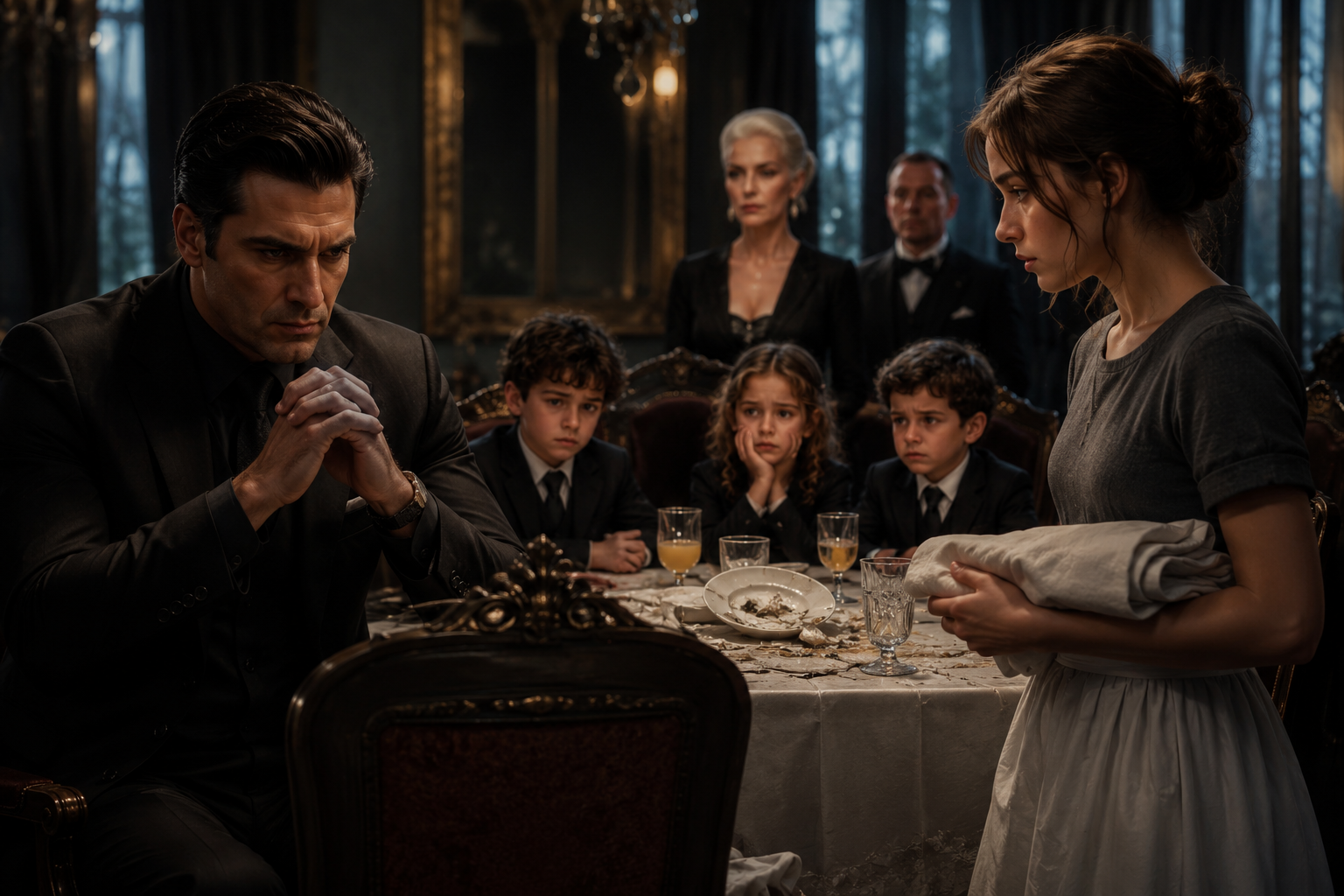
Stella shook her head. “Mama made moons.”
Dante looked at his daughter.
“What?”
Stella pointed to the napkin. “She made one for me. One for Matteo. One for Nico.”
Nico wiped his face with his sleeve. “She said if the house got dark, we should count the moons.”
Matteo stared at the empty chair. “She said no one could take her chair unless we let them.”
Dante gripped the back of the nearest chair until his knuckles whitened.
For three years, he had been told the children attacked governesses because they were angry at their mother. Because they blamed every woman who entered the house. Because they were damaged, disobedient, impossible.
But Lila saw what he was seeing now.
The triplets had not been defending chaos.
They had been defending a place.
Selene stepped forward. “Children remember things incorrectly. Grief rearranges memory.”
“No,” Lila said before she could stop herself.
Selene’s eyes snapped toward her. “Excuse me?”
Lila’s mother appeared in the service doorway then, face pale beneath the harsh light. Rosa Moreno still wore her gray laundry apron, her hair wrapped in a scarf, her hands red from steam and soap.
“Lila,” she whispered. “Enough.”
But it was too late for enough.
Dante looked past Lila to Rosa.
“Mrs. Moreno,” he said. “Come in.”
Rosa did not move.
Two guards shifted, as if waiting to block her. Dante saw it.
“Let her pass.”
The guards stepped aside.
Rosa entered the dining room like a woman stepping into a courtroom where the judge already hated her. In one hand she carried a mended pillowcase. In the other she held Lila’s old metal lunch tin, the blue one with chipped paint and a broken clasp.
Selene went very still.
“Rosa,” she said gently. “You are tired. This is a family matter.”
Rosa looked at the triplets. Then at Dante.
“No, ma’am,” she said. “It became mine the morning your family’s secrets came down my laundry chute.”
Dr. Voss closed his medical case.
Dante noticed.
“Leave it open,” he said.
The doctor’s hand froze.
Rosa set the lunch tin on the table. Lila opened it because her mother’s fingers had begun to shake.
Inside lay a child’s hair ribbon, a cracked ivory button, a small silver charm shaped like a crescent moon, and a folded strip of hospital intake paper so old the crease had browned. The letters were faded, but readable.
Isabel Moretti. Emergency admission. Time: 1:16 a.m.
The date was three years earlier.
The night Isabel was supposed to have packed a suitcase and left the house before midnight.
Dante stared at the paper as if it had risen from a grave.
“Where did this come from?” he asked.
Rosa’s eyes filled, but she did not look away.
“The next morning, I found it tangled in a sheet from the private wing. There was mud on the hem. Not garden mud. Road mud. I thought Mrs. Moretti had been hurt. I went to Mrs. Harrow.”
Selene’s face remained calm.
Rosa continued. “She told me Mrs. Moretti had left willingly. She said if I repeated kitchen gossip, I would lose my position. Then she said people might remember the missing moon necklace from Mrs. Moretti’s room and wonder why a laundry woman suddenly had enough money for medicine and rent.”
Lila turned to Selene.
“My mother never told you which necklace,” she said.
Selene blinked once.
Lila’s voice grew steadier. “She only said you threatened her. You said moon necklace.”
The room turned toward Selene.
A tiny mistake.
A fatal one.
Dante picked up the crescent charm from the tin. His thumb brushed the edge as if his skin recognized it before his mind did.
“She wore this on a chain,” he said.
Rosa nodded. “It was in the sheet too.”
Selene’s composure bent, but did not break. “This is absurd. A laundry woman hoards trinkets for three years and suddenly becomes a witness?”
“No,” Lila said. “She became afraid for three years.”
Dante looked at Rosa. “Why keep it?”
Rosa’s voice almost failed. “Because if Mrs. Moretti left, I did not understand why her things came down hidden in bloody—”
She stopped.
Lila squeezed her hand.
Rosa corrected herself. “In ruined sheets. And if she did not leave, I did not know who I could tell.”
No one spoke.
Rain struck harder against the windows. The chandelier hummed faintly above them. Somewhere far in the house, a door closed.
Dante turned to the silver-haired man near the fireplace. Enzo Calder had been his adviser for twenty years. He had watched the whole dinner without a word, his hands folded over the head of his cane.
“Records,” Dante said.
Enzo nodded.
“Service elevator. Garage. West hall. Laundry level. Three years ago tonight.”
Selene laughed softly. “You cannot be serious.”
Dante looked at her.
The laugh died.
Within fifteen minutes, the dining room emptied of everyone who did not need to hear what came next. The children were sent to the small sitting room with Lila, but Stella refused to release the old napkin, and Dante did not make her.