No Governess Lasted One Dinner With the Moretti Triplets—Until the Laundry Room Girl Spoke the Name Their Father Had Buried

The seventh governess quit before dessert.

She did not make a scene. Women hired by the Moretti household were trained, polished, and expensive enough to understand that panic looked vulgar in silk. Miss Rosalind Wren merely rose from the dining table with her napkin clenched in one shaking hand, bowed stiffly toward Dante Moretti, and said, “I’m afraid I am not the right fit for your family.”

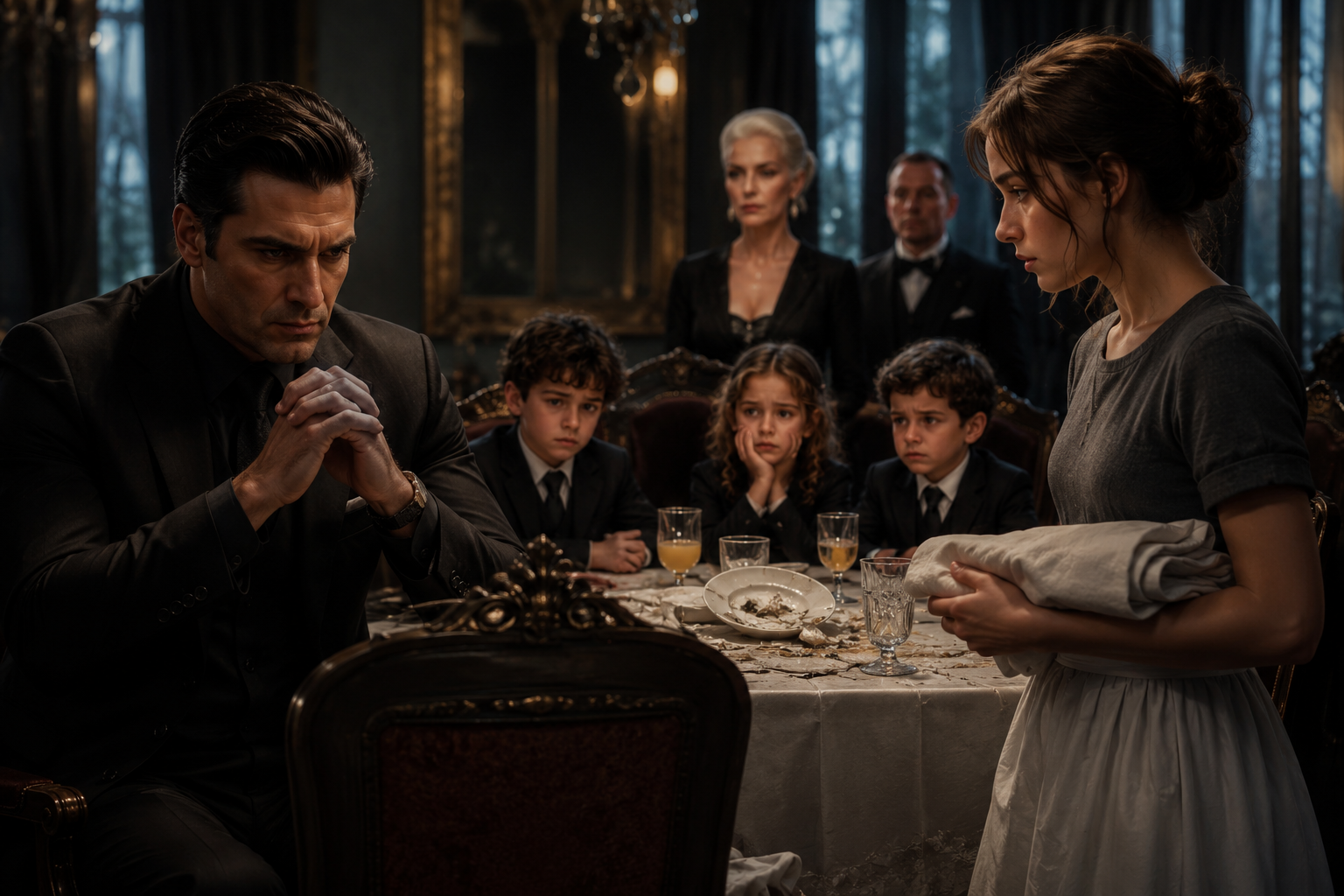
A porcelain bowl lay shattered near her feet. Cream soup had splashed across the antique rug like pale paint. One crystal glass had rolled under the sideboard. A silver fork sat bent beside little Stella Moretti’s chair, though no one had seen the child bend it.

Dante did not move.

At the head of the long mahogany table, beneath a chandelier bright enough to make every lie look elegant, he looked more like a judge than a father. His black suit was perfect. His dark hair was brushed back. His hands rested on either side of his untouched plate.

Across from him sat his three children.

Matteo, the oldest by four minutes, had eyes too serious for a seven-year-old. He stared at Miss Wren as if he were memorizing another betrayal.

Nico, small and narrow-shouldered, kept his gaze on his lap. His lower lip trembled, but he would rather have bitten through it than cry in that room.

Stella, with her dark curls pinned too tightly away from her face, had gone silent in the frightening way only children can—silent not because they do not feel, but because they have learned no one comes when they do.

Dante looked at the ruined table. Then at Miss Wren.

“You were recommended by the Van Asten family,” he said.

Miss Wren’s face went pale. “Yes, sir.”

“They said you handled difficult children.”

The word difficult moved across the table like a knife being passed from hand to hand.

Matteo’s shoulders rose.

Nico shut his eyes.

Stella’s fingers curled around the edge of her chair.

From the service doorway, Lila Moreno saw all of it.

She should not have been there. Laundry girls were not supposed to hover near the private dining room, especially not during family dinner. But the upstairs housekeeper had sent her with fresh napkins after Stella had overturned the first basket. Lila had arrived just in time to see Miss Wren reach toward the empty chair beside Dante and say, in a cheerful voice, “Perhaps we should remove this extra setting. Empty places make children dwell on unpleasant things.”

Then the war had started.

Stella had screamed.

Nico had knocked over the soup.

Matteo had thrown a glass—not at Miss Wren, never quite at her, but near enough to make her understand that the Moretti triplets could calculate distance better than most grown men.

And now the seventh governess was leaving, just like the six before her.

Dante lifted one hand.

A guard near the wall stepped forward and escorted Miss Wren out. The woman did not even ask for her coat.

The dining room fell into a silence so heavy Lila could hear rain tapping against the tall black windows.

Beside Dante’s right shoulder stood Selene Harrow, the woman who had run the Moretti estate since Dante’s wife disappeared three years earlier. Selene was beautiful in a cold, marble sort of way, with silver-blond hair twisted at her neck and a black dress that made grief look fashionable. She placed a hand on Dante’s chair.

“You see?” she said softly. “This is exactly why the children need structure. A firmer arrangement. A permanent decision.”

Dante did not answer.

Dr. Rowan Voss, the family physician, stood near the sideboard with his leather medical case open. He had been summoned after Nico refused breakfast that morning and Stella cried in her sleep again. He held a small brown bottle between two fingers and spoke with the patience of a man used to being obeyed.

“The evening dose may settle them,” he said. “Their nervous systems are overstimulated. Predictable routines are essential.”

Lila watched him tilt the bottle over three small cups of orange cordial.

One drop. Two.

He wiped the rim of the bottle with his thumb and slid the cups closer to the children’s plates.

No one noticed Lila in the doorway.

That was the gift and curse of being the laundry room girl. She was nineteen, old enough to know when adults were lying and young enough that rich people still mistook her for furniture. She carried linens. She mended cuffs. She returned shirts to closets larger than the apartment she shared with her mother. People spoke around her because they assumed silence meant stupidity.

But Lila had learned the mansion by listening.

She knew which guards hated each other.

She knew which cook watered down the expensive wine after midnight.

She knew Dr. Voss always came on Tuesdays and Thursdays, except this week he had come three evenings in a row.

She knew Selene Harrow had been smiling more since Dante’s lawyer began visiting.

And she knew the triplets were not monsters.

Monsters did not hide under laundry tables when thunder rolled over Lake Michigan.

Monsters did not ask a girl from downstairs to fold napkins into birds and then pretend they had never asked.

Monsters did not go still every time someone touched the empty chair.

Dante finally spoke.

“Take the cups away.”

Dr. Voss paused. “I beg your pardon?”

“The cups,” Dante said. “Away from my children.”

Selene’s hand tightened on the back of his chair. “Dante, don’t let one bad dinner make you suspicious of ordinary care.”

“It is not one bad dinner,” he said.

That quiet sentence changed the air in the room.

Lila should have turned around and gone back downstairs. Her mother had warned her a thousand times: never know too much in a house like this. Knowledge was heavier than laundry and twice as dangerous. But just as she shifted, Stella looked toward the service doorway and saw her.

Not the fresh napkins.

Not the apron.

Her.

“Lila,” Stella whispered.

Every adult turned.

Lila froze.

Selene’s expression sharpened. “Why are you standing there?”

“I brought the linen, ma’am.”

“Then leave it and go.”

Lila stepped forward, placed the napkins on the sideboard, and tried not to look at the three cups.

Matteo looked at them for her.

“She saw,” he said.

Dante’s gaze moved to his son. “Saw what?”

Matteo’s mouth tightened. He was brave, but only in bursts. The kind of bravery children build when fear is older than they are.

Lila swallowed.

“The doctor put something in their drinks,” she said.

Dr. Voss smiled at once, a smooth professional smile. “Of course I did. A prescribed calming mixture. Nothing unusual.”

“Then why is tomorrow’s label already on the bottle?” Lila asked.

The room went colder.

Selene looked at her.

Dante stood.

He did not rush. He did not shout. He crossed the room with the slow precision of a man who had made more powerful people nervous than Lila could imagine. He picked up the bottle, turned it in his hand, and read the white pharmacy label.

His face did not change.

That frightened everyone more.

“Prepared for renewal tomorrow,” he said.

Dr. Voss adjusted his cuff. “The pharmacy prepares refills in advance.”

“For all three children,” Dante said, “before you examined them tonight.”

“Their regimen is long-standing.”

“Not my question.”

Nico looked up.

It was the first time all evening his father’s anger had pointed somewhere else.

Lila backed toward the door, but Stella reached out and grabbed her apron with two small fingers.

“Don’t go,” the little girl whispered.

Selene’s smile returned, thinner now. “Stella, darling, staff cannot sit with the family.”

At the word staff, Stella’s face changed.

Matteo pushed back his chair. Nico’s fork clattered. The old storm began to gather again.

Lila did not know what made her say it. Maybe it was the way all three children stared at the empty chair. Maybe it was the orange cups. Maybe it was the napkin in her pocket, the one she had found that morning tangled in a bundle of old table linens from the sealed west pantry.

Or maybe she had been waiting three years without admitting it.

She looked at the empty chair and whispered, “Isabel.”

The whole dining room stopped breathing.

Dante turned so slowly that Lila wanted to run.

Selene’s lips parted.

Dr. Voss lowered the bottle.

The triplets went perfectly still.

Not wild.

Not spoiled.

Not dangerous.

Just stunned.

Stella released Lila’s apron and pressed both hands to her mouth. Nico’s eyes filled instantly. Matteo stared at Lila as if she had opened a locked door inside his chest.

Dante’s voice was almost too soft to hear.

“What did you say?”

Lila’s knees weakened.

No one said that name in the Moretti house. Not in the dining room. Not in the nursery. Not in the laundry. Three years earlier, Isabel Moretti had vanished after a violent argument, leaving behind a husband, three children, and a story so bitter the walls seemed to remember it: she had abandoned them. She had chosen betrayal over motherhood. She had run with secrets that could destroy Dante’s empire.

After that, Dante had forbidden her name.

Not because he had stopped loving her.

Because hearing it hurt too much.

Lila reached into her apron pocket and pulled out the napkin.

It was old, softer than the others, with a narrow border of hand embroidery nearly worn away from washing. She unfolded it with trembling fingers. In one corner, beneath a faded moon stitched in blue thread, was a name.

Isabel.

And underneath it, three smaller moons.

Matteo made a sound that was not quite a sob.

“Where did you get that?” Dante asked.

“In the west pantry linen trunk,” Lila said. “The one Mrs. Harrow ordered cleared this morning.”

Selene’s voice became silk over broken glass. “Old household fabric. Nothing more.”

Stella shook her head. “Mama made moons.”

Dante looked at his daughter.

“What?”

Stella pointed to the napkin. “She made one for me. One for Matteo. One for Nico.”

Nico wiped his face with his sleeve. “She said if the house got dark, we should count the moons.”

Matteo stared at the empty chair. “She said no one could take her chair unless we let them.”

Dante gripped the back of the nearest chair until his knuckles whitened.

For three years, he had been told the children attacked governesses because they were angry at their mother. Because they blamed every woman who entered the house. Because they were damaged, disobedient, impossible.

But Lila saw what he was seeing now.

The triplets had not been defending chaos.

They had been defending a place.

Selene stepped forward. “Children remember things incorrectly. Grief rearranges memory.”

“No,” Lila said before she could stop herself.

Selene’s eyes snapped toward her. “Excuse me?”

Lila’s mother appeared in the service doorway then, face pale beneath the harsh light. Rosa Moreno still wore her gray laundry apron, her hair wrapped in a scarf, her hands red from steam and soap.

“Lila,” she whispered. “Enough.”

But it was too late for enough.

Dante looked past Lila to Rosa.

“Mrs. Moreno,” he said. “Come in.”

Rosa did not move.

Two guards shifted, as if waiting to block her. Dante saw it.

“Let her pass.”

The guards stepped aside.

Rosa entered the dining room like a woman stepping into a courtroom where the judge already hated her. In one hand she carried a mended pillowcase. In the other she held Lila’s old metal lunch tin, the blue one with chipped paint and a broken clasp.

Selene went very still.

“Rosa,” she said gently. “You are tired. This is a family matter.”

Rosa looked at the triplets. Then at Dante.

“No, ma’am,” she said. “It became mine the morning your family’s secrets came down my laundry chute.”

Dr. Voss closed his medical case.

Dante noticed.

“Leave it open,” he said.

The doctor’s hand froze.

Rosa set the lunch tin on the table. Lila opened it because her mother’s fingers had begun to shake.

Inside lay a child’s hair ribbon, a cracked ivory button, a small silver charm shaped like a crescent moon, and a folded strip of hospital intake paper so old the crease had browned. The letters were faded, but readable.

Isabel Moretti. Emergency admission. Time: 1:16 a.m.

The date was three years earlier.

The night Isabel was supposed to have packed a suitcase and left the house before midnight.

Dante stared at the paper as if it had risen from a grave.

“Where did this come from?” he asked.

Rosa’s eyes filled, but she did not look away.

“The next morning, I found it tangled in a sheet from the private wing. There was mud on the hem. Not garden mud. Road mud. I thought Mrs. Moretti had been hurt. I went to Mrs. Harrow.”

Selene’s face remained calm.

Rosa continued. “She told me Mrs. Moretti had left willingly. She said if I repeated kitchen gossip, I would lose my position. Then she said people might remember the missing moon necklace from Mrs. Moretti’s room and wonder why a laundry woman suddenly had enough money for medicine and rent.”

Lila turned to Selene.

“My mother never told you which necklace,” she said.

Selene blinked once.

Lila’s voice grew steadier. “She only said you threatened her. You said moon necklace.”

The room turned toward Selene.

A tiny mistake.

A fatal one.

Dante picked up the crescent charm from the tin. His thumb brushed the edge as if his skin recognized it before his mind did.

“She wore this on a chain,” he said.

Rosa nodded. “It was in the sheet too.”

Selene’s composure bent, but did not break. “This is absurd. A laundry woman hoards trinkets for three years and suddenly becomes a witness?”

“No,” Lila said. “She became afraid for three years.”

Dante looked at Rosa. “Why keep it?”

Rosa’s voice almost failed. “Because if Mrs. Moretti left, I did not understand why her things came down hidden in bloody—”

She stopped.

Lila squeezed her hand.

Rosa corrected herself. “In ruined sheets. And if she did not leave, I did not know who I could tell.”

No one spoke.

Rain struck harder against the windows. The chandelier hummed faintly above them. Somewhere far in the house, a door closed.

Dante turned to the silver-haired man near the fireplace. Enzo Calder had been his adviser for twenty years. He had watched the whole dinner without a word, his hands folded over the head of his cane.

“Records,” Dante said.

Enzo nodded.

“Service elevator. Garage. West hall. Laundry level. Three years ago tonight.”

Selene laughed softly. “You cannot be serious.”

Dante looked at her.

The laugh died.

Within fifteen minutes, the dining room emptied of everyone who did not need to hear what came next. The children were sent to the small sitting room with Lila, but Stella refused to release the old napkin, and Dante did not make her.

Lila sat between the triplets on a velvet sofa that probably cost more than her mother’s yearly wages.

“Did she really not leave?” Nico whispered.

Lila had no answer safe enough for a child.

So she gave him the only honest one.

“I don’t think she wanted you to believe she did.”

Matteo stared at the closed doors. “Papa said she chose herself.”

Stella pressed the napkin to her cheek. “Papa said we don’t say her name.”

Lila looked toward the doors. “Maybe your papa believed what someone wanted him to believe.”

Matteo’s jaw hardened. “He should have known.”

The words were small.

The wound was not.

Downstairs, Dante went to the laundry level for the first time in years.

The Moretti mansion had three worlds. Upstairs was marble, velvet, crystal, and silence. The middle floors were bedrooms, nurseries, galleries, and guarded corridors. But below all that, beneath the kitchens and wine rooms, the laundry level breathed heat like a sleeping animal. Machines turned. Pipes ticked. Steam clouded the ceiling.

Rosa led Dante to the old chute behind the sorting table.

“The sheet jammed there,” she said. “I pulled it down before sunrise. There was a wheel mark on the cloth. Like something had been rolled through the garage.”

Enzo stood beside Dante with a tablet in hand.

“The archived system is damaged,” he said. “But not gone.”

Dante’s security chief, Gavin Vale, arrived moments later, sweating despite the cold basement air. He had been younger three years ago, ambitious and loyal to whoever seemed closest to power.

Dante did not greet him.

“Tell me about the missing footage.”

Gavin swallowed. “There was a technical interruption that night.”

“How long?”

“Nine minutes.”

“When?”

Gavin looked at Enzo’s tablet, though everyone could tell he already knew.

“From 1:07 to 1:16 a.m.”

Rosa covered her mouth.

The hospital intake paper said 1:16.

Enzo tapped the screen. A record opened.

“During the interruption,” he said, “the west service elevator registered Mrs. Harrow’s master key.”

Dante closed his eyes for half a second.

When he opened them, the father was gone.

Not replaced by rage. Rage would have been easier.

This was colder. Cleaner. The kind of silence men feared because they could not bargain with it.

“Do not show her what we have,” Dante said.

Enzo studied him. “You want her to speak first.”

“I want to know which lie she chooses when she thinks the old one still works.”

They returned upstairs.

Selene waited in the blue sitting room, composed again, one ankle crossed over the other, tea untouched beside her. Dr. Voss stood near the mantel with his bag at his feet. The children were allowed back in, though Dante told the guards to stand outside the door.

That alone changed the room.

For years, the triplets had eaten with men behind their chairs.

Tonight, for the first time, no one stood over them.

Dante looked at Selene.

“You have asked me for guardianship authority over the children.”

Her expression softened with practiced concern. “Only because they need consistency. You have enemies. Your name makes ordinary childhood impossible. They need a woman’s hand.”

“And the trust access?”

“For schooling, medical care, travel, emergencies.”

“And tomorrow morning I was supposed to sign.”

“Yes,” she said carefully. “You agreed.”

Dante nodded once.

Then he placed three things on the table.

The napkin with Isabel’s embroidered moons.

The faded hospital intake paper.

The silver crescent charm.

Selene looked at the charm too long.

Only a heartbeat.

Long enough.

Dante said, “Tell me again what happened the night my wife left.”

Dr. Voss spoke first. “Isabel was unstable. She refused rest. She had become paranoid about the children’s safety. She left after a confrontation.”

“Was she injured?”

“No.”

“Did she receive medical care?”

“Not from me.”

“That is not what I asked.”

Dr. Voss’s face tightened.

Dante turned to Selene. “Your key opened the west service elevator after one in the morning.”

“I managed this house,” Selene said. “My key opened many doors.”

“On the night Isabel disappeared.”

“It was chaos. I cannot be expected to remember every corridor.”

Lila, standing near her mother by the door, suddenly remembered something.

Not from the records.

From laundry.

“The blue sheets,” she said.

Everyone turned.

Her throat dried, but she continued. “My mother said the sheet she found was blue. The private wing stopped using blue sheets before Mrs. Moretti disappeared. I know because Mrs. Harrow ordered them removed after the nursery renovation.”

Selene’s eyes narrowed. “Laundry inventories are not evidence.”

“No,” Dante said. “But fear is.”

He turned to Nico. “Son.”

Nico stiffened.

Dante lowered his voice. “Did your mother have blue sheets on her bed that night?”

Nico looked terrified to be asked and more terrified not to answer.

Stella whispered, “The moon sheets.”

Matteo nodded once. “She said we could sleep there if the storm scared us.”

Selene’s mask slipped.

Just slightly.

Dr. Voss reached down for his medical bag.

Dante did not look away from Selene.

“Doctor,” he said, “touch that bag again and you will answer to people outside this house.”

The doctor froze.

Enzo’s phone buzzed. He glanced at the message, then held the screen toward Dante. A restored security image, grainy and dim, filled the display.

West service corridor.

A rolling laundry cart.

Selene beside it.

Dr. Voss behind her.

A pale blue sheet covering something that was not laundry.

Lila heard Rosa’s breath catch.

Selene stood.

“You do not understand what she was going to do,” she said.

Dante’s face went still.

“Then explain it.”

Selene’s eyes brightened, but her tears looked rehearsed. “She was going to ruin you. She had documents. She was going to give your enemies names, accounts, routes—everything. She was going to take the children and bury the Moretti family to save herself.”

Dante said nothing.

“She would have destroyed your father’s legacy,” Selene continued. “She would have made your children targets. I protected them when you were too blinded by love to see what she had become.”

Matteo moved closer to Nico.

Stella gripped the napkin.

Lila looked at her mother.

Rosa’s face had gone gray.

“What is it?” Lila whispered.

Rosa reached into the lunch tin again.

Selene saw the movement.

“No,” she said.

One word.

Not elegant.

Not controlled.

Afraid.

Rosa pulled out a small music box wrapped in a hand towel. It was dented, the painted ballerina broken from the top. Lila recognized it from the shelf above their stove. Her mother had kept it for years but never played it.

“I found this in the sheet too,” Rosa said. “It was cracked. I thought it was only a toy.”

Dante looked at it. “That was Stella’s.”

Stella nodded slowly. “Mama wound it when I cried.”

Rosa turned the tiny key.

For a moment, only warped music filled the room. A thin, trembling lullaby.

Then a woman’s voice emerged beneath the damaged tune.

Weak.

Breathless.

Alive.

“Dante, if this ever reaches you, I did not leave them.”

The room changed.

No one moved.

No one breathed.

The voice continued, broken by static and music.

“Selene told me you would believe the papers. Rowan said no one listens to a wife who sounds frightened. But I am frightened because they are my children. Not because I am guilty.”

A pause.

A scrape.

Then Selene’s voice, younger but unmistakable: “Make sure the children remember screaming. By morning, he will hate her enough to survive.”

Dr. Voss’s voice followed. “The dosage was too strong.”

Selene snapped, “Then fix your mistake.”

The recording crackled.

Isabel’s voice returned, barely there.

“Tell Matteo he was brave. Tell Nico he was kind. Tell Stella the moon is still hers. Tell them I did not choose to go.”

The music box clicked.

Silence followed.

For three years, Dante Moretti had hated his wife in the parts of his heart where grief had hardened into pride. He had hated the story of the suitcase. Hated the official statement. Hated the thought of Isabel walking away while the triplets cried themselves sick. Hated himself most of all for loving a woman he believed had abandoned their children.

But now her voice stood in the room.

Not traitor.

Not coward.

Mother.

Stella began to sob.

Nico folded in on himself.

Matteo’s face crumpled, and he turned away because he could not bear to be seen breaking.

Dante lowered himself to one knee.

He did not reach for them.

That restraint, more than anything, told Lila he understood. He had spent years demanding obedience from wounded children. Tonight, for the first time, he waited for permission.

Stella went first.

She crossed the room with Isabel’s napkin clutched to her chest and touched Dante’s hand.

“Can we say Mama’s name now?” she whispered.

Dante closed his eyes.

When he opened them, they were wet.

“Yes,” he said. “You can say Isabel’s name.”

Nico came next, crying without sound. Matteo resisted for three seconds, then walked into his father’s arms like a boy returning from a war no child should have fought.

Dante held them all.

Not like heirs.

Not like problems.

Like children.

His children.

Selene stood by the table, and everything she had built began leaving her without anyone touching her.

It left when Stella chose the napkin instead of Selene’s outstretched hand.

It left when Nico whispered, “You made Papa hate her.”

It left when Matteo looked at Dante and said, “You should have listened to us,” and Dante answered, “Yes.”

No excuse.

No command.

Just truth.

Dante removed the Moretti signet ring from his finger and placed it beside Isabel’s charm.

“Enzo,” he said.

“Yes.”

“Call outside counsel.”

Selene’s face changed.

Not when he said counsel.

When he said outside.

Family lawyers protected the Moretti name.

Outside lawyers protected the truth from it.

By midnight, the mansion no longer belonged only to secrets.

An independent attorney arrived with two assistants and sealed evidence bags. A child welfare advocate entered through the front door, not the service entrance. State medical investigators took Dr. Voss’s bag, records, and phone. Federal agents came quietly, without spectacle, and accepted the restored security files from Enzo.

No one dragged Selene away.

No one had to.

Her punishment began the moment Dante stopped allowing fear to speak in her voice.

The guardianship papers were destroyed. Her access to the children’s trust was frozen. Dr. Voss’s clinic records were placed under legal review before dawn. Gavin Vale resigned before anyone asked him to, then learned resignation was not the same thing as escape.

Rosa stood near the wall, both hands folded in front of her apron, looking as if she expected someone to remember she was only laundry staff and send her belowstairs.

Dante turned to her in front of his advisers, lawyers, investigators, and children.

“Mrs. Moreno,” he said, “you kept what I failed to protect.”

Rosa shook her head. “I was afraid.”

“So was I.”

The room went silent.

No one in that mansion had ever heard Dante Moretti admit fear.

He looked at his children. “But I was afraid of pain. You were afraid for your daughter. That makes you braver than I was.”

Rosa covered her mouth.

Dante turned to the attorney. “Every accusation ever placed in Mrs. Moreno’s employment file is removed tonight. Every unpaid hour is restored. Any threat made against her housing, her job, or her child goes into the legal record.”

The attorney nodded.

Then Dante looked at Lila.

He reached inside his jacket and pulled out a folded check.

Lila stepped back before he could open it.

“I don’t want money.”

Dante paused. “Then what do you want?”

Lila looked at the triplets.

Matteo was trying to stand like a soldier and failing because his father’s arm was still around him. Nico held the broken music box as carefully as if it contained his mother’s heartbeat. Stella had tucked Isabel’s napkin beneath her chin.

“I want people to stop calling them bad when they are scared,” Lila said. “And I want my mother to have a home no one in this house can threaten.”

Dante folded the check.

“Done.”

“Not charity,” Lila said quickly.

For the first time that night, something almost like warmth touched his face.

“No,” he said. “Not charity. Witness protection. Back pay. Damages. A door that locks because it belongs to her.”

By morning, Rosa and Lila were moved to a safe apartment in Evanston through an independent legal arrangement, not a Moretti favor. Rosa received health coverage, formal compensation, and a written apology signed by Dante himself. Lila received a scholarship from a foundation with no Moretti name attached.

The triplets received something no money could purchase.

Permission to remember correctly.

The next week, dinner in the Moretti mansion looked nearly the same to someone who did not understand what had changed. The chandelier still glowed. The silver still shone. The lake still pressed darkness against the windows. The guards still existed, but they no longer stood behind the children’s chairs.

There were no orange cups.

No doctor at the sideboard.

No governess rehearsing patience.

The empty chair beside Dante remained.

But it was no longer turned away from the table.

Behind it, in a simple glass frame, hung Isabel’s embroidered napkin with the three blue moons. Beside the plate sat the silver crescent charm, polished clean.

For the first few minutes, dinner was quiet.

Not the old quiet. Not the kind built from dread.

This was the quiet of people learning that peace did not always arrive loudly.

Stella looked at Lila, who had been invited not as staff, not as charity, not as a servant’s daughter who knew too much, but as the girl who had said the name everyone else feared.

“Can you make the bird again?” Stella asked.

Lila smiled and folded her napkin into a crooked swan.

Nico copied her carefully.

Matteo tried, failed, and frowned at the result.

“It looks like a chicken that made a bad decision,” he muttered.

Nico laughed.

Then he stopped, startled by his own sound.

Everyone noticed.

Dante set down his fork.

He did not correct him. He did not tell him to behave like a Moretti. He did not remind him where he was.

He let the laughter stay.

So Nico laughed again.

Softer this time.

Stella joined him.

Matteo fought it for exactly two seconds before he laughed too.

The sound moved through the dining room like sunlight entering a locked house.

At the end of dinner, Lila took the blank place card from beside her plate and wrote one name in careful script.

Isabel.

She slid it toward the empty chair.

Dante looked at it for a long time.

His silence no longer frightened the children.

Stella leaned against his arm. Nico kept the broken music box near his plate. Matteo looked at the framed napkin, then at Lila.

“Now everyone knows where she sits,” Lila said.

Dante touched the place card once.

Gently.

“Yes,” he said. “Now everyone knows.”

And for the first time in three years, dinner at the Moretti mansion ended without broken dishes, without screaming, and without another governess running for the door.

Because the triplets had never needed someone stricter.

They had needed someone invisible enough to hear the truth, brave enough to speak it, and kind enough to bring their mother’s name back to the table.

No Governess Lasted One Dinner With the Moretti Triplets—Until the Laundry Room Girl Spoke the Name Their Father Had Buried
The woman went to rescue the kitten, but on the spot she found another one, a very small and very uncommon kitten.