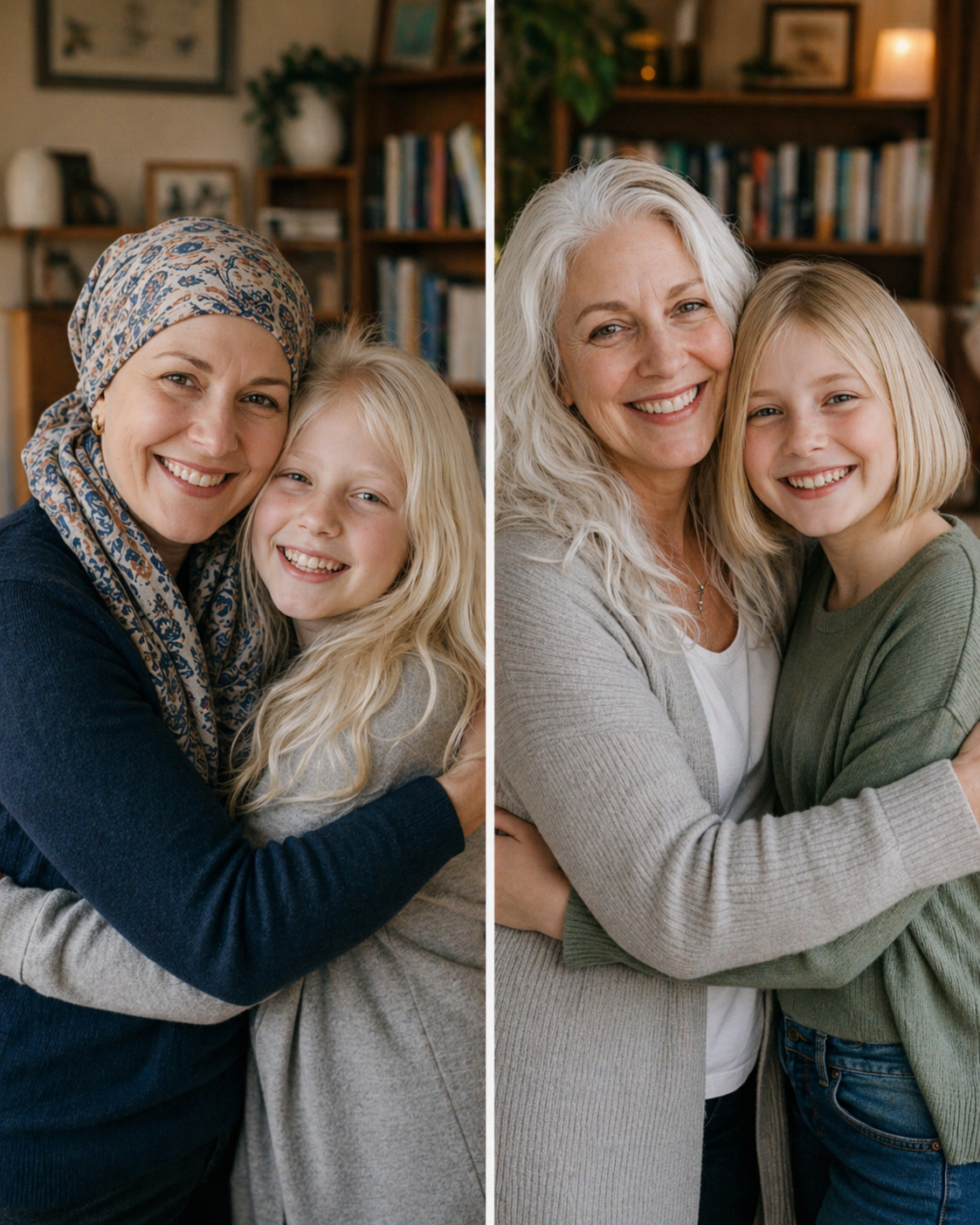
At first, I believed the most difficult part of this year was watching my teenage daughter struggle to stay strong while I endured chemotherapy. But everything changed in an instant after a single phone call from her school turned our world completely upside down.
My daughter, Ava, is fifteen. For nearly her entire life, it has been just the two of us against the world.
Her father, Daniel, was officially declared dead when she was only four years old.
It happened after a devastating car accident on a rain-soaked road just outside town. There was a fire. The coffin was closed. I remember a police officer sitting across from me at the kitchen table, quietly saying, “I’m so sorry.” There was a funeral I can barely recall, and paperwork I signed in a haze so thick I could hardly recognize my own handwriting.
Back then, I was sitting at that same kitchen table, pretending to eat soup I couldn’t taste.
A few weeks ago, my hair began falling out in clumps.
So I cut it short, wrapped scarves around my head, and tried to convince myself it didn’t matter as much as it did.
Then one afternoon, Ava came home from school, dropped her backpack near the door, and held out a small box.
“I got you something,” she said softly.

I was still sitting at the kitchen table, staring into my bowl. “From where?”
“Just open it.”
When I looked up at her, something felt off. “Ava… what did you do?”
She hesitated, swallowing hard, her gaze dropping to the floor.
She didn’t answer immediately. Instead, she slowly pushed back the hood of her sweatshirt.
Her hair was gone.
I jumped to my feet so quickly that my chair scraped loudly across the floor.
“What did you do?”
She rushed to explain, “I sold part of it… and the rest I gave to Ms. Carla at the salon. She made this wig for you.”
Her voice trembled slightly as she added, “I knew we couldn’t afford one. And I know you say it’s just hair… but I also know you miss feeling like yourself.”
Tears blurred my vision as I let out a shaky laugh.
In two steps, I crossed the room and pulled her into my arms, holding her so tightly she made a small sound of surprise.
She leaned back just enough to meet my eyes. “You’re my mom.”
That was all it took. I broke down completely—messy, uncontrollable sobbing.
She hugged me again and muttered, half-joking, “Okay… wow. I was trying to do something nice. I didn’t expect this much crying.”
Through tears, I laughed. “You’re incredible.”
“You raised me,” she replied with a shrug.
Then, more quietly, “You’ve sacrificed way more.”
The next morning, she went to school, and I went to my chemotherapy session.
Before she left, I gently held her face. “I never want you to feel like you have to fix this for me.”
“I know,” she said.
But something in her tone made it clear she would still try anyway.
That day, the treatment was especially brutal. One of those sessions where even the thought of getting home feels overwhelming. By the time I made it inside, I was so weak I had to sit on the edge of my bed just to take off my shoes.
That was when my phone rang.
It was the school.
I answered immediately. “Hello?”
“Ms. Elena?” It was Ava’s history teacher. Her voice was tense. “You need to come to the school right away.”
I straightened, alarmed. “Why? Is Ava okay?”
There was a brief pause. “She’s safe. But there are police officers here, and they need to speak with both of you.”
A chill ran through me.
“Police? Why are the police with my daughter?”
“I think it’s best if you hear everything in person.”
“Put Ava on the phone.”
A moment later, Ava’s voice came through, shaky and uncertain.
“Mom?”
“What happened?”
“I… I found something.”
“What do you mean you found something?”
“I didn’t do anything wrong, I promise.”
“What did you find?”
“Please… just come.”
I barely remember the drive. Only flashes—red lights, my hands gripping the steering wheel too tightly, my mind racing through every possible nightmare scenario in less than ten minutes.

When I arrived, my legs felt unsteady.
The principal’s office door was open. Inside were three officers, the principal, and Ava—sitting rigidly in a chair, her eyes red, her hands clenched tightly in her lap.
I went straight to her.
“Are you hurt?”
She stood quickly and wrapped her arms around me. “No.”
“Then what is going on?”
One of the officers spoke calmly. “Ma’am, please have a seat.”
I shook my head. “Tell me what happened first.”
He nodded. “Your daughter is not in trouble.”
That should have reassured me. It didn’t.
I sat down only because my body felt like it might give out.
The officer placed a folder on the desk and opened it.
“We’ve been investigating financial irregularities tied to a former children’s home that once stood on part of this property,” he explained. “This morning, your daughter discovered something hidden in the theater storage area that may be connected.”