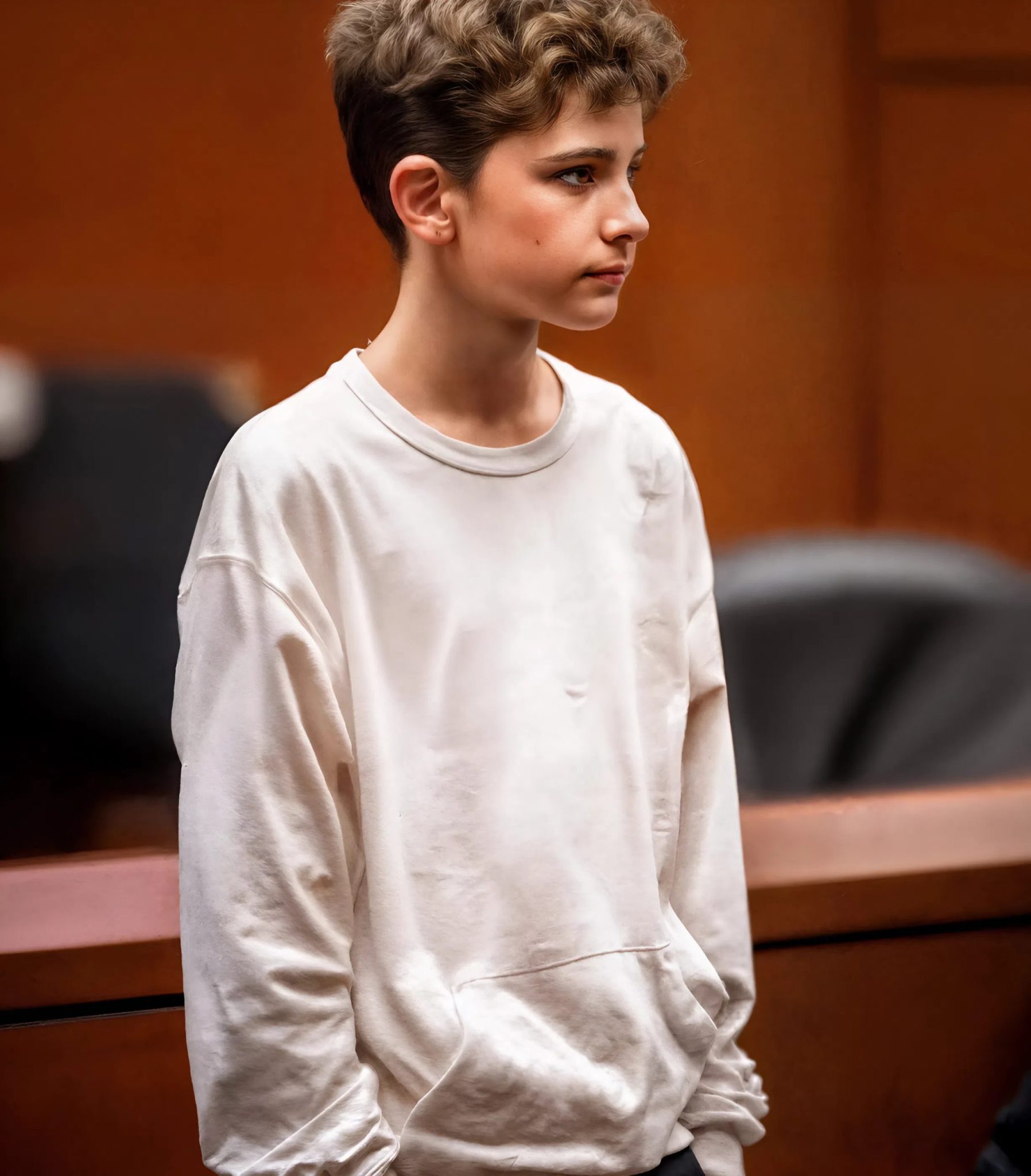
My son, who was placed in a foster family, never uttered a word… until the day the judge asked him a question.
When Sylvie opens her home to a nine-year-old boy who doesn’t speak, she doesn’t expect to ever hear his voice. Yet over the years, something deeper develops between them — woven from silent gestures, small acts of kindness and unconditional love. Until the day when, in the courtroom, he finally finds his words.
I said ‘yes’ not because I thought I could ‘fix’ him.

I said ‘yes’ because the house had been too quiet for too long, and I knew that kind of silence. His silence, however, was different — wary, anxious…
Mine came from pain. His came from something I shouldn’t have asked questions about.
I said ‘yes’ not because I thought I could fix him.
‘He’s nine years old,’ the social worker told me, pausing just long enough for the words to sink in. ‘He doesn’t talk, Sylvie. At all. And to be honest, most families turn him down.’
‘I’m not “most families”, Estella,’ I replied.
I didn’t need more noise. I needed someone who understood silence and accepted love, even when it was expressed through it.
‘I’m not “most families”, Estella.’
After three miscarriages and a husband who finally said he ‘couldn’t hope for something that never happens anymore,’ I learned to live with absence.
When he left, he took with him the last crumb of my expectations. But not my ability to love. That remained.
And sooner or later, it needed somewhere to go.
I didn’t wake up one morning with a ready answer. Everything was slower. I started volunteering at library readings, then began collecting food parcels for a shelter. I told myself I was just keeping busy, but one afternoon I found myself holding a forgotten child’s jacket… and I couldn’t let it go.
But not my ability to love. That remained.
And then I understood.
A week later, I filled out the forms. The training took time. So did the checks; but when the folder arrived in the post — thick, heavy with hope — I held it to my chest as if it had a pulse.
‘All you need to do now… is wait,’ I said to myself in front of the mirror. ‘Your baby will come, Sylvie.’
And when they called me and asked if I could take in a child that no one wanted, I said ‘yes’ without hesitation.
‘Your baby will come, Sylvie.’
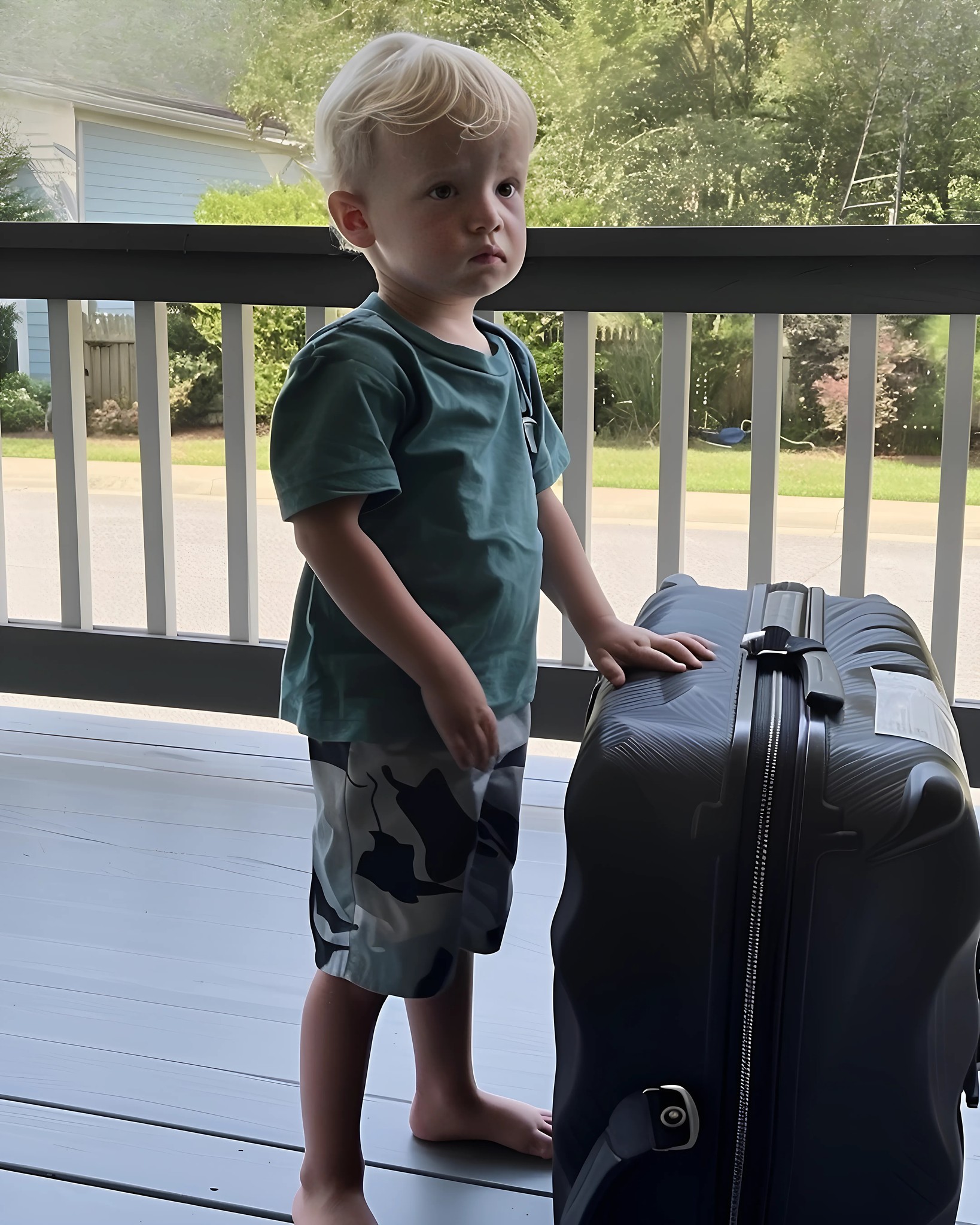
Little Alan arrived with a backpack and a look that made people uncomfortable. He didn’t cry or flinch. He stopped at the door and looked around, as if marking all the ways out.
‘Hello, sweetie,’ I said, holding out my hand. ‘Hello, Alan. I’m Sylvie.’
He didn’t take it. He walked past me and sat down on the edge of the sofa. I offered him hot chocolate and biscuits. He nodded, a hint of a smile on his lips.
He stood in the doorway, watching, as if memorising all the exits.
And so it began.
That evening, I read aloud to him. He didn’t look at me, but he didn’t leave the room either. That… was enough.
I didn’t force Alan to talk. I just lived next to him, leaving room for sound — if he ever wanted to come.
I cooked him meals and left little handwritten notes, not expecting a reply. Sometimes they were silly jokes — about squirrels stealing my tomatoes. Sometimes they were something more tender.
I didn’t force Alan to talk.
‘I’m proud of you, my dear.’
‘You’re doing great, Alan.’
‘You are the light I’ve always dreamed of.’
For weeks, they came back crumpled… or didn’t come back at all. And then one day I noticed one, neatly folded and placed on the kitchen counter. I opened it and saw my words — whole, neat, clean.
‘You are the light I have always dreamed of.’

‘He kept it…’ I whispered, tears in my eyes.
I cooked and told him stories while cutting vegetables. Little stories — like how I once broke my ankle chasing a runaway kitten, or how I tried to bleach my hair and ended up with orange roots.
‘It was awful, my dear! Really, Alan, I looked ridiculous! I couldn’t leave the house for a whole week.’
He never replied, but sometimes his shoulders would twitch slightly, as if he were laughing quietly.
I showed him the birds nesting on the porch, the shapes of the clouds, and the song that reminded me of my mother. His silence did not seem like rejection to me. Rather, it was like someone listening with great attention — as if he were learning the language of safety, the language of security.
Over time, Alan began to sit closer during our evening reading. Then he started waiting for me at the door while I looked for my keys. If I forgot my scarf, he would silently hand it to me.
That winter, when I fell ill, I woke up feeling exhausted and in pain all over my body and saw a glass of water on the bedside table and a neatly folded note next to it.
That was when I realised for the first time that he cared about me too.
Years passed. Alan turned twelve, then thirteen. The house became warmer, a little ‘noisier’. He hummed as he loaded the dishwasher and moved quietly around the kitchen. Once, when I sang an Aretha Franklin song out of tune, he smiled.
That smile broke me. For the first time, I realised that I didn’t just love him — I was loved too.
And yet people kept asking:
‘He’s too old, isn’t he?’
‘There’s obviously something wrong with this child, isn’t there? You don’t want him to get help?’
‘He doesn’t need to talk until he’s ready,’ I always replied. ‘He just needs to feel loved. And he needs to stay.’
At fourteen, Alan was taller than me. I caught him putting things away on shelves I couldn’t reach. He didn’t say anything — he just helped. And then I realised: he was mine, even if it wasn’t written on paper yet.
I filled out the adoption papers a week before his birthday.
When I told him about it, I didn’t ask.
“If you want us to make it official, my dear, I’ll do it. You don’t have to say anything. Just nod, Alan. Okay?
He looked at me for a long time, then nodded once.
On the morning of the hearing, he barely touched his breakfast. His hands kept moving, folding the napkin into smaller and smaller squares.
‘They won’t send you back, my dear,’ I said. ‘I promise. That’s not the issue.’
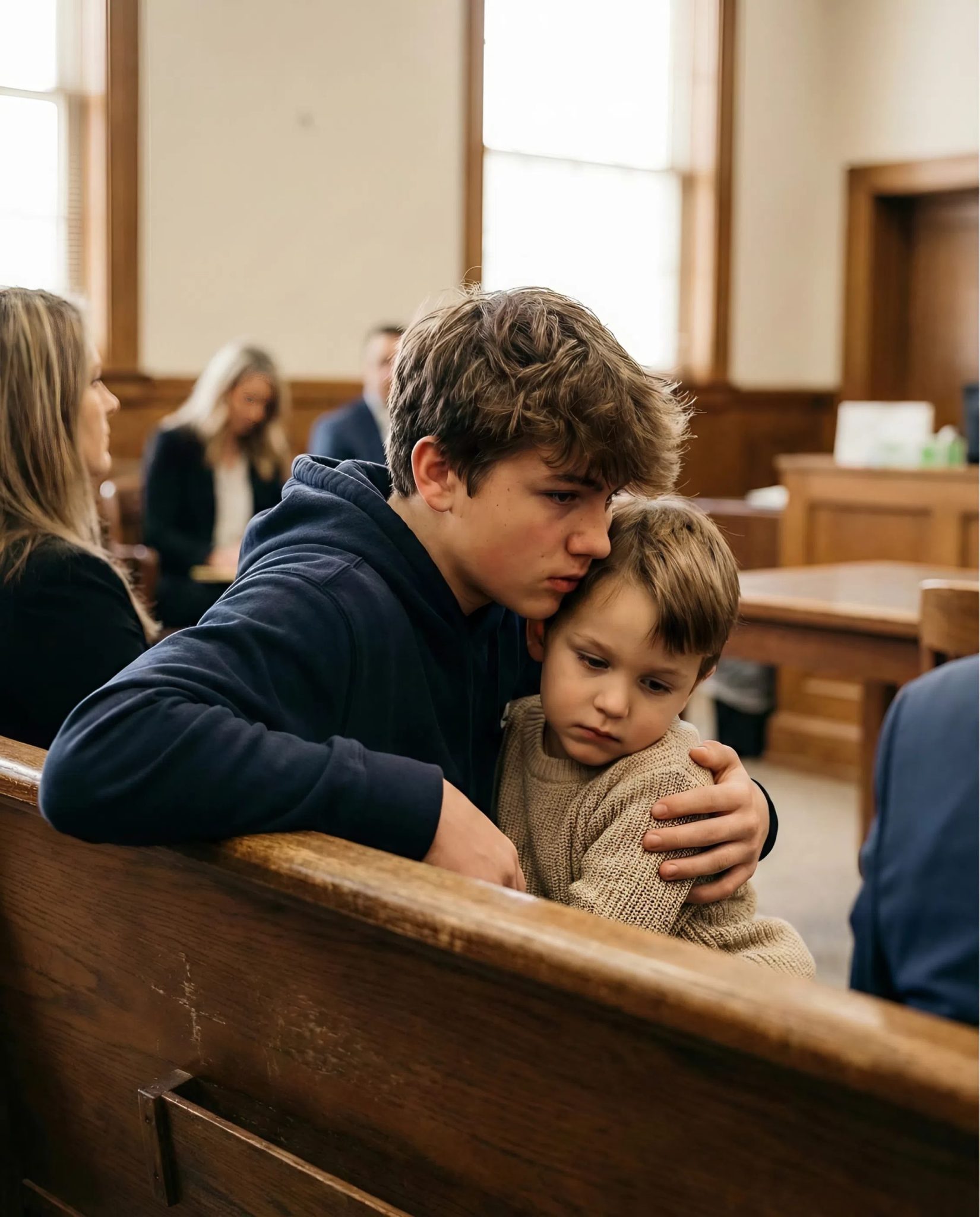
‘They won’t send you back, my dear.’
‘Alan, you’re mine,’ I added. ‘You’re my child. And today, nothing changes except the paper that confirms it.’
He met my gaze for a second. There was something in it — doubt, maybe even fear — then he nodded again.
The courtroom was cold and too brightly lit — the kind of light that makes you feel exposed. Judge Brenner sat before us with a kindly face, his glasses sliding down his nose, a stack of cases in front of him — too heavy for something so personal.
Estella, our social worker, sat next to us with her ever-present cardboard folder and kind eyes.
‘Alan,’ the judge said in a warm, unhurried voice. “You don’t have to speak today, my boy. You can just nod or shake your head if that’s easier. Or you can write everything down. Do you understand?”
Alan nodded once, without looking up from the floor.
‘Do you want Sylvie to adopt you? Do you want this woman to be your legal mother?’ the judge asked with a slight smile, pointing at me.
At first, the pause was almost imperceptible. Then it dragged on… too long. I felt Estella stir beside me. My chest tightened.
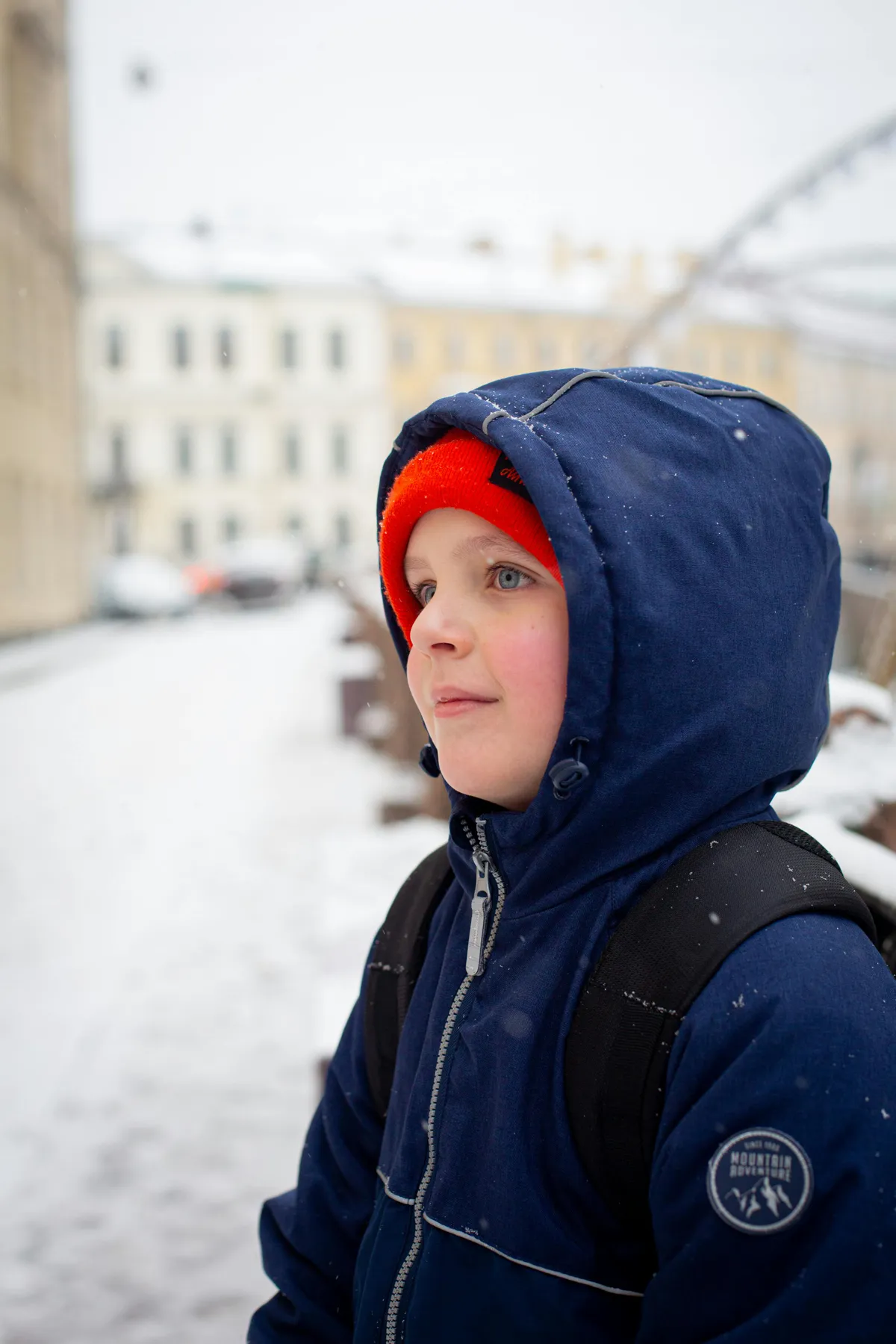
I looked at Alan: his shoulders were tense, his hands clenched on his knees, his thumbs pressed together as if he were holding something inside.
Alan slowly shifted in his chair, as if his body weight had changed. He cleared his throat. The sound was sharp and harsh in the silence.
I almost stopped breathing: was my son about to speak for the first time?
And then… he spoke.
“Before I answer… I want to say something.
Even Judge Brenner leaned forward, his face impassive.
When I was seven years old, my mother left me in a supermarket. She said she would be back soon. I waited. I waited until late in the evening. I was hungry, so I ate a cracker I found under the candy counter. Then the shopkeeper called the police, and that’s how they found me.
His hands clenched into fists.
— Then I was moved from family to family many times. One said I scared them. Another said I was too big to be “cute”. The third didn’t even learn my name.
He took a shaky breath.
“When Sylvie took me in, I didn’t trust her. I thought she would send me back too. But she didn’t.
He paused.
“She made me chocolate. She read me stories. She left me notes. And she paid attention to what I liked to eat. She allowed me to just be in my shell, waiting, on the edge… for the moment when she would break.
Then he really looked at me — for the first time since we entered the courtroom.
“She never forced me to talk. She stayed. And she did everything she could to make me understand that I was important to her… and even… that she loved me.
I saw the judge look at me. His eyes were soft, but the weight of Alan’s words hung in the air. My lips trembled.
I didn’t try to stop myself. Pretending it wasn’t the most important thing in the world was pointless.
Alan looked down. His fingers fiddled with the hem of his T-shirt, and his voice became a whisper.
‘I didn’t say anything,’ he said slowly, “because I thought… if I made a mistake, if I said the wrong thing, Sylvie would change her mind. And someone would come and take me away again.
I swallowed hard, tears welling up faster than I could hold them back.
He hesitated, then raised his head.
“But I want her to adopt me. Not because I need someone. But because she’s been my mum for a long time.

Estella exhaled loudly, almost sobbing. I heard her searching for a handkerchief. Judge Brenner’s eyes narrowed into a warm, approving smile.
‘Then,’ he said quietly, ‘I think we have our answer.’
The air in the car park seemed warmer than it had been in the morning. I leaned against the car to adjust the strap on my shoe, but my hands were shaking so much that I gave up halfway through.
My son walked around to the other side of the car, reached into his jacket pocket and pulled out a folded handkerchief. He handed it to me without saying a word.
‘Thank you, my dear,’ I said.
It was only the second time I had heard him speak. But the way he said it — calmly, confidently — made me realise that he had stopped hiding.
That evening, I cooked his favourite meal. He didn’t say much at the table, but he sat next to me and ate everything.
Before bed, I picked up the old book I had been reading to him for years, the one we never finished. Alan was fourteen, and he still let me read to him — something I treasured, not knowing how to explain it.

But before I opened the book, he touched my hand lightly.
‘Can I read it myself tonight?’ he asked.
I slowly handed him the book, trying not to cry again.
He took it with both hands, turned the page as if it were sacred, and began to read, transporting us into a world of imagination.
To tell the truth, I didn’t need to hear the words ‘I love you.’ It was enough for me to know that I had built a home that someone wanted to return to — again and again.