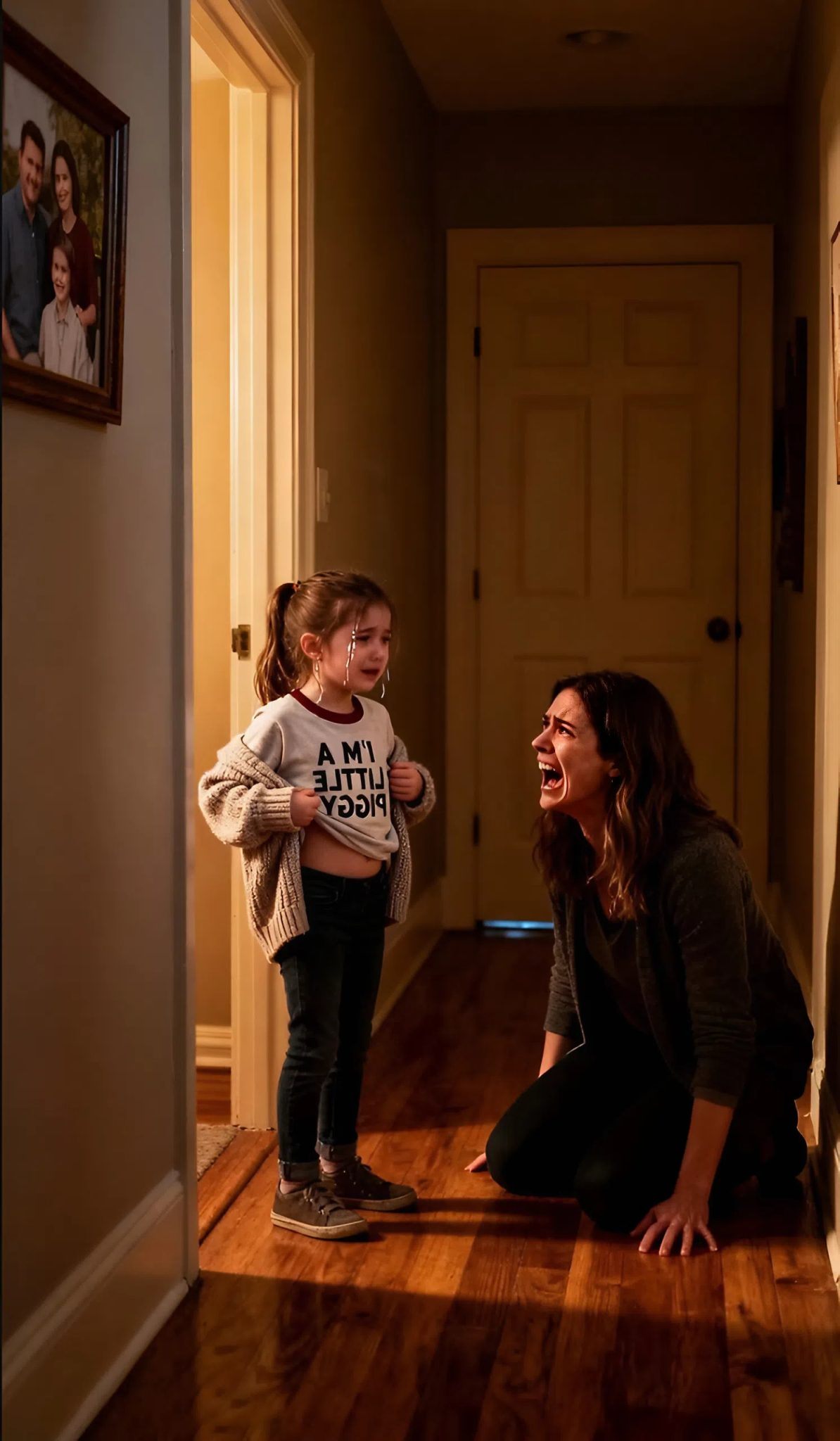
The bin bag was not tied.
It hung loosely on her small body — a grotesque parody of clothing, swaying with each shallow breath she took.
The rustling, almost weightless black plastic clung to her skin like shame and crackled in the eerie silence of our hallway.
My daughter, Lily, stood in the doorway, staring at the floorboards.
She didn’t cry.
She didn’t complain.
She didn’t make a sound.
She just whispered in a voice as dry as a leaf:
‘Grandma said… Grandma said I’m too fat to wear pretty dresses.’
Then, with a resignation no seven-year-old should possess, she raised her arms.
The air seemed to leave the room.
It wasn’t just a sight — it was a map of cruelty burned into her soft, innocent skin.

Bruises, purple fingerprints darker than the night outside the window, and red stripes like burns from a banister criss-crossed her back.
They were vicious marks.
Deliberate marks.
I didn’t scream.
I didn’t tremble.
I didn’t ask questions.
The time for confusion had passed; it was time for devastation.
I walked towards her, my movements smooth and cold.
I told her to go wash her hands, keeping my voice as flat as the line on a heart monitor.
I kissed her forehead—it was damp, cold with fear—and watched her walk to the bathroom.
Then I turned and walked to the hook by the door.
I took the car keys.
I used to believe in blood loyalty.
I married into the Halloway family thinking that their cold faces were just their manner, a generational stoicism that needed to be respected.
I believed that their harsh words were just ‘old school,’ a rougher form of love.
My mother-in-law, Victoria, smiled through clenched teeth, her eyes devoid of warmth.
She was always watching.

Always judging.
‘She’s too soft,’ she would say, sipping her tea and staring at my daughter.
‘She needs discipline.’
‘She eats too many sweets.’
‘You’re spoiling her rotten, Elena.’
Seven years of comments disguised as concern.
Seven years of control wrapped in false love.
I ignored it.
That was my first mistake.
The sin of inaction, the betrayal of instinct.
But when my car’s engine roared to life, drowning out the silence of the suburbs, I made a vow to myself.
There would be no more mistakes.
The road to Victoria Manor merged into a blur of lights and seething rage.
I didn’t turn on the music.
I needed silence to sharpen my thoughts.
I needed to turn the molten heat in my chest into cold, hard steel.
Anger is a fire that burns you from within; precision is a blade that cuts forever.

When I arrived, the house stood out against the night sky — a flawless two-storey colonial mansion, screaming perfection.
The lawn was mowed to perfection.
The windows glowed with a warm, inviting yellow light that belied what was happening inside.
I knocked.
When she opened the door, she smiled.
That smile was muscle memory — a distortion of the face, practised for decades in front of mirrors.
A smile for church elders, for neighbours, for the world.
She wasn’t expecting me.
And she certainly wasn’t expecting the silence that hung between us like a guillotine blade.
‘Elena?’ she asked, and a crack of doubt appeared in her porcelain mask.
‘Is everything all right? Where’s Lily?’
I entered without asking.
I didn’t shout.
I didn’t accuse.
I didn’t raise my voice.
I just looked around.

The house hadn’t changed.
The air smelled of lavender and condemnation.
The same sofa stood in the living room, covered with plastic — an altar of cleanliness instead of comfort.
The same family photos adorned the mantelpiece: everyone in them looked frozen, proud and religious.
She started talking, her voice turning into nervous chatter.
‘I just made some tea.’
‘Did you forget something? You know, Lily was misbehaving today.’
‘Very naughty.’
‘I had to—’
I stopped listening because I hadn’t come to explode.
I came to confirm.
And I confirmed.
I turned to her and did the unthinkable.

I hugged her.
It confused her.
I felt her body stiffen, like a mannequin.
I smelled her cheap floral perfume, a scent that tried to hide the rottenness of her soul.
I heard her shallow breath catch in her throat.
I felt the fear she was trying to bury deep beneath her tweed jacket.
She didn’t know how to respond to affection she hadn’t forced.
I stepped back, looked her straight in the eye and whispered:
‘Thank you for loving my daughter.’
Then I turned and walked out.
I heard the door close slowly behind me.
It was her moment of defeat.
She was expecting a scandal, a hysterical mother who could be presented to her friends as ‘unstable.’
She was ready to play the victim.
But I gave her nothing.
I no longer needed anger.
I needed proof.

That night, already safe in my own home, I did not sleep.
I became a forensic photographer of my own child’s pain.
I photographed everything.
Every bruise, every mark, every red line on her skin.
I photographed the bin bag.
I recorded Lily’s voice describing what had happened — her little words painted a picture of torture.
‘She made me wear this so I would sweat and lose fat, Mummy.’
‘She said I was sinful.’
The following week, while Victoria was at her bridge club, I went to her house again.
I had a key — given to me years ago ‘in case of an emergency’.
It was an emergency, but not the one she had in mind.
I installed small, high-resolution cameras in the living room, kitchen, and guest room where Lily stayed during her visits.
They were expensive, almost invisible, with a tiny, quiet red light promising the truth.
I didn’t do it because I was physically afraid of her.

I did it because I knew who she was.
She was a pillar of the community.
A saint.
Without proof, I would have been just a jealous daughter-in-law.
I quietly hired a solicitor.
Mr Vance was a shark in a grey suit — a man who specialised in destroying families.
I didn’t tell my husband, David.
David was a good man, but he was her son.
He had lived under her thumb for forty years, trained to believe that her cruelty was love.
If I had told him too soon, he would have gone to her, she would have cried, and the cycle would have started all over again.
No.
I had to cut off the snake’s head with one blow.
I started gathering evidence.
Her messages came late at night, vibrating in my phone like threats.
‘Has she been behaving well today?’
‘You need to control her diet, Elena.’
‘She looks bloated.’

‘I’m just trying to help.’
‘God hates gluttony.’
I saved everything.
I made backups on three different hard drives.
I contacted the school psychologists.
I consulted doctors.
I built up documentation like a slow, silent wall — brick by brick, fact by fact.
Weeks passed.
The cameras recorded everything.
Not just physical abuse, but verbal poison too.
‘You’re disgusting,’ Victoria’s voice rang out clearly on the recording as she snatched the biscuit from Lily’s hands.
‘No man will ever love a pig.’
‘Do you want to be alone?’ Like your mother?
I watched these recordings in the dark, tears streaming down my face, my hand pressed against my mouth to stifle my sobs.
Every instinct screamed at me to rush over there and burn her house to the ground.
But I waited.

I was waiting for Christmas Eve.
The church was her world.
St. Jude’s Church was her pride and joy, her kingdom, the stage on which she played her greatest role — Matriarch.
It was Christmas service.
The air was thick with the scent of pine needles and burning wax.
The light fell softly, casting long shadows on the high vaulted ceilings.
The children were dressed in white, their parents looked proud, and the choir sang a melody of peace.
Victoria, of course, sat in the front row.
Perfect posture.
Perfect hair, lacquered into a silver helmet.
Perfect false piety.
She wore a red velvet coat — the image of a kind grandmother.
People waved at her.
The pastor nodded to her.
She absorbed their admiration like a vampire absorbs blood.
It was time for testimonials.
It was a tradition — ‘Words of Joy.’
An opportunity for the elders to bless the community.

Victoria had just finished her speech, dabbing her dry eye with a lace handkerchief after her monologue on ‘sacrificial love.’
The congregation murmured their approval.
And then I stood up.
My husband, David, gently squeezed my wrist.
‘Elena? What are you doing?’
‘Testifying,’ I whispered.
The hall fell silent as I approached the microphone.
My heels tapped out a rhythmic count on the marble floor.
My hands weren’t shaking.
My heart was beating slowly and heavily, like a military drum.
I stood behind the lectern.
Victoria smiled at me from the front row — tensely, confusedly.
She nodded slightly, urging me to ‘play my part.’
‘I want to talk about family,’ I began, and my voice filled the vast space.
“About trust.
About grandparents who claim to protect.
The hall smiled.

They were waiting for a tribute.
‘We are taught that love is kind,’ I continued, looking at the faces in the pews.
“We are taught that love does not envy, does not boast, is not proud.
“But we often forget that love does not harm.
I took a small remote control out of my pocket.
I had made arrangements with the audio-visual team beforehand, telling them I had a ‘touching family montage.’
They didn’t check the file.
‘This month, my daughter Lily learned a lesson about love,’ I said, my voice growing firmer.
‘She learned it from her grandmother.’
I pressed the button.
The huge screen behind the altar, usually reserved for hymns and scripture, came to life.
There was no blurring.
There was no filter.
There was no soft music.

The first image was a rubbish bag.
Black plastic clinging to Lily’s sobbing body.
The second was the back of her legs, covered in scars and purple bruises.
The third was a video clip.
Victoria’s voice boomed through the church’s powerful sound system — distorted, but unmistakable:
“You’re disgusting.
No man will ever love a pig.”
A collective sigh swept through the hall, as if the air had been sucked out of it.
A woman in the second row dropped her psalter.
I didn’t look at the screen.
I looked at Victoria.
She tried to stand up, but couldn’t.
Her legs wouldn’t hold her.
Her mouth opened — a black hole of shock — but no sound came out.
She looked around desperately for an ally, a sympathetic glance.
She found none.
‘This,’ I said, pointing to the screen, which now showed a photograph of a hand-shaped bruise on Lily’s arm, ‘was done in the name of discipline.’
It was hidden behind a smile.
The silence was absolute.
Heavy. Suffocating.
The pastor stood to one side, frozen, clutching his Bible to his chest.
‘The police?’ I said into the microphone, answering the question hanging in the air.
‘No.’
‘Not yet, anyway.’
‘The law will come later.’
‘Quiet.’
‘Clean.’
I leaned closer to the microphone.
‘But the damage? Really?’
‘They belong to you.’

‘To her community.’
I looked directly at Victoria—her face had lost all colour, and she looked like a wax figure melting in the heat.
‘Merry Christmas, Victoria.’
I dropped the microphone.
It didn’t clatter — just fell silently onto the carpeted step.
I walked down the aisle.
David was staring at the screen, his face a mask of horror and realisation.
He wasn’t looking at me.
He was looking at his mother and seeing a monster for the first time in his life.
I walked out through the double doors into the cold winter night.
The air was clean and sharp.
The consequences were not a fiery storm.
It was frost.
We didn’t go to the police right away, although my solicitor filed a restraining order the next morning.
But the real punishment was not legal.
It was social.

Victoria was not arrested.
She was erased.
That was my plan.
Arrests can be distorted.
Lawyers can argue about context.
But shame?
Shame in a city like this is a life sentence.
Her neighbours stopped visiting her.
The postman stopped chatting.
The church ladies, her praetorian guard, no longer sat next to her.
They formed a new circle — without the woman who beat her child.
Her phone stopped ringing.
Her respect evaporated like water on hot asphalt.
She became a ghost in her own life.
That night, David stepped out of the shadows of his childhood.
He cried for three days.

He begged Lily for forgiveness until his voice was hoarse.
He wasn’t perfect, but he had finally woken up.
We severed all ties.
No financial support.
No visits.
No phone calls.
Weeks later, she tried to talk to me.
I was in the shop, in the fruit section, choosing apples.
Lily was with me — in a bright yellow summer dress, laughing at something on her tablet.
She didn’t see her grandmother approaching her.
Victoria looked smaller.
Thinner.
The red velvet coat was gone, replaced by a dull grey cardigan.
Her hair was no longer styled; it hung lifelessly around her face.
She looked like a building slated for demolition.
She stopped her trolley next to mine.

She didn’t look at Lily.
She couldn’t.
‘I didn’t mean to hurt her,’ she croaked.
Her voice was brittle, stripped of its former haughtiness.
‘I… I was trying to save her from…’
She fell silent, her hands trembling on the trolley handle.
I looked through her.
I no longer saw the matriarch.
I no longer saw power.
I saw a sad, broken old woman who used terror to feel important.
‘I know,’ I said calmly, without pity.
‘You wanted to break her so you could mould her in your own image.’
‘Elena, please,’ she whispered, tears filling her eyes.
‘I have no one.’
‘The phone… it never rings.’
I smiled.
It wasn’t a warm smile.
It was the smile of a predator who had finished its meal.

‘That’s the point, Victoria.’
I turned to Lily.
‘Let’s go, sunshine.’
‘Let’s get some ice cream.’
Lily looked up, saw the old woman and froze for a second.
I thought she would be scared.
But she looked at Victoria with indifference towards the stranger.
‘Okay, Mummy!’ Lily said happily.
We left.
We didn’t look back.
Now my daughter wears dresses she chooses herself.
Sometimes they don’t match.
Sometimes they’re tight.
Sometimes they’re loose.
It doesn’t matter.

She eats when she’s hungry.
She stops when she’s full.
She laughs loudly, with her mouth open, without shame.
The bin bag is gone.
The bruises have faded, becoming invisible memories, processed by her resilience.
But the memory lives on in me.
Not as pain, but as a reminder.
Like a totem.
Sometimes I sit on the porch, drink coffee and watch the leaves fall.
I hear rumours about Victoria.
She’s selling the house.
Moving to a small town two states away.
Running from the silence she created herself.
I didn’t swing a belt.
I didn’t raise my fist.
I didn’t scream until my throat bled.
I took her power, her image, her position, her world.
I took it all away piece by piece — quietly, legally, perfectly.
When she opened that door many weeks ago, I embraced her.
And when she closed her eyes, thinking she had won, I destroyed her without regret, without mercy, without noise.
I did it the way monsters deserve.
And I would do it again.