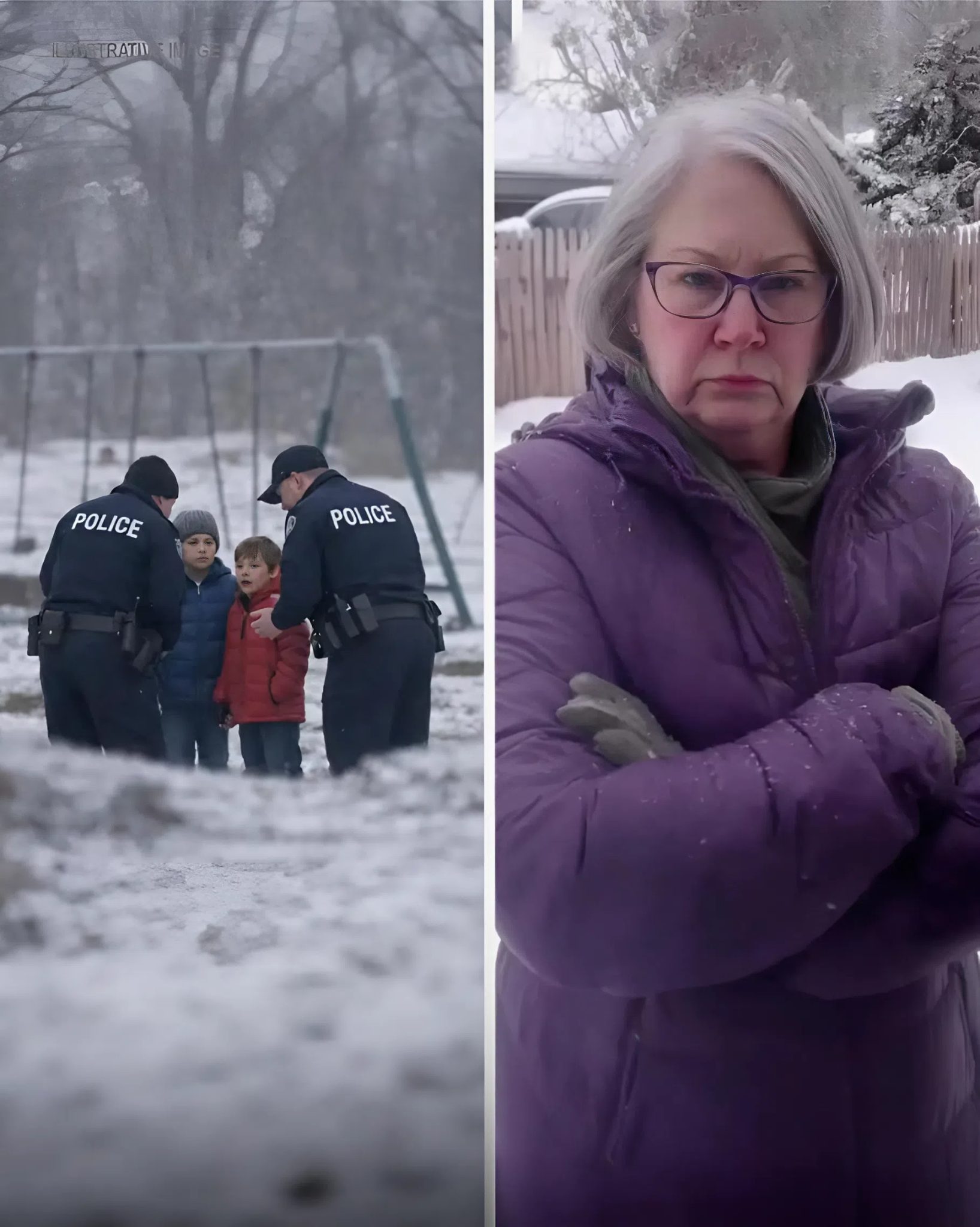
He watched it and his face tensed.
“Do you have more footage like this?” he asked.
“Yes,” I said. “From the whole week. She always watches them when they’re outside. Last time she said they might be drug addicts. My sons are afraid of her.”
He nodded and walked over to Deborah.

I stayed by the swings, but I was close enough to hear what was happening.
“Ma’am,” the police officer addressed her. “We saw video footage from the neighbors’ cameras.”
Deborah blinked. “Footage?”
“Yes. Of you standing outside, watching the children, and calling us when nothing dangerous is happening.”
“That doesn’t matter,” she snapped. “It’s still disturbing. I have a right to peace and quiet. They’re screaming all the time.”
The other police officer, who had been silent until then, folded his arms. “They’re on the playground,” he said. “Kids are loud.”
Deborah snorted. “Not like this. They’re screaming like animals. This isn’t normal.”
A nearby mother said in a low voice, “Are you serious?”
Another parent said more loudly, “They’re children, not monks.”
Deborah shook her head as if she had just realized that others could hear her.
The first police officer remained calm. “You have the right to call if you see a real danger,” he said. “But these repeated calls, without evidence, without an emergency, without a crime…”
He paused for a moment.

“This is misuse of the emergency number.”
Deborah’s face turned red. “I’m not abusing anything. I’m reporting what I hear.”
“There are children playing on the recording,” said the second police officer. “If we get another call like this, it could result in a fine for a misdemeanor. Do you understand?”
Deborah was angry and felt cornered.
“Fine,” she spat. “I won’t call again. But if something happens, it’s on you.”
She turned on her heel, stormed out, and slammed the door.
The first police officer came back to me.
“You did the right thing by documenting it,” he said quietly. “If she calls again, save these videos.”
“Thank you,” I replied. “Last time, my boys thought they were in trouble with the police.”
He shook his head. “They’re not in trouble. They’re kids. Tell them that.”
The next week was surprisingly calm.
The kids were back outside playing, riding bikes, playing tag, and kicking soccer balls in front of the houses.

Deborah’s blinds remained closed.
There was no more conspicuous peeping, no staring from behind the door, no phone in her hand when my sons laughed.
On the third day, Noah ran up to me, sweaty and grinning.
“Mom, did the mean lady go away?” he asked.
“No,” I said. “She still lives here.”
He furrowed his brow. “Then why isn’t she angry anymore?”
I looked across the street at the closed curtains.
“Because,” I replied, “he realized that now others can see what he’s doing.”
That was all it took.
I didn’t yell at him. I didn’t make a scene. I didn’t start a neighborhood war.
I protected my children, gathered evidence, and remained calm.
Now, when my sons are outside laughing too loudly, my stomach doesn’t cramp up. Because what if Deborah picks up the phone again?
It won’t be me on the defensive, it will be her.
Zamraštil čelo. „Tak proč už není naštvaný?“
Podíval jsem se na ulici, na zatažené záclony.
„Protože,“ odpověděla jsem, „si uvědomila, že teď vidí i ostatní, co dělá.“
To stačilo.
Nekřičela jsem na ni. Neudělala jsem scénu. Nezačala jsem sousedskou válku.
Ochránila jsem své děti, shromáždila důkazy a zůstala klidná.
Teď, když jsou moji synové venku a smějí se příliš hlasitě, nemám žaludeční křeče. Co když Debora znovu zvedne telefon?
Nebudu to já, kdo se bude bránit, ale ona.