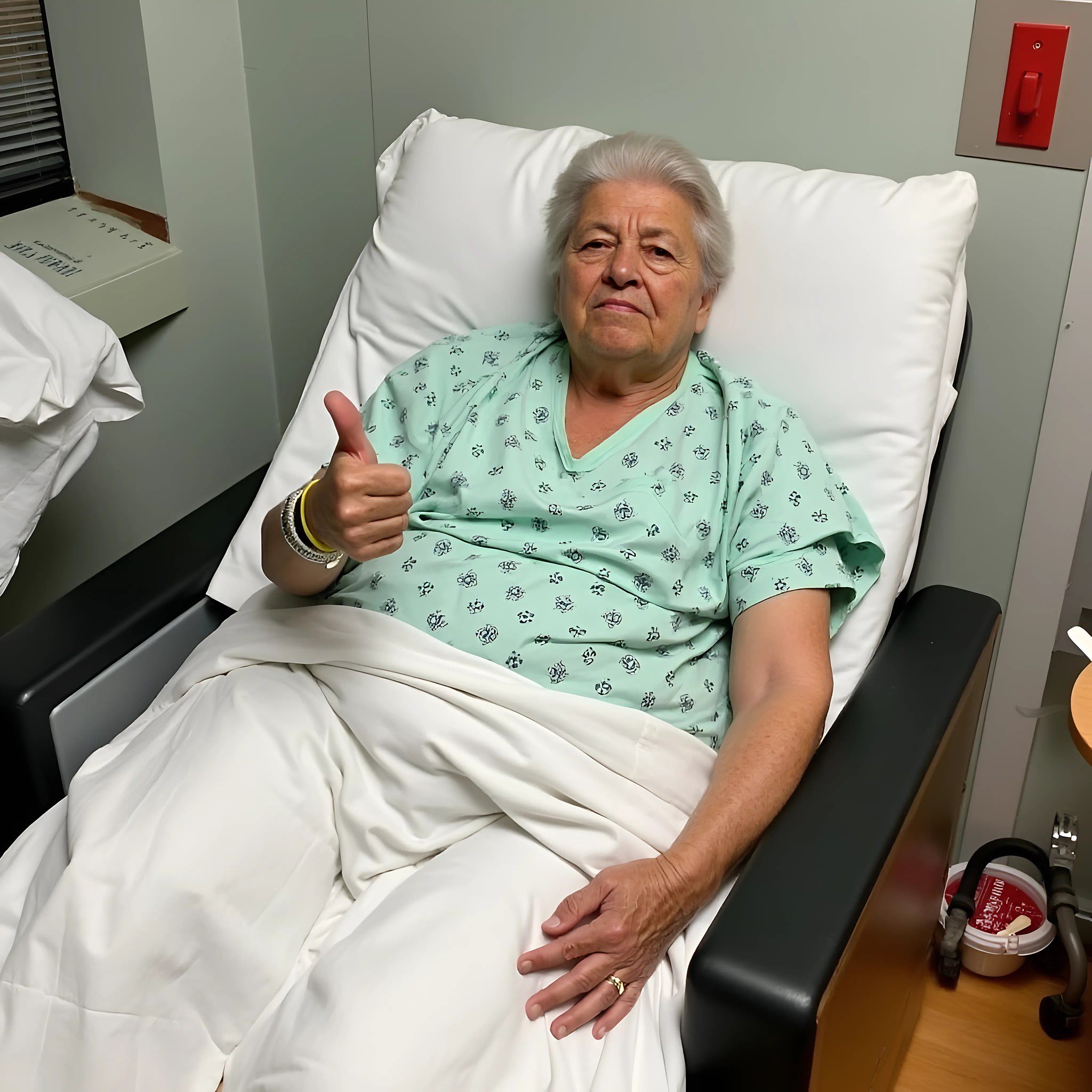
I sat nearby, watching her chest rise and fall slowly, each breath becoming more difficult. The hospice room smelled of antiseptic and wilted flowers, and the dim light cast shadows on her emaciated face. She had been fading for several weeks, but today seemed… different. Final.
The nurse warned me that it could happen at any moment. ‘Sometimes they hold on to something last,’ she said softly. I didn’t know what my mother was holding on to—until she finally opened her eyes.
She looked at me with a tenderness I hadn’t seen in years. Not since my teenage rebellion began. Not since all those cruel words were spoken between us. I squeezed her frail hand, barely holding back my tears.
‘Mum, it’s okay,’ I whispered. ‘You can rest now.’
Her lips trembled as if speaking took all her strength. I leaned closer, my heart pounding wildly. Her voice was barely audible, but what she said shook me to my core.
‘Your father… he’s alive.’
I jerked my hand away, feeling everything inside me turn upside down. ‘What…?’ My voice broke.
She exhaled quietly, her fingers going limp in my palm.
I wanted to shake her, to make her explain, but she was gone.
And I was left alone with the weight of those last words — words that turned everything I knew about my life upside down.
The next few days passed in a fog. My mother’s funeral was modest—mostly neighbours and a couple of her old friends. Everyone thought I was just mourning her loss, but inside me something new was stirring. A deep sense of confusion.
All my life, my mother had said that my father had died in a car accident before I was born. She never remarried and rarely spoke of him. And now, just before she died, she said he was alive?
I stood by her coffin, barely responding to the sympathetic words of those around me. The days merged into a series of tearful phone calls, pots of food left on my doorstep, and sleepless nights when I just stared at the ceiling.
After the funeral, I began sorting through my mother’s papers. Among the insurance policies and old bills, I found a worn envelope with my name on it. My hands trembled as I opened it. Inside was a yellowed sheet of paper with uneven lines written in her familiar handwriting:
I didn’t want to lie to you. I had my reasons. If you want to find it, start with the box in the attic. I love you more than you can imagine.
There was no signature, just a hastily drawn heart.
The next morning, I went to the house where I had spent my childhood. It felt strange to open the door and not say, ‘Mum, I’m home!’ The silence was oppressive. Sunlight fell on dust-covered shelves, and everything seemed smaller than in my memories.
In the attic, I rummaged through boxes of New Year’s toys, old blankets, and faded books until I found the one I was looking for. A cardboard box sealed with tape. Inside were letters, photo albums… and a single Polaroid photo of a man with dark hair and warm eyes. Behind him was a sign that read ‘North Harbour.’ On the back was a date—more than twenty years ago—and a name: Roman.
Underneath the photo was a stack of letters. I opened one:

Dear Olga,
I know you’re afraid of being disappointed in me again. But please don’t push me away. We have to find a way to do this for our child.
My heart began to beat wildly.
The letters were written a few weeks before I was born. Roman tried to keep in touch. Mum replied, but her words betrayed her fear. She convinced him that it would be better this way. That he wouldn’t be able to provide a stable life. She was afraid of pain, afraid of broken promises. She thought it would be safer for me to live without knowing I had a father.
I reread everything over and over again. There was no exact address among the letters, only hints: he worked at the docks in North Harbour. It was a small coastal village three hours away.
The next day, I got in the car and drove there. I didn’t know what to feel—anger? Sadness? Hope?
The northern harbour greeted me with old wooden piers, the smell of salt and the sound of boats lapping against the water. I walked along the pier, showing my photo to random passers-by. Most of them just shrugged.
Towards evening, I stumbled upon an old fishing tackle shop. The sign was worn and only the words ‘Tackle and T’ were legible. Inside, the woman behind the counter looked closely at the photo and nodded.
‘Yes, he comes here. I remember him saying he has a child. He lives on the outskirts, on Bayside Road.’
I thanked her and headed there.
The house was small, with peeling blue paint. I took a deep breath and knocked.
The door opened. Standing in front of me was the same man—aged, with grey hair, but still recognisable.
I tried to speak, but the words stuck in my throat. Finally, I exhaled:
‘Are you… Roman?’
He nodded slowly. ‘Yes. Can I help you?’
I clenched my fingers. ‘I…’ A deep breath. ‘I’m your daughter.’
He froze. Then his face twitched, and he exhaled:
‘I always hoped… but I didn’t know if I would ever see you.’
We talked all evening. He told me how he had tried to fight for me, but Mum didn’t believe he would stay. How he wanted to come back, but was afraid he would cause me more pain.
I cried. He cried.
A week later, we stood together at my mother’s grave. I laid flowers and whispered:
‘I forgive you, Mum. I understand. And I love you.’
As I left the cemetery, I suddenly realised that her last words had not ruined my life. They had given me a chance to find her other half.
Sometimes the truth hurts, but it is the truth that sets us free.