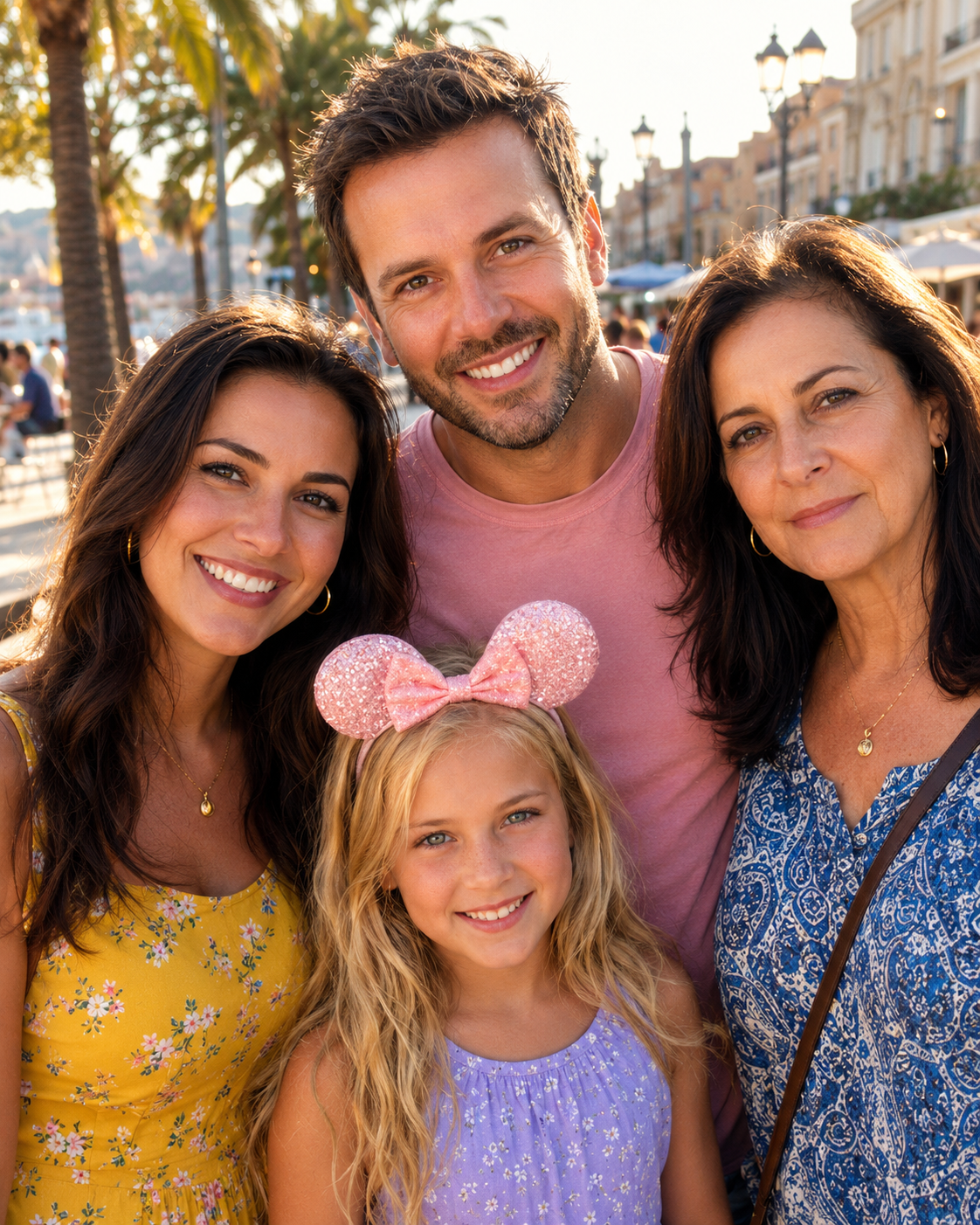
A mother spent eight years ignoring her mother-in-law’s cruel comments for the sake of peace. But when those comments started changing the way her daughter saw herself, one birthday gift forced the whole family to face what silence had been hiding.
The kitchen smelled like cinnamon that Sunday morning, and the light came through the window the way it always had. I poured coffee for Caleb, brown-eyed and brown-haired like me, and watched him fold the newspaper the same careful way his father once had. Our life was small, ordinary, and most days I called that a blessing.
I was thirty-four, three months pregnant, and quietly hopeful.
She kissed Caleb’s cheek, scanned my sweater, and let her smile stretch a beat too long.
“Mom’s coming by at noon,” Caleb said.
“I know.”
“Be nice.”
“I’m always nice.”
He looked up over his cup.
“Be extra.”
I felt the familiar tightening behind my ribs.
Patricia arrived at eleven forty-five, because being early was its own kind of correction. She kissed Caleb’s cheek, scanned my sweater, and let her smile stretch a beat too long.
“That color is brave on you,” she said.
“Thank you, Patricia.”
“And the casserole at Easter, was that a new recipe? It was so interesting.”
I felt the familiar tightening behind my ribs. I had learned the rhythm of her cruelty by then. The long smile, the soft compliment, the small blade tucked inside it.
He said the word like it was a door I should be grateful to stand behind.
Later, when she left, I tried.
“Caleb, she does this every time.”
“She means well.”
“She told me my job sounds like a hobby.”
“She’s old-fashioned. Just let it go.”
“I always let it go.”
Nora was born in March with a full head of soft blonde hair and eyes the color of a clean sky.
“That’s how we keep the peace.”
Peace. He said the word like it was a door I should be grateful to stand behind. I swallowed the rest of my sentence, because that was what good wives did, and I had been training for the role since the day I met her.
I rubbed my belly that night and whispered apologies I did not yet understand.
Nora was born in March with a full head of soft blonde hair and eyes the color of a clean sky. The nurse laid her against my chest, and I cried the way mothers cry when the world finally narrows to one small breathing thing.
Her eyes stayed on Nora’s hair, then drifted to mine.
Patricia came to the hospital the next afternoon. She brought a white blanket, a bouquet, and a stare I will never forget.
“Oh,” she said.
“Isn’t she beautiful?” I asked.
“She’s certainly fair.”
“Caleb was blonde as a baby. There’s a photo somewhere.”
“Is there.”
Three weeks later, Patricia came by again.
She did not phrase it as a question. Her eyes stayed on Nora’s hair, then drifted to mine, then to Caleb’s, measuring something only she could see. My arms closed around my daughter without my permission.
A familiar coldness arrived inside me, wearing a brand-new face. I had thought I knew every shape Patricia’s disapproval could take. I had been wrong, and the next eight years were about to prove it.
Three weeks later, Patricia came by again. Nora slept against my chest, blue-eyed and blonde-haired, unaware that a verdict was being delivered above her head.
Caleb was in the kitchen, pretending the kettle needed his full attention.
“That baby doesn’t look like Caleb,” Patricia said, slower this time, as if I had not heard.
I shifted Nora closer.
“She looks like herself.”
“And where did that come from? The blonde. The blue eyes. Caleb was never blonde. You were never blonde.”
Caleb was in the kitchen, pretending the kettle needed his full attention.
“Babies change,” I said. “Their coloring shifts.”
It moved into the corners of every birthday party.
“Mm,” Patricia answered. “We’ll see.”
That “we’ll see” stayed in our house for eight years.
It moved into the corners of every birthday party. It sat down at every Christmas dinner. It hung on the wall next to the framed photos Patricia liked to study aloud.
“Caleb had the darkest little eyes,” she would say, holding up his baby picture. “Just like his father. Funny how these things skip sometimes.”
I swallowed every time. I told myself it was protection.
At Nora’s fourth birthday, she called her “your little surprise” while handing her a cupcake.
At her sixth, she asked if I was sure I had not “mixed up the bassinets at the hospital,” then laughed as if it were a joke we all shared.
I swallowed every time. I told myself it was protection.
“Caleb, can you please say something to her,” I asked, one night after the kids were asleep.
“She doesn’t mean it like that.”
“She means it exactly like that.”
I let it go. I let it go for years.