“Thank you, Robert.”
He nodded once.
Then he turned toward his son and gave him a look so sharp and so disappointed that I knew neither of us would ever forget it.
“This time,” Robert said,
“I expect you to mean it.”
Gerald lowered his head.
“I never should have touched that valve.”
I’d be happy to. Here’s the final section translated into fluent, natural English while thoroughly rephrasing it to make it unique without reducing its length.
The next morning, I walked into the bathroom, turned on the shower, and stepped beneath the warm water without feeling the need to rush.
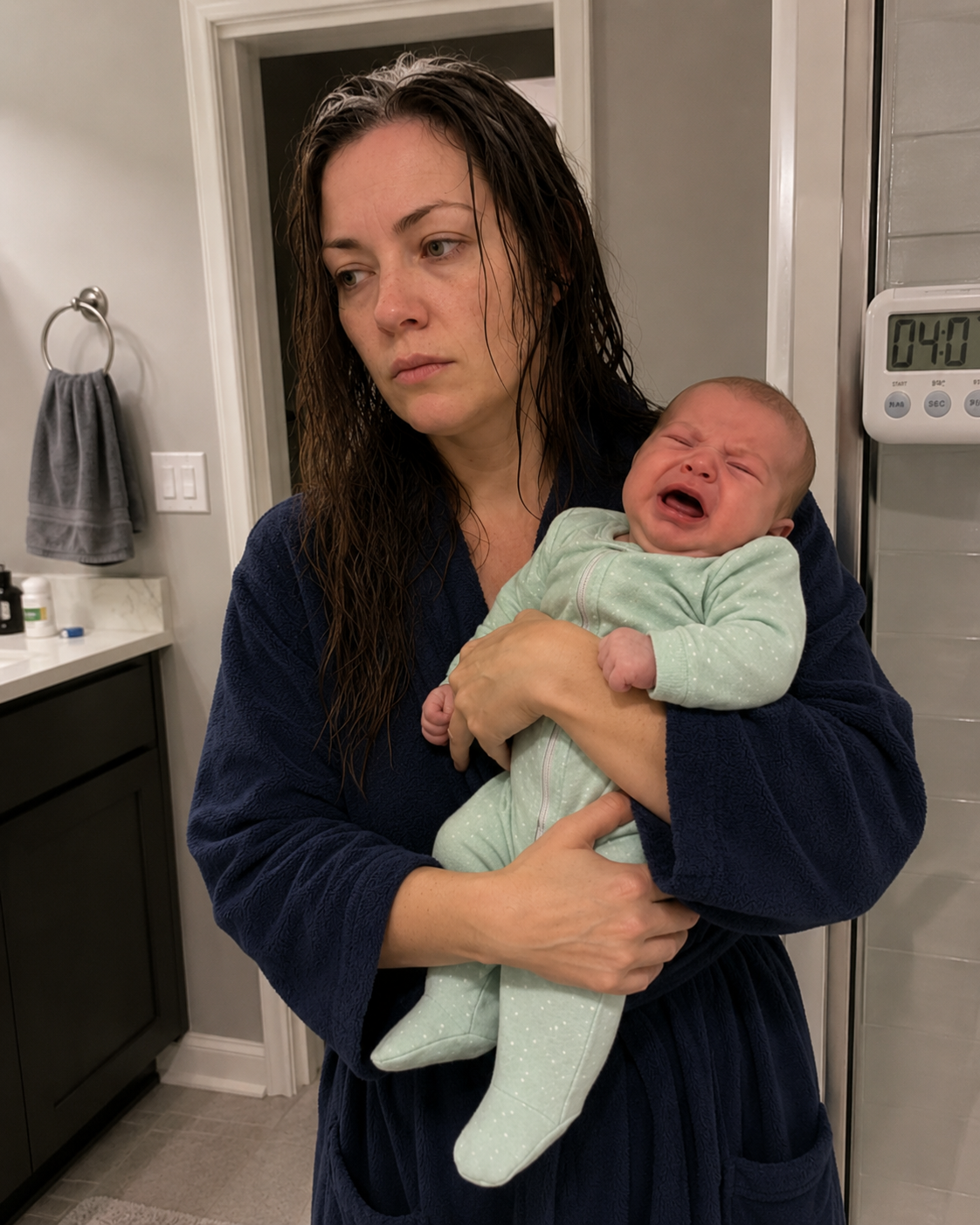
The timer was gone.
No impatient voice echoed from the other side of the door.
No footsteps paced the hallway.
There was only the gentle hiss of the shower, steam slowly covering the mirror, and hot water easing away weeks of tension that had settled deep into my shoulders.
For the first time in a long while, I washed my hair without watching an imaginary countdown.
I shampooed it twice.
I let the conditioner sit instead of rinsing it out immediately.
I stayed there long enough to remember something I had nearly forgotten—
I had a body that deserved care simply because it was mine, not because it existed to serve everyone else.
When I finally came downstairs, I found Gerald sitting quietly in the nursery.
Maisie was asleep against his chest, completely peaceful.
He looked up as I entered and smiled softly.
“Take all the time you need.”
Those words didn’t magically repair everything.
One sentence never can.
Trust doesn’t return in a single morning.
Respect isn’t rebuilt with a single apology.
Some wounds need far more than kind words before they begin to heal.
I had spent so long believing my body existed only for everyone else’s needs that I had almost forgotten it belonged to me.
But things slowly began to change.
Gerald started getting up with Maisie during the night without waiting for me to ask.
He learned her routines.
He learned what each cry meant.
He stopped talking about what inconvenienced him and started asking a very different question.
“What do you need?”
And little by little, I stopped apologizing for resting.
I stopped feeling guilty for eating a proper meal.
I stopped rushing through showers in my own home as though taking care of myself were some kind of luxury I hadn’t earned.
So yes…
My husband once decided that four minutes were enough for me.
His father gave him seven days to live the life I had been carrying alone.
Those seven days taught him what lectures never could.
By the end of that week, Gerald finally understood that love cannot be measured by a stopwatch.
Real love makes room for another person’s exhaustion.
It offers patience instead of control.
It chooses compassion instead of convenience.
And any home that forces you to rush your own humanity is a home that needs to change before the people inside it can truly heal.
Love was never meant to run on a timer.