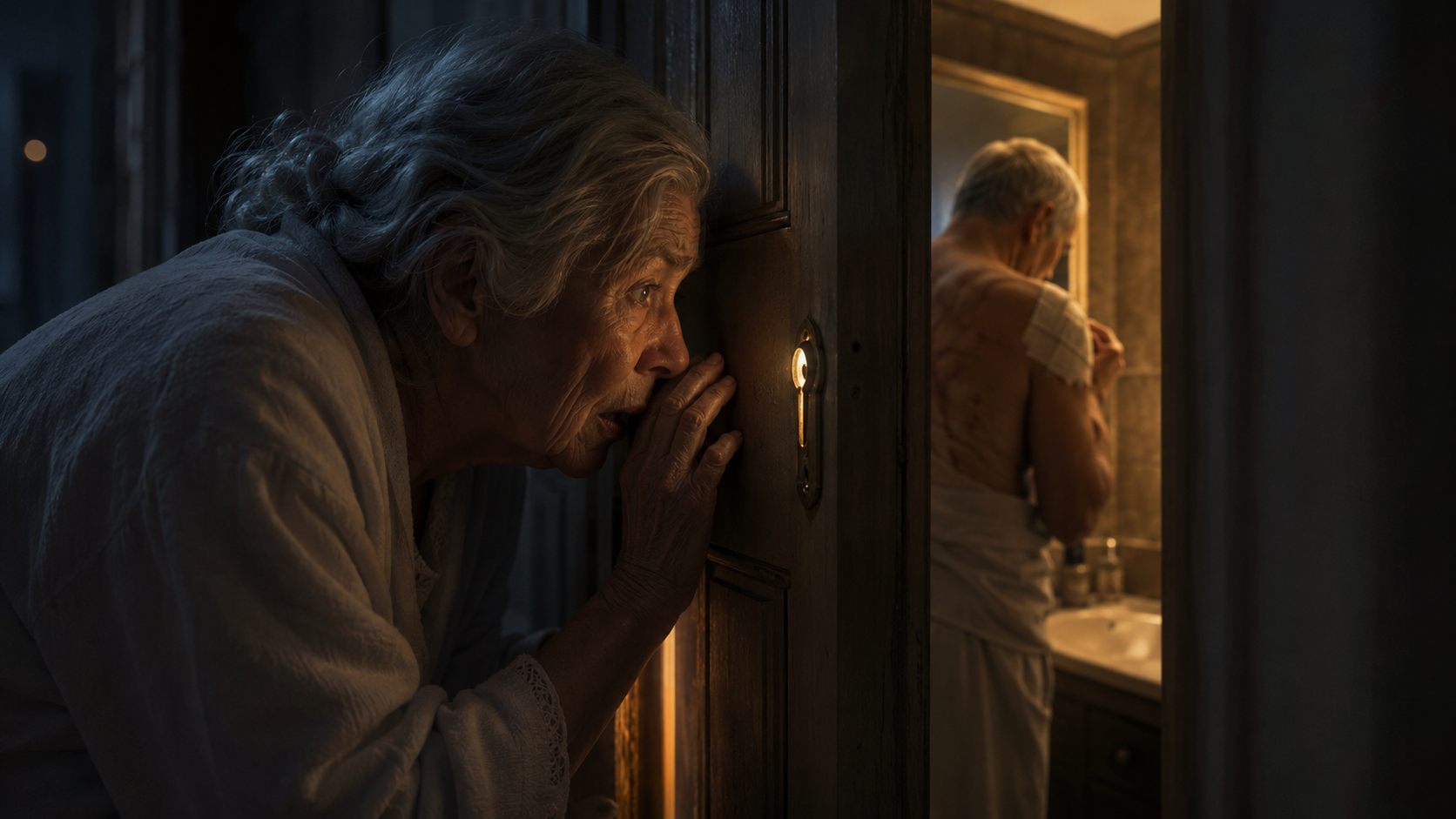
For thirty-five years, Evelyn Hart woke to the same sound.
Not the birds.
Not the pipes shuddering awake in the old walls.
Not the first delivery truck coughing its way down Harbor Street before sunrise.
It was the bathroom door.
Every morning, at exactly four-seventeen, her husband slipped out of bed as carefully as a thief and walked barefoot down the narrow hallway. Evelyn would lie still beneath the quilt, eyes closed, breathing slowly, pretending not to hear what she had heard for more than half her life.
The soft scrape of the bottom drawer opening.
The click of a small metal box.
The whisper of plastic.
Then the bathroom door closing.
Then the lock.
For the first years of their marriage, she had told herself it was nothing. Men had their little rituals. Her father had polished his shoes before dawn every Sunday even when he no longer went anywhere important. Her brother used to smoke on the porch at sunrise and say the quiet helped him think. Thomas was private. That was all. Private, disciplined, old-fashioned.
But privacy did not usually sound like a man trying not to cry.
They lived in a small blue house near the Oregon coast, the kind of house that leaned a little toward the sea as if listening for storms. Thomas had painted it himself in the summer of 1982, standing on a ladder in long sleeves while everyone else in the neighborhood wore T-shirts and complained about the heat. He had built the kitchen shelves, fixed the roof twice, planted lavender along the front path because Evelyn once said the smell reminded her of her mother’s garden.
People loved Thomas Hart.
They called him dependable.
They called him quiet.
They called him the last decent man left on Harbor Street.
At the grocery store, widows asked him to carry their bags. Children on bicycles slowed down when he was in the driveway because he never shouted, only raised one eyebrow, which was somehow worse. When the church boiler broke, Thomas fixed it without sending a bill. When Mrs. Bell’s son didn’t come home for Christmas, Thomas shoveled her walk before sunrise for three straight mornings and never mentioned it.
Everyone thought Evelyn had married safety.
Sometimes she had thought so too.
She met him when she was twenty-two and working at a diner outside Astoria. Thomas came in every Thursday at six in the evening, ordered black coffee and toast, and left a dollar tip even when the meal cost less than that. He was not handsome in the easy way some men were handsome. He was too thin, too serious, with watchful gray eyes and hands that looked older than the rest of him. But he listened when Evelyn spoke, and that was rare enough to feel like romance.
He never talked about his childhood.
When she asked, he said, “There isn’t much worth telling.”
When she asked again, he said, “I got out.”
She had thought he meant poverty. Or a bad father. Or some family shame people from small towns buried because they believed silence was cleaner than truth.
They married in autumn, under a maple tree behind her aunt’s house, with twelve guests and a cake that leaned dangerously to one side. Thomas wore a dark suit despite the warm weather. Evelyn remembered touching his sleeve during the vows and feeling the tension in his arm, hard as a board, as if he were preparing for someone to strike him.
She mistook it for nerves.
For years, Evelyn mistook many things.
She mistook his sleeplessness for discipline.
She mistook his silence for strength.
She mistook the way he flinched from sudden touch for a dislike of affection.
She mistook the locked bathroom for a habit.
Until habits began leaving stains.
At first it was only the smell: antiseptic, sharp and medicinal, drifting into the bedroom when Thomas returned before dawn. Then there were towels in the hamper with tiny rust-colored marks folded carefully inside, as if he believed linen could keep secrets. Once she found strips of gauze wrapped in newspaper at the bottom of the trash. Another time she opened the drawer beneath the sink and discovered bottles of ointment hidden behind the cleaning powder.
When she asked him about it, Thomas went still.
Not annoyed.
Not embarrassed.
Still.
It frightened her more than anger would have.
“What is this?” she asked, holding up a roll of bandage.
His face lost color. “Leave it alone, Evelyn.”
“Are you sick?”
“No.”
“Are you hurt?”
“No.”
“Then what are you doing every morning?”
He stepped toward her, and for one terrible second she thought he might take the bandage from her hand like a man taking evidence from a witness.
Instead, he said very softly, “Please.”
That word ended the conversation.
Please.
Not stop.
Not don’t.
Please.
Evelyn put the bandage back.