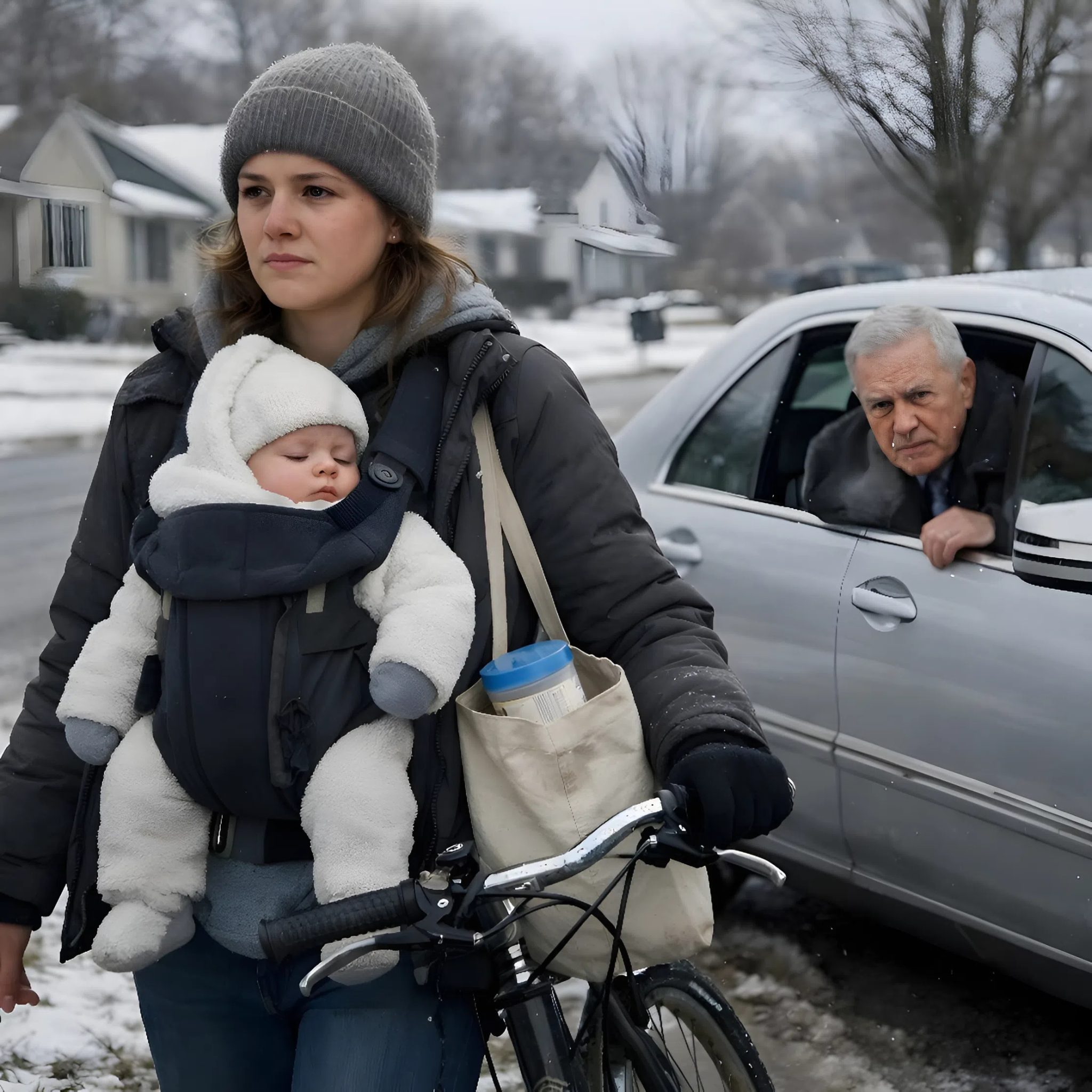
That morning was one of those mornings when the cold is not ‘wintery and cosy’ but merciless. The air burns your lungs, the pavements glisten as if warning you: one wrong step and you’ll fall. Our suburb near Chicago seemed deserted and austere, as if the city had decided that today, everyone would survive as best they could.
I went out anyway — because we were almost out of baby formula. No walk for pleasure. No ‘getting some fresh air.’ Just the simple, harsh mathematics of motherhood: the baby needs to eat, so I have to get to the shop.
Ethan was strapped to me in an old baby carrier I had once bought from another mother. The fabric was faded, but it held strong. He pressed his cheek against my jumper, looked at me with wide eyes and… was too quiet. This silence was frightening: it was as if he was already learning to recognise tension.
With my other hand, I was pushing a second-hand bicycle along the pavement — the tyre had gone flat right at the gate, as if on purpose. The rubber seemed to have grown tired along with me and given up. My fingers were numb, my cheeks were burning, and my body still felt foreign after giving birth. Sleep came in bursts of an hour and a half and did not cure anything.
Outside, it was freezing and the road was slippery.
I was carrying a newborn who needed feeding.
In my hands, I had a bicycle that wouldn’t ride.
In my head, I had fatigue and the feeling that there was no help coming.
And then a black saloon car stopped nearby. At first, I only noticed its confident movement, tinted windows and the feeling that the car ‘had the right’ to take up the road. Then the rear window rolled down.
‘Olivia,’ came a voice, flat and cold as metal.
My insides clenched. Grandfather Victor Hale appeared at the window—grey hair, stern eyes, and an expression that usually made grown men start making excuses before he even asked a question.
‘Why aren’t you driving the Mercedes I gave you?’ he demanded.
It was said in such a way that I didn’t want to argue. I stopped. The bike tilted, and I caught it so it wouldn’t fall. Ethan blinked and clung tighter to my jumper.
We hadn’t seen each other for almost a year: since Ethan was born, since my husband, Ryan, was sent to serve abroad, and since I ‘temporarily’ returned to my parents’ house. In their minds, ‘helping the family’ meant control and endless conditions. But Grandfather always helped differently: without sentimentality, but with opportunities and influence.
Grandfather shifted his gaze from the bike to the child, then back to me. His face hardened.
I had to answer. There was a lump in my throat — the familiar fear of saying too much and then paying for it. But somewhere inside, stubborn honesty awoke.
‘I don’t have a car,’ I exhaled. ‘Mary drives the Mercedes.’
Mary is my younger sister. She got away with a lot: she knew how to be ‘nice’ when she needed to be and ruthless when it suited her. She knew how to build power in the family through money and attention.
My grandfather’s reaction was instantaneous. His calmness vanished as if someone had flipped a switch. Anger flashed in his eyes — not loud, but heavy and dangerous.
Sometimes a single truthful phrase is enough to shatter someone’s carefully constructed order.
He didn’t ask for clarification or express doubt. He simply made a subtle gesture to the driver. The door opened.
‘Get in,’ said my grandfather.
I climbed into the car, holding Ethan close to me. I was immediately enveloped in warmth: the smell of leather, the faint scent of expensive cologne. Ethan sighed quietly and relaxed. The bicycle remained in the snow.
And it was precisely this — leaving it there, like leaving behind an unnecessary version of oneself — that made me blink frantically to keep from crying.
Grandfather was silent for a while, looking out the window. The silence was more oppressive than any questions. I had time to imagine how my parents would ‘rewrite reality’ again: they would call me unstable, tired, ‘postpartum,’ suggestible. They knew how to sound convincing. And they were even better at making me look ‘too emotional.’
Finally, he spoke:
‘Olivia, this isn’t just about the car, is it?’
I froze. Panic rose in my chest: if I told the truth, my parents might start to take revenge — pressure Ryan, threaten legal action, hint at custody. They had already tried.
But then I looked at Ethan. At how calmly he was breathing on my chest. And I realised: his future shouldn’t depend on a home where love always comes with ‘conditions’.
‘Grandfather,’ I said unexpectedly calmly. ‘This isn’t a “family feud”. It looks like a crime.’
He looked as if he had been waiting for those very words.
I told him briefly, sticking to the facts — like someone who had lived in survival mode for too long. The gifted Mercedes was ‘kept safe’ at my mother’s house, I didn’t have the keys, and the car ended up with Mary ‘so it wouldn’t sit idle.’ My mail was ‘sorted,’ bank notifications mysteriously disappeared, and my card was ‘helped to control’ because I was supposedly ‘exhausted.’