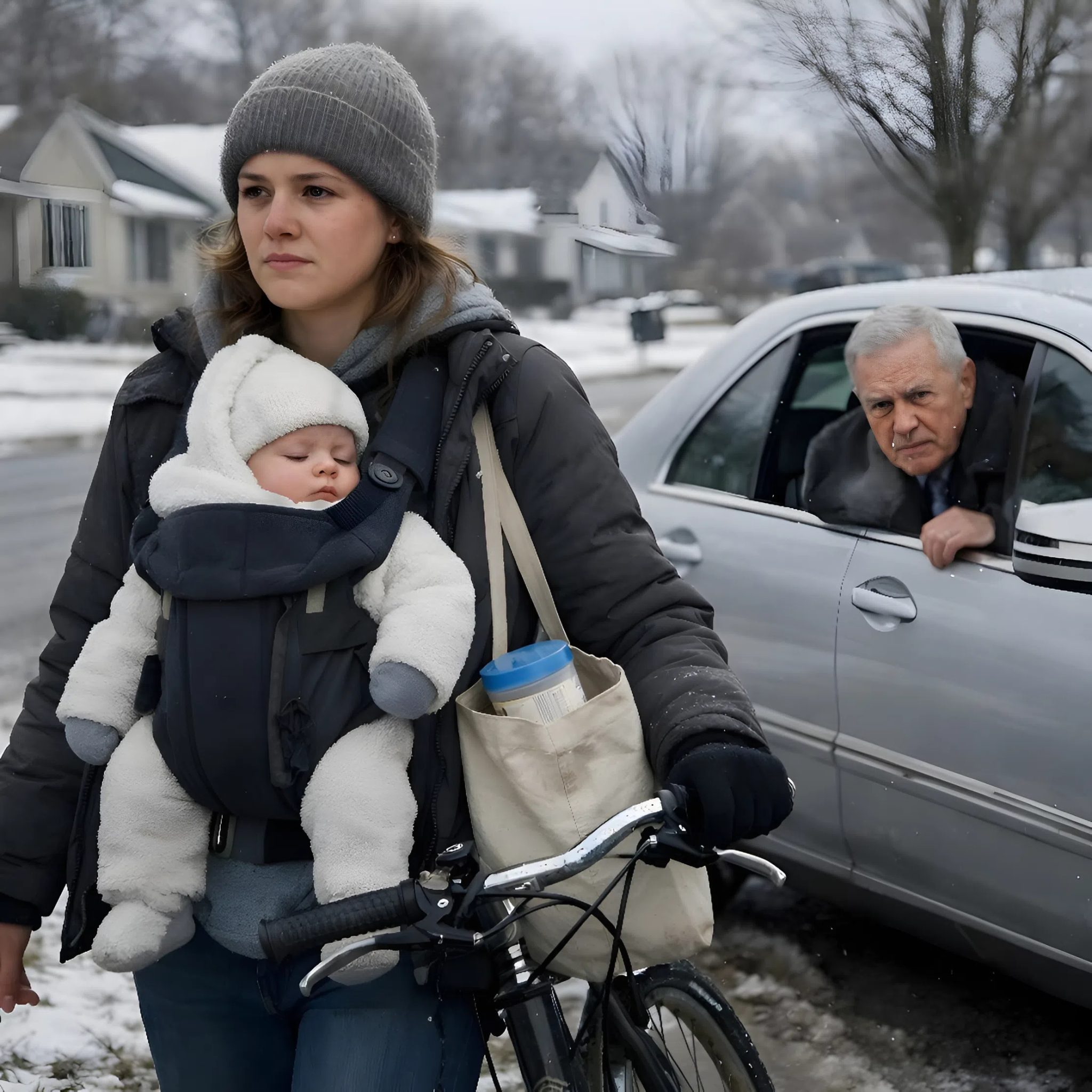
That morning was one of those mornings when the cold is not ‘wintery and cosy’ but merciless. The air burns your lungs, the pavements glisten as if warning you: one wrong step and you’ll fall. Our suburb near Chicago seemed deserted and austere, as if the city had decided that today, everyone would survive as best they could.
I went out anyway — because we were almost out of baby formula. No walk for pleasure. No ‘getting some fresh air.’ Just the simple, harsh mathematics of motherhood: the baby needs to eat, so I have to get to the shop.
Ethan was strapped to me in an old baby carrier I had once bought from another mother. The fabric was faded, but it held strong. He pressed his cheek against my jumper, looked at me with wide eyes and… was too quiet. This silence was frightening: it was as if he was already learning to recognise tension.
With my other hand, I was pushing a second-hand bicycle along the pavement — the tyre had gone flat right at the gate, as if on purpose. The rubber seemed to have grown tired along with me and given up. My fingers were numb, my cheeks were burning, and my body still felt foreign after giving birth. Sleep came in bursts of an hour and a half and did not cure anything.

Outside, it was freezing and the road was slippery.
I was carrying a newborn who needed feeding.
In my hands, I had a bicycle that wouldn’t ride.
In my head, I had fatigue and the feeling that there was no help coming.
And then a black saloon car stopped nearby. At first, I only noticed its confident movement, tinted windows and the feeling that the car ‘had the right’ to take up the road. Then the rear window rolled down.
‘Olivia,’ came a voice, flat and cold as metal.
My insides clenched. Grandfather Victor Hale appeared at the window—grey hair, stern eyes, and an expression that usually made grown men start making excuses before he even asked a question.
‘Why aren’t you driving the Mercedes I gave you?’ he demanded.
It was said in such a way that I didn’t want to argue. I stopped. The bike tilted, and I caught it so it wouldn’t fall. Ethan blinked and clung tighter to my jumper.
We hadn’t seen each other for almost a year: since Ethan was born, since my husband, Ryan, was sent to serve abroad, and since I ‘temporarily’ returned to my parents’ house. In their minds, ‘helping the family’ meant control and endless conditions. But Grandfather always helped differently: without sentimentality, but with opportunities and influence.
Grandfather shifted his gaze from the bike to the child, then back to me. His face hardened.

I had to answer. There was a lump in my throat — the familiar fear of saying too much and then paying for it. But somewhere inside, stubborn honesty awoke.
‘I don’t have a car,’ I exhaled. ‘Mary drives the Mercedes.’
Mary is my younger sister. She got away with a lot: she knew how to be ‘nice’ when she needed to be and ruthless when it suited her. She knew how to build power in the family through money and attention.
My grandfather’s reaction was instantaneous. His calmness vanished as if someone had flipped a switch. Anger flashed in his eyes — not loud, but heavy and dangerous.
Sometimes a single truthful phrase is enough to shatter someone’s carefully constructed order.
He didn’t ask for clarification or express doubt. He simply made a subtle gesture to the driver. The door opened.
‘Get in,’ said my grandfather.
I climbed into the car, holding Ethan close to me. I was immediately enveloped in warmth: the smell of leather, the faint scent of expensive cologne. Ethan sighed quietly and relaxed. The bicycle remained in the snow.

And it was precisely this — leaving it there, like leaving behind an unnecessary version of oneself — that made me blink frantically to keep from crying.
Grandfather was silent for a while, looking out the window. The silence was more oppressive than any questions. I had time to imagine how my parents would ‘rewrite reality’ again: they would call me unstable, tired, ‘postpartum,’ suggestible. They knew how to sound convincing. And they were even better at making me look ‘too emotional.’
Finally, he spoke:
‘Olivia, this isn’t just about the car, is it?’
I froze. Panic rose in my chest: if I told the truth, my parents might start to take revenge — pressure Ryan, threaten legal action, hint at custody. They had already tried.
But then I looked at Ethan. At how calmly he was breathing on my chest. And I realised: his future shouldn’t depend on a home where love always comes with ‘conditions’.
‘Grandfather,’ I said unexpectedly calmly. ‘This isn’t a “family feud”. It looks like a crime.’
He looked as if he had been waiting for those very words.
I told him briefly, sticking to the facts — like someone who had lived in survival mode for too long. The gifted Mercedes was ‘kept safe’ at my mother’s house, I didn’t have the keys, and the car ended up with Mary ‘so it wouldn’t sit idle.’ My mail was ‘sorted,’ bank notifications mysteriously disappeared, and my card was ‘helped to control’ because I was supposedly ‘exhausted.’

And most importantly — the debits. Large sums. Too large for ‘groceries and nappies.’
The car is registered to me, but my sister has access to it.
Mail and bank notifications went through my parents.
They ‘managed’ my accounts, explaining that it was out of concern for me.
Money disappeared, and I was told, ‘There are no funds.’
Grandfather listened without interrupting. When I finished, he said just one sentence to the driver:
‘Let’s go to the police station.’
I felt a rush of heat.
‘Grandfather, wait…’ I blurted out. ‘They’re my parents. If that’s the case… they might… Ryan… Ethan…’
He took my hand firmly, calmly, confidently.
‘They hide behind the word “family” while they rob you and your future child,’ he said. ‘You said it yourself: this is a crime. From this moment on, you and Ethan are under my protection.’
Something inside me broke — not from weakness, but from relief. From the realisation of how long I had been living with bated breath.
‘Okay,’ I whispered. ‘Let’s go.’
The statement that turned a ‘family story’ into a case
The police station smelled of coffee, wet jackets, and bright lights that left no shadows. Without my grandfather, I would probably have turned around at the entrance and run away — back to familiar trouble, where at least I knew how to survive.
But he called me while we were still in the car and said:
‘I contacted your solicitor. He’ll be here soon.’
It sounded unreal: ‘my solicitor.’ As if it weren’t my life, but a film. We were shown into a separate room, where the officer listened to me attentively. At first, her gaze was cautiously neutral — as in ordinary family conflicts. But the more facts emerged, the more serious her questions became.

‘Did you sign a power of attorney or documents giving them access to the accounts?’ she asked.
‘No. Never.’
Then my grandfather added quietly, but in a way that made the air in the room seem to thicken:
‘I set up a fund of $150,000 for my granddaughter. The documents were supposed to go directly to her.’
The officer looked up. My grandfather turned to me:
‘Did you receive these papers?’
My breath caught in my throat.
‘No… I didn’t even know it existed.’
Sometimes the worst thing is not the loss of money, but the realisation that someone has been deciding for years what you ‘shouldn’t know’.
From that moment on, it was no longer a matter of ‘parental care,’ but of concealment, manipulation, and possible fraud. The statement was treated as a criminal case. We left after dark, and the car drove not to my parents’ house, but to my grandfather’s estate.
A house where no unnecessary questions are asked
Everything on the estate was organised differently: quietly, clearly, efficiently. There was already a cot in the room. No one asked questions or judged — they just helped. I laid Ethan down and, when the adrenaline finally subsided, I felt not tears, but anger. Pure, clear anger.
‘Are you afraid?’ asked Grandfather.
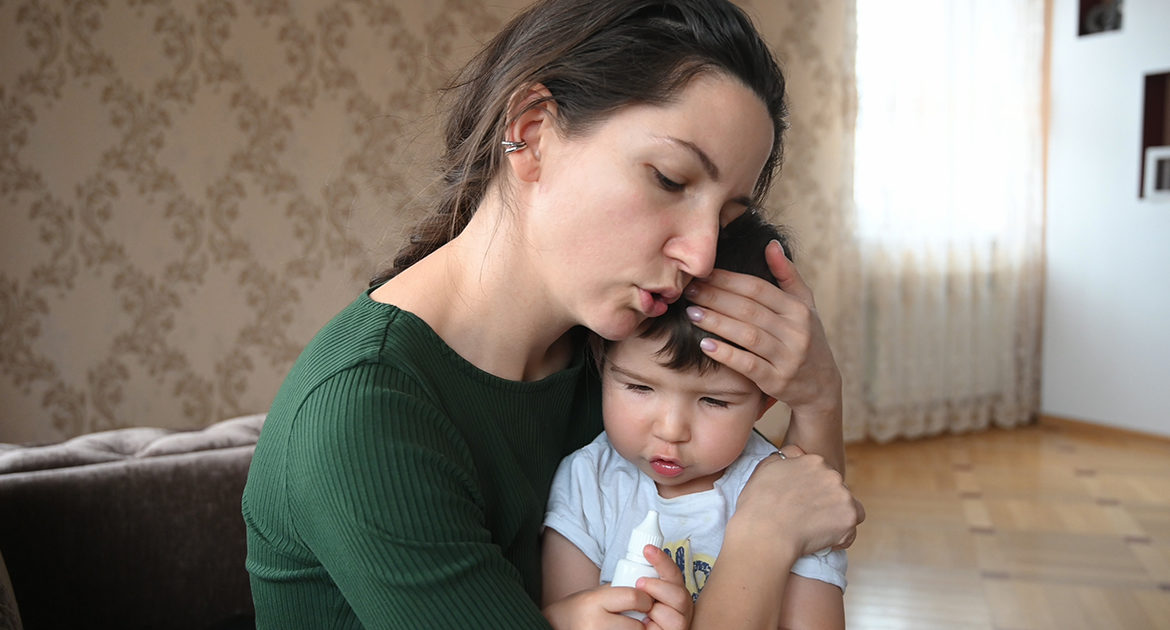
I looked at the fire in the fireplace.
‘No. I’m angry. And I’m thinking about what they’ll do next.’
He nodded:
‘You didn’t start this war. But now you’ve stopped keeping quiet.’
When threats come in messages
In the morning, my phone was buzzing with calls and messages — Mum, Dad, Mary. First, it was ‘concern’ and ‘worry,’ then demands and accusations. And then Mary wrote something particularly unpleasant: a hint that she might ‘tell everyone’ that I was ‘not okay’ and ‘couldn’t cope with the child.’
It wasn’t sympathy. It was an attempt to intimidate and create a ‘version of events’ in advance.
Grandfather read it and said:
‘They’re sending us the evidence themselves.’
That same day, specialists arrived: a solicitor and a financial expert. They didn’t argue about feelings — they gathered facts. Money can’t be gaslit when everything is laid out in statements and dates.
Lawyers recorded the threats and prepared documents.
A financial expert began tracing transfers and withdrawals.
Requests for disclosure of information were sent to banks and the fund custodian.
The main goal was to stop further access to the accounts.
Later, the expert reported that almost $80,000 had been withdrawn without my consent. The expenses included purchases related to Mary, improvements to her parents’ home, and even a paid holiday. And all this against the backdrop of the phrase ‘there’s not enough money for formula.’

Attempted pressure and legal protection
My parents arrived at the gates of the estate, made a scene, demanded that I ‘return the child,’ and played the victims. We did not engage in conversation. Lawyers advised us to record what was happening and call the police. The officers who arrived warned them and drew up a report.
But the main point was different: the lawyer explained that the next step in the pressure campaign would be to approach my husband, Ryan. The parents might try to convince him that I had ‘lost it’ and was ‘dangerous.’
I called Ryan on video chat. He was tired but attentive. And I did what the lawyers taught me: I spoke in facts, without hysterics and without asking him to ‘save me.’
The car. Withdrawing money. The secret fund. Threats. The police report. The expert’s work.
Ryan was silent for a long time, and then he said:
‘I believe you. And we’ll document everything. They won’t be able to use my service against you.’
The most dangerous weapon of manipulators is isolation. When it disappears, their power melts away.
Restraining order and attempt to ‘play games’ through the authorities
When my mother sent a message hinting that I could be accused of ‘child abduction,’ the lawyers immediately filed for an emergency restraining order. The court quickly issued a temporary protection order: no calls, visits, messages, or attempts to contact Ryan through third parties. The order also applied to Ethan.

Later, there was an attempt to exert pressure through social services — someone reported that the child was ‘unsafe.’ We cooperated calmly: we showed the nursery, food, documents from the paediatrician, as well as threats and the court order. The investigation ended with nothing: the complaint looked like a retaliatory attempt to cause harm.
All contact with the family was legally prohibited.
The attempt to ‘check’ through the services was not confirmed.
The documents and correspondence became part of the evidence base.
The main thing is to remain calm and follow the rules.
Financial discoveries that cannot be explained by ‘care’
The investigation continued. It turned out that some of the mail was being redirected through a statement signed by my mother. More serious details emerged: a forged document was found in one of the institutions, which gave my parents the authority to manage my finances on my behalf. The signature did not look like mine.
The financial crimes detective called it what it was: fraud.
And at that moment, the old mindset of ‘but they’re family’ finally switched off in my head. Family does not give you the right to rewrite your life on paper and squander your future.
Court, property return and a new foothold
In court, the lawyers presented correspondence, financial schemes and evidence of pressure. The judge looked at behaviour, not ‘family roles’. The restraining order was extended and strengthened. Violation threatened immediate consequences.
A civil case followed: return of assets, compensation. It was officially confirmed that the Mercedes was registered to me. The car was returned by court order.
When I first got behind the wheel, my hands were shaking. Not from fear, but from an unfamiliar feeling: I no longer had to ask permission for something that was rightfully mine.
Freedom sometimes begins not with loud victories, but with a simple action: taking your keys and going where you need to go.
The end: not revenge, but a way out of the trap
Later, the case went to criminal court: proceedings began on the most serious charges. The result was an obligation to return the money and restrictions that protected me and my child. I did not seek public humiliation of my family — I needed security and clear boundaries.
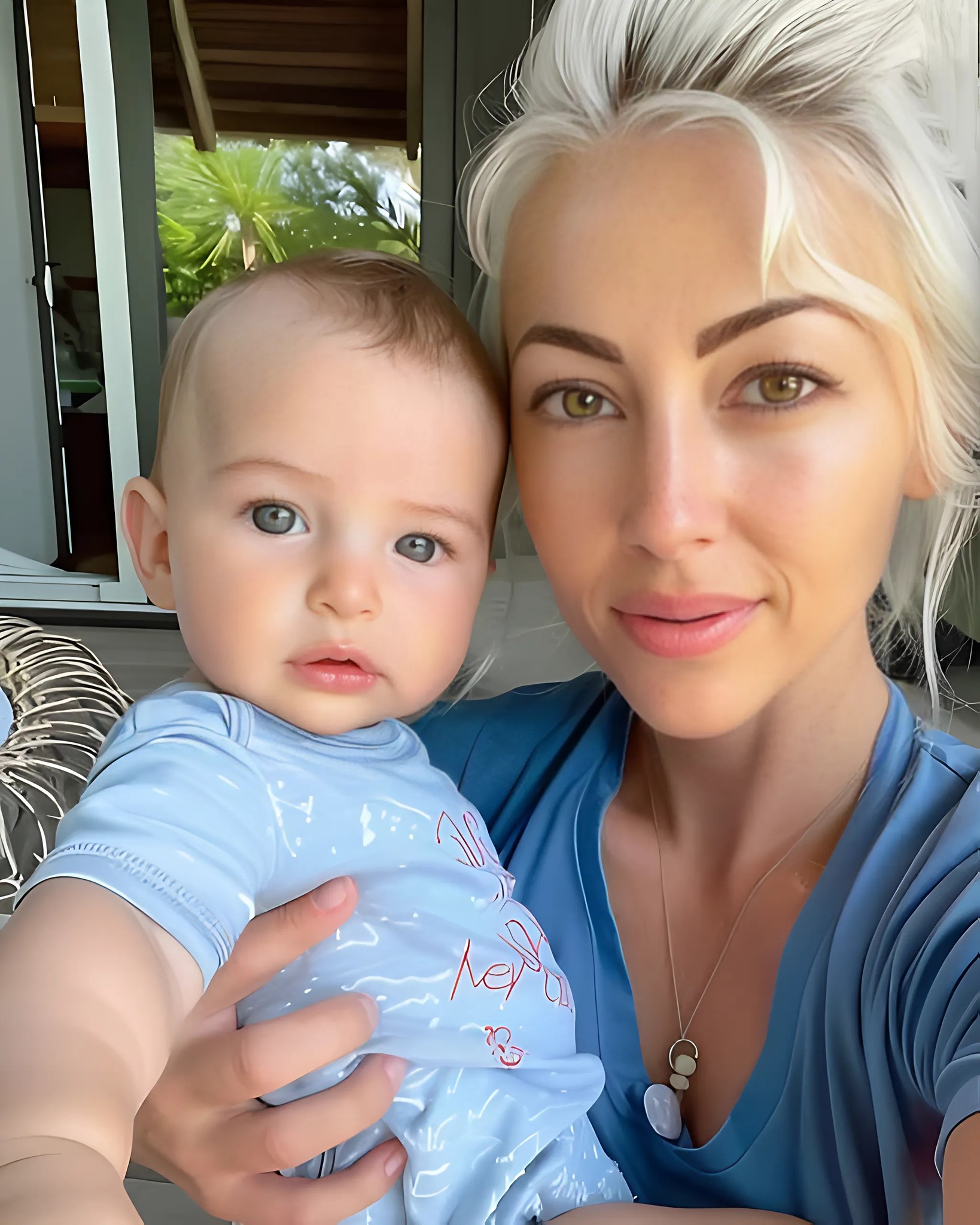
Over time, I rented my own flat: bright, quiet, with a room for Ethan. Ryan helped from a distance, leaving a clear trail in the documents in case of new attempts at pressure.
And one day I went back to the shop to buy baby formula — without panic, without counting coins, and without fear of hearing ‘no money.’ Ethan smiled as he looked at the lamps on the ceiling, as if the world had finally become simple and kind.
I realised the main thing: I didn’t need to ‘win’ against those who tried to control me. It was enough to leave their system of control and start building a life in which the word ‘family’ meant support, not power.