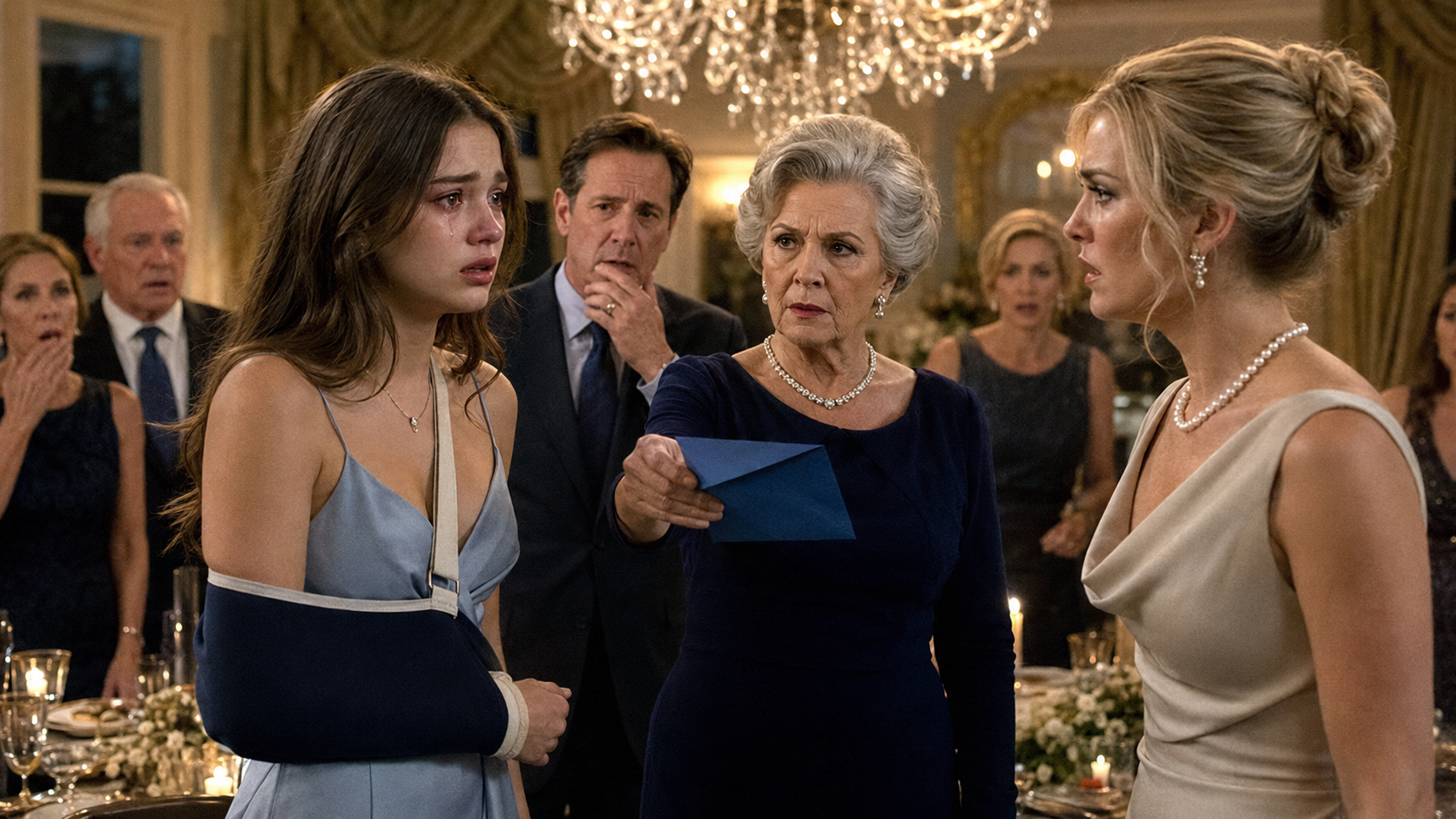
But my father stopped.
That hurt him.
I was glad.
Then I hated myself for being glad.
Then I decided I could be glad for one night.
“You should go upstairs,” Grandma told him.
He looked at her like a child.
“Mom.”
“No,” she said. “You do not get to be the son tonight. You do not get comfort from the mother of the woman you betrayed.”
His face twisted.
“I made mistakes.”
Grandma’s voice was calm.
“No. You made choices and called them mistakes when they became expensive.”
He looked at me.
“I loved your mother.”
I held the pearls tighter.
“Maybe. But you didn’t honor her.”
That was the last thing I said to him that night.
He went upstairs alone.
Grandma helped me stand.
My ankle screamed when I put weight on it, but I did not cry this time. She brought my crutches, held my elbow, and guided me into the living room.
The room looked strange.
Serena had removed the old family quilt from the couch weeks ago and replaced it with white pillows no one was allowed to touch. She had hidden my mother’s books in storage baskets. She had put away the photo of Mom laughing with flour on her cheek from the year we tried to bake bread and failed spectacularly.
Grandma noticed too.
Without saying a word, she walked to the storage cabinet and opened it.
Inside were my mother’s books.
Her gardening journal.
A framed photo from my eighth-grade graduation.
A ceramic bowl I had made in school, ugly and lopsided, with Mom painted across the side in purple.
Grandma took out the bowl and placed it on the coffee table.
Then the photo.
Then the books.
One by one, she returned my mother to the room.
I sat on the couch, holding the pearls, watching the house breathe again.
Finally, Grandma sat beside me.
“I should have read it sooner,” she said.
I shook my head.
“You were waiting for him to do the right thing.”
She looked at the doorway where my father had disappeared.
“Yes.”
“Mom was too.”
Grandma’s eyes filled.
“She loved him.”
“I know.”
“That was the tragedy.”
I leaned into her shoulder like I was little again.
For the first time in almost a year, the house did not feel haunted by what was missing.
It felt guarded by what remained.
The next morning, Serena sent twelve messages.
Then twenty.
Then an email.
Then a long post online about betrayal, grief, and being “punished for loving a broken family.”
Grandma printed it out, marked three false statements in red pen, and sent it to Marian’s attorney.
The post disappeared by noon.
By the end of the week, movers came for Serena’s things.
There were fewer boxes than I expected.
That was because most of what she had used was never hers.
My mother’s robes stayed.
My mother’s books stayed.
My mother’s china stayed.
The pearls stayed with me.
My father stayed too, but not in the way he had before. He moved into the guest room. He stopped using the master bedroom after Grandma told him Marian’s attorney had documented everything.
For weeks, he tried to talk.
I was not ready.
Maybe someday I would be.
Maybe not.
Forgiveness, I learned, is not a bill other people get to hand you because they are tired of owing.
On my twentieth birthday, the house legally became mine.
Grandma brought a cake from the bakery my mother loved. My aunt came. Two neighbors came. The pastor sent flowers and a handwritten apology. My father stood awkwardly in the kitchen, looking like a guest in the home he once tried to give away.
When it was time to blow out the candles, Grandma placed the blue envelope beside me.
“There’s one more thing,” she said.
My father looked up.
So did I.
Grandma smiled gently.
“This part was only for Lila.”
My hands shook as I opened it.
Inside was a smaller note.
My mother’s handwriting again.
Not legal.
Not angry.
Just hers.
My brave girl,
If you are reading this, then you made it through the hardest part. I am sorry I could not stand beside you in the room where the truth came out. But I need you to know something: protecting you was the last great work of my life. Not because you are weak. Because you were mine.
Do not let bitterness build a second grave inside you. Let people earn their way back slowly, if they can. Let others leave forever, if they must. But never confuse keeping peace with keeping quiet.
This house is not a prize. It is a place to become yourself.
Fill it with people who say your name kindly.
Wear the pearls when you need to remember that you come from women who survived more than anyone saw.
And when someone tries to replace me, do not fight for my place.
No one can take it.
I read the last line three times.
Then I cried.
Not the quiet kind of crying I had learned to do in bathrooms and stairwells.
Real crying.
The kind that bent me forward.
Grandma held me.
My aunt cried too.
Even my father turned away and covered his mouth.
But this time, no one told me to stop.
No one said I was ruining the mood.
No one called it grief talking.
They let me cry in my mother’s house, under my mother’s roof, with my mother’s pearls in my hand.
And when I finally stood, I walked to the living room mirror.
My ankle had healed by then.
My arm had too.
The scars were still there, faint but visible.
I fastened the pearls around my own neck.
For a second, I saw her.
Not as a ghost.
Not as a memory.
As a woman who had known exactly what love was worth, and exactly what betrayal cost.
My father came to the doorway.
He did not step inside.
“Lila,” he said quietly. “You look like her.”
I touched the pearls.
“No,” I said.
Then I smiled, because for the first time it did not hurt to say it.
“I look like me.”