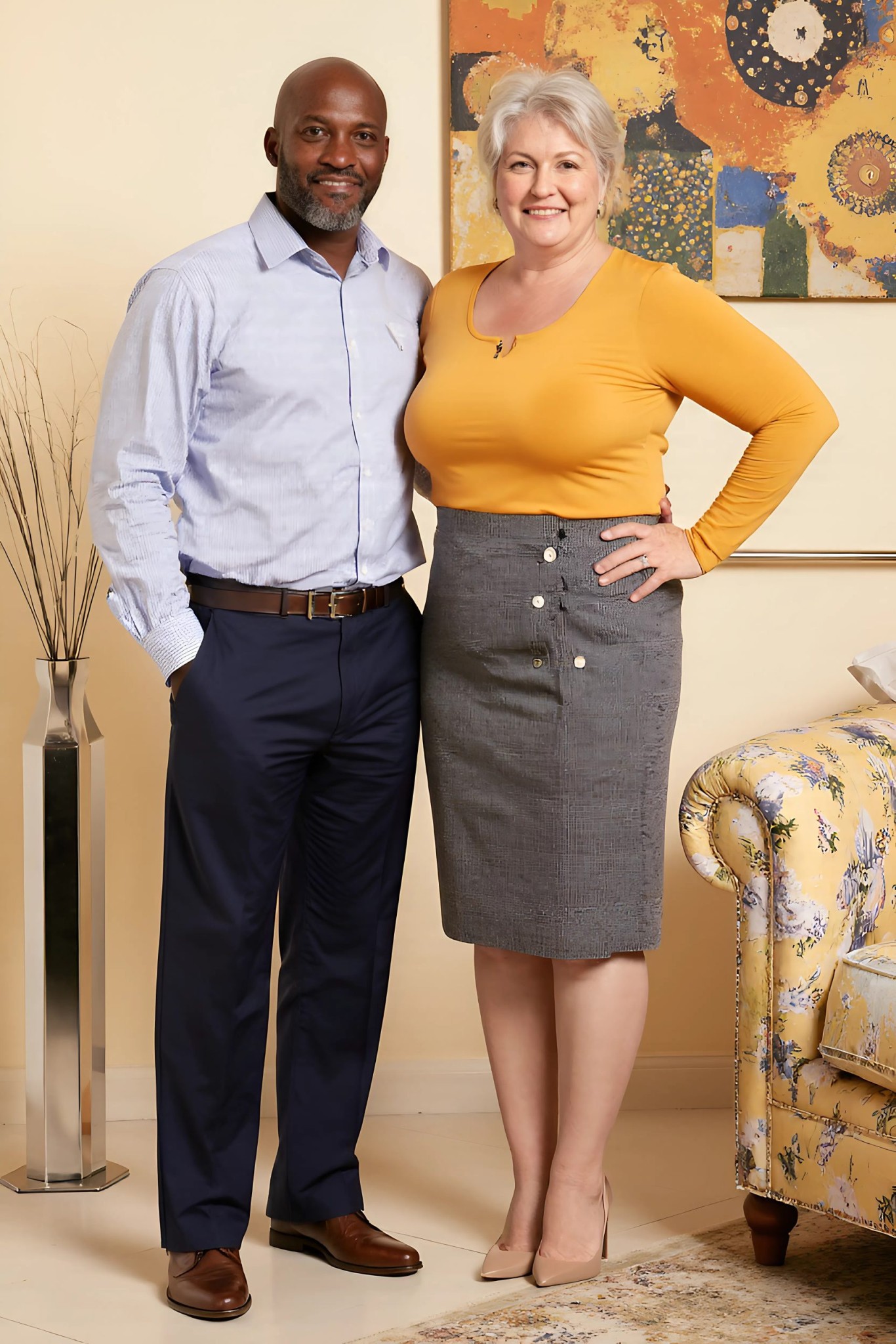
Everyone thought he was just a ‘transitional’ option.
I had just come out of a 19-year marriage that ended quietly but painfully — without drama, just alienation. So when I showed up at Thanksgiving with Karim, arm in arm and carefree and happy, jaws dropped before the turkey was even carved.
It wasn’t just his age. Or the fact that he was barefoot, smiling as if he’d been here a hundred times before. It was how easy we felt with each other. Effortless. Like something new they couldn’t quite put their finger on.

My sister cornered me in the laundry room. She whispered, ‘Are you sure this isn’t just… you trying to feel wanted?’
I didn’t answer. I didn’t owe her anything.
But the truth is, I did wonder. In quiet moments. Not about us, but about what I didn’t know. Karim was kind, calm, the kind of man who looked you in the eye and really listened. But there were gaps. Stories that began and never ended. Phone calls he always took in the hallway. One drawer in his flat that he never opened when I stayed over.
I didn’t press him.
Until last week…
—
Continued
…when I opened that drawer.
He was in the shower, humming some old soulful tune. I spilled coffee on my jumper and went to look for one of his. I was going to take something from his wardrobe, but I walked past that drawer — and curiosity finally got the better of me.
It wasn’t locked. It slid open easily. Inside were papers, photographs and a small leather notebook tied with string. Everything smelled faintly of cedar and time.
At first, it looked like souvenirs from travels. Postcards from Morocco, a faded train ticket from Berlin, and a Polaroid of a young Karim standing on a pier. Then I saw the letters.
There were dozens of them. All addressed to a name I didn’t recognise: ‘Amina’.
They were dated several years ago and written in his handwriting. Some of the pages were smudged with ink, as if he had cried while writing. Some were poems. Others were simple diaries — what he saw, what he thought, what he regretted.
I froze when I read the line: “If I could give the rest of my days to see her again, I would. But life gives no mercy, does it?”
I stood there too long. He found me with one of the letters in my hand.
He didn’t yell. He didn’t snatch it from my hands. He just stood in the doorway, towel around his hips, and said quietly, ‘So… now you know.’
I didn’t speak. My chest tightened as if I had been caught stealing someone’s soul.
Karim sat down next to me and began to talk.
Amina was his wife. They met when he was twenty and married three years later. She died six years ago — from ovarian cancer that spread too quickly. They tried everything. She was only thirty-one when she passed away.

I listened in silence, a hot feeling of guilt creeping up my spine. He never mentioned her. Not by name. Not even a hint.
‘She asked me to keep living,’ he said, staring straight ahead. “She made me promise I wouldn’t rot in her memory. But sometimes I still do.”
I asked why he hadn’t told me.
He shrugged. ‘Because people don’t see love as something multi-layered. They think that moving on means erasing. I never wanted to erase her. But I also didn’t want to scare you away.’
That night, I lay awake next to him, staring at the ceiling. I wasn’t jealous of Amina. My heart was broken for her. And for him. And, strangely enough, for myself — for not knowing how deep his still waters ran.
The next morning, I kissed him before leaving and said, ‘You can talk about her. I want to know her. I want to know all of you.’
He smiled, but behind that smile was sadness.
A few days later, we were at my house again. My parents had invited us over for Sunday dinner — another attempt, I assumed, to size him up, as families do when they think they’re being subtle.
Everything was fine until my father made a cutting remark about ‘those who move on too quickly.’
I saw Karim flinch.
I squeezed his hand under the table and said firmly, ‘Dad, moving on isn’t disrespectful. It’s survival. People grieve in different ways.’

He chuckled and changed the subject, but the atmosphere had changed.
After dinner, Mum called me into the kitchen while the others chatted in the living room. She dried her hands with a towel and looked at me for a long time.
‘Do you care about him?’ she asked.
I nodded. ‘Yes. I do.’
‘Then stop shielding us from him,’ she said gently. ‘We can handle his truth. You’re the one who needs to stop hiding.’
I didn’t know what to say. But her words stayed with me.
Over the next few weeks, our relationship deepened. Karim slowly opened up more and more. He showed me old photographs, told me about Amina’s laughter, how she made cinnamon pancakes on Sundays. I cried once as he described their last Christmas together.