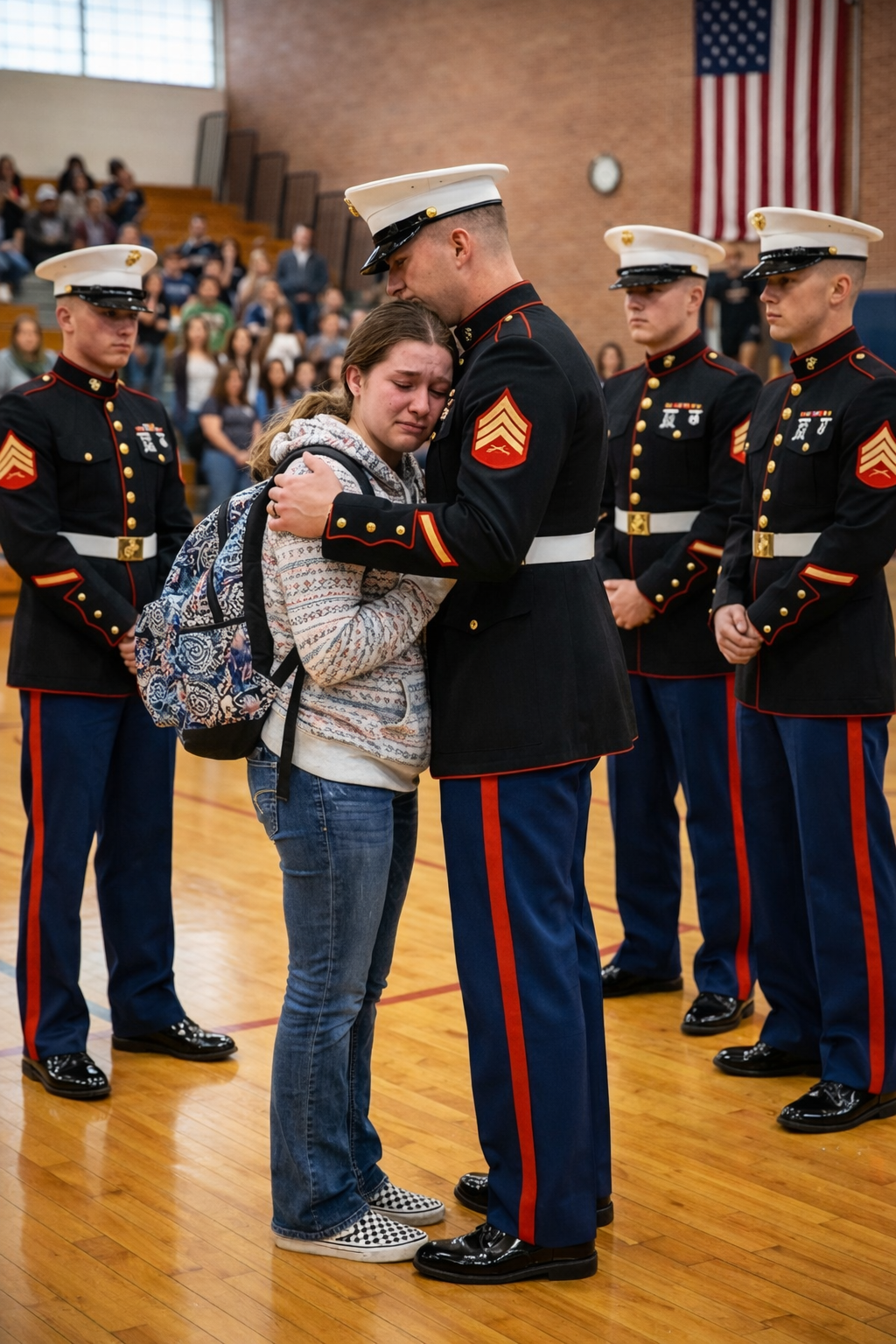
That single statement shifted the entire atmosphere. This wasn’t something sudden or staged—it had been waiting all along. Somehow, that made it even more powerful.
The Marine holding the flag added, “This is a ceremonial replacement display flag. Your family should have received a proper one at the time. That mistake is also being corrected.”
My knees nearly gave out.
Then the officer—Captain Ruiz—continued.
“Your husband was brave. But that word alone isn’t enough. He was steady. He lifted others when things were hard. He wrote home whenever he could. He was proud to be a Marine. And he was proud to be Grace’s father.”
Grace broke down—not loudly, but completely. Her hands trembled as tears fell.
Captain Ruiz stepped down from the stage, knelt in front of her, and spoke gently.
“He talked about you all the time. He would be incredibly proud of you.”

The auditorium fell into complete silence.
Then the principal spoke again.
“There is one more thing. Her classmate has asked to say something.”
The girl stepped forward into the aisle, her face flushed, her hands shaking.
She stopped in front of Grace.
“I was cruel,” she said. “I didn’t understand what I was saying. I’m really sorry.”
Grace looked at her for a long moment.
Then she gave a small, single nod.
When the assembly ended, she ran to me. I held her tightly, my arms aching from how hard I refused to let go.
“They remembered him, Mom,” she whispered.
I kissed her hair. “No, sweetheart. They never forgot.”
That should have been the end.
But it wasn’t.
That night, the medal sat on our kitchen table beside the folded flag. Grace kept walking past it, as if she needed to reassure herself it was real.
Then she stopped.
“Mom?”
“Yes?”
“If this was approved years ago… why didn’t we get it?”
I started to answer with the simplest explanation.
“Paperwork. Delays.”
But even as I said it, something didn’t feel right.
Because deep down, I had always sensed something was off about the records after Daniel died—too neat, too brief, too quickly finalized.
The next afternoon, Captain Ruiz called.
“I hope I’m not intruding,” he said. “There are documents tied to the reopened review that I believe should be delivered in person.”
An hour later, he sat at my kitchen table with a sealed envelope.
Grace lingered in the doorway until he nodded to her. “You should stay. This concerns your father too.”
Inside were official records, citations, witness statements—and one handwritten letter Daniel had sent to his unit chaplain after a particularly difficult week.
Ruiz spoke carefully.
“The delay with the medal was real. But reopening the file also reopened questions about the mission itself.”
I looked at him. “What kind of questions?”
“The kind your family should have known existed.”
As I read through the documents, I understood why they hadn’t been sent sooner.
The mission where Daniel died had been flagged beforehand—concerns about faulty intelligence, timing, warnings from men on the ground.
Daniel had gone anyway. Because that was his duty.
Then everything went wrong.
He saved others. Covered them. And died doing it.
For years, I had carried only grief.
Now, anger joined it.
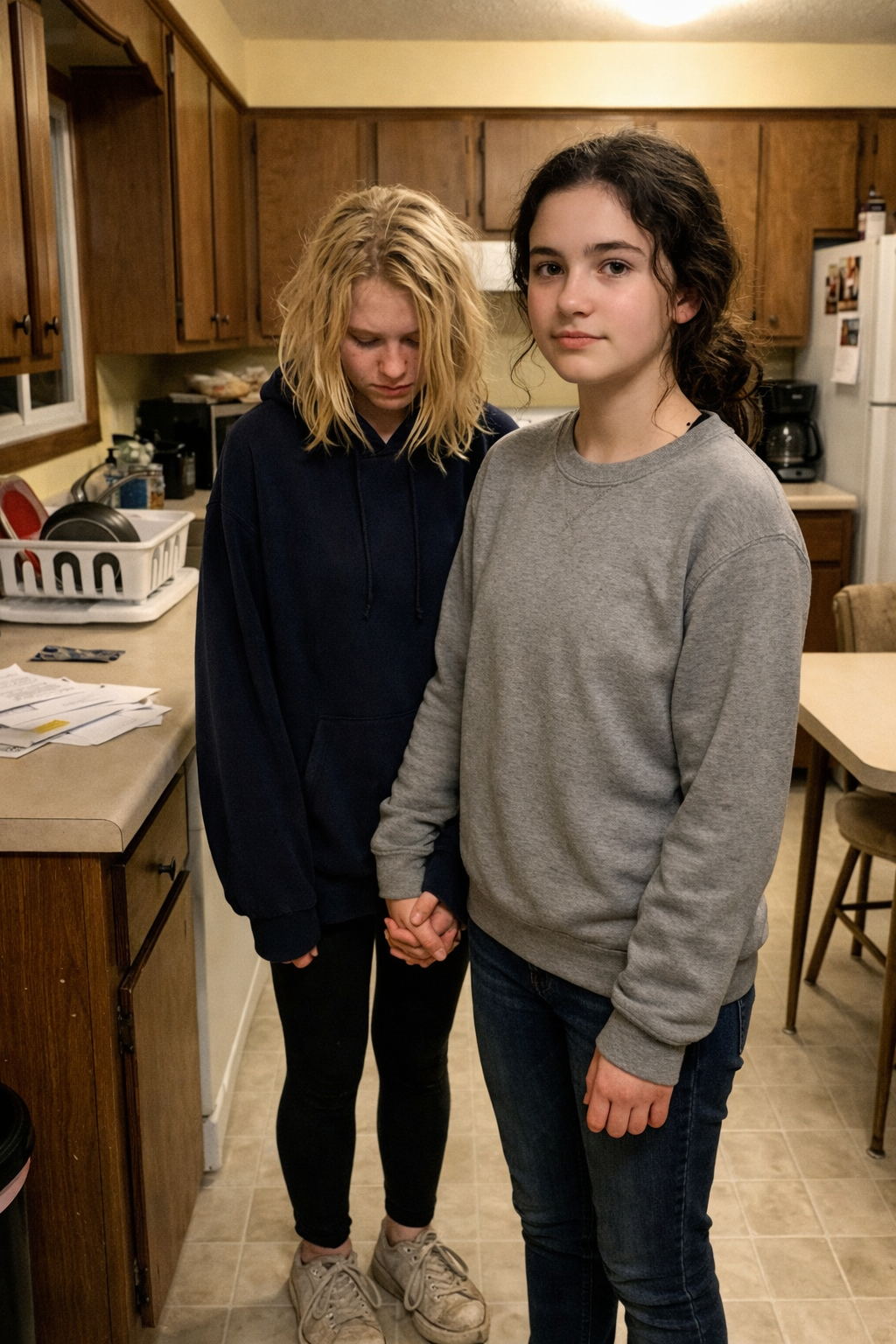
Grace asked quietly, “Did they lie about Dad?”
I met her eyes. “Not about him.”
“Then what?”
Ruiz answered. “About how complete the story was.”
She looked pale. “So he died because someone made a mistake?”
Ruiz’s silence said enough.
I spent months asking questions. Not days—months.
Most answers came back redacted. Some offices contradicted themselves. I pieced together the truth from fragments and persistence.
In the end, one thing was clear: Daniel and others had raised concerns before that mission. Those warnings were acknowledged—and ignored.
The official story honored sacrifice. But it buried failure higher up.
Later that spring, during the school’s recognition event, I was asked to speak.
I almost refused.
But then I saw Grace in the front row, wearing her father’s dog tags beneath her blouse.
I folded my prepared speech.
At the microphone, I said:
“My husband was a hero. I’m grateful my daughter is finally hearing that out loud. But I’ve learned something—heroism and failure can exist in the same story. The people on the ground can do everything right and still be failed by those above them.”
The room went still.
“For years, I was given a version of my husband’s death that was honorable—but incomplete. He deserves the full truth. So do all families who sacrifice.”
My voice shook, but I didn’t stop.
“He was brave. He was funny. He loved his daughter more than anything. If we remember him, we remember all of him—not just the parts that are comfortable.”
When I stepped back, silence filled the room.
Then Captain Ruiz stood and saluted.
Another Marine followed.
Then a veteran in the crowd stood as well.
After that, things changed.
The school quietly removed Grace’s detention.
But what mattered most happened at home.
I told her everything.
She began asking different questions—not about how he died, but about how he lived.
Did he sing in the car? What did he order at restaurants? Was he ever afraid?
I told her everything.
That he burned pancakes but kept trying. That he sang loudly and off-key. That he cried the first time he held her—and denied it while still crying.
One evening, she pinned the medal beside a photo of him holding her as a toddler.
She stood there for a long time.
“I think I understand him better now,” she said.
I stood beside her, looking at the man I loved, frozen in time.
“So do I,” I replied.
Things aren’t perfect now. Not simple. But clearer.
My daughter no longer feels like she has to defend her father’s memory alone.
And no matter how long it took, he was finally honored in front of the person who needed it most.