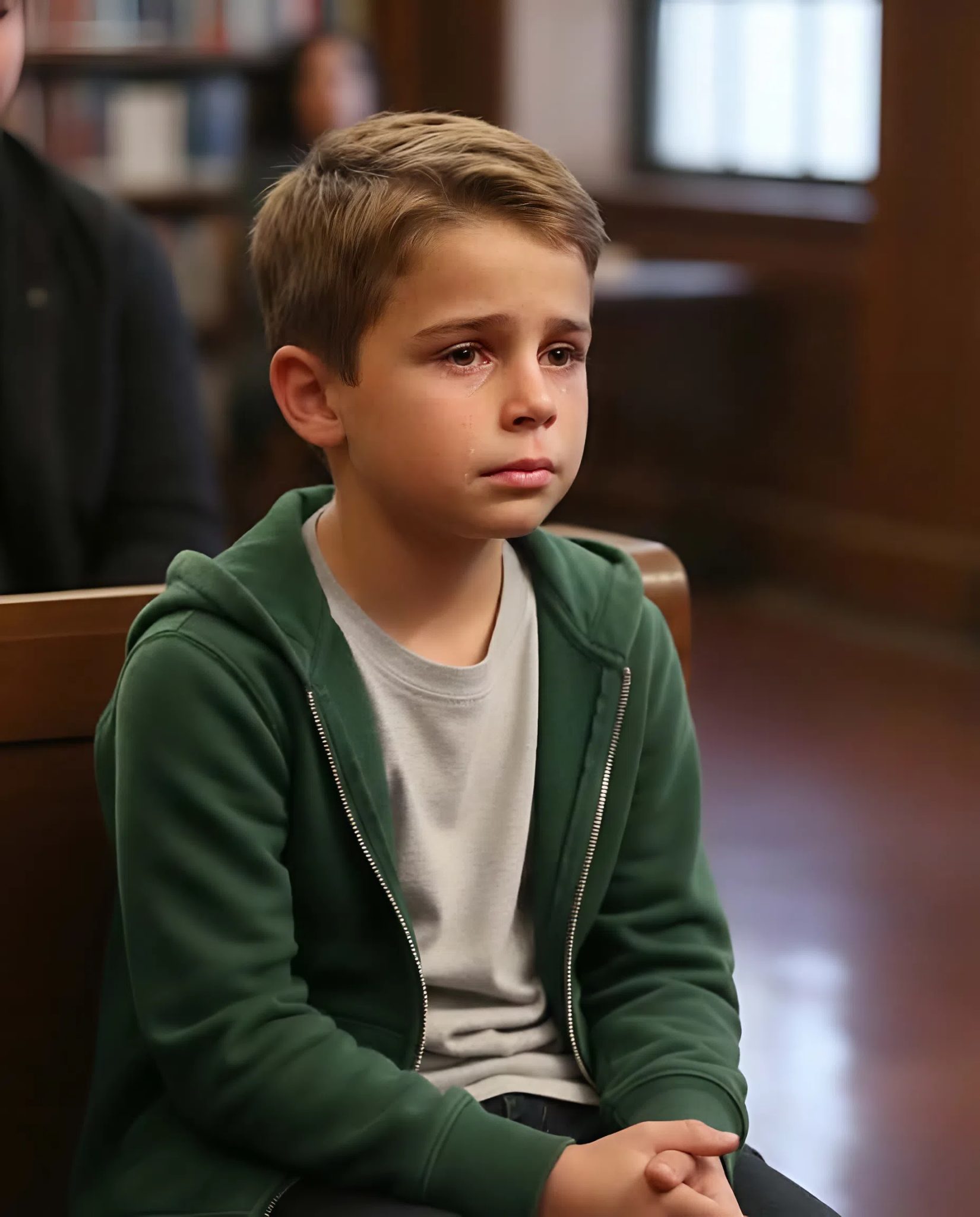
It was simple.
A sheet of paper drawn in pencil.
A timeline.
The judge turned back to Howard. “Would you like to explain this?”

Howard stepped forward and pointed.
“This is when Dad started having money problems,” he said. “They argued about it a lot. Dad told Mom things would get better if she helped fix it.”
Then he moved his finger.
“This is when Mom fixed everything.”
My throat tightened.
He pointed again.
“This is when Dad left.”
For the first time, Aidan shifted uncomfortably.
“And this,” Howard continued, “is when Dad said Mom was the problem.”
The room fell completely silent.
When he finished, I stood.
“Your Honor, what my son said is true,” I said calmly. “The debt was paid on March 3rd. Aidan left that same evening. And two days later, he filed legal documents claiming I was unstable.”
I didn’t need to say more.
Howard looked at the paper one last time.
Then he asked quietly,
“If Mom was the problem… why did everything change only after she helped Dad?”
The silence that followed was different.
Not confusion.
Understanding.
The judge looked from the screen to Aidan.
“Would you like to explain that?”

“With respect, Your Honor,” his lawyer quickly said, “this is a child’s interpretation—”
The judge raised a hand.
“I didn’t ask you.”
Aidan cleared his throat. “It’s more complicated than that. There were issues long before—”
“Then explain the timing,” the judge said.
Aidan hesitated.
Just for a moment—but it was enough.
“There were deeper problems,” he said finally. “Paying the debt just made it clear.”
The judge glanced back at the timeline.
“And yet, the sequence your son presented aligns with your wife’s account.”
There was no clean way out of it.
No explanation that didn’t contradict what everyone could now see.
The judge turned back to Howard.
“Did anyone help you with this?”
“No,” he said. “I just wrote what happened.”
“Why?”
Howard shrugged slightly. “My counselor told me to draw my feelings. This is how I understood everything.”
The judge nodded.
“You can sit down.”
Howard returned to his seat. I reached back, took his hand, and held it tightly.
After that, everything shifted.
My lawyer spoke next—calmly, without exaggeration. He walked through the timeline, emphasizing facts: I had resolved a major financial burden, maintained stability, and no concerns about my parenting had been raised until after the debt was gone.

Then he stopped.
The judge reviewed his notes.
“Custody decisions are based on stability and consistency,” he said. “In this case, concerns about instability appear only after a significant financial issue was resolved.”
Aidan said nothing.
“The timeline presented,” the judge continued, “raises valid questions about motive.”
Then he looked at me.
“You have clearly been the consistent parent.”
The decision came shortly after.
I was granted primary custody.
Aidan received limited, structured visitation.
Not what he wanted.
But enough for the court to remain balanced.
The rest—property, assets—would be decided later.
But the most important thing had already been determined.
Howard would stay with me.
Outside the courtroom, I didn’t realize how tightly I had been holding everything in until I finally exhaled.
Howard stood beside me.
“Mom… did we win?”
I smiled softly. “Yeah. We did.”
He nodded, satisfied.

Aidan stepped out a few minutes later. He paused, looking at us.
For a moment, I thought he might speak to Howard.
He didn’t.
Instead, he looked at me. “This isn’t over.”
“I know,” I said.
Because I did.
There would be more—more hearings, more decisions.
But the most important part had already changed.
And he knew it.
That evening, Howard sat at the kitchen table doing his homework—like it was just another ordinary day. I stood in the doorway, watching him quietly.
“You okay?” I asked.
“Yeah,” he said without looking up.
I sat across from him.
“You know… what you did today wasn’t easy.”
“I just told the truth.”
I smiled.
“Yes. You did.”
He looked up at me then.
“I didn’t like how he talked about you. That’s not what I see.”
That hit me harder than anything else.
Later that night, after he went to bed, I found his timeline still lying on the table.
I picked it up.

Simple lines. Simple words.
But undeniable truth.
In the days that followed, things slowly began to settle into a new rhythm.
I met with Steve again, and we started working through everything else.
But this time, it felt different.
Because I wasn’t standing on unstable ground anymore.
Looking back now, I understand something I couldn’t see before.
While I was trying to fix everything—trying to survive—Howard had been watching.
That simple piece of paper didn’t just change the outcome of a hearing.
It changed everything.
Because it showed the truth in a way no argument could distort.
And it reminded me of something I’ll never forget:
Even when everything feels like it’s falling apart, someone is still paying attention.
And sometimes—
that’s enough to make everything fall back into place.