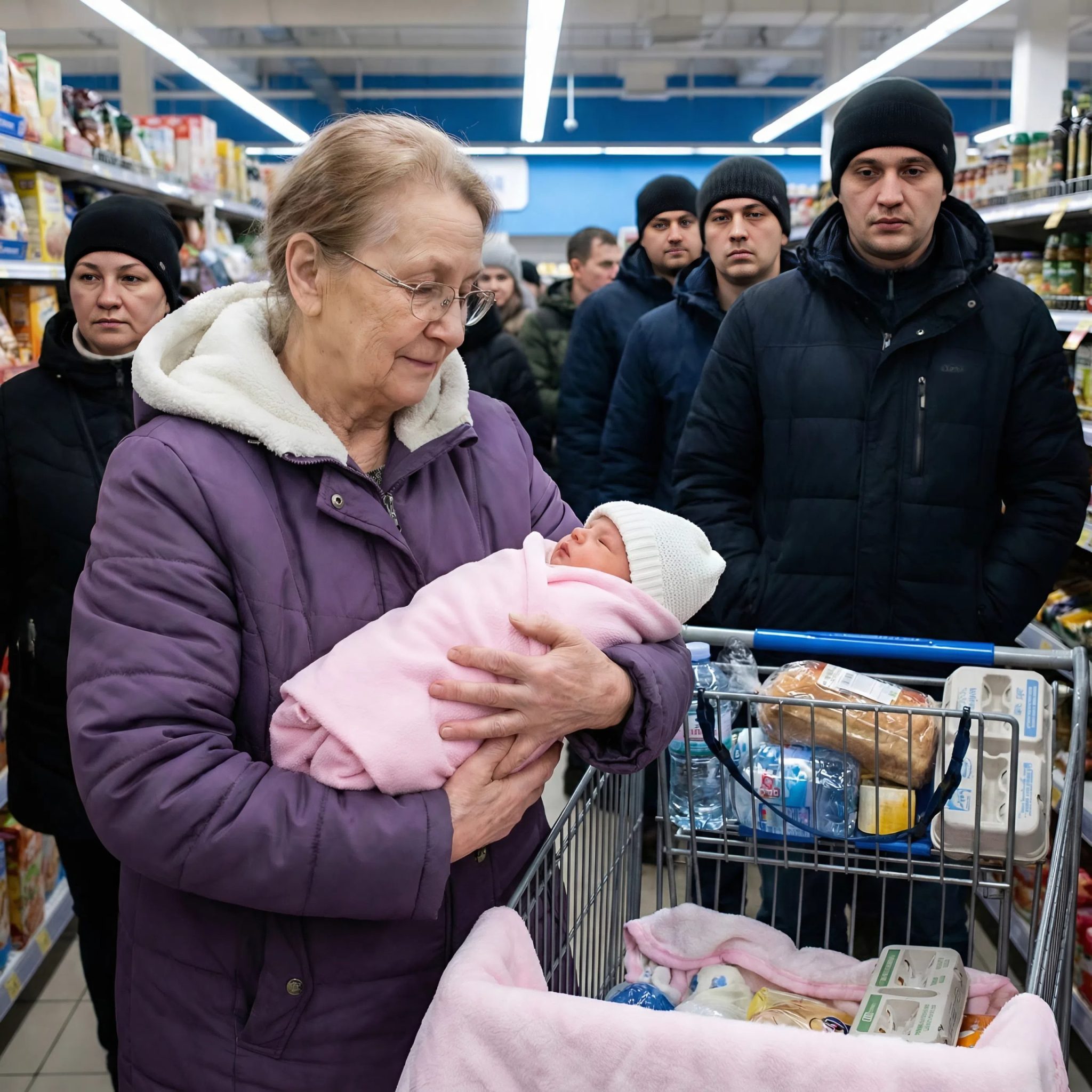
When my card was declined at checkout, the people behind me burst into laughter. I stood there—72 years old, with my baby granddaughter crying against my chest—and for a moment, I wished I could melt into the tiled floor.
I never imagined I’d be raising a baby again at my age.
Six months earlier, my daughter Sarah had come downstairs with a suitcase while I stirred oatmeal on the stove. I remember the cinnamon in the air, the kettle simmering, and the soft breaths of the two-week-old baby sleeping in her bassinet.
I thought Sarah was simply taking Lily out for fresh air.
Instead, she placed her gently in the living room bassinet, smoothing the blanket across her small chest.
“I’m going to clear my head, Mom,” she said, kissing Lily’s forehead.
“Alright, sweetheart,” I replied. “Don’t stay out too long. It’s cold.”
She never came home.
I didn’t find the note until the next morning, folded beside the coffeepot:
“Mom, I can’t do this. Don’t try to find me.”
I called her phone until my fingers ached. Filed a missing person report. The police were sympathetic but firm—she was an adult who left voluntarily. Without signs of danger, their hands were tied.
I tracked down Lily’s father, a man Sarah had dated briefly. When he finally answered, his tone was bored and dismissive.
“Look, I told Sarah I wasn’t ready for this.”
“But you have a daughter,” I pleaded. “She needs you.”
“You’re the grandmother,” he said flatly. “Handle it.”
Then he hung up—and blocked me.
So here I am, rocking a baby at 3 a.m., scraping together coins at midday, and surviving on my late husband’s pension and shrinking savings. I once pictured retirement as book clubs, garden parties, and maybe a bus trip with the widows from church.
Instead, I know the exact price of every diaper brand within ten miles.
That day at the store, everything already felt unbearably heavy. My back hurt from pacing the apartment with a fussy baby. The kitchen sink was leaking again. The washing machine made a grinding noise I couldn’t afford to diagnose.
We were out of diapers and baby food, so I bundled Lily into her carrier, pulled on my thin winter coat, and headed out into the November cold.
“We’ll be quick, my love,” I whispered. “Grandma promises.”
Inside, the grocery store was chaos—too-loud holiday music, people shouting over discounted turkeys, carts blocking aisles. Everyone preparing for Thanksgiving while I was just trying to survive the week.
I grabbed baby food, diapers, and a small piece of turkey breast so we could at least pretend it was a holiday.
At the register, I tried to smile at the young cashier. He didn’t look up.
I swiped my card.
Beep. Declined.
My stomach knotted.
I tried again, my hands shaking.
Beep. Declined.
“Could you… try once more?” I whispered.

A man behind me groaned loudly. “Oh, come on. Is this a charity line?”
Lily started to cry, her wail slicing right through my chest. I bounced her gently.
“Shh, it’s okay. Grandma’s here.”
Then a woman somewhere behind me said, loud enough for all to hear, “Maybe if you didn’t have kids you can’t afford, you wouldn’t be holding everyone up.”
Her friend snickered. “At least buy what you can pay for. People like this make me sick.”
Heat crawled up my cheeks. I searched my purse and pulled out everything I had: eight crumpled dollars.
“Just the baby food,” I whispered. “Please. Just the baby food.”
That’s when I heard a man’s voice.
“Ma’am. You with the baby.”
I braced myself for more cruelty and turned slowly.
But the man addressing me wasn’t sneering. He looked mid-thirties, dressed in a dark suit and long black coat, as if he’d stepped out of an office into this chaos by accident. His expression was calm. His eyes were kind.

“Please don’t be upset,” he said softly.
He walked past me to the cashier.
“Cancel her order,” he said. “Ring everything up again.”
The cashier blinked at him. “Sir—”
“All of it,” he repeated, still gentle but firm.
The groceries were rescanned. He tapped his card.
Beep. Approved.
The line fell silent.
Someone muttered, “What, you paying for all of us too, hero?”
The man turned, expression steady.
“You just watched an elderly woman struggle to buy baby food,” he said. “And mocked her instead of helping. If that were your mother standing here, how would you feel?”
No one answered. No one dared look up. Even the woman who insulted me stared at her shoes.

My face burned—but now from something closer to gratitude than shame.
“Thank you,” I whispered. “I don’t know how to—”
“You don’t need to thank me,” he said. “Just take care of your little one.”
Lily had stopped crying. She lay quietly in her carrier, sensing the shift around us.
I gathered the bags with trembling hands and waited near the exit, watching him finish his own shopping. When he walked out, I gently caught his sleeve.
“Please,” I said breathlessly. “Give me your number or email. I’ll repay you as soon as my pension—”
He shook his head.
“No need,” he said softly. “My mother passed away two months ago. You remind me of her.” He swallowed hard. “Doing something good in her memory helps me.”
Tears blurred my eyes.
He noticed me shifting Lily uncomfortably.
“Let me drive you home,” he offered.
“I couldn’t ask—”
“You’re not asking,” he said. “I’m offering.”
His name was Michael. His car was polished and expensive, but when he saw the baby, he didn’t hesitate—he reached into the back seat for a child seat.
“You have kids?” I asked.
He buckled Lily in with practiced ease. “Two. A seven-year-old boy and a three-year-old girl.”
“You must be a wonderful father,” I said.
He smiled faintly. “I’m trying.”
As he drove, I found myself telling him everything—Sarah’s disappearance, the note, the blocked father, the sleepless nights, the bills that wouldn’t stretch.
Michael listened quietly. Truly listened.
“You must be exhausted,” he said eventually. “Let me help. I could hire a nanny for you. Someone experienced. Someone good.”
“Oh—no,” I protested instantly. “I can’t afford—”
“You wouldn’t pay,” he said. “I would. For my mom.”
I refused again. It was too generous, too overwhelming.
He didn’t push. When we reached my apartment, he carried the bags upstairs. I thanked him, assuming that would be the end of it.
The next afternoon, my doorbell rang.
Michael stood there with a woman and his two children. He held a steaming pie dish.
“We came to invite you and Lily for Thanksgiving,” he said. “This is my wife, Rachel.”
Rachel stepped forward with a folder. “Michael told me about you. We put together some nanny options—background checks, references, everything. If you ever feel ready.”
My hands shook as I opened the folder. It was real. All of it.
Thanksgiving at their home felt like walking into a warm, bright world after months of darkness. Laughter, comfort, food passed around the table, Lily in a highchair between their children as if she’d always belonged there.
A few days later, when Michael asked again about the nanny, I finally said yes.
Her name is Patricia, and she has changed our lives. She adores Lily. For the first time since Sarah left, I can drink tea while it’s hot. Sometimes I even nap.
Every year now, I bring a pie to Michael and Rachel’s for Thanksgiving. Each year, Lily—bigger, stronger, more joyful—runs ahead of me up their front steps.

That day at the grocery store could have broken me. Instead, one man’s compassion cut through cruelty and turned strangers into family.
Sometimes the world is cold and loud and unkind.
But then—someone steps forward.
Looks you in the eye.
And reminds you that you are not invisible.
And that single moment can change everything.