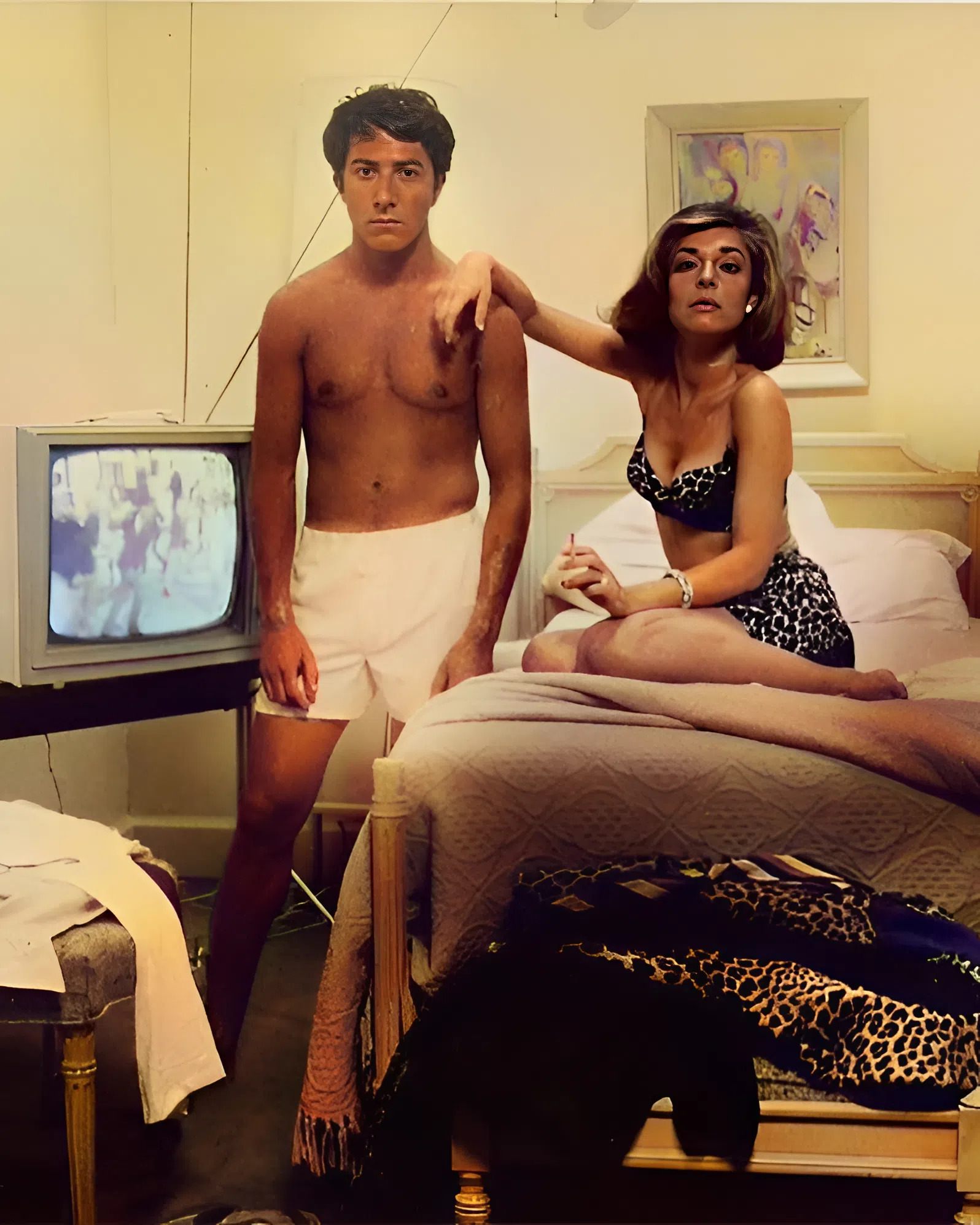
Little-known mistakes and film bloopers in The Graduate

Even before terms like ‘MILF’ and ‘cougar’ had entered the vernacular, The Graduate became a genuine sensation and left an indelible mark on everyone who saw it.

Anne Bancroft played one of the leading roles of her career, combining refinement, beauty and emotional depth with striking ease, whilst Dustin Hoffman’s awkward innocence made the film at once relatable, funny and very much alive. Scenes such as the iconic line ‘Mrs Robinson, you’re trying to seduce me, aren’t you?’ have long since become legendary.
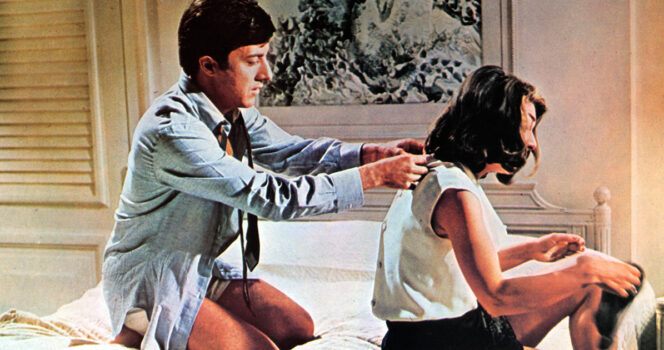
But even such a masterpiece was not without its mistakes and curiosities. And there is a story behind one particularly steamy scene that few people know about… and once you hear it, you will never be able to watch that episode in the same way again…

The Graduate was released in 1967, at the height of Beatlemania, when the Vietnam War was already sparking street protests. Hippie culture was rapidly gaining momentum, and people were increasingly questioning authority, social norms, sex and relationships. The film managed to capture the very essence of the era — vividly, accurately and brilliantly capturing its time.

But even such a masterpiece had its hidden sides. Almost sixty years on, little-known mistakes and curious stories from the set are finally coming to light, and they may well change your view of this film forever.

A window cleaner?

In the role of Benjamin Braddock — a recent college graduate drawn into a scandalous affair with the older, married Mrs Robinson, played by Anne Bancroft — Hoffman brilliantly conveyed a painful awkwardness and self-consciousness.

Braddock’s politeness and utter naivety proved to be a real comic gem in the film.

When Hoffman came to audition for the part, he was not yet thirty. At the time, he was not a well-known actor, and what’s more, the producers hadn’t originally envisaged him for the role at all.

When Hoffman turned up at the casting office, producer Joseph E. Levine mistook him for a window cleaner. Hoffman instantly realised what was going on, kept his cool and even started wiping the glass. It was only a moment later that Levine realised who was actually standing before him — and that’s when the real magic of the casting began.

Why Robert Redford didn’t get the part

Before the role of Benjamin Braddock went to Dustin Hoffman, Robert Redford had auditioned alongside Candice Bergen. However, director Mike Nichols wasn’t convinced that Redford could convincingly portray the loser that the character required.

When Nichols explained his reservations, Redford set about proving that he fully understood Benjamin’s awkwardness and his sense of social alienation.

Nichols listened to him — and then landed a decisive blow with a single sentence:

‘Bob, take a look at yourself in the mirror. Can you really imagine that a man like you would have trouble seducing a woman?”

Redford got the message, and the role went to another actor, but a bond had already formed between him and Nichols by then: Nichols had previously cast him in his first Broadway hit, Barefoot in the Park.
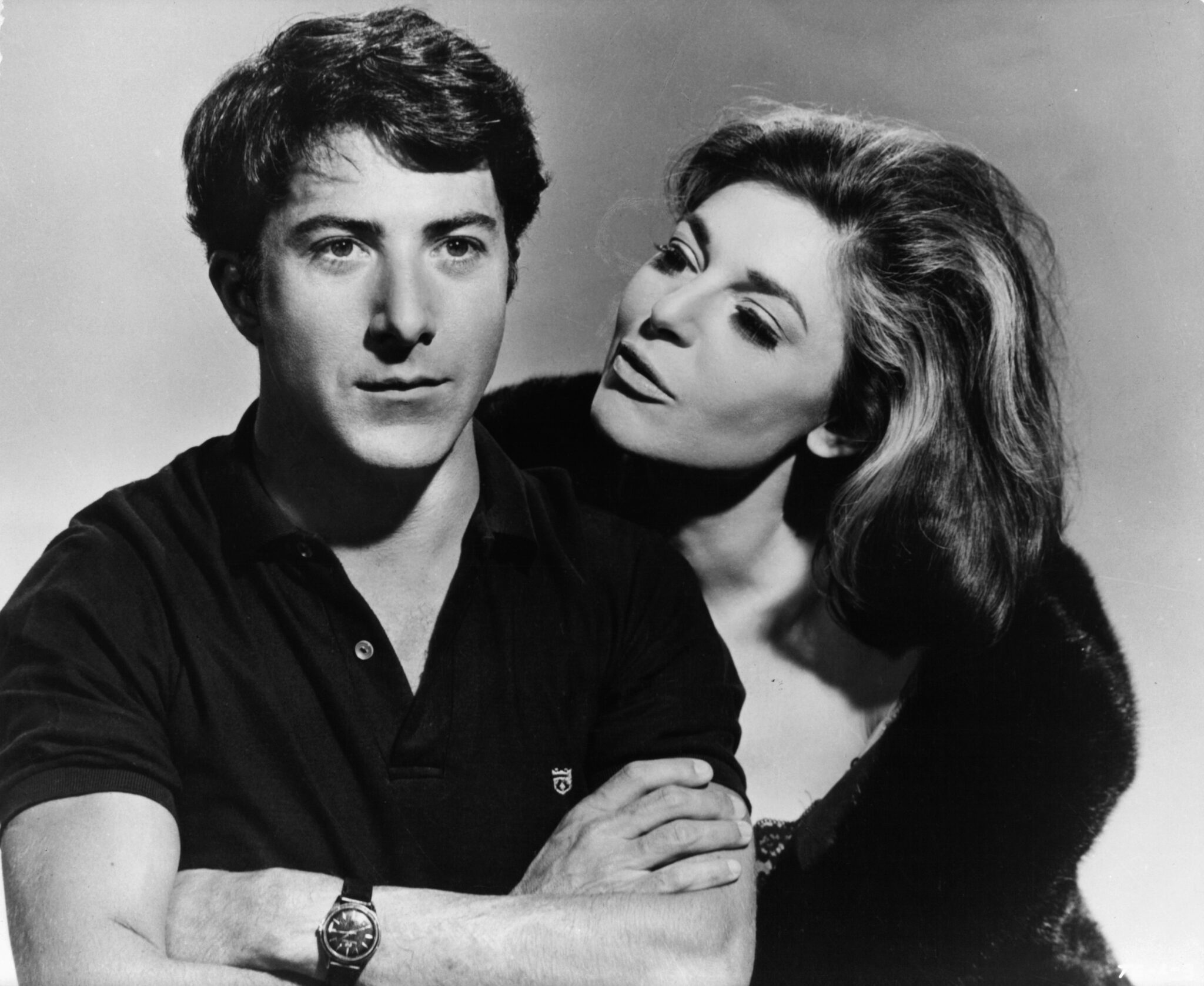
He was nicknamed ‘Big Nose’

Speaking of the chaotic casting for The Graduate — here’s another noteworthy detail: Hoffman was asked to perform a love scene with the daughter of the heroine, Anne Bancroft, played by Katharine Ross, even though he had never filmed such scenes before.

He later admitted: ‘A girl like Ross would never be interested in a bloke like me, not even in a million years.’ Ross herself was also unsure, saying that Hoffman ‘looked barely a metre tall with his cap on… so unkempt. It would be a disaster.’

And yet, despite all this awkwardness — or perhaps precisely because of it — Mike Nichols cast him anyway. Nichols subsequently won an Oscar for Best Director for this film.

‘As far as I understand, Mike Nichols took a huge risk by casting me in a role for which I wasn’t suited, in the sense that I was Jewish. In fact, many of the reviews were very negative. It was a kind of veiled anti-Semitism… In the reviews, I was called ‘big-nosed’ and they wrote about my ‘nasal voice’,” Hoffman recalled years later.

From box-office triumph to $55 a week

The Graduate grossed a staggering $104.9 million and became the biggest hit of 1967, but Dustin Hoffman himself hardly got rich. He was paid $20,000 for his role in the film, and after paying taxes and rent for temporary accommodation, he was left with just $4,000. So what did he do next? He applied for unemployment benefit in New York State and received $55 a week, living in a tiny two-room flat in the West Village.
Why Doris Day turned it down

We’ve already said a lot about Dustin Hoffman, but Anne Bancroft, in the role of Mrs Robinson, literally stole the show. It is hard to imagine anyone else playing this character with such power, subtlety and inner tension. Bancroft was an outstanding actress — perhaps even underrated — and although she did not win an Oscar for this role, her performance remains unforgettable and truly iconic to this day.

We’ve already said a lot about Dustin Hoffman, but Anne Bancroft as Mrs Robinson literally stole the show. It’s hard to imagine anyone else playing this role with such power, subtlety and inner tension.

Bankcroft was an outstanding actress — perhaps underrated — and although she did not win an Oscar for this particular role, her portrayal of the character has remained forever etched in the memory of audiences and has become truly legendary.

Interestingly, Mike Nichols’ first choice for the role of Mrs Robinson was the French actress Jeanne Moreau. The reasoning behind this was that in French culture there was a stereotype that ‘mature’ women often ‘initiate’ young men into matters of love and sexuality. Casting the actress proved difficult — for example, Doris Day turned down the offer because she felt the nudity required by the script was excessive. In the end, the role went to Anne Bancroft, and she created a character that became truly unforgettable.

That very scene in the hotel

During rehearsals for the famous scene in the hotel room, Anne Bancroft had no idea what Dustin Hoffman was about to do. But suddenly he grabbed her breast.

Hoffman later explained that this gesture reminded him of schoolboys’ pranks, where they pretend to put on a jacket whilst trying to sneak a touch at someone.

When it happened, Mike Nichols burst out laughing, and Hoffman himself couldn’t hold back either. Instead of cutting the take, he turned towards the wall and started banging his head against it, trying to stifle his laughter. Nichols found the moment so funny that he decided to keep it in the final cut of the film.

So that sudden burst of awkward humour visible on screen was entirely genuine.

Mrs Robinson wasn’t much older

Anne Bancroft became an instant sensation thanks to her role as the seductive Mrs Robinson, but, despite the fact that she cemented her image as a ‘mature woman’, the actress was only 36 at the time — just eight years older than Katharine Ross, who played her on-screen daughter, and only six years older than Hoffman.

Of course, Hollywood did its best to visually emphasise the age difference, but that wasn’t the only factor. Hoffman naturally looked very youthful, almost boyish, whereas Bancroft, who had been a long-time smoker and drinker, appeared older than her years.

Elizabeth Wilson, who played Mrs Braddock, said in an interview with Connecticut Magazine in 2012 that Bancroft ‘had problems with alcohol’, and this probably partly explains why she looked older than her actual age in the film.

The sad end to Anne Bancroft’s life

Anne Bancroft herself admitted that the role left her with mixed feelings because, as she said in an interview, it ‘overshadowed all her other work’. For many years after the release of The Graduate, young men told the actress that she was the first woman they had ever fantasised about.

Sadly, Bancroft died of uterine cancer on 6 June 2005 at the age of 73. Her death came as a surprise to many, as the very private actress had kept her illness a secret. During a moving memorial service in New York in her honour, the lights on Broadway were dimmed, and Paul Simon performed the song ‘Mrs Robinson’.

An unusual decision for the time

Did you know that The Graduate made the folk-rock duo Simon & Garfunkel even more famous? Initially, director Mike Nichols and editor Sam O’Steen used their songs — such as The Sound of Silence — merely as a temporary musical backdrop to better gauge the rhythm of the editing. But Nichols soon realised that replacing them with an original soundtrack would rob the film of its special magic, so he kept these tracks in the film, which was quite an unusual move for the time.

Paul Simon did indeed write two songs for the film — ‘Punky’s Dilemma’ and ‘A Hazy Shade of Winter’ — but Nichols rejected both. They were later included on the album Bookends. And what is particularly surprising is that the song ‘Mrs Robinson’ wasn’t originally written for the film at all. Simon was working on a song called ‘Mrs Roosevelt, dedicated to Eleanor Roosevelt, when Nichols decided to include it in the film.

It is also interesting to note that in the film version, Simon and Garfunkel perform only the chorus — without the verses. Moreover, some of the lyrics in this chorus differ from the final version, which later became a huge hit.

Two intriguing cinematographic techniques

The Graduate proved to be a groundbreaking film in many respects and was released at precisely the moment when it was most needed. Some of its visual choices are very subtle, yet truly brilliant.

Towards the end, there is a scene where Benjamin runs straight towards the camera. Thanks to a very long-focus telephoto lens, it creates the impression that he is barely moving from the spot, even though he is running with all his might. This is a subtle and clever way of showing his inner sense of stagnation.

In another scene, Benjamin moves across the screen from right to left, whilst everyone else is moving from left to right. In Western culture, the direction from left to right is perceived as natural — like reading a page — whilst from right to left feels wrong. These cinematographic choices emphasise the film’s central theme: Benjamin seems to be moving in the wrong direction and cannot truly move forward.

The truth about the nude scenes

During the filming of The Graduate, Anne Bancroft immediately made it clear that there would be no topless scenes featuring her, particularly in the challenging bedroom scene with Benjamin.

So the film crew had to get creative.

They headed to the Sunset Strip to find a stand-in willing to appear in the necessary shots. The first candidate? She refused to film with stickers covering her breasts. They had to fall back on a backup plan, and in the end, a second stand-in saved the day. Even the filming of a classic film isn’t without its behind-the-scenes adventures…

On-screen bloopers in The Graduate

Even acclaimed film classics have their little slip-ups, and here are the three most noticeable bloopers in this cult film:

The disappearing lipstick: at the party to celebrate Benjamin’s return home, a woman leaves a bright lipstick mark on his cheek, but later it vanishes without a trace and without any explanation.

A night that looks like day: when Ben drives Mrs Robinson home at night, the scene in the conservatory suddenly looks as though it is taking place on a sunny day.

The mysteriously silent stereo: after Mrs Robinson puts on some music to entertain Benjamin, it suddenly stops playing just as he rushes downstairs to avoid meeting Mr Robinson.

How Mrs Robinson’s leg became a legend

Even decades after its premiere, The Graduate still holds a special place in the hearts of film lovers and continues to be discovered by new generations of cinema enthusiasts. Its influence on pop culture has been immense and has often taken on a humorous form.

For example, the famous scene where Mrs Robinson seduces Benjamin by trapping him between her legs was parodied in an episode of Roseanne entitled ‘David and Goliath’ — in a fantasy sequence where Jackie takes on the role of Bancroft’s character and attempts to seduce David.

This scene is also parodied in the Simpsons episode ‘Lisa’s Substitute’, where Mrs Crabapple humorously attempts to seduce Mr Bergstrom, voiced by none other than Dustin Hoffman himself.

Decades after its release, The Graduate remains one of the cornerstones of cinema history, combining wit, great acting and bold storytelling. Its influence has long extended beyond the screen — the film has shaped pop culture, inspired countless parodies and continues to captivate new generations of viewers.

Whether it’s Dustin Hoffman’s awkward charm, Anne Bancroft’s unforgettable art of seduction, or the haunting soundtrack by Simon & Garfunkel, this film proves that a true classic never loses its power — over the years, it only grows deeper and richer.

Little-known mistakes and film bloopers in The Graduate
5 very rare and unusual breeds of cats