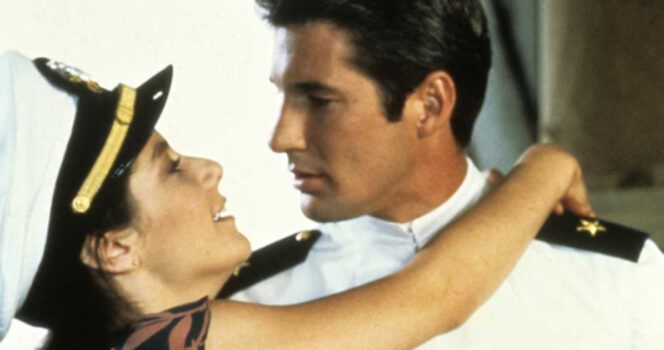
During the filming of the intimate scene in a hotel room, Debra Winger later said that the atmosphere on set was extremely uncomfortable for her and caused her to shut down emotionally, rather than simply going through the motions.
“It was one of the worst experiences of my life. Filming the scenes in the hotel room was really tough,” she said.
Winger also added that she didn’t feel particularly close to Gere on set, and this tension made even the simplest moments difficult to perform.
“I didn’t feel particularly close to Richard Gere, and every time the director wanted us to kiss, I felt like bursting into tears,” she said.
An unexpected path to the Oscar
In the role of Sergeant Emil Foley in An Officer and a Gentleman, Louis Gossett Jr. created a character that became one of the defining roles of his career. The role earned him an Oscar for Best Supporting Actor, making him the first African-American actor to win the award in that category.
Director Taylor Hackford took an unusual approach to heighten Foley’s intimidating and overbearing presence. He deliberately housed Gosett separately from the other actors to maintain the air of sternness and aloofness required for the role of the instructor.
The casting process itself proved challenging. Several A-list stars turned down the role, and the producers were reportedly impressed by Mandy Patinkin’s screen test. However, Hackford ultimately decided that Patinkin was ‘too ethnic’ for the role of the drill sergeant.
As a result, the film crew conducted their own research in Pensacola, Florida, and discovered something remarkable: many of the best instructors there were indeed Black. It was this observation that ultimately paved the way for Louis Gossett Jr. to land one of the film’s most iconic roles.
Hitting a sore spot
In an interview in 2013, Richard Gere explained that both he and Louis Gossett Jr. underwent special training for the karate scenes used in the intense military training sequences.
According to Gere, he eventually got the hang of the choreography, whereas Gossett found it more difficult, despite intensive training. During filming, things went awry: Gere, irritated and having lost his rhythm, accidentally struck Gossett in the groin.
Following this incident, Gossett reportedly stormed off the set and did not return for two days. To avoid disrupting the schedule, Gir and director Taylor Hackford brought in a Black karate expert as a stunt double to continue the work.
Despite what had happened, Gere later said that he took full responsibility for the incident and was confident that it had not ruined their relationship. After the film’s release, he and Gossett met from time to time. Sadly, Louis Gossett Jr. passed away in 2024 at the age of eighty-seven.
The actual filming locations
Although the film is set in Florida, a significant portion of An Officer and a Gentleman was filmed on the Pacific Northwest coast. As the US Navy did not grant permission to film at NAS Pensacola, where the Aviation Officer Candidate School was actually located, Fort Worden — a former US Army base — was used instead.
At the start of the film, as Zack leaves his father’s house, a slice of real naval history can be seen in the background: the battleships USS New Jersey and USS Missouri, along with the aircraft carrier USS Hornet, moored at the shipyard in Bremerton, Washington.
Shortly after filming wrapped, both battleships were modernised and recommissioned. The Missouri later played a prominent role in the Gulf War, and subsequently both ships, along with the USS Hornet, were decommissioned and converted into museum exhibits.
The motel scenes were filmed at the Tides Motel in Port Townsend, Washington. One of the rooms used in the film still has a wooden plaque on the door, commemorating its place in cinema history.
What annoyed Winger most about the film
Far more than the nude scenes, Debra Winger was reportedly upset that several of her scenes as Paula, a paper mill worker from Seattle, were cut during editing.
‘I can never be completely satisfied, because it’s not the full performance I gave,’ she told The Philadelphia Inquirer in 1983.
She explained that important parts of her character’s past never made it into the final version:
‘The audience will never know, for example, that Paula’s father was cruel to her. We filmed a scene where it was clear that if I did something wrong, he would slap me in the face and push me. And there was another scene that emphasised that, in my relationship with my sisters, I was effectively like a mother to them.’
She added that it was precisely these cut scenes that were key to understanding the depth of the character:
“Paula had many qualities that showed where her strength of character came from and what she had to overcome at home.”
Mistakes that made it onto the screen
No great film is without its minor slip-ups.