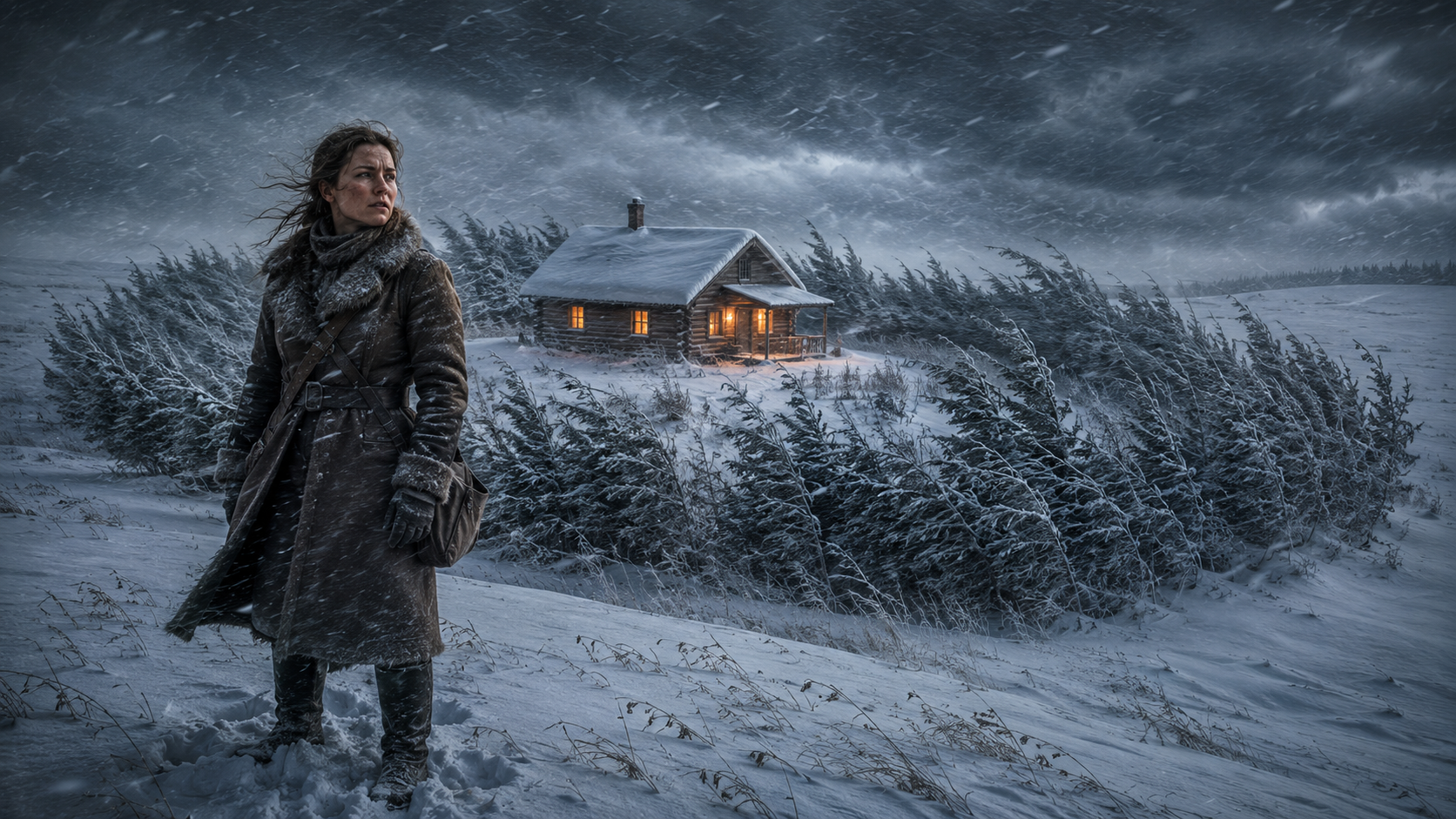
When the first thaw softened the mountain road, Clara Voss went outside with a shovel, a coil of twine, and forty-three young trees bundled in wet burlap.
The village of Ashford Hollow was still half-asleep under the last dirty ribs of snow. Chimney smoke dragged itself sideways over the roofs. The creek had only just begun to speak again beneath its lid of ice. Up on the north rise, where Clara’s cabin stood alone against the open fields, the wind had never stopped speaking at all.
It had spent the whole winter clawing at her door, slipping through the chinks in the wall, shaking the roof until the nails squealed. It had buried the porch twice, frozen the pump handle to her glove, and pressed so hard against the windows at night that Clara had slept with her boots on because she was never certain whether dawn would find glass still in the frames.
So when spring came, Clara did not buy curtains. She did not paint the porch. She did not plant flowers.
She planted trees.
Not in a neat little row like decoration. Not near the house like shade. She planted them in a wide, curving belt around the north and west sides of the cabin, far enough away to break the wind before it reached her walls, close enough to catch drifting snow before it buried the door.
Black spruce for winter muscle. Willow for bending without breaking. Red osier dogwood for density near the ground. A few young poplars for height, though every man at the feed store had told her poplars were greedy, messy things.
“Good,” Clara had said when old Mrs. Baird warned her. “Let them be greedy. I need something on this hill that wants to live.”
By noon her palms were blistered.
By two o’clock her hem was black with mud.
By three, the first wagon slowed on the road.
“Look there,” called Judd Kessler, leaning from the driver’s bench with a grin broad enough to shame a wolf. “Widow Voss is building herself an army of sticks.”
His brother Mercer laughed beside him. Two hired hands in the back slapped their knees as though they had never heard anything sharper.
Clara drove her shovel into the earth and did not look up.
“Maybe she’s raising them to do chores,” Mercer shouted. “A woman alone needs all the help she can plant.”
More laughter.
The shovel hit a stone. Clara worked the blade around it, pried it loose, and tossed it aside.
“She can hear you,” someone said quietly.
That voice made her pause.
She looked up then.
Elias Ward stood near the road with one hand on the neck of his horse. He was tall, dark-eyed, and broad-shouldered in the plain way of a man who worked more than he talked. He served as foreman for Silas Rourke, the richest cattleman in the valley, though Clara had heard he had once studied surveying and bridgework before life dragged him home by the collar.
Elias was not laughing.
That should have comforted her.
It did not.
Silence, when courage was needed, was only another shape of cowardice.
Judd noticed Elias looking and gave him a shove with his elbow. “Go on, Ward. Ask her if she expects those twigs to stop a blizzard.”
Elias frowned. “Enough.”
The word was low, but it reached the men. They quieted, though not from shame. Men like that only understood warning when it came in another man’s voice.
Clara straightened slowly. Her lower back throbbed. Her knees had taken on the deep ache of wet soil and old grief.
Elias walked halfway toward her.
“What are you making?” he asked.
“A shelterbelt.”
He looked at the thin saplings, then at the open fields stretching north of her cabin like a bare table.
“These?” he asked.
“For now.”
“The north wind here comes off the ridge like a hammer.”
“I noticed.”
“These trees are too small.”
“They grow.”
“Not before next winter.”
“Then I will help them.”
Judd laughed again from the road. “Hear that? She’s going to help the trees grow faster.”
Clara turned her face toward him. “No. I am going to help them survive. That is a different thing. You might not know the difference.”
The wagon went quiet.
Mercer’s grin curdled. Judd spat into the road, but he said nothing more.
Elias studied her for a moment, and something like respect flickered across his face before he hid it.
“You’ll need more than one line,” he said.
“I know.”
“And brush low between them. Wind slips under young trunks.”
“I know.”
“And if you tie them too tight, the roots won’t strengthen.”
“I know.”
His mouth twitched, almost a smile. “You have read about this.”
Clara picked up the next sapling. “I have frozen about this.”
The smile vanished.
Behind Elias, the hired men began to move on, bored now that the widow would not cry and Elias would not mock her for their entertainment. The wagon rolled toward town, taking its laughter with it.
Elias remained.
“You need help with the holes?” he asked.
“No.”
“That was not charity.”
“I did not say it was.”
“Then why refuse?”
Clara pressed the sapling into the ground and packed soil around its roots with both hands. “Because I do not know yet what your help costs.”
Elias took off his hat. The gesture was small and old-fashioned. On another day it might have been charming.
Today it only made her tired.
“I work for Rourke,” he said. “That does not mean I belong to him.”
Clara looked past him, toward the immense pastureland rolling north of her cabin. Silas Rourke owned most of what the eye could reach. He owned the road through the hollow, the grazing rights above the creek, half the timber slope, the general store building, and enough debts in enough pockets that even men who hated him tipped their hats when he passed.
“No,” Clara said. “But many things that work for him end up acting owned.”
Elias accepted the blow without flinching.
“Fair enough.”
He put his hat back on and returned to the road.
Clara watched him go only long enough to know he was not looking back.
Then she planted another tree.
Three days later, Silas Rourke came himself.
He arrived in a polished black carriage with brass fittings that flashed under the cold spring sun. His driver stayed in the seat. Rourke stepped down as though the mud had been placed there by mistake and ought to apologize.
He was sixty, maybe more, but carried his age like a weapon. Silver hair, clean gloves, long coat, eyes pale and assessing. He looked at Clara’s cabin, then at the newly planted trees, then at Clara herself.
“Mrs. Voss,” he said. “You have been busy.”
“Yes.”
“May I come in?”
“No.”
His brows rose.
Clara held the door half-open and filled the space with her body. She was not a delicate woman. Grief had thinned her face but not her frame. Winter had taken sleep, softness, and two fingernails. It had not taken her size.
Rourke noticed.
Men always did.
“I will be brief,” he said.
“That would be kind.”
He smiled as though she had made a joke he could afford to forgive. “I am prepared to make a generous offer on this property.”
“It is not for sale.”
“You should hear the amount.”
“No amount changes the answer.”
“Everyone says that before the right amount.”
“Then everyone has been speaking to you. I have not.”
His smile cooled.
The wind moved around them, tugging at the loose strands of Clara’s hair. Behind Rourke, the young trees trembled in their shallow holes, each one no taller than a child.
“This land is poorly situated for a woman alone,” he said. “The rise takes the weather first. The road drifts over. The well is exposed. Your late husband chose a hard place to leave you.”
“My husband did not leave me the land. My father did.”
“Then your father chose poorly.”
“My father chose what he could pay for.”
“And now you can choose better.”
Clara’s hand tightened on the doorframe. “By selling to you.”
“By allowing a more practical man to fold this useless strip into a working range.”
There it was.
Not land.
A strip.
Not her home.
A problem to be folded away.
Rourke looked toward the saplings again. “And I see you are already spending money trying to tame weather.”
“I am slowing it.”
“With sticks?”
“With time.”
“Time is expensive.”
“So are mistakes.”
His eyes narrowed. “You believe I have made one?”
Clara glanced toward his broad north fields. They were open and scraped bare, the grass grazed low, the old brush lines cut out years before. She had seen the way snow raced across them in winter, nothing to slow it, nothing to hold it, nothing to soften the force before it struck her cabin.
“I believe you removed every living thing that stood between this hill and the ridge,” she said.
For a moment, Rourke’s face emptied.
Then he laughed softly.
“My dear Mrs. Voss, cattle cannot graze through trees.”
“No. But wind can gallop through absence.”
The driver shifted in his seat.
Rourke heard it. His smile returned, sharper this time.
“You have spirit,” he said. “The valley admires spirit in small amounts.”
“I will try not to spend it all at once.”
He stepped closer.
Clara did not step back.
“Winter nearly killed you,” he said quietly. “Everyone knows it. You burned furniture in February. You traded your wedding silver for flour. Ward found you half-frozen at the pump after the big drift.”
Clara’s cheeks burned, but she kept her eyes steady.
“That is not a reason to sell.”
“No,” Rourke said. “It is a reason to stop pretending endurance is the same as wisdom.”
She felt the words land because they were not entirely false.
Last winter had not made her brave. It had made her desperate. She had survived by inches, by stubbornness, by luck, by the mercy of a neighbor who found her before the cold finished its work.
But survival had taught her what comfort never would.
She knew where the wind struck first.
She knew where snow piled deepest.
She knew which corner of the cabin groaned before midnight.
She knew the shape of danger now.
And knowledge, once earned, was property no man could buy.
Rourke took an envelope from his coat and placed it on the porch rail.
“Think on it,” he said.
“I won’t.”
“Winter will think for you.”
He returned to his carriage.
Clara watched him leave. Only when the road was empty did she pick up the envelope.
She did not open it.
She used it to start the stove.
By June, Ashford Hollow had made Clara’s trees into a public joke.
At church, Mrs. Holm asked whether Clara expected birds to pay rent in her forest.
At the general store, Judd Kessler told a cluster of men that the widow was “planting husbands by the dozen and hoping one grew useful.”
Children passing the rise sang little rhymes about “Clara’s wooden soldiers.”
Even kind people were unkind in the soft way, which sometimes stung worse.
“You must be lonely up there,” Mrs. Baird said one morning, patting Clara’s hand. “A garden would cheer you more than all those gloomy evergreens.”
“They are not for cheer.”
“Then what are they for?”
Clara looked out the store window toward the north ridge, where clouds gathered like bruises.
“They are for the day cheer is not enough.”
She bought twine, nails, and four sacks of meal. She paid in coins counted twice. When she stepped outside, Elias Ward was waiting by the hitching post with a bundle of willow cuttings tied across his saddle.
Clara stopped.
“I did not ask for those,” she said.
“I know.”
“I am still not taking charity.”
“Good. I am not offering any.”
“What are you offering?”
“Information.”
She stared at the cuttings. “Information has leaves now?”
“These root fast if you keep them wet. Put them in the low gaps. They’ll catch snow close to the ground.”
“Why?”
“Because you are right.”
The answer was so plain she did not know what to do with it.
Elias looked uncomfortable, as if truth were a tool he had not used in some time.
Clara crossed her arms. “Did it pain you to say that?”
“Yes.”
She nearly smiled.
He glanced toward the store windows. Several faces had turned away too late.
“You know they are watching,” he said.
“They are always watching.”
“Does it bother you?”
“Of course.”
“You do not show it.”
“That is not the same thing.”
Elias nodded slowly. “No. It isn’t.”
For a moment they stood in the muddy street while the village pretended not to listen.
Then Elias said, “Rourke is angry.”
“I guessed.”
“He has been asking who sells you supplies. Who lends tools. Who comes up your road.”
“Does he imagine windbreaks are contagious?”
“He imagines anything he did not order is rebellion.”
Clara took the bundle of willow cuttings from his saddle. “And you? Are you rebelling?”
“I have not decided yet.”
“That sounds dangerous.”
“It is.”
“For whom?”
He looked up toward the ridge.
“For the man who waits too long.”
After that, Elias came twice a week.
Never at the same hour. Never openly enough to call attention. He brought stakes, old rope, a cracked wheelbarrow, a sack of bone meal, a roll of wire, and once, without explanation, a tin of coffee that smelled too expensive for any honest errand.
Clara accepted the supplies after making him name a price for each one. Sometimes she paid with eggs. Sometimes with mended shirts. Sometimes with preserves from the last jars her mother had put up before dying.
At first they worked in stiff quiet.
Then the quiet changed.
It became the kind of silence that could hold two people without making either one small.
Elias showed her how to brace the tallest saplings without strangling them. Clara showed him the map she had drawn of winter drifts around the cabin. He studied it long enough that his face lost its guarded look.
“You measured all this?” he asked.
“With a broom handle marked in inches.”
“During storms?”
“After storms.”
“Alone?”
“Unless the wind counts.”
He traced one line with his finger. “The drift curls here because the shed corner turns it.”
“Yes.”
“And here, this low place fills first.”
“Yes.”
“If you build brush between these two rows, not solid, just woven loose, it will drop snow here before it reaches the porch.”
“That is what I thought.”
“It will make a wall.”
“That is what I need.”
Elias looked at her.
Clara waited for the warning. Men always had one ready. Too hard. Too much. Too late. Too strange.
Instead he said, “Then we should start tomorrow.”
The word we hung in the cabin like a lantern.
Clara turned away first.
“There is no we,” she said.
“No?”
“No. There is my land, my cabin, my trees, and your habit of arriving with useful objects.”
“Useful objects can be loyal.”
“Objects, perhaps.”
“Men?”
“Less often.”
He accepted that too.
By August, the shelterbelt had shape.
From the road, it still looked foolish to those determined to see foolishness: uneven rows of saplings, brush piles, stakes, water barrels, rough mulch, and strips of cloth tied to branches to startle deer away.
But from inside the curve, Clara could already feel the difference.
On windy afternoons, the grass near the cabin no longer lay flat. Dust dropped sooner. The pump handle did not rattle as fiercely. The porch lantern stayed lit longer before the gusts found it.
Small victories.
But winter was made of small defeats, and Clara knew better than to despise small victories.
Silas Rourke came again in September.
This time he rode on horseback, with Judd and Mercer Kessler behind him. Elias was not with them.
Clara was repairing the west fence when they approached. She kept working until Rourke dismounted.
“Mrs. Voss.”
“Mr. Rourke.”
His horse tossed its head. It did not like the brush rows. Animals often understood boundaries before people did.
“I hear Ward has been visiting.”
Clara wrapped wire around the post and twisted it tight. “Then your hearing is still in working order.”
Judd snorted.
Rourke ignored him. “He is my employee.”
“I am not.”
“No. You are a widow with a difficult winter ahead.”
“Many things are difficult.”
“Especially when faced alone.”
She looked up. “Are you threatening me?”
“I am advising you.”
“The difference being?”
“Whether you are wise enough to appreciate it.”
Clara stood.
The wind moved through the young trees behind her. Their leaves flickered silver and green. They were not tall enough yet. Not strong enough yet. But they were alive, and there were many of them.
“I have heard your advice,” she said. “You may go.”
Rourke’s eyes hardened.
“You think those saplings make a fortress?”
“No.”
“You think Ward makes you safe?”
“No.”
“You think stubbornness will hold a roof down?”
Clara stepped closer, close enough to see the fine lines at the corners of his pale eyes.
“I think you are afraid.”
Judd laughed once, then stopped when Rourke turned his head slightly.
“Careful,” Rourke said.
“No,” Clara answered. “You have confused caution with obedience for so long that you hear every honest word as danger.”
Rourke’s mouth tightened.
Clara pointed toward his fields. “You cleared the old breaks. You tore out the willows along the drainage. You grazed the north pasture down to dirt by October because every acre had to earn. Now the wind comes off your land harder than it ever did before, and my little trees are the only ones telling the truth about it.”
His face went still.
“You know nothing about running land.”
“I know what happens when a man strips it bare and calls the emptiness profit.”
Mercer muttered, “Mouthy woman.”
Clara turned her eyes on him. “Uninvited man.”
Judd’s hand twitched toward his reins.
Rourke smiled then, but there was no warmth in it.
“Winter will settle this.”
“Yes,” Clara said. “I expect it will.”
The first real storm came early.
On the second week of November, rain fell all morning, turned to sleet by afternoon, then froze hard after sunset. By midnight, the wind rose from the north with the sound of a train breaking loose from its tracks.
Clara woke to the cabin shaking.
She lit the lamp, pulled on wool stockings, skirt, coat, gloves. The stove still held a red heart under the ash. She fed it split wood and listened.
The wind struck.
The roof groaned.
Snow hissed against the walls.
But the old scream at the north window was different.
Lower.
Broken.
Not gone, but interrupted.
Clara took the lantern and went to the door. When she opened it, the storm shoved itself inside. She leaned her shoulder against the wood, forced her way onto the porch, and raised the lantern.
At first she saw nothing but white.
Then lightning flickered blue behind the clouds, and for one bright instant the world appeared.
The shelterbelt was working.
Snow had piled in the brush rows, caught and held before it reached the cabin. The young spruce bent but did not snap. The willow whips thrashed and sprang back. The woven brush at ground level had already gathered a low white wall that lifted the wind over the porch instead of letting it slam straight into the door.
Clara laughed.
It came out wild and breathless, torn away by the storm before it reached anyone’s ears.
She went back inside and barred the door.
By dawn, the road was gone.
By noon, the valley was blind.
The second night was worse.
Clara had just finished melting snow for water when something pounded on the door.
Not wind.
A fist.
She froze.
The pounding came again.
“Clara!”
Elias.
She lifted the bar and opened the door. He fell in with half the storm on his back. His face was raw from cold, lashes iced white, one sleeve torn, blood dark at his temple.
She slammed the door behind him.
“What happened?”
“Rourke’s west barn went down,” he gasped. “Roof first. Then the side wall. Men scattered.”
“Sit.”
“No time.”
“Sit or fall. Choose.”
He sat.
She pulled off his gloves. His fingers were pale but moving. She set coffee to boil, then brought cloth for his head.
“How many?” she asked.
“Six at the barn. Three made it to the lower shed. I found Mercer in a drift and dragged him there. Judd went for the road like a fool. Rourke tried to reach the main house. I do not know if he made it.”
Clara pressed the cloth to his cut. “Why are you here?”
His eyes met hers.
“Because your cabin is the only place still standing on this side of the rise.”
The words settled between them with all the weight of the winter to come.
Another pounding struck the door.
Clara and Elias turned.
A voice outside shouted, “Help! Open!”
Elias stood too quickly and swayed. Clara caught his arm, then went to the door.
When she opened it, Judd Kessler stumbled in, dragging Mercer by the collar. Both men were crusted in ice. Mercer’s lips were blue. Judd’s confidence had vanished somewhere in the storm.
Behind them came two Rourke hands Clara recognized but had never spoken to. Last came Silas Rourke himself.
His hat was gone. His silver hair was frozen flat against his skull. One cheek was cut. His coat hung open, one side torn from shoulder to hem. He stood on Clara’s porch like a king who had discovered weather did not accept titles.
For a moment, nobody spoke.
The wind roared over the roof.
Clara held the door.
Rourke looked past her into the warm cabin, then at the snow wall gathered around the shelterbelt outside.
His eyes understood before his pride did.
“Mrs. Voss,” he said hoarsely.
Clara stepped aside.
“Come in before you die proving something.”
They entered.
There were too many bodies for the little room. Too much wet wool, too much shivering, too much fear. Clara gave orders because someone had to, and the men obeyed because near death had made them briefly intelligent.
“Boots off by the stove. Wet gloves there. You, wrap him in that quilt. Elias, do not stand. Judd, stop shaking him, he needs warmth, not panic. Mr. Rourke, close that shutter before the hinge tears out.”
Rourke blinked at being commanded.
Then he closed the shutter.
For three hours, the cabin became a battlefield against cold.
Mercer vomited twice, then began to shiver properly, which Clara took as a good sign. Judd cried when he thought no one was looking. One of the hired hands prayed in a whisper. Elias sat near the stove with a bandage around his head and watched Clara move through the cramped room as if seeing her for the first time.
Near midnight, the worst gust yet struck the hill.
The cabin shuddered.
The lamp flickered.
A beam in the ceiling creaked.
Judd flinched. “God save us.”
Clara held up a hand. “Listen.”
They listened.
The wind slammed into the outer belt of trees, tore through the branches, broke against the brush wall, rose, curled, and passed over. The sound changed as it moved. It did not hit the cabin full-force. It arrived wounded.
Rourke heard it.
Everyone heard it.
Mercer, wrapped in Clara’s quilt, whispered, “It should’ve taken the door.”
“It would have,” Elias said.
No one asked what he meant.
They all knew.
By morning, the cabin was buried on three sides, but not crushed. The shelterbelt had gathered the snow outward, building a curved white rampart that looked almost deliberate, almost designed by a hand larger than any person’s. The trees rose from it in dark, bending lines.
A fortress, the village would later say.
But Clara knew better.
A fortress was built to keep people out.
Her trees had kept death out.
That was not the same thing.
When the storm finally broke on the third afternoon, silence spread across the valley so suddenly it felt unnatural.
The rescued men stepped onto the porch one by one.
Rourke’s west barn was a black ruin in the distance. Fences were down. The road had vanished. Drifts lay across his open fields in violent, uneven waves, some higher than a wagon, because nothing had slowed the wind before it dropped its burden.
Around Clara’s cabin, the snow was deep too, but shaped. Held. Managed.
The shelterbelt had done what no one believed it could do.
Judd stood staring at the trees.
Clara came out behind him with a bucket of ash for the icy steps.
He turned, swallowed, and looked at his boots.
“I said things,” he muttered.
“Yes.”
“Fool things.”
“Yes.”
“I am sorry.”
Clara scattered ash on the steps. “Be better when no one is freezing.”
His face reddened. “I will try.”
“Try where I can see it.”
He nodded.
Mercer could not meet her eyes at all.
The hired hands thanked her plainly, which she accepted plainly.
Rourke was last.
He stood at the edge of the porch, looking at the curved rows of young trees. Snow clung to their branches. Some had bent nearly to the ground. Two had snapped. Most stood.
“You saved my men,” he said.
“The trees helped.”
His jaw tightened at the correction.
Then, slowly, he nodded.
“The trees helped,” he repeated.
Clara waited.
Rourke took a breath that seemed to pain him. “I misjudged your work.”
“Yes.”
“And your judgment.”
“Yes.”
Elias, standing near the door, looked down to hide something like a smile.
Rourke heard it anyway.
The old cattleman turned toward him. “You knew.”
Elias did not deny it. “I suspected.”
“And said nothing?”
“I said enough. You did not like the answer.”
For once, Rourke had no ready reply.
Clara stepped down from the porch. Snow came nearly to her knees. She walked to the first row of spruce and brushed ice from a bent branch.
“These are young,” she said. “They will need replacing where the storm broke them. More brush in the low gaps. More willow near the drainage. If the valley wants to survive winters like this, it needs shelter rows again.”
Rourke looked over his ruined field.
For years, he had measured land by how much it could be forced to yield. Grass. Cattle. Money. Obedience. He had not measured what absence cost.
Now the cost lay white and enormous before him.
“And you would advise me?” he asked.
Clara turned. “No.”
His brows drew together.
“I would charge you.”
Elias laughed once before he could stop himself.
Judd coughed into his fist.
Rourke stared at Clara.
Then, for the first time since she had known him, Silas Rourke laughed without cruelty. It was not pleasant exactly. Too rusty. Too surprised. But it was human.
“What is your price, Mrs. Voss?”
Clara looked toward the valley.
“No more offers on my land. Ever.”
“Done.”
“The old service-road plan ends.”
His mouth tightened. “That is more complicated.”
“So is freezing.”
A pause.
“Done,” he said.
“And you will replant the north fields. Not for pretty. For survival. Willow along the drainage. Spruce staggered across the rise. Brush breaks where the snow runs.”
“You expect me to turn pasture into thicket?”
“I expect you to stop mistaking bareness for strength.”
Rourke studied her for a long moment.
Then he looked at Elias. “Can it be done?”
Elias looked at Clara, not Rourke. “Yes.”
Rourke heard the allegiance in that small choice.
So did Clara.
“So,” Rourke said. “The valley’s useless trees have become a public necessity.”
Clara brushed snow from her gloves. “They were never useless. You were simply laughing too loudly to hear what they were saying.”
News traveled faster than thaw.
By the end of the week, everyone in Ashford Hollow knew that Clara Voss’s cabin had stood while Rourke’s west barn fell. Everyone knew Judd and Mercer Kessler had survived the storm under her roof. Everyone knew Silas Rourke had walked away from the hill without the deed he wanted and with instructions for planting trees.
The same mouths that had mocked now found new words.
Practical.
Clever.
Providence.
Luck.
Clara let them have their vocabulary. It cost her nothing.
In March, when the thaw began, men came up the road with shovels.
Judd came first, red-faced and awkward, carrying a bundle of spruce seedlings.
“For the ones that broke,” he said.
Clara looked at the seedlings, then at him.
“Plant them where I tell you.”
“Yes, ma’am.”
Mercer came with wire. Mrs. Baird came with bread and stayed to mulch. Children who had once sung about wooden soldiers carried buckets from the pump. Elias came every morning and left only when Clara ordered him away to sleep.
By April, the hill looked less lonely.
By May, Rourke’s north field was marked with rows.
Not enough yet. But beginnings were allowed to be small.
One evening, Clara and Elias stood beside the tallest spruce in her shelterbelt. Its top had browned from winter burn, but new green showed along the lower branches.
“It will live,” Elias said.
“You sound certain.”
“I am practicing.”
“At what?”
“Trusting things that take time.”
Clara glanced at him.
The sunset laid copper over the thawing fields. Water ran in thin bright lines toward the creek. Somewhere below, a hammer rang where men repaired a barn wall. Beyond that, the ridge stood dark and patient.
Elias shifted his weight. “Rourke offered me the north restoration.”
“You should take it.”
“I did.”
“Good.”
“He also said I am free to keep helping here.”
Clara raised an eyebrow. “How generous of him to permit you to do what I have not requested.”
Elias smiled. “Have you not?”
“No.”
“Will you?”
She looked at the rows of young trees, at the repaired porch, at the land that had tried to kill her and then, with help, had become her ally.
“I might request useful objects from time to time,” she said.
“Objects only?”
“For now.”
His smile softened. “For now is more than I expected.”
The wind moved through the shelterbelt.
Not gone. Never gone. But changed.
It slipped through spruce needles, combed willow stems, bent dogwood twigs, and came to the cabin carrying less of itself than before.
Clara listened.
A year earlier, the wind had sounded like a threat.
Now it sounded like work.
And work, she understood, could become a kind of promise.
That winter, the valley planted trees.
Not everyone. Not at first. Pride has deeper roots than spruce. But enough.
A line of willow appeared behind the schoolhouse. Brush breaks rose near the lower road. Mrs. Holm planted dogwood near her chicken yard and pretended it had always been her idea. Judd Kessler put spruce along the west edge of his small place and threatened to punch any man who called them toothpicks.
When the first snow came, people watched differently.
They looked not only at the sky, but at the land.
Where wind ran free.
Where snow gathered.
Where shelter stood.
And high on the north rise, Clara Voss stood on her porch while the young trees darkened against the white world.
Elias came up the road just before dusk with a sack of flour over one shoulder and a crooked little pine under his other arm.
Clara opened the door.
“What is that?” she asked.
“A tree.”
“I have noticed.”
“It is for the south side.”
“The south side does not need a windbreak.”
“No,” he said. “But someday you may want shade.”
She looked at the little pine, then at Elias.
“Shade is not survival.”
“No,” he said. “It is something after.”
Clara took the tree from him.
For a long moment, neither spoke.
Then, from the road below, a boy’s voice called out, bright and teasing, “Mrs. Voss! My pa says your trees saved half the valley!”
Clara turned and saw Judd’s youngest son waving from a sled.
She lifted one hand.
The boy shouted, “He says we’re planting more come spring!”
Elias leaned beside the doorframe. “What will you tell him?”
Clara looked at the shelterbelt.
The trees were still young. Still imperfect. Still scarred from the storm. But they stood in their wide, stubborn curve, holding space against the north.
She smiled.
“Tell your father,” she called, “to dig deep holes.”
The boy laughed and vanished down the road.
Clara stepped back into the warmth of the cabin. Elias followed, closing the door behind him.
Outside, winter gathered its breath.
Inside, the stove burned steadily.
And around the little house on the rise, the so-called useless trees took the first blow, bent beneath it, and held.

