Leona picked up the deed.
“We’ll see.”
He sighed. “Girls who say that usually learn by bleeding.”
Leona folded the deed into her satchel.
“Then I’ll try to bleed usefully.”
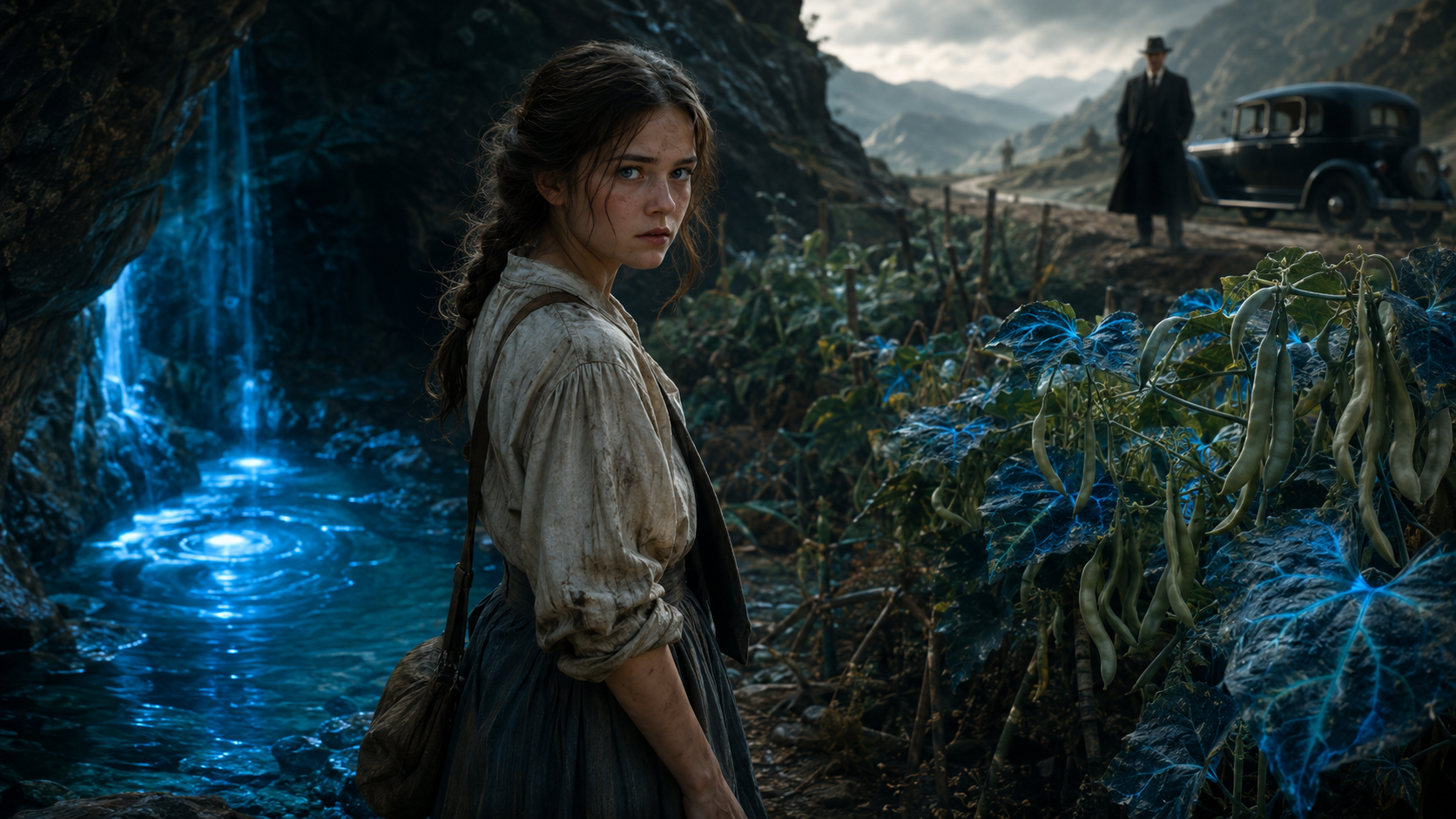
Blue Hollow lay three miles north of town, beyond a road that became a track, then a suggestion, then a quarrel between mud and stone. By the time Leona reached it, rain had soaked her hair flat and filled one boot. The ravine opened suddenly between black pines. Mist hung low among the trunks. The ground sloped toward a basin of pale rock where water spilled soundlessly from a crack in the hillside.
It was blue.
Not sky blue. Not river blue. Not any ordinary blue Leona knew.
It shone from within itself, deep and cold and strange, like a piece of evening trapped underground. The pool was no wider than a wagon wheel, but light trembled beneath its surface even under the gray rain.
Leona stood at the edge and felt every warning she had ever heard gather behind her teeth.
Poison.
Curse.
Madness.
Bad water.
Dead land.
She was so thirsty her tongue stuck to the roof of her mouth.
The orphanage had given her no flask. Pride had given her no supper. The rain dripping from pine needles was not enough. She knelt, cupped both hands, and lifted the blue water.
It smelled faintly of stone after lightning.
“Lord,” she whispered, though she was not sure anyone was listening, “if this kills me, make it quick.”
She drank.
The water was cold enough to hurt. It ran down her throat like a blade made of snow. For one terrible second, she waited for burning, choking, darkness.
Nothing happened.
The rain kept falling.
A crow shouted somewhere above the ravine.
Leona laughed once, sharply, because she was alive and because nobody who had warned her was there to see it.
By nightfall, she found the remains of an old charcoal shed half-collapsed beneath vines. The roof leaked in four places. One wall leaned outward. A raccoon had claimed the corner and abandoned it only after judging her too poor to rob. Leona dragged pine boughs over the worst holes, curled beneath her coat, and slept with the deed tucked inside her dress.
In the morning, she was still alive.
So she planted the beans.
They were not hers either, not exactly. She had saved them from Saint Brigid’s kitchen garden, three wrinkled scarlet beans that had fallen behind a crate. Mrs. Greaves would have called it theft. Leona called it inheritance from a place that owed her more than beans.
She dug with a broken hinge. The soil fought her. It was gray, sour, and tight as a fist. Her fingers went numb in the cold mud. She planted one bean near the blue pool, one farther uphill where rainwater ran clear, and one beside the shed because loneliness makes people foolish enough to plant hope near where they sleep.
She watered the first with blue water.
The second with rain.
The third with whatever dripped from the roof.
“Grow if you want,” she told them. “I’m not your matron.”
For three days, nothing happened.
On the fourth morning, the blue-water bean split the ground.
On the fifth, it was taller than her thumb.
On the sixth, taller than her hand.
The rainwater bean emerged thin and yellow, as if apologizing for itself. The shed bean did not appear at all. But the first bean rose as though someone beneath the earth were pulling it upward by invisible thread.
Leona watched it with growing fear.
She had wanted proof the water would not kill.
She had not expected proof it wanted to live.
By the end of the second week, the bean vine had climbed a branch she had stuck in the ground and was reaching for another. Its leaves were broad, dark, and veined faintly blue. Small red flowers opened along it, bright as sparks.
Leona did not tell anyone.
A secret was the first kind of property she had ever owned.
She worked where she could. Mrs. Odelia Crane, a widow who lived near the north road, hired her to wash linens and split kindling. Odelia was built like a fence post and spoke with the softness of falling tools.
“You’re the Saint Brigid girl,” she said when Leona knocked.
“Yes, ma’am.”
“You got family?”
“No, ma’am.”
“You got trouble?”
“Probably.”
That made Odelia snort.
“Honest enough. Stack that wood. Don’t faint in my yard. I hate dragging people.”
At noon, Odelia gave her stew, bread, and a look sharp enough to peel bark.
“You living in Blue Hollow?”
“Yes, ma’am.”
“You drinking that water?”
Leona’s spoon stopped.
Odelia groaned. “Mercy preserve me from girls with more backbone than supper.”
“It hasn’t killed me.”
“Yet is a powerful word.”
“The beans like it.”
“The beans?”
Leona should have lied.
Instead, hunger and loneliness opened her mouth.
“One bean grew. Fast.”
Odelia stared at her for a long moment. Then she crossed herself with a hand that smelled of onions.