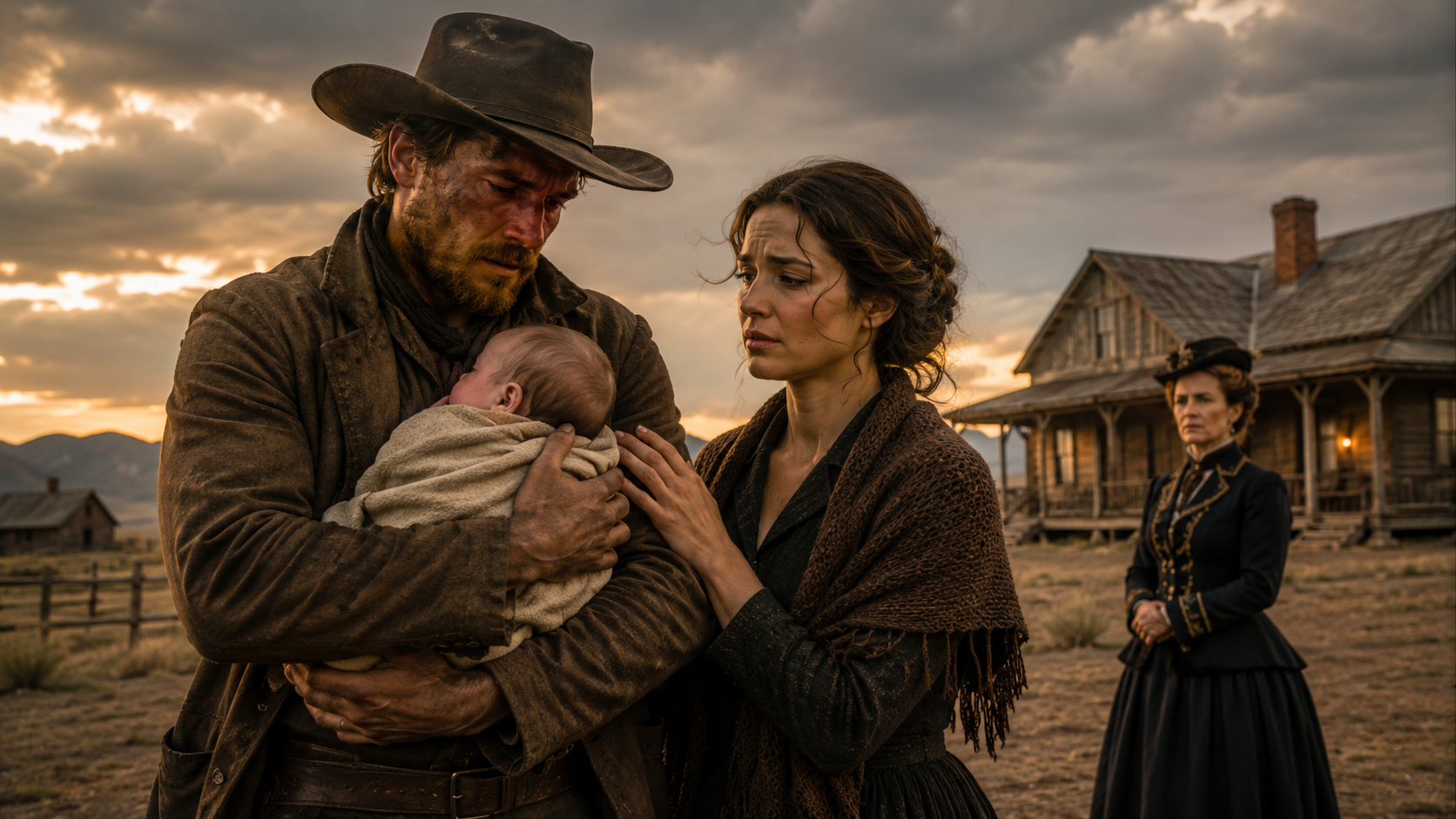
Eliza held Ruth and rocked her until the storm inside the child passed.
Later, after Ruth slept and Mercy had been fed, Jonah found Eliza hanging the sign on her door. It sat crooked. He did not correct it.
“She made me repaint it three times,” he said.
Eliza smiled. “She spelled mercy wrong on the first two?”
“She spelled room wrong.”
“That sounds like Ruth.”
Silence settled, warm and shy.
Jonah stood beside her in the hallway.
“Eliza.”
She looked at him.
He held out a small box.
“I know I said I wouldn’t ask.”
Her breath caught.
“I am not asking tonight either,” he said quickly. “Not for an answer. Not for a promise. This is only yours.”
Inside the box was not a ring.
It was a key.
Eliza stared at it.
“The house key,” Jonah said. “The front door sticks, so it’s mostly symbolic.”
A surprised laugh broke from her.
His smile came slowly.
“I realized you never had one. You wait for someone to let you in, or you use the kitchen latch. That was wrong.”
Eliza touched the key with one finger.
“It does not bind you,” he said. “It only means no one here has the right to lock you out.”
Her eyes filled.
She took the key.
Not his hand.
Not yet.
But the key.
In spring, when the cottonwoods silvered and the road to the old mill dried hard enough for wagon wheels, Eliza went back to her cabin.
Jonah drove her.
Ruth sat between them, pretending she had not packed a bag in case Eliza forgot to return. Mercy slept in a basket at their feet, fat-cheeked and furious whenever the wagon stopped moving.
The cabin looked smaller than Eliza remembered. Lonelier too. Wind had worried one shutter loose. Grass grew through the step. Inside, dust lay over everything. Her old life waited there, patient and hollow.
Jonah carried in her trunk.
Ruth hovered in the doorway.
Eliza walked through the rooms. Her first husband’s carved shelf. Her second husband’s repaired chair. The cradle that had never been used long enough to wear smooth.
She stood before it for a long time.
Jonah came no closer than the doorway.
At last, Eliza lifted the cradle blanket, folded it carefully, and placed it in her trunk.
Ruth whispered, “Are you staying here?”
Eliza looked around the cabin that had sheltered her when no one else would, and imprisoned her when grief had nowhere to go.
“No,” she said.
Ruth exhaled so loudly Mercy startled awake and began to fuss.
Eliza turned to Jonah.
“I want to sell it.”
He nodded. “All right.”
“And I want the money kept in my name.”
His face softened. “Of course.”
“And I want to decide what room I sleep in.”
“Yes.”
“And I want people to stop calling me Mrs. Wren like both my husbands are standing behind me.”
Jonah’s eyes searched hers.
“What do you want to be called?”
Eliza looked down at Mercy, who was reaching for her with both hands.
Then at Ruth, who had already begun smiling.
Then at Jonah, who stood waiting without reaching, asking without asking, loving without closing a fist around it.
“Eliza,” she said.
So that was what they called her.
The wedding, when it finally happened, was small.
Not because the town lacked interest. Half of Coldwater Bend would have crammed into the church if invited. But Eliza had no desire to be displayed as proof of the town’s redemption, and Jonah had no desire to feed people who had once starved her of kindness.
Dr. Harlan stood with them. Ruth held Mercy, who babbled through the vows. The hired man’s wife cried into a handkerchief. The preacher spoke gently and did not mention curses, graves, destiny, or replacement.
Jonah promised honor.
Eliza promised truth.
Both seemed harder and better than romance.
Afterward, Ruth asked if she could call Eliza “Mama.”
The whole room went silent.
Eliza knelt before her. “Only if you want to. And only when you want to. And never because anyone says you must.”
Ruth nodded solemnly.
“I want to sometimes.”
“Sometimes is enough.”
Ruth hugged her.
Mercy, not to be ignored, grabbed Eliza’s veil and tried to eat it.
Jonah laughed.
Eliza looked up at the sound and saw not a widower, not a desperate father, not a man drowning in grief, but Jonah—mud on his boots, silver beginning at his temples, eyes full of a future neither of them had expected to survive long enough to want.
Years later, people in Coldwater Bend would tell the story differently.
They would say Eliza Mercer had saved a baby with milk and courage.
They would say Jonah Mercer had stood against the town for the woman everyone feared.
They would say Viola Trask’s cruelty had been uncovered by one child’s confession and one doctor’s bottle.
They would say many things.
But Eliza remembered the truth more simply.
A hungry child had swallowed.
A grieving man had listened.
A frightened girl had told the truth.
And a woman the town called cursed had finally been allowed to be what she had always been.
Not a shadow.
Not a warning.
Not a graveyard with a heartbeat.
Alive.