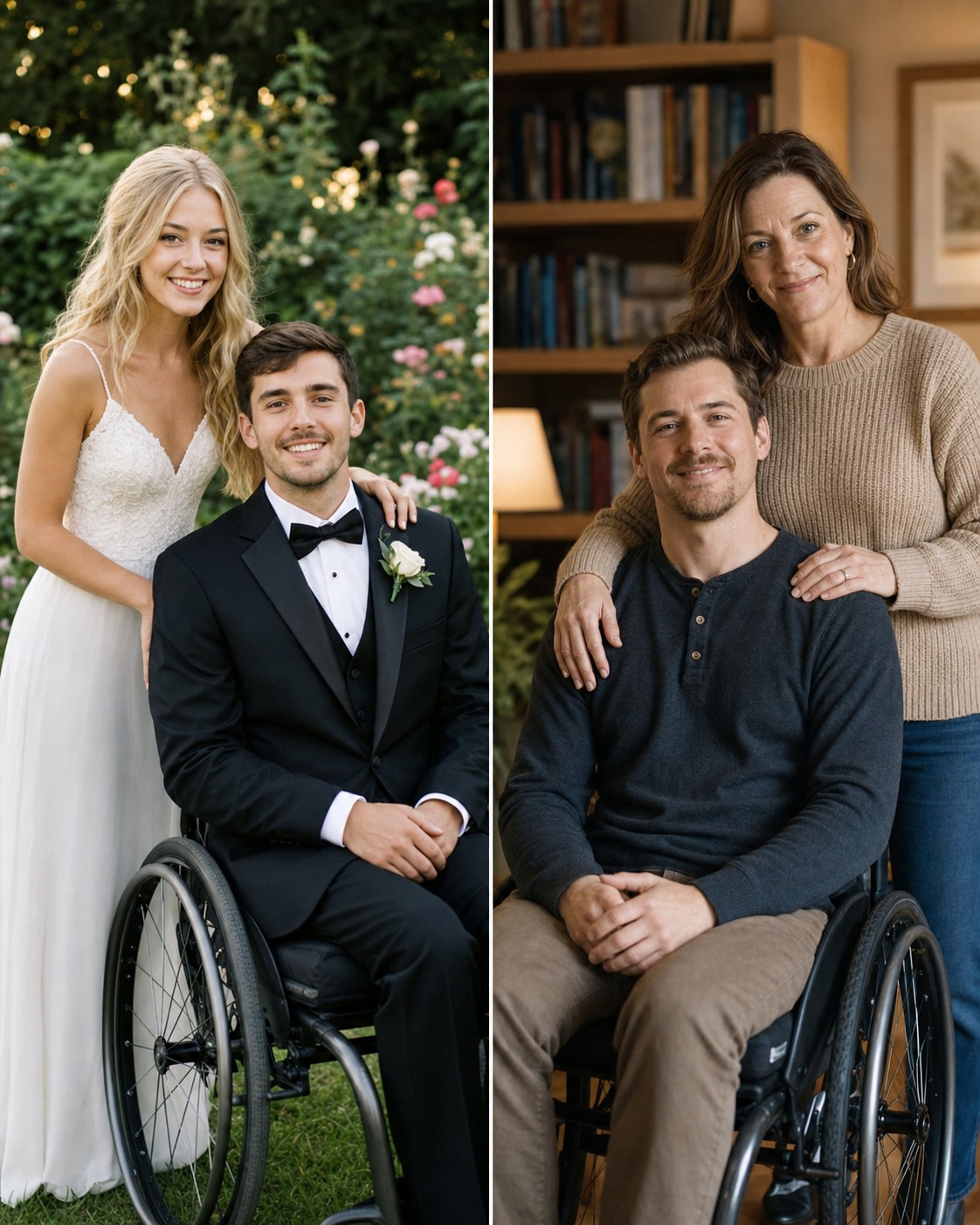
Just between you and me: I married my paralysed school sweetheart, despite all the warnings — and fifteen years later, the truth came to light.

I met the man who would later become my husband during my final year of high school—a time when life still felt both simple and limitless. The future stretched before us like an endless highway, and we genuinely believed that love alone was powerful enough to overcome any obstacle that might stand in our way.

We were both seventeen years old then, growing up in a small Pennsylvania town where everyone seemed to know everyone else’s business. We were young enough to believe wholeheartedly that love was the most important thing in the world, yet old enough to make plans that felt permanent and undeniably real.

We spent countless hours talking about our future together. We discussed which colleges we would apply to, imagined sharing a tiny apartment with unreliable plumbing, and laughed about how we would somehow transform it into the perfect romantic home. We talked about careers we barely understood and dreamed about adulthood without having the slightest idea of the challenges it would eventually place before us.

His name was Michael, and he was my first true love—the kind of love that leaves a permanent mark on your heart and quietly becomes the standard against which every future relationship is measured. According to him, I was his first real love too. He told me that so many times I eventually stopped counting.

Whenever he smiled at me across the noisy cafeteria during lunch or reached for my hand between classes, the world felt stable, predictable, and safe.

Then, just one week before Christmas during our senior year, everything we had built together shattered.

The Accident That Changed Everything

Michael was driving to his grandparents’ house on a snowy December evening to deliver Christmas presents. It was one of those dangerous winter nights when temperatures suddenly plunge after a brief thaw, leaving roads coated with invisible ice.

A patch of black ice on a rural road.

A truck approaching from the opposite direction.

A driver who couldn’t stop in time despite desperately trying.

The exact details always seemed to blur together whenever people retold the story, but the outcome was painfully clear.

Michael suffered a severe spinal cord injury and was left paralyzed from the waist down.

No movement.

No sensation.

No hope, according to the doctors.

Even now, decades later, I can still remember the smell of the hospital. It was a strange mixture of disinfectant and industrial cleaning products—sterile, sharp, and unforgiving. I remember the steady beeping of monitors tracking his vital signs. I remember how cold his hand felt in mine despite the warmth of the room.

Most vividly, however, I remember the doctor’s carefully measured voice when he delivered the news that would permanently alter our lives.

“I’m very sorry,” he said. “The spinal cord damage is complete. He will never walk again.”

The words hung in the room like a sentence handed down by a judge.

Michael’s face went blank with shock.

His mother quietly cried.

His father stared at the floor, struggling to comprehend what this meant for his son’s future.

I was still trying to process those words when my parents arrived at the hospital about an hour later.

They stood awkwardly at the foot of Michael’s bed and offered polite expressions of sympathy. Yet even then, I could see something else in their eyes.

Calculation.

Evaluation.

Judgment.

They were already imagining the future.

And in that future, there was no place for Michael.

On the drive home that night in their luxury sedan, they never asked how Michael was coping emotionally. They never asked about his pain, his recovery prospects, or what challenges lay ahead.

Instead, they focused entirely on me.

Not because they were worried.

Because they had already decided what I should do.

“This isn’t the life you want,” my mother said calmly from the passenger seat.

“You’re only seventeen,” my father added while looking at me through the rearview mirror. “You’ll meet someone else. Someone healthy. Someone with opportunities ahead of him. Someone who can give you a normal future. Don’t sacrifice your life over this.”

Both of my parents were respected attorneys in our town. Reputation mattered deeply to them. Status mattered. Appearance mattered. Success mattered.

Overnight, Michael transformed in their eyes from a promising young man into a burden.

A liability.

A mistake.

I told them I loved him.

I told them that love meant staying when life became difficult, not leaving when things stopped being convenient.

They called me naïve.

They said love alone wasn’t enough.

They insisted I would understand someday when I was older.

But I refused to leave him.

I visited him every day during rehabilitation. I stood by him despite their objections. Eventually, it became clear that I was choosing Michael over my parents’ approval.

That was when they carried out their threat.

They cut me off financially without hesitation.

The college fund they had built since my birth disappeared overnight.

I was removed from inheritance plans.

Every door they could close, they closed.

Then they told me not to contact them until I came to my senses.

I packed a single duffel bag with clothes and a few treasured belongings, walked out of their beautiful home, and went straight to Michael.

The Family That Welcomed Me When My Own Wouldn’t

Michael’s parents were ordinary working-class people living in a modest two-story house.

When I arrived, they didn’t hesitate for a second.

They gave me the spare bedroom that had once belonged to Michael’s older sister. They never made me feel like a burden, a charity case, or someone who owed them for their kindness.

During those first months, I helped care for Michael.

I learned how to safely transfer him between his wheelchair and bed. I assisted with physical therapy exercises. I adapted to the countless daily tasks that suddenly required entirely new methods.

I learned how to stay strong during the nights when he broke down crying, overwhelmed by the belief that his condition would never improve.

To help support us, I worked part-time at a grocery store, taking evening and weekend shifts whenever possible. I completed my education through alternative programs after effectively leaving traditional school.

Money was always tight.

Every dollar mattered.

Every expense had to be carefully considered.

That spring, when prom season arrived, I convinced Michael to attend with me.

People stared when we entered the decorated gymnasium.

Some whispered.

Others awkwardly looked away.

I couldn’t have cared less.

To me, Michael remained the smartest, kindest, and most remarkable person I knew.

The one who laughed at my terrible jokes.

The one who believed in me when almost everyone else had disappeared.

We married young.

I was nineteen.

He was twenty.

The ceremony took place at a courthouse with only a few friends and his parents present.

My parents weren’t there.

Neither were any of the wedding traditions I had once imagined as a little girl.

Still, we built a life together.

Slowly.

Imperfectly.

Honestly—or at least that was what I believed.

At twenty-three, I gave birth to our daughter.

She had Michael’s eyes and my stubborn determination.

After she was born, I secretly hoped my parents would finally reach out.

I thought perhaps becoming grandparents would soften them.

A birthday card.

A phone call.

Anything.

Nothing ever came.

Fifteen years passed in silence.

Fifteen years without holidays together.

Without family gatherings.

Without grandparents in my daughter’s life.

And throughout all those years, I believed Michael and I were unbreakable.

We had survived more than most couples ever face.

I believed there were no secrets between us.

No hidden cracks beneath the foundation.

Then one ordinary afternoon destroyed everything.

The Truth That Changed My Entire Life

I came home early from work that day after a power outage forced our medical office to close.

Michael worked remotely as a software developer—a career he had built despite the limitations imposed by his injury.

As I stepped inside, I heard raised voices coming from the kitchen.

One voice was Michael’s.

The other belonged to someone I hadn’t heard in fifteen years.

My mother.

She was standing in my kitchen, furious, shaking with anger, holding a thick stack of documents.

“How could you do this to her?” she shouted at Michael. “How could you lie to my daughter for all these years?”

I froze.

My bag slipped from my shoulder.

For a moment, nothing made sense.

“Mom?” I whispered.

She turned toward me.

The expression on her face was unlike anything I had seen before.

There was anger.

But there was something else too.

Guilt.

“Sit down,” she said.

Michael had gone completely pale.

His hands gripped the edge of the table so tightly his knuckles turned white.

“Please,” he whispered. “Please let me explain.”

My heart pounded painfully.

My hands trembled as I took the documents from my mother.

Medical records.

Insurance paperwork.

Neurological evaluations.

Specialist reports.

And then I found the sentence that shattered my world.

The paralysis had never been considered permanent.

I read it once.

Then twice.

Then again.

According to years of documented medical evaluations, Michael had regained partial movement and sensation less than two years after the accident.

Several specialists concluded that, with surgery and intensive rehabilitation, he could potentially walk again.

Not perfectly.

Perhaps with assistance.

Perhaps with limitations.

But independently.

Functionally.

I looked up at him through tears.

“You told me there was no hope,” I whispered. “You told me you would never walk again.”

He immediately broke down.

Sobbing.

Shaking.

Terrified.

“I was scared,” he cried. “I thought you’d leave. Your parents already hated me. I thought if you knew there was a chance, you’d wait for me to recover and eventually resent me if I failed. Or worse—you’d realize you could have had a completely different life.”

“So you lied?” I asked.

My voice rose.

“For fifteen years?”

He nodded miserably.

Unable to meet my eyes.

Then my mother slammed her hand against the table.

“He contacted us,” she said bitterly. “Two years after the accident. He asked us to help pay for the surgery. But only if we promised never to tell you.”

I stared at her in disbelief.

“You knew?”

She looked away.

“We thought you were trapped,” she said quietly. “We thought you had sacrificed your future. We convinced ourselves that keeping this secret was the only way to protect you.”

The room felt smaller.

The air felt heavier.

Every sacrifice I had made suddenly looked different.

Every double shift.

Every struggle.

Every defense of Michael.

Every story I told our daughter about her father’s courage.

Everything had been built upon a lie.

“I loved you,” I told him. “I chose you when everyone else walked away.”

“I love you,” he cried.

“I never stopped.”

“But you didn’t trust me,” I answered.

And that realization hurt more than anything else.

“You never trusted me enough to tell me the truth.”

Starting Over Again

That night, I didn’t scream.

I didn’t throw anything.

I didn’t make dramatic speeches.

I packed a bag.

The same way I had fifteen years earlier.

Then I took our twelve-year-old daughter and stayed with a friend.

The divorce was quiet but devastating.

Michael admitted everything once confronted with the evidence.

The truth was undeniable.

And our marriage could not survive such a profound betrayal.

Yet something unexpected happened afterward.

My parents tried to reconnect.

This time there were no conditions.

No demands.

No attempts to control my choices.

For the first time in over fifteen years, they apologized.

Not because they regretted wanting to protect me.

They still believed their concerns about Michael had been justified.

But they apologized for taking away my right to choose.

For deciding my future without my consent.

For erasing me from their lives.

Forgiveness didn’t happen immediately.

Some wounds take years to heal.

Some trust never fully returns.

But slowly, carefully, we began rebuilding something resembling a relationship.

Today, I have created a different life.

A life grounded in honesty.

In personal freedom.

In self-respect.

And in the understanding that the people who truly love us owe us the truth.

I don’t regret loving my high school sweetheart.

Those years taught me resilience, loyalty, and strength I never knew I possessed.

But they also taught me something even more important.

Love cannot survive without truth.

And sacrifice loses its meaning when it is built on deception.

This story raises difficult questions about trust, loyalty, and whether love can survive when one person makes life-altering decisions on another person’s behalf “for their own good.”

What do you think about Michael’s decision to hide the truth? Were the parents right to fund the surgery while keeping the secret? Could you forgive a betrayal of this magnitude?

Share your thoughts and join the conversation about honesty, sacrifice, and the responsibilities we have toward those who love us.

Just between you and me: I married my paralysed school sweetheart, despite all the warnings — and fifteen years later, the truth came to light.
The one who gave birth to supermodels. Have you seen the Hadid sisters’ mum?