
I took part in audits of financial transactions.
I monitored compliance with the company’s established policies.
Most importantly, I could speak openly to senior management about violations without fearing that my opinion would be considered inconvenient.
Three months later, the internal investigation was complete.
It turned out that one of Richard’s sons had been secretly taking money from the family business for several years.
The older businessman’s suspicions had not been entirely wrong.
He had simply been wrong about the number of people involved.
Only one of his two heirs had betrayed him.
The discovery devastated Richard.
This was not merely a case of financial fraud.
He had been betrayed by someone he had loved as a son—someone he had hoped would one day inherit the life’s work he had built.
Even so, Richard found the strength to face the facts and make the decisions that had to be made.
About a year after those events, he announced that he was finally retiring.
On his last working day, he gathered the entire company together.
In front of the large team stood a man who had devoted nearly all of his adult life to the construction business.
He looked carefully at the employees around him.
Then he spoke a single sentence:
“The most valuable employee is not the one who always agrees with the boss. A person’s true worth is revealed when they have the courage to say no because circumstances demand it.”
As I listened, I remembered that unsettling Friday night.
The empty corridors.
The enormous office.
The key turning in the lock.
The black envelope on the desk.
And my own decision to leave, even though I might lose my job.
Only then did I finally understand why that moment had mattered so much to Richard.
He had not been planning to reveal some personal secret.
He had not been trying to court me.

And he had not been searching for someone who would obey his every wish without question.
Richard Mercer needed a person who could remain honest under pressure.
Someone who would not sell another person’s trust for money.
Someone who would not be intimidated into silence by a powerful employer.
Someone who would protect the company even when the threat came from the owner’s closest relatives.
With time, I understood something else as well.
Trust cannot be built on fear, secret examinations, and constant suspicion alone.
Real respect begins when people are willing to speak openly, admit their mistakes, and honor one another’s boundaries.
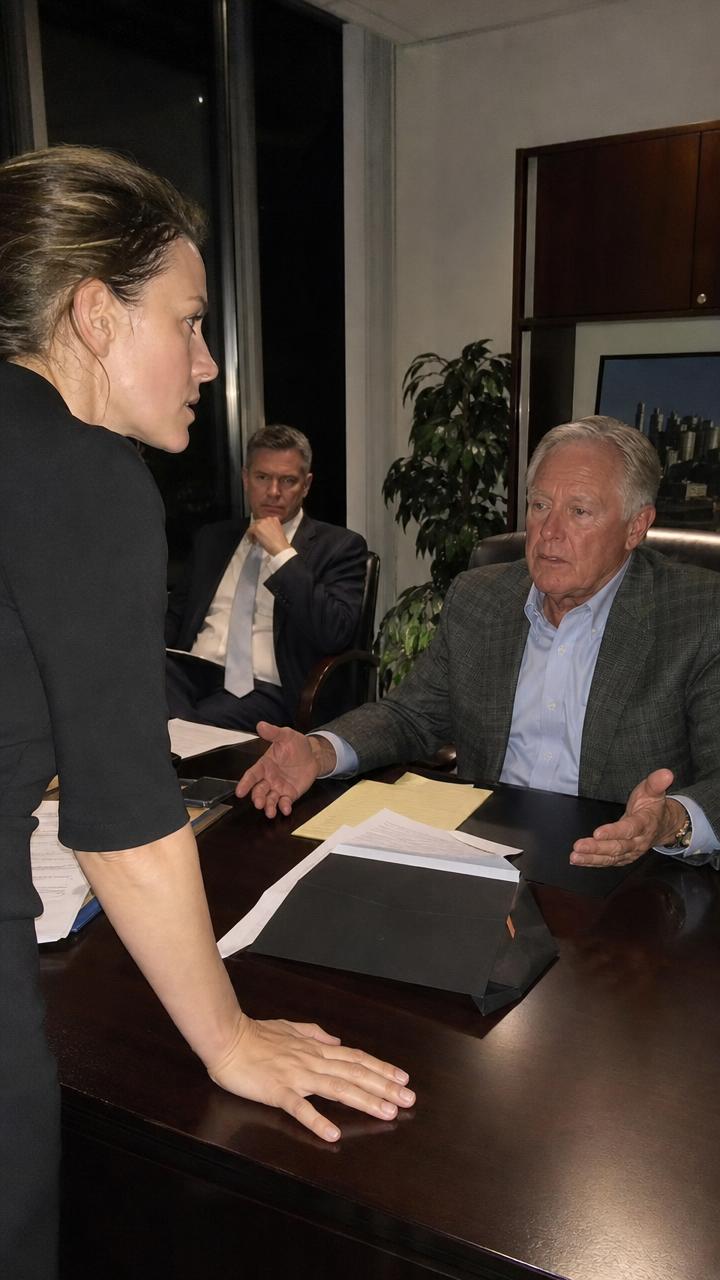
I never fully approved of Richard’s methods. I never would.
But the experience permanently changed the way I understood my own value.
Before that, I had believed that a good employee had to be convenient, efficient, agreeable, and free of conflict.
Then I learned that sometimes the most important professional quality is the ability to say firmly:
“No. You cannot do this to me.”
That decision, unexpectedly, opened an entirely new chapter of my life.
What would you have done in my place? Would you have accepted such a powerful position after being subjected to a humiliating and frightening test, or would you have left the company even after learning the executive’s real intentions? Share your thoughts in the comments.