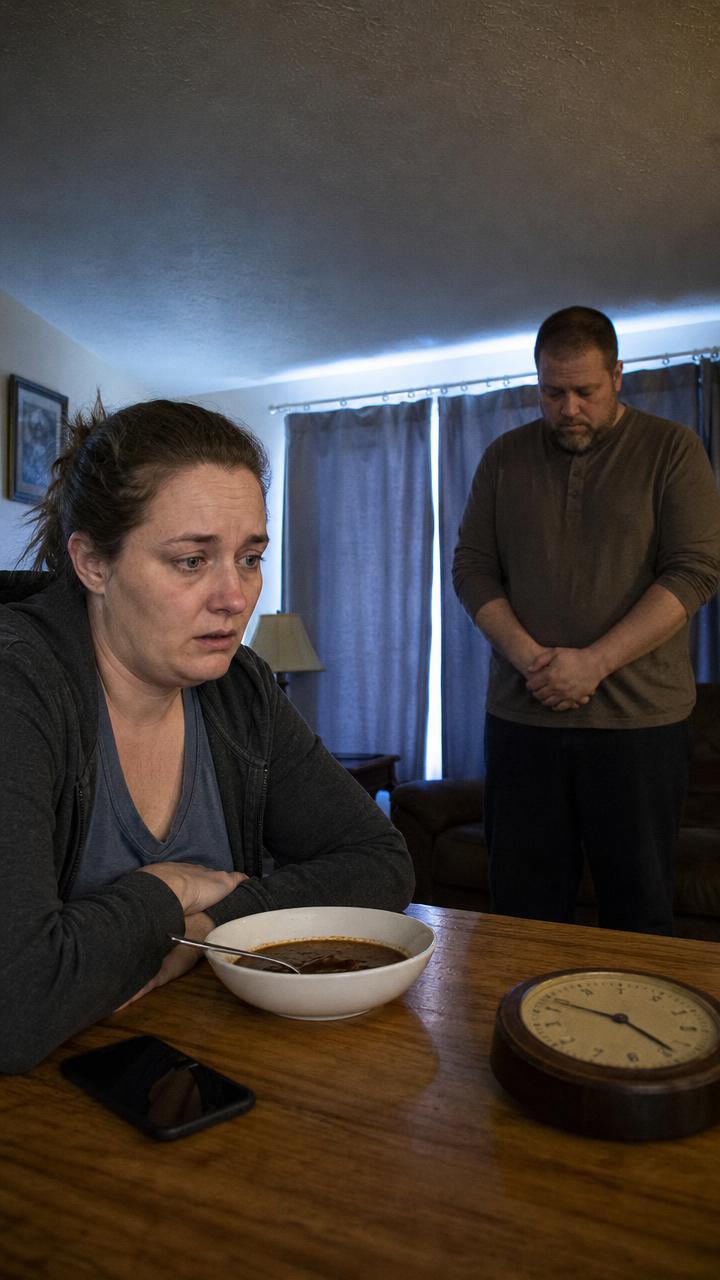
It began about two months ago.
My husband, Ethan, suddenly developed a strange new routine. Every evening, precisely at 7:14, he would rise from the sofa, draw every curtain in the living room, and then return from the kitchen carrying a small white bowl.
It always held the same soup—thick, dark, and filled with an unfamiliar smell I could never quite identify.
“You need to finish it,” he would say. “Every last spoonful.”
At first, I treated it as one of his odd little habits and laughed.
“Ethan, I’m not a child. If I don’t want to eat something, I won’t.”
He never laughed with me.
Instead, he would sit across from me and watch in silence until the bowl was empty. Sometimes, when I set it down, he would take it from my hands and inspect the bottom carefully, as though he needed proof that not a single drop remained.
What unsettled me most was the way he monitored me. It wasn’t enough for him to see me finish dinner. He seemed desperate to know that something specific had actually entered my body.
One evening, I pretended to pour the soup down the sink. Ethan noticed immediately. There was still another serving in the pot, and without saying a word, he ladled it into a clean bowl and placed it in front of me.
“Please,” he said quietly. “Don’t argue with me tonight. Just trust me.”
“Then tell me what you’re putting in it.”
For several seconds, he remained silent.
“Something your body needs right now.”
That answer finally broke whatever patience I had left.
Ethan’s behavior had been changing in other ways, too. He began taking secret phone calls, spending longer periods of time in the garage, and locking the door behind him every time he went inside. One afternoon, I found a receipt from a medical center in the pocket of his jacket. For some reason, his browser history was also being erased completely and constantly.
Then, in the middle of the night, I woke up and saw Ethan standing beside our bed. He was perfectly still, staring down at me as if he were checking whether I was breathing.
“What are you doing?” I asked, my voice shaking.
“Nothing,” he replied. “Go back to sleep.”
By morning, I knew exactly what I had to do.
That evening, when Ethan briefly stepped away from the kitchen, I poured several spoonfuls of soup into a small glass jar and hid it at the bottom of my bag. The following morning, I carried the sample to a private laboratory.
I told the woman at the desk that I suspected someone might be deliberately adding an unknown substance to my food. She stared at me for a moment longer than seemed normal.
“Do you think someone is trying to poison you?”
I couldn’t make myself speak. I only nodded.
She told me the results would be ready in three days.
Those became the longest three days of my life.
Every evening at exactly 7:14, Ethan closed the curtains, placed the bowl in front of me, and sat down across the table. I ate while the most frightening possibilities crowded my mind.
Perhaps he was trying to make me sick slowly. Maybe the soup explained why I had felt weak and exhausted for weeks. Or perhaps the medical-center receipt had something to do with me after all, and Ethan and someone else were secretly searching for a way to get rid of me.
On the third day, the laboratory finally called.
“Mrs. Bennett?”
“Yes?”
“We need to speak with you in person about the sample you left here. Can you come in today?”
My hands went cold.
When I arrived, a doctor asked me to sit down and arranged several sheets of paper in front of him.
“We found no poison, sedatives, or dangerous chemicals in the sample,” he said.
I let out a breath I hadn’t realized I was holding. Relief began to spread through me, but the doctor continued.
“However, the soup contains extremely high levels of iron, folic acid, vitamin B12, and several naturally occurring plant compounds. This combination is usually used to help restore the body in cases of severe anemia.”
“But I’ve never had anemia.”
The doctor studied my face.
“Are you certain? You look extremely pale. I strongly recommend that you have blood drawn today.”
I agreed.
About an hour later, the doctor returned to the room. His expression had changed completely.
“Your hemoglobin level is dangerously low,” he said. “There’s something else we discovered.”
He paused.
“You’re pregnant. Approximately seven weeks.”
For a moment, I couldn’t move.
Ethan and I had dreamed of becoming parents for years. After two miscarriages, doctors had warned us that another pregnancy could seriously endanger my health. Over the past year, the pain and disappointment had exhausted us so completely that we had almost stopped speaking about having a child.
I went home clutching the test results as though they were the only thing holding me upright.
It was 7:13.
Ethan stood by the window. The instant the clock changed to 7:14, he performed the same familiar movement, drawing the curtains closed. Then he went into the kitchen and returned a few minutes later with that same white bowl.