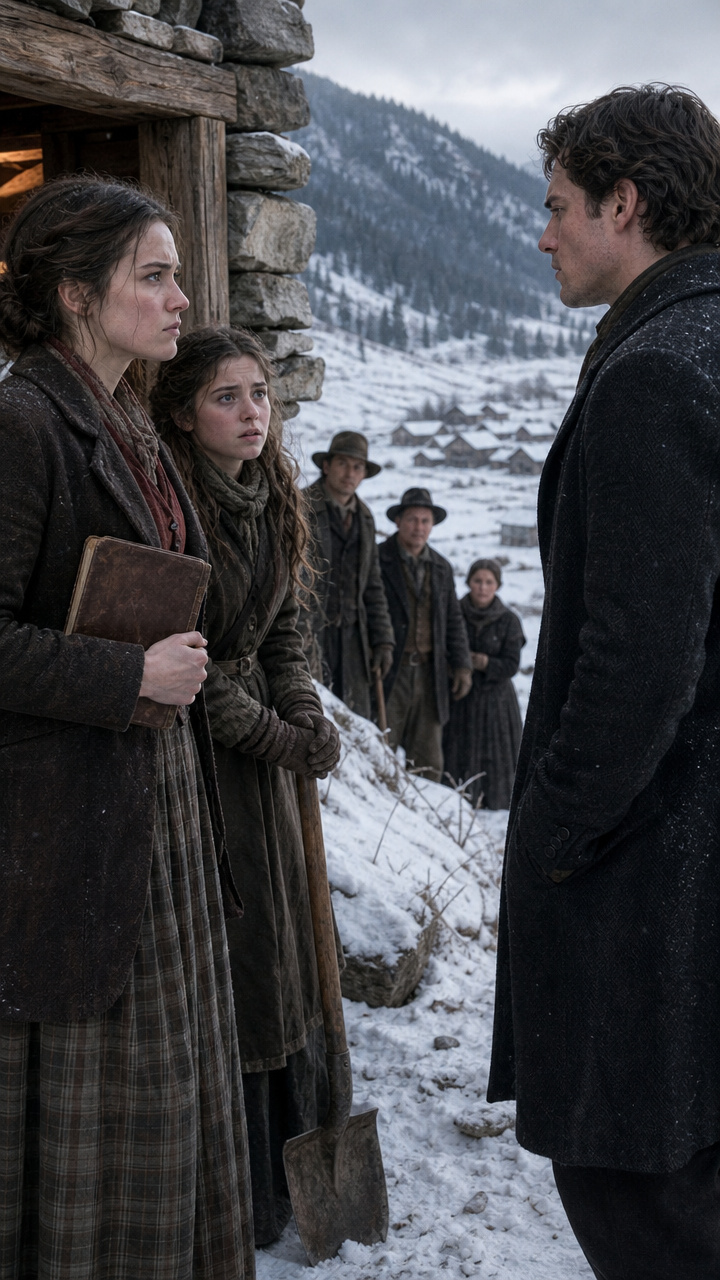
He could no longer lift beams, but he could spot a crooked line from twenty paces. He knew how wet mortar should feel, how smoke behaved before it became dangerous, and why drainage deserved the devotion of religion whether people admitted it or not.
The next day, he returned with chisels, two plumb lines, and a sack of iron hinges he claimed had been “making a nuisance of themselves” in his shed.
In April, another helper arrived.
Her name was Ruth Bell, though everyone called her Ruthie. She was a widow with broad shoulders, sharp eyes, and a manner that made politeness seem unnecessary. Her husband had died three winters earlier when wet snow brought down their barn roof. Since then, Ruth had repaired everything herself. Pity had proved less dependable than a sound mallet.
She watched the sisters work for nearly an hour before speaking.
“I didn’t come to encourage you.”
Eleanor wiped sweat from her forehead. “Why did you come?”
“To find out whether my husband died because weather is cruel or because we built like idiots.”
No one answered.
Eleanor handed her the notebook.
Ruth read for a long time. When she finished, her face was completely still.
“Show me the raised floor,” she said.
Eleanor did.
She explained the crossbeams, the open space below, the way cold traveled through solid contact, and why still air mattered. She described how the cave’s steady temperature would not heat the room by itself, but would keep winter from stealing every bit of warmth they created.
Ruth listened as intensely as if she were hearing a confession from the dead.
At last, she said, “Most houses are boxes begging the wind to be kind.”
Amos, seated on a stone nearby, gave an approving grunt.
By June, the floor frame was finished.
By July, the sisters and their helpers had laid thick planks over the beams. They fitted together so tightly that even crumbs would struggle to find a crack. The first time Clara crossed the floor in her stockings, she laughed aloud. The sound was so sudden that Eleanor turned, thinking she had hurt herself.
“It doesn’t feel like stone,” Clara said.
“No,” Eleanor replied. “It feels like ours.”
The front wall rose in August.
They cut logs from the slope, peeled them, notched them, and set them beneath the overhang. Gaps were packed with clay, straw, ash, and pine pitch. Amos insisted every joint be tested twice. Ruth demanded a storage bench beneath the window because, as she put it, “survival is easier when there is somewhere to put beans.”
When Eleanor was not looking, Clara carved small marks inside the doorframe—one for every week they had refused to quit.
The accident happened in September.
They were lifting a heavy beam above the doorway when a temporary brace slipped. The beam lurched. Clara, standing too close, lost her balance and fell backward toward a stone ledge.
Eleanor moved without thinking.
She caught Clara around the waist and twisted hard, throwing them both aside. Clara landed on top of her instead of the rock. The beam crashed down where Clara’s head had been.
For several seconds, no one breathed.
Then pain burst through Eleanor’s ribs.
Ruth reached them first.
“Clara?”
“I’m fine,” Clara gasped.
“Eleanor?”
Eleanor tried to sit and failed. White sparks crowded her vision.
Amos cursed in a low, ancient voice.
Ruth pressed careful fingers along Eleanor’s side. “One cracked rib, perhaps two. Not a clean break. You’ll be angry every time you breathe for a month.”
Clara began to sob. “We have to stop. Eleanor, we have to stop. This place nearly killed you.”
Eleanor lay on the floor they had built and stared at the unfinished doorway.
“No,” she whispered.
Clara wiped her face. “How can you say that?”
“Falling timber nearly killed me. Not the cave.”
“That is not enough of a difference.”
“It is exactly the difference.” Eleanor forced herself to breathe shallowly. “People die in barns, churches, kitchens, and beds. That doesn’t make shelter the enemy. Bad construction is the enemy. Carelessness is the enemy. Quitting because Daniel Boone is waiting to be proven right—that is the enemy.”
Clara knelt beside her, trembling.
“What if he is right?”
Eleanor turned her head.
“If we stop now, he won’t have been right,” she said. “We will have made him right.”
The next morning, Clara tightened the brace herself.
By November, the house beneath the mountain was nearly ready.
The fireplace took the longest.
Amos refused to let them hurry. The firebox had to be deep enough to draw cleanly without swallowing the heat. Its back had to fit into the cave’s own stone mass. The throat needed to narrow at exactly the right point. The vent had to be lined wherever loose grit might fall.
Eleanor’s ribs ached through every hour, but she continued slowly and carefully, refusing to give pain more authority than purpose.
The first test fire filled the room with smoke.
Clara coughed until her eyes watered. Ruth swore so fiercely that Amos told her to save a few words for the funeral if they had built it wrong.