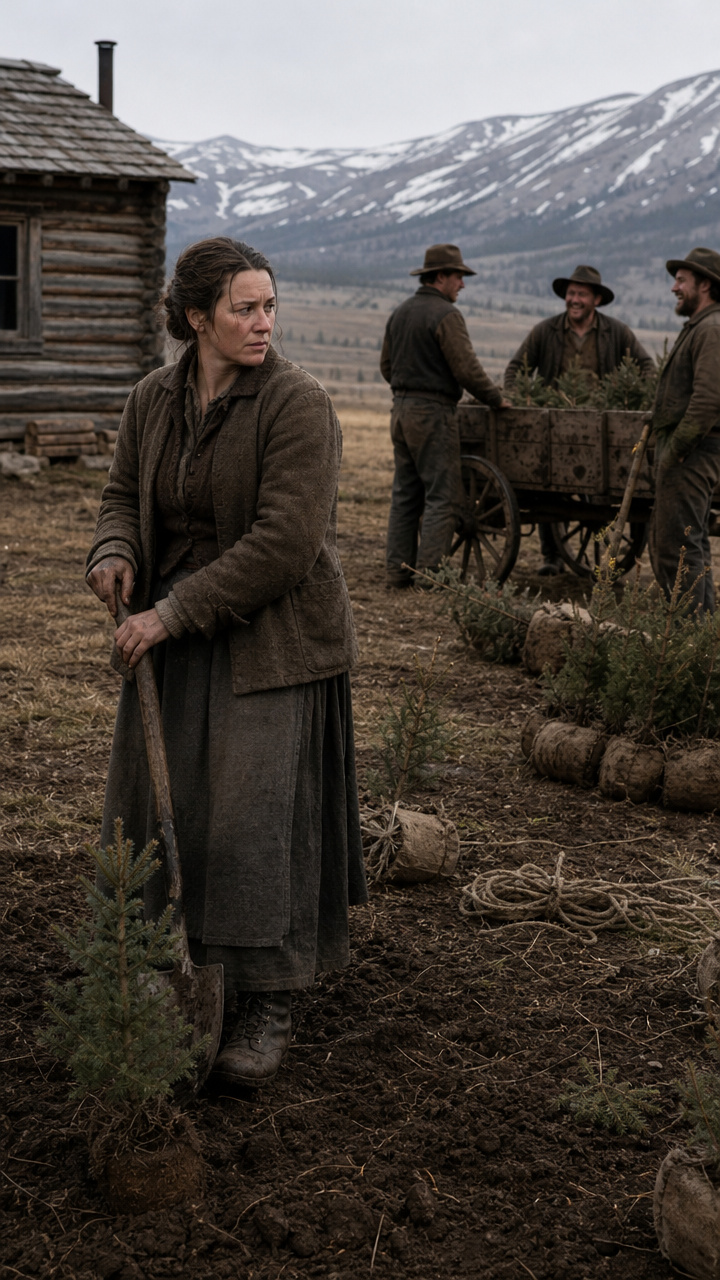
Hannah pressed the cloth to Caleb’s wound. “Why did you come here?”
His eyes met hers.
“Because this is the only cabin still standing on this side of the rise.”
The words settled between them with the weight of the entire winter.
Another blow struck the door.
Hannah and Caleb both turned.
A voice outside cried, “Help! Open up!”
Caleb rose too quickly and swayed. Hannah caught his arm, then moved to the door.
When she opened it, Roy Mercer staggered inside, dragging Glenn by the collar. Ice coated both men. Glenn’s lips had turned blue. Roy’s confidence had vanished somewhere out in the storm.
Two hired men followed, men Hannah recognized but had never spoken to. Gideon Vale came last.
His hat was gone. Silver hair lay frozen against his skull. One cheek was cut, and his coat hung open, torn from shoulder to hem. He stood on Hannah’s porch like a king who had just discovered that the weather did not recognize titles.
For a moment, nobody spoke.
The wind thundered across the roof.
Hannah held the door.
Vale looked past her into the warm cabin. Then he glanced at the snow wall gathered around the shelterbelt.
His eyes understood before his pride did.
“Mrs. Reed,” he said hoarsely.
Hannah stepped aside.
“Come in before you die trying to prove something.”
They entered.
There were too many bodies for the small room. Too much wet wool, too much trembling, too much fear. Hannah gave orders because someone had to, and the men obeyed because near death had temporarily made them sensible.
“Boots beside the stove. Wet gloves there. Wrap him in that quilt. Caleb, don’t stand. Roy, stop shaking him—he needs heat, not panic. Mr. Vale, close that shutter before the hinge tears loose.”
Vale blinked at being commanded.
Then he closed the shutter.
For three hours, the cabin became a battlefield against the cold.
Glenn vomited twice, then began to shiver properly, which Hannah considered a hopeful sign. Roy cried when he thought no one was looking. One of the hired hands whispered prayers. Caleb sat near the stove with a bandage around his head and watched Hannah move through the crowded room as though he were seeing her for the first time.
Near midnight, the strongest gust yet struck the rise.
The cabin shuddered.
The lamp flickered.
A ceiling beam groaned.
Roy flinched. “God help us.”
Hannah raised one hand. “Listen.”
They listened.
The wind hit the outer belt of trees, tore through the branches, crashed into the brush wall, lifted, curled, and swept over the cabin. The sound changed as it passed. It no longer struck the walls with its full force.
It arrived wounded.
Vale heard it.
Everyone did.
Glenn, wrapped in Hannah’s quilt, whispered, “It should have taken the door.”
“It would have,” Caleb said.
No one asked him to explain.
They understood.
By morning, snow covered three sides of the cabin, but the house was not crushed. The shelterbelt had gathered the snow outward, creating a curved white rampart that looked almost intentional, almost designed by a hand larger than any human one.
The trees rose from it in dark, bending lines.
A fortress, the village would later call it.
But Hannah knew better.
A fortress was built to keep people out.
Her trees had kept death out.
Those were not the same thing.
When the storm finally broke on the third afternoon, silence spread over the valley so abruptly that it seemed unnatural.
The rescued men stepped onto the porch one at a time.
Vale’s western barn stood black and broken in the distance. Fences had collapsed. The road had disappeared. Drifts covered the open fields in violent waves, some higher than a wagon, because nothing had slowed the wind before it dropped its burden.
Around Hannah’s cabin, the snow was deep as well—but it had been shaped, caught, and controlled.
The shelterbelt had done what no one believed it could do.
Roy stood staring at the trees.
Hannah came outside carrying a bucket of ash for the icy steps.
He turned, swallowed, and looked down at his boots.
“I said some things,” he muttered.
“Yes.”
“Stupid things.”
“Yes.”
“I’m sorry.”
Hannah scattered ash across the steps. “Be better when nobody is freezing.”
His face reddened. “I’ll try.”
“Try where I can see it.”
He nodded.
Glenn could not meet her eyes.
The hired men thanked her directly, and she accepted their thanks directly.
Vale was the last to leave.
He stood at the edge of the porch, staring at the curved rows of saplings. Snow clung to their branches. Some had bent almost to the ground. Two had snapped. Most remained standing.
“You saved my men,” he said.
“The trees helped.”
His jaw tightened at the correction.
Then, slowly, he nodded.
“The trees helped,” he repeated.
Hannah waited.
Vale drew in a breath that appeared to hurt him. “I misjudged your work.”
“Yes.”
“And your judgment.”
“Yes.”
Near the doorway, Caleb lowered his gaze to hide something like a smile.
Vale noticed anyway.
The old cattleman turned toward him. “You knew?”
“I suspected.”
“And you said nothing?”
“I said enough. You didn’t like the answer.”