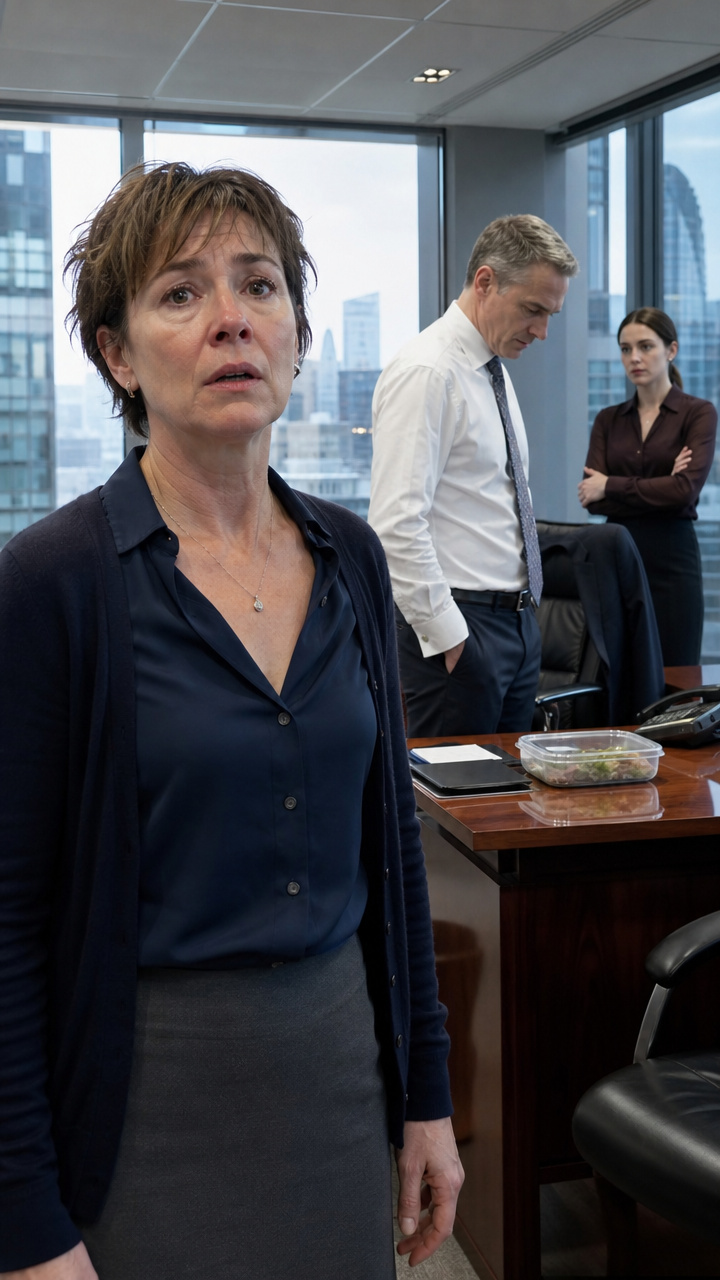
During the following year, Walter and I worked with a renewed management team to carry out a broad restructuring.
We created a strict ethics and compliance system.
We strengthened financial oversight.
Quarterly revenue returned to record levels.
I was no longer a passive investor.
I now chaired the board of Hartline Logistics.
The company that carried my father’s name.
And now, once again, mine.
I agreed to take the chair not to obstruct Grant.
I want to make that especially clear.
The revenge version of the story would sound more dramatic.
But it would not be true.
I accepted the position because something unexpected became obvious:
I was very good at the work.
That was the quietest and most astonishing discovery of all.
For fifteen years, I had been taught in thousands of small ways that business was Grant’s world.
That I was merely decorative beside him.
That he embodied competence.
That my greatest achievement was marrying successfully.
Part of me had believed it.
But when real work appeared in front of me, I discovered that I understood the company almost instinctively.
The way a person understands the house where she grew up.
Because I had grown up in it.
My father had built the business practically at our kitchen table.
As a child, I heard his phone calls.
Contract negotiations.
Route discussions.
Warehouse problems.
Staffing decisions.
Financial questions.
Long before I ever opened the shareholder agreement, I had absorbed the logic of the company.
The board had not offered the chair to a helpless former wife out of pity.
They invited a Hart back into leadership because the company had begun losing direction.
They remembered what the Hart name had once meant at the head of the business.
As I restructured departments and developed ethical safeguards that would prevent another Grant Mercer from taking shape, I understood something important.
I was not merely preserving my father’s legacy.
I was continuing it.
The competence automatically attributed to my husband for fifteen years had been sitting quietly at the other end of the table the entire time.
No one had asked it to stand.
Chapter 26 — Across the Street
That day, I attended the opening ceremony for a new logistics complex in the center of the city.
When I stepped out of the car to meet reporters, government officials, and company employees, I noticed a familiar figure across the street.
Grant.
I barely recognized him.
An ordinary, wrinkled jacket.
Thinning hair without the flawless styling he once maintained.
A worn shoulder bag.
After the scandal, nearly every major company in the industry refused to work with him.
Eventually, he had managed to obtain a mid-level position at a small independent brokerage firm across town.
Now he stood watching.
I watched the mayor hand me a pair of ceremonial golden scissors.
I watched the assembled crowd begin to applaud.
Cameras flashed.
Reporters photographed the woman Grant had once believed was weak.
Quiet.
Completely dependent on him.
Chapter 27 — Nothing
Our eyes met across the busy street.
Only for a second.
I did not frown.
I did not smile triumphantly.
I felt no surge of anger.
No sweetness of revenge.
Nothing at all.
Grant had become a stranger from my former life.
A man who had traded a genuine empire for an illusion and eventually lost both.
I turned away.
I faced the cameras.
The golden scissors waited against the red ribbon.
I closed them.
Then I stepped forward into the future I had built with my own hands.
Later, I thought about that feeling—or, more precisely, the lack of it.
It surprised me most of all.
I had imagined that the day I finally saw Grant diminished, something enormous would rise inside me.
Celebration.
Justice.
At least the dark satisfaction of seeing the scales finally balance.
Instead, there was only a clean, peaceful emptiness.
Sometimes you look at a house where you once lived and suddenly understand that you feel nothing for it anymore.
Standing there with the ceremonial scissors, I realized that nothing had been the real goal.
More than that, it was the clearest measure of how far I had come.
Hatred would have meant Grant still had a place inside me.
Wanting to see him suffer would have meant that some part of my life was still circling him.
But I felt nothing.
And nothing meant freedom.
The real kind.
The complete kind.
The kind that arrives when the person who once defined your entire world has finally become the size of a stranger on the opposite side of the street.
Throughout our marriage, Grant had been certain I was small.
Quiet.

Dependent.
That I would not survive without him.
Now he had the final proof of how completely wrong he had been.
He stood on a public sidewalk in a wrinkled jacket, unable to take his eyes off me.
I held his gaze for barely a second before turning my attention toward something much more important.
Once, he needed to make me small in order to feel powerful.
I did not need to watch him be destroyed.
I only needed him gone from my life.

And he was.
The red ribbon shone beneath the afternoon sun.
Ahead of me stood a company.
My work.
My life.
And it was time to begin.
THE END.