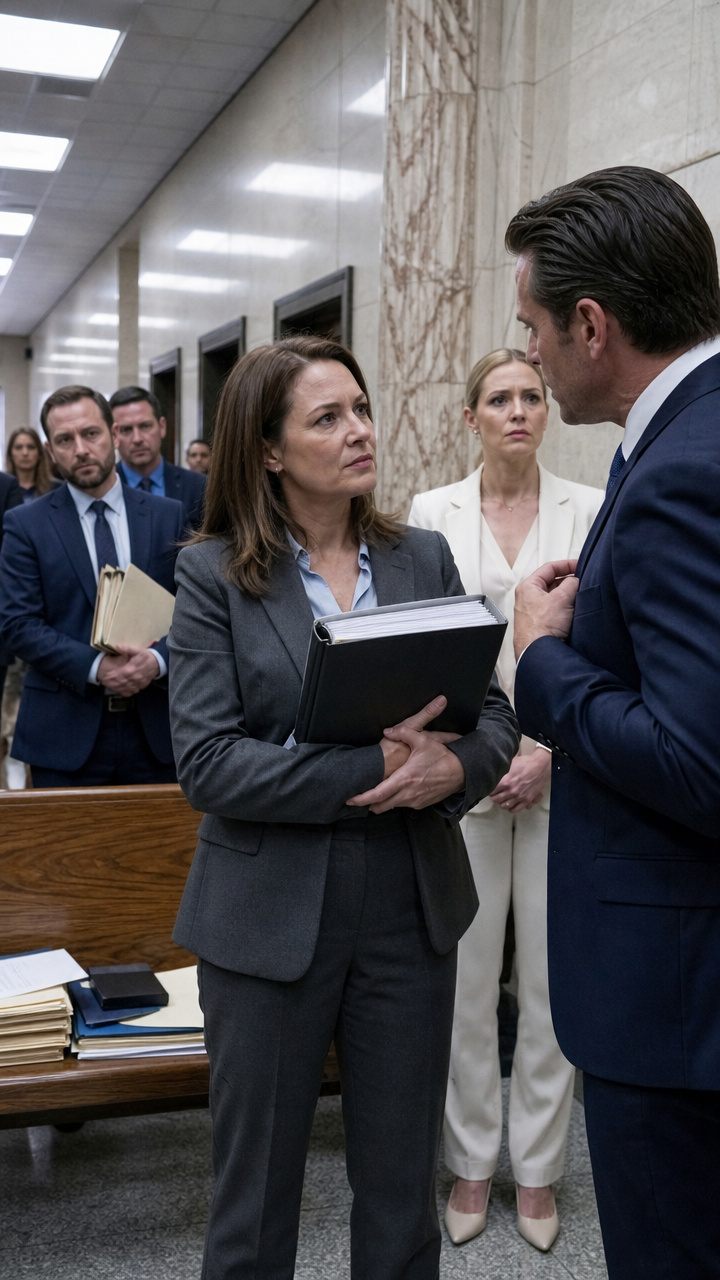
For the first time, I allowed one thought to settle completely.
Daniel had always viewed the apartment as a trophy.
Then he had used it as collateral.
But the home had begun long before the concrete and glass.
My grandmother had laid the first stone with hands damaged by work.
My income had maintained it for years.
My vigilance had saved it.
Daniel had merely been a loud guest inside.
I did not redecorate everything immediately.
I wanted to learn the rooms without him.
I spent more time sitting in silence.
I moved his chair because it occupied too much space.
I bought new sheets.
I painted the pantry a deep, calming blue and turned it into a real office.
I installed shelves for my files and placed my desk facing the window.
There is a particular kind of happiness that appears when your living space is no longer organized around another person’s distorted reality.
One morning, I sat there with coffee beside my computer.
I knew that happiness.
Months later, Arthur called about a technical detail concerning collection of the compensation.
After explaining the procedure, he added, “Most people think strength has to be loud.”
He paused.
“In my experience, real strength often just keeps the records.”
As soon as we ended the call, I wrote the sentence down.
It was too accurate to forget.
Eventually, Daniel became nothing more than a fragmented story told by other people.
He left the company.
The tax investigation expanded.
His car was repossessed after missed payments.
He moved into a small rental apartment in a neighborhood where he had once sworn he would never live.
A mutual acquaintance saw him in a bar.
“He didn’t look well,” she told me.
I asked no questions.
Real consequences do not remain dramatic for long.
They become bills.
Payment schedules.
Plans that must be rewritten.
Sometimes I still remember the morning of the hearing.
Daniel had leaned toward me and promised that before the day ended, I would own nothing.
I understand now that the statement revealed his deepest fear.
He measured people by what they possessed.
To him, losing property meant almost ceasing to exist.
He believed everyone lived the same way.
He never understood that my life had never been contained in objects.
It was in my work.
In my ability to do that work well.
In my willingness to look at the truth directly.
In the quiet certainty that when an account stops balancing, I can discover exactly where the error began.
He mistook silence for emptiness.
That was the greatest mistake of his life.
The following spring, months after the divorce, I took a short trip alone.
I drove to a small lakeside town and rented a wooden house with a terrace overlooking the water.
The lake was still cold from the melting snow.
I brought three books.
My laptop remained in my bag for emergencies only.
For once, I carried no one else’s expectations.
On the second evening, wrapped in a blanket, I sat outside and listened to birds and the soft movement of the water.
I realized how long I had arranged my life around another person’s moods.
Peace did not return as a dramatic explosion.
It came gradually, like warmth returning to a hand you had not realized was numb.
When I returned home, I changed the name displayed beside my apartment buzzer.
I removed Carter.
I restored my birth name.
Emily Morgan.
A name that had been reduced to a footnote during my marriage.
The building manager looked at me.
“Would you like us to change it now?”
“Yes.”
An hour later, my name occupied the space on the intercom.
That small correction brought me almost as much peace as the court’s decision.
Another line in the records of my life had been restored.
I did not become louder after Daniel.
The story might have seemed more dramatic if I had transformed into an entirely different woman.
But that would have been false.
I remained myself.
I still preferred spreadsheets to displays.
I still thought before speaking.
I still disliked crowded celebrations.
The difference was essential.
My silence belonged to me now.
It was no longer an empty space into which other people could project their idea of my weakness.
It was a tool.
A discipline.
A choice to value precision over noise.
At the right moment, precision can strike harder than a scream.
Nearly a year after the hearing, I saw Daniel for the last time.
It was raining.
I had just left a grocery store, carrying several bags and holding my umbrella beneath my arm.
He stood near the flower stand at the entrance.
He looked older.
Not because of the years.
His face carried the exhaustion of someone finally forced to live inside the disorder he had created without help.
He was not old.
He was worn out.
Our eyes met.
We stopped at the same moment.
For several seconds, beneath the harsh store lights, we stood like two actors who had forgotten which scene they were meant to perform.
Daniel took one careful step toward me.
“Emily…”
I waited.
“There’s something I wanted to say.”
He lowered his eyes.
“I don’t know… I’m sorry. I was stupid. I didn’t think.”