A couple near the window looked over.
“You would really do this to me?” he asked.
I took my umbrella and placed a fifty-dollar bill beside my untouched coffee.
“You did it to yourself.”
He stared at me as if I had become someone he did not know.
Perhaps I had.
Or perhaps he had only ever known the version of me that loved him enough to remain silent.
I stepped outside into the rain.
Cold water touched my face as I reached the sidewalk, but for the first time in years, I felt clean.
A week later, Margaret took the fight public.
At eight in the morning, the plaza outside Whitmore Holdings filled with noise.
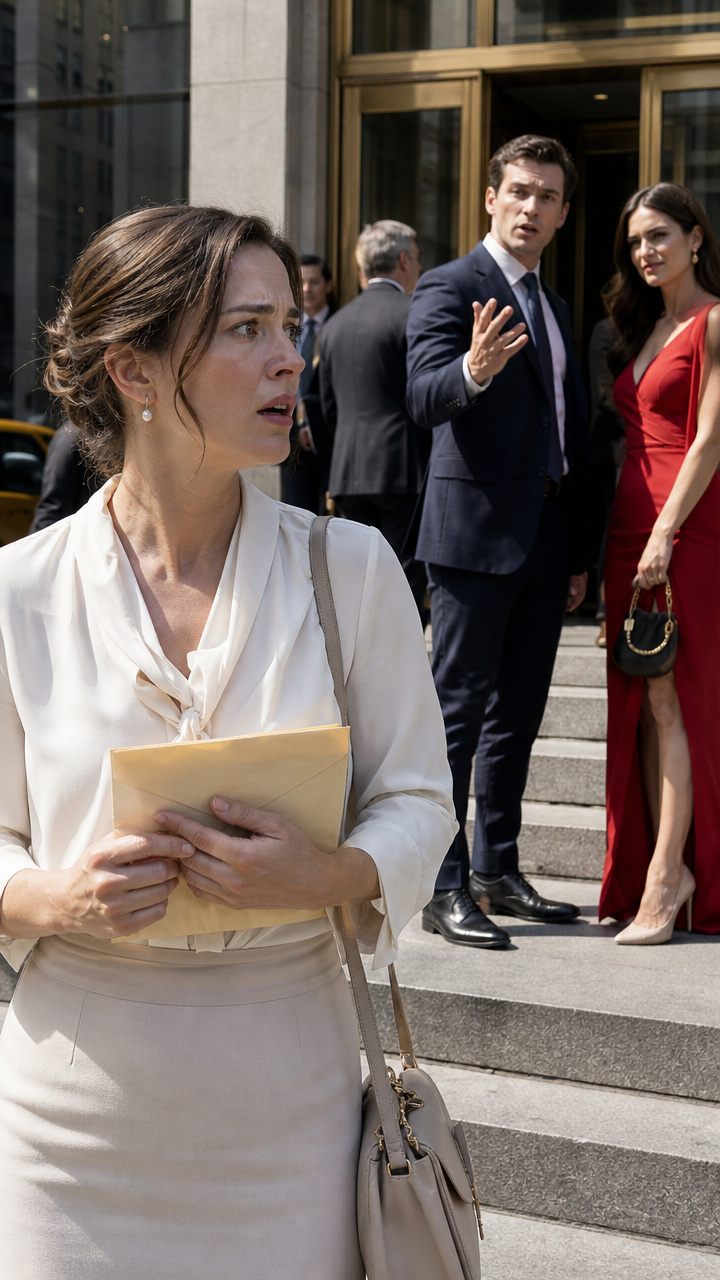
The sun was bright. Employees moved through the lobby turnstiles with coffee cups, handbags, and identification badges when shouting began outside.
From my office on the top floor, I watched the security feed.
Margaret stood before a crowd of Carter relatives, holding a cheap megaphone in one hand and a poster in the other. Her hair was messier than usual. Her pearls were gone. Behind her, people carried signs accusing Whitmore Holdings of destroying families and stealing honest jobs.
Pedestrians slowed.
Phones came out.
A delivery worker stopped his bicycle beside the curb.
Colin called from the lobby.
“Miss Whitmore, should we contact the police?”
I watched Margaret point toward the building with theatrical outrage.
“Not yet.”
There was a pause.
“Not yet?”
“Open the main doors. Invite them inside. Offer water and tea. If Margaret wants an audience, give her one.”
When I reached the lobby, the Carters had taken over the seating area.
They sat on leather sofas beneath the enormous presentation screen where we usually displayed quarterly milestones and charity initiatives. Several employees stood along the walls. Visitors hovered near reception. Security maintained a careful perimeter.
Margaret saw me and rushed forward.
“You cruel little princess,” she shouted. “Our family worked for your company for years, and you threw us out with nothing because you couldn’t keep your husband!”
I let her speak.
That mattered.
People like Margaret needed the rope made from their own words.
She shouted about loyalty. Sacrifice. Family. Class prejudice. A jealous former wife. A heartless billionaire father.
The lobby grew quieter the louder she became.
When she finally paused for breath, I touched the small microphone clipped to my blazer.
“You say your family worked hard for this company,” I said. “Since everyone is gathered here, let’s discuss that work openly.”
Martin stood beside the presentation controls.
I nodded.
The screen lit up.
A scanned contract appeared.
Robert Carter’s signature sat at the bottom.
“This is a procurement contract approved by Robert Carter, former head of procurement,” I announced. “The listed prices were nearly three times the market rate.”
The next slide appeared.
A bank record.
“The difference was routed through an outside entity connected to Laura Carter, former chief accountant.”
A murmur passed through the employees.
Laura, standing near the back of the crowd, began to cry.
I clicked again.
“Here are three vendor entities registered to Evan Carter. No office. No full-time employees. No evidence of completed services. Yet they received monthly payments from Whitmore Holdings for years.”
Margaret’s face turned gray.
The megaphone slipped from her fingers and hit the polished floor with a hollow thud.
I kept my voice calm.
“Your family did not break its back for this company. Thousands of honest employees did. Your family took from them.”
Sirens sounded outside.
Several official vehicles stopped near the entrance.
Investigators entered the lobby carrying folders.
Robert tried to move toward the side exit.
Colin was already there.
Laura covered her mouth.
Evan began shouting that it was all a misunderstanding.
Margaret looked around for sympathy.
She found none.
The performance had become evidence.
And the audience understood.
That afternoon, Margaret chose a more desperate weapon.
Children.
My father’s home in Greenwich stood behind wrought-iron gates on a quiet road lined with old trees and carefully kept lawns. The American flag beside the porch moved gently in the warm breeze. It was the kind of neighborhood where people noticed unfamiliar cars and lowered voices traveling through hedges.
Margaret arrived with Nathan’s two children from a previous relationship.
Henry was ten.
Lily was six.
She made them stand outside the gate in the heat with cardboard signs hanging around their necks.
Grandpa Richard, Aunt Claire, please forgive our father.
Save our family.
I watched from the security monitor in the living room beside my father.
Henry’s face was red and damp with sweat. Lily kept rubbing her eyes. Margaret knelt beside them, crying loudly whenever a neighbor slowed down.
My father’s hand tightened around his cane.
His knuckles turned white.
“Open the gate,” he said.
“Dad—”
“Open it.”
The wrought-iron gate slid aside.
My father walked out slowly. He was thinner than he had once been, but his back remained straight. He did not look toward Margaret first.