If those had been my reasons, Daniel would have been right. It would have been personal revenge, and I would still have been bound to him, allowing the man who hurt me to determine the terms of my life.
But that was not what happened.
Cole Capital had discovered evidence of serious financial crimes during a legitimate business acquisition. The firm had a legal obligation to report that evidence to the proper authorities.
It was not personal.
That was precisely what Daniel could not understand. His downfall was not my passionate project. It was a professional obligation.
He had created the evidence.
The law required the report.
I simply happened to be standing at the intersection of both.
Then my cousin’s husband approached, looking deeply uncomfortable.
“Claire,” he said, “there are two gentlemen asking for Daniel.”
Daniel turned.
Near the ballroom entrance stood two federal agents, patient and unhurried, exactly where the timeline of events had placed them.
Lauren looked at them and whispered one word.
“Run.”
Daniel stared at her in disbelief.
In that single look, I understood that whatever had existed between them had already ended. She was not saying, “We’ll fix this.” She was not saying, “I’m with you.”
She was telling him to flee alone while she stayed behind.
Five years earlier, Lauren had stood barefoot in my kitchen wearing my husband’s shirt, looking at me with the triumph of a woman convinced she had won a prize.
She had believed she and Daniel shared something powerful enough to justify the ruins they had made of my marriage.
Now, at the first sound of consequences, their great love revealed itself as appetite and convenience.
The relationship that destroyed my marriage had never been love. It had been mutual benefit.
When the federal agents appeared, the two people who had betrayed me together turned against each other with the speed of rats abandoning a sinking ship.
Lauren cooperated with prosecutors within weeks.
Daniel would have done the same to her if given the opportunity.
They had built their union on my wreckage. It turned out to have been built on nothing.
I did not have to lift a finger.
I only had to survive long enough to watch.
Chapter Thirteen — That Line Rarely Ages Well
The agents did not arrest Daniel in the ballroom.
Reality, I learned, is rarely as theatrical as fiction.
Instead, they invited him into a private conference room and quietly informed him that investigators had questions about suspected wire fraud, falsified corporate records, and unauthorized movement of company funds.
Upstairs, the wedding continued. The band played. My cousin danced. Champagne flowed. Most guests remained unaware.
Downstairs, in a small carpeted room, Daniel’s life began to collapse.
Lauren tried to leave.
One of the investigators stopped her politely.
“Ms. Pierce? We would like to speak with you as well.”
Her face hardened into the same expression I remembered from my kitchen five years earlier.
“This has nothing to do with me.”
For the first time that night, I allowed myself a small smile.
“That sentence rarely ages well,” I told her.
She looked at me with pure hatred.
“You planned this.”
“No,” I said.
And that was the truth.
The truth was much better than a plan.
Chapter Fourteen — Documentation, Not Theater
I had not known Daniel would attend the wedding.
I had not expected Lauren to be on his arm.
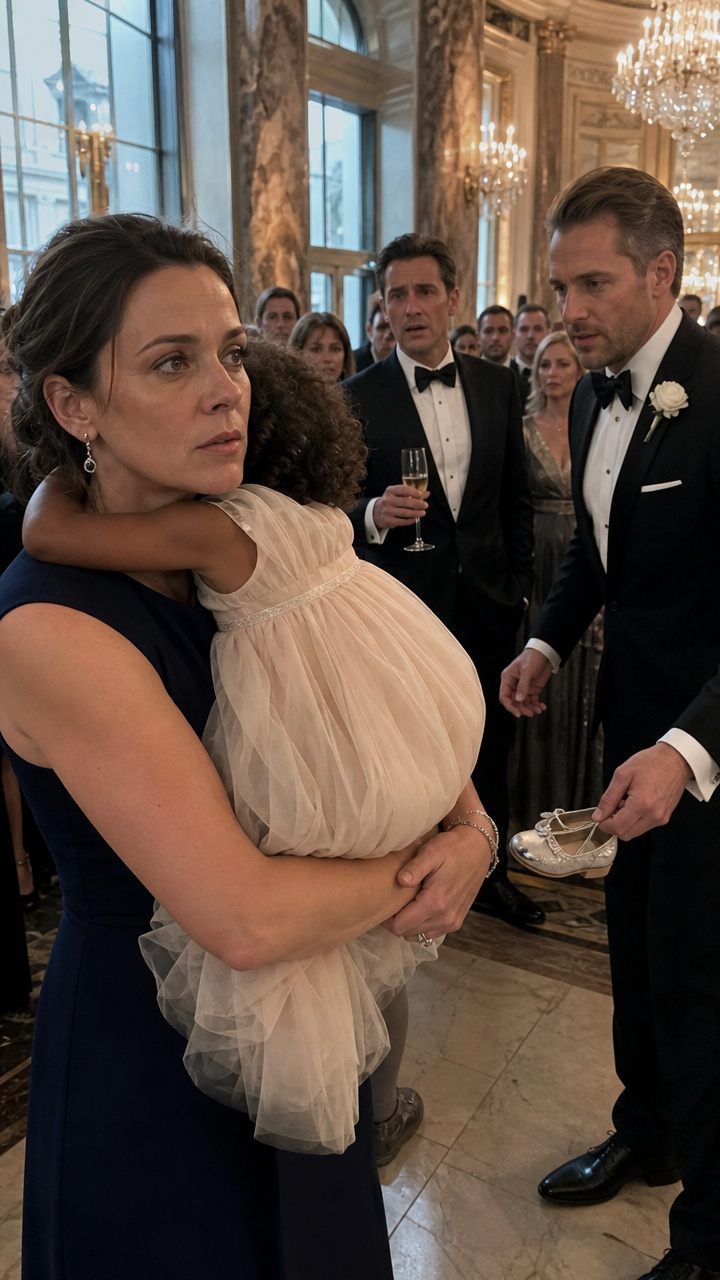
I had certainly not scripted the moment in which he would announce, without prompting, that leaving me was the smartest decision of his life—thirty seconds before my daughter ran into my arms and my husband approached with her shoes.
None of it was planned.
It happened the way truth eventually happens to people who spend years building lies: not according to anyone’s schedule, but at the worst possible moment for the guilty.
Daniel believed in theater.
He believed winning meant a dramatic gesture, a cutting remark, a public humiliation, or a perfectly timed smirk.
He had built his entire encounter with me around one polished line.
And it achieved nothing.
The best consequences do not need theater.
They need documentation.
Daniel had brought his performance to that wedding. I had brought a paper trail.
Only one of those things could change a life.
He believed power was a performance—the ability to dominate a room, deliver the sharpest response, and appear impossible to intimidate.
It is a seductive idea. Many people spend enormous energy trying to look powerful.
But performed power is fragile. It depends on an audience and on someone else agreeing to be intimidated.
The power I had learned to use was different.
It did not impress anyone in a room. It did not deliver clever lines. It lived in files, records, filings, and carefully preserved facts.
You cannot outtalk a paper trail.
You cannot intimidate documentation.
You cannot make a documented transfer disappear with a devastating comeback.
Daniel arrived at the wedding carrying the only kind of power he understood.
He was facing the kind that lasts.